 Add to Chrome
 Add to Firefox
 Add to Edge
PixWorld: Unifying 3D Scene Generation and Reconstruction in Pixel Space
Jul 06, 2026
3D reconstruction and generation are commonly tackled by separate paradigms: pixel-based regression for reconstruction, and latent diffusion for generation. Recent works attempt to unify them in latent space, but with notable drawbacks: the diffusion objective is defined on latent features rather than the underlying 3D representation, and both branches suffer from information loss introduced by latent encoding, while requiring a pretrained Variational Autoencoder (VAE) or Representation Autoencoder (RAE). In this paper, we reformulate these two tasks under a unified pixel-space diffusion paradigm and introduce PixWorld, a single model that jointly addresses 3D reconstruction and generation. By supervising diffusion directly on rendered images, PixWorld removes the above limitations and aligns optimization with 3D scene fidelity. Beyond photometric and perceptual supervision that operates at the 2D image level and lacks 3D geometric awareness, we further introduce a geometry perception loss that aligns rendered views with their ground truth in the geometry-aware feature space of a pretrained 3D foundation model, providing 3D structural supervision. PixWorld consistently outperforms prior latent-space generation methods and matches state-of-the-art reconstruction methods, demonstrating the superiority of a unified pixel-space approach.

Feed-Forward 3D Scene Modeling: A Problem-Driven Perspective
Apr 15, 2026Reconstructing 3D representations from 2D inputs is a fundamental task in computer vision and graphics, serving as a cornerstone for understanding and interacting with the physical world. While traditional methods achieve high fidelity, they are limited by slow per-scene optimization or category-specific training, which hinders their practical deployment and scalability. Hence, generalizable feed-forward 3D reconstruction has witnessed rapid development in recent years. By learning a model that maps images directly to 3D representations in a single forward pass, these methods enable efficient reconstruction and robust cross-scene generalization. Our survey is motivated by a critical observation: despite the diverse geometric output representations, ranging from implicit fields to explicit primitives, existing feed-forward approaches share similar high-level architectural patterns, such as image feature extraction backbones, multi-view information fusion mechanisms, and geometry-aware design principles. Consequently, we abstract away from these representation differences and instead focus on model design, proposing a novel taxonomy centered on model design strategies that are agnostic to the output format. Our proposed taxonomy organizes the research directions into five key problems that drive recent research development: feature enhancement, geometry awareness, model efficiency, augmentation strategies and temporal-aware models. To support this taxonomy with empirical grounding and standardized evaluation, we further comprehensively review related benchmarks and datasets, and extensively discuss and categorize real-world applications based on feed-forward 3D models. Finally, we outline future directions to address open challenges such as scalability, evaluation standards, and world modeling.
OneWorld: Taming Scene Generation with 3D Unified Representation Autoencoder
Mar 17, 2026Existing diffusion-based 3D scene generation methods primarily operate in 2D image/video latent spaces, which makes maintaining cross-view appearance and geometric consistency inherently challenging. To bridge this gap, we present OneWorld, a framework that performs diffusion directly within a coherent 3D representation space. Central to our approach is the 3D Unified Representation Autoencoder (3D-URAE); it leverages pretrained 3D foundation models and augments their geometry-centric nature by injecting appearance and distilling semantics into a unified 3D latent space. Furthermore, we introduce token-level Cross-View-Correspondence (CVC) consistency loss to explicitly enforce structural alignment across views, and propose Manifold-Drift Forcing (MDF) to mitigate train-inference exposure bias and shape a robust 3D manifold by mixing drifted and original representations. Comprehensive experiments demonstrate that OneWorld generates high-quality 3D scenes with superior cross-view consistency compared to state-of-the-art 2D-based methods. Our code will be available at https://github.com/SensenGao/OneWorld.
LifeEval: A Multimodal Benchmark for Assistive AI in Egocentric Daily Life Tasks
Feb 28, 2026The rapid progress of Multimodal Large Language Models (MLLMs) marks a significant step toward artificial general intelligence, offering great potential for augmenting human capabilities. However, their ability to provide effective assistance in dynamic, real-world environments remains largely underexplored. Existing video benchmarks predominantly assess passive understanding through retrospective analysis or isolated perception tasks, failing to capture the interactive and adaptive nature of real-time user assistance. To bridge this gap, we introduce LifeEval, a multimodal benchmark designed to evaluate real-time, task-oriented human-AI collaboration in daily life from an egocentric perspective. LifeEval emphasizes three key aspects: task-oriented holistic evaluation, egocentric real-time perception from continuous first-person streams, and human-assistant collaborative interaction through natural dialogues. Constructed via a rigorous annotation pipeline, the benchmark comprises 4,075 high-quality question-answer pairs across 6 core capability dimensions. Extensive evaluations of 26 state-of-the-art MLLMs on LifeEval reveal substantial challenges in achieving timely, effective and adaptive interaction, highlighting essential directions for advancing human-centered interactive intelligence.
Thinking with Geometry: Active Geometry Integration for Spatial Reasoning
Feb 05, 2026Recent progress in spatial reasoning with Multimodal Large Language Models (MLLMs) increasingly leverages geometric priors from 3D encoders. However, most existing integration strategies remain passive: geometry is exposed as a global stream and fused in an indiscriminate manner, which often induces semantic-geometry misalignment and redundant signals. We propose GeoThinker, a framework that shifts the paradigm from passive fusion to active perception. Instead of feature mixing, GeoThinker enables the model to selectively retrieve geometric evidence conditioned on its internal reasoning demands. GeoThinker achieves this through Spatial-Grounded Fusion applied at carefully selected VLM layers, where semantic visual priors selectively query and integrate task-relevant geometry via frame-strict cross-attention, further calibrated by Importance Gating that biases per-frame attention toward task-relevant structures. Comprehensive evaluation results show that GeoThinker sets a new state-of-the-art in spatial intelligence, achieving a peak score of 72.6 on the VSI-Bench. Furthermore, GeoThinker demonstrates robust generalization and significantly improved spatial perception across complex downstream scenarios, including embodied referring and autonomous driving. Our results indicate that the ability to actively integrate spatial structures is essential for next-generation spatial intelligence. Code can be found at https://github.com/Li-Hao-yuan/GeoThinker.
ObjVariantEnsemble: Advancing Point Cloud LLM Evaluation in Challenging Scenes with Subtly Distinguished Objects
Dec 19, 2024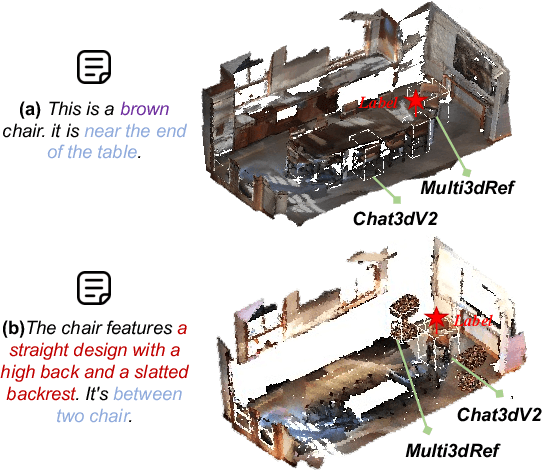
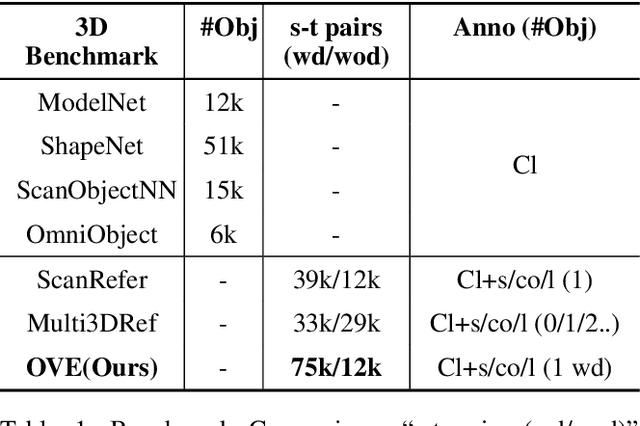
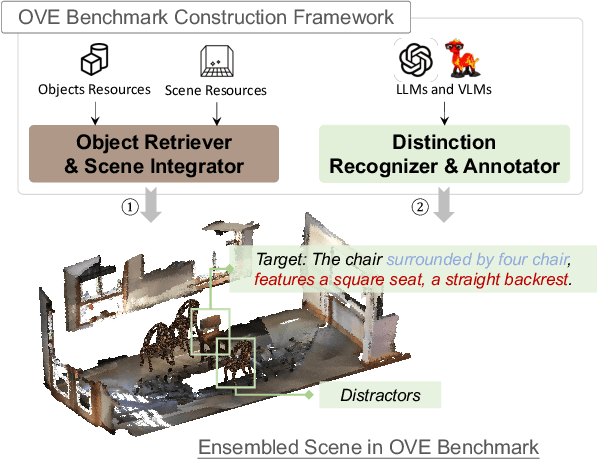
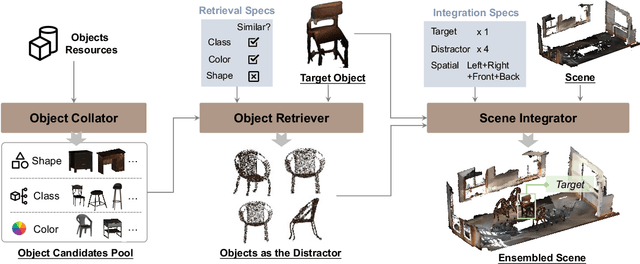
3D scene understanding is an important task, and there has been a recent surge of research interest in aligning 3D representations of point clouds with text to empower embodied AI. However, due to the lack of comprehensive 3D benchmarks, the capabilities of 3D models in real-world scenes, particularly those that are challenging with subtly distinguished objects, remain insufficiently investigated. To facilitate a more thorough evaluation of 3D models' capabilities, we propose a scheme, ObjVariantEnsemble, to systematically introduce more scenes with specified object classes, colors, shapes, quantities, and spatial relationships to meet model evaluation needs. More importantly, we intentionally construct scenes with similar objects to a certain degree and design an LLM-VLM-cooperated annotator to capture key distinctions as annotations. The resultant benchmark can better challenge 3D models, reveal their shortcomings in understanding, and potentially aid in the further development of 3D models.