 Add to Chrome
 Add to Firefox
 Add to Edge
KVServe: Service-Aware KV Cache Compression for Communication-Efficient Disaggregated LLM Serving
May 13, 2026
LLMs are widely adopted in production, pushing inference systems to their limits. Disaggregated LLM serving (e.g., PD separation and KV state disaggregation) improves scalability and cost efficiency, but it also turns KV into an explicit payload crossing network and storage boundaries, making KV a dominant end-to-end bottleneck. Existing KV compression are typically static runtime configurations, despite production service context varies over time in workload mix, bandwidth, and SLO/quality budgets. As a result, a fixed choice can be suboptimal or even increase latency. We present \emph{KVServe}, the first service-aware and adaptive KV communication compression framework for disaggregated LLM serving: KVServe (1) unifies KV compression into a modular strategy space with new components and cross-method recomposition; (2) introduces Bayesian Profiling Engine that efficiently searches this space and distills a 3D Pareto candidate set, reducing $50\times$ offline search overhead; and (3) deploys a Service-Aware Online Controller that combines an analytical latency model with a lightweight bandit to select profiles under constraints and correct offline-to-online mismatch. Integrated into vLLM and evaluated across datasets, models, GPUs and networks, KVServe achieves up to $9.13\times$ JCT speedup in PD-separated serving and up to $32.8\times$ TTFT reduction in KV-disaggregated serving.

CCL-D: A High-Precision Diagnostic System for Slow and Hang Anomalies in Large-Scale Model Training
May 06, 2026As training scales grow, collective communication libraries (CCL) increasingly face anomalies arising from complex interactions among hardware, software, and environmental factors. These anomalies typically manifest as slow/hang communication, the most frequent and time-consuming category to diagnose. However, traditional diagnostic methods remain inaccurate and inefficient, frequently requiring hours or even days for root cause analysis. To address this, we propose CCL-D, a high-precision diagnostic system designed to detect and locate slow/hang anomalies in large-scale distributed training. CCL-D integrates a rank-level real-time probe with an intelligent decision analyzer. The probe measures cross-layer anomaly metrics using a lightweight distributed tracing framework to monitor communication traffic. The analyzer performs automated anomaly detection and root-cause location, precisely identifying the faulty GPU rank. Deployed on a 4,000-GPU cluster over one year, CCL-D achieved near-complete coverage of known slow/hang anomalies and pinpointed affected ranks within 6 minutes-substantially outperforming existing solutions.
TACO: Efficient Communication Compression of Intermediate Tensors for Scalable Tensor-Parallel LLM Training
Apr 27, 2026Handling communication overhead in large-scale tensor-parallel training remains a critical challenge due to the dense, near-zero distributions of intermediate tensors, which exacerbate errors under frequent communication and introduce significant computational overhead during compression. To this end, we propose TACO (Tensor-parallel Adaptive COmmunication compression), a robust FP8-based framework for compressing TP intermediate tensors. First, we employ a data-driven reshaping strategy combined with an Adaptive Scale-Hadamard Transform to enable high-fidelity FP8 quantization, while its Dual-Scale Quantization mechanism ensures numerical stability throughout training. Second, we design a highly fused compression operator to reduce memory traffic and kernel launch overhead, allowing efficient overlap with communication. Finally, we integrate TACO with existing state-of-the-art methods for Data and Pipeline Parallelism to develop a compression-enabled 3D-parallel training framework. Detailed experiments on GPT models and Qwen model demonstrate up to 1.87X end-to-end throughput improvement while maintaining near-lossless accuracy, validating the effectiveness and efficiency of TACO in large-scale training.
Research Paradigm of Materials Science Tetrahedra with Artificial Intelligence
Mar 14, 2026The classical material tetrahedron that represents the Structure-Property-Processing-Performance-Characterization relationship is the most important research paradigm in materials science so far. It has served as a protocol to guide experiments, modeling, and theory to uncover hidden relationships between various aspects of a certain material. This substantially facilitates knowledge accumulation and material discovery with desired functionalities to realize versatile applications. In recent years, with the advent of artificial intelligence (AI) techniques, the attention of AI towards scientific research is soaring. The trials of implementing AI in various disciplines are endless, with great potential to revolutionize the research diagram. Despite the success in natural language processing and computer vision, how to effectively integrate AI with natural science is still a grand challenge, bearing in mind their fundamental differences. Inspired by these observations and limitations, we delve into the current research paradigm dictated by the classical material tetrahedron and propose two new paradigms to stimulate data-driven and AI-augmented research. One tetrahedron focuses on AI for materials science by considering the Matter-Data-Model-Potential-Agent diagram. The other demonstrates AI research by discussing Data-Architecture-Encoding-Optimization-Inference relationships. The crucial ingredients of these frameworks and their connections are discussed, which will likely motivate both scientific thinking refinement and technology advancement. Despite the widespread enthusiasm for chasing AI for science, we must analyze issues rationally to come up with well-defined, resolvable scientific problems in order to better master the power of AI.
GFormer: Accelerating Large Language Models with Optimized Transformers on Gaudi Processors
Dec 19, 2024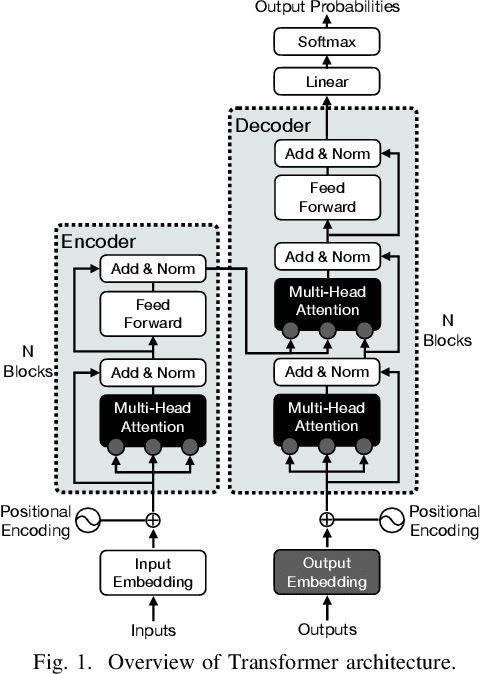
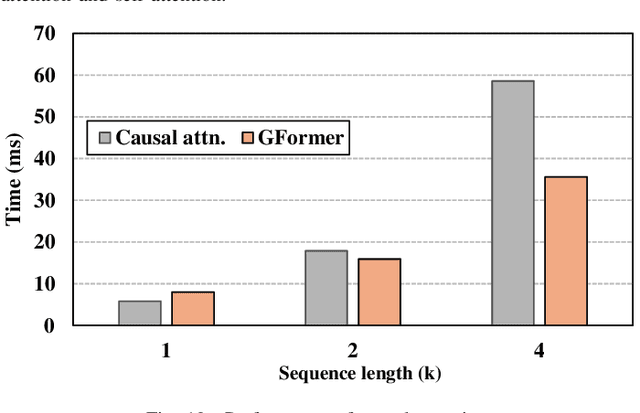
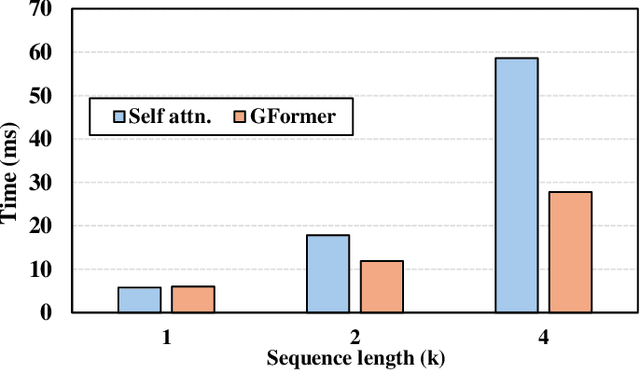
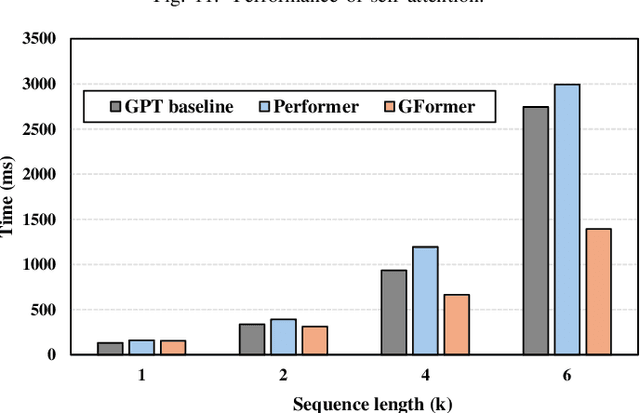
Heterogeneous hardware like Gaudi processor has been developed to enhance computations, especially matrix operations for Transformer-based large language models (LLMs) for generative AI tasks. However, our analysis indicates that Transformers are not fully optimized on such emerging hardware, primarily due to inadequate optimizations in non-matrix computational kernels like Softmax and in heterogeneous resource utilization, particularly when processing long sequences. To address these issues, we propose an integrated approach (called GFormer) that merges sparse and linear attention mechanisms. GFormer aims to maximize the computational capabilities of the Gaudi processor's Matrix Multiplication Engine (MME) and Tensor Processing Cores (TPC) without compromising model quality. GFormer includes a windowed self-attention kernel and an efficient outer product kernel for causal linear attention, aiming to optimize LLM inference on Gaudi processors. Evaluation shows that GFormer significantly improves efficiency and model performance across various tasks on the Gaudi processor and outperforms state-of-the-art GPUs.
SDP4Bit: Toward 4-bit Communication Quantization in Sharded Data Parallelism for LLM Training
Oct 20, 2024


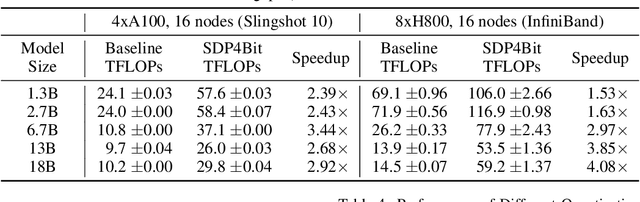
Recent years have witnessed a clear trend towards language models with an ever-increasing number of parameters, as well as the growing training overhead and memory usage. Distributed training, particularly through Sharded Data Parallelism (ShardedDP) which partitions optimizer states among workers, has emerged as a crucial technique to mitigate training time and memory usage. Yet, a major challenge in the scalability of ShardedDP is the intensive communication of weights and gradients. While compression techniques can alleviate this issue, they often result in worse accuracy. Driven by this limitation, we propose SDP4Bit (Toward 4Bit Communication Quantization in Sharded Data Parallelism for LLM Training), which effectively reduces the communication of weights and gradients to nearly 4 bits via two novel techniques: quantization on weight differences, and two-level gradient smooth quantization. Furthermore, SDP4Bit presents an algorithm-system co-design with runtime optimization to minimize the computation overhead of compression. In addition to the theoretical guarantees of convergence, we empirically evaluate the accuracy of SDP4Bit on the pre-training of GPT models with up to 6.7 billion parameters, and the results demonstrate a negligible impact on training loss. Furthermore, speed experiments show that SDP4Bit achieves up to 4.08$\times$ speedup in end-to-end throughput on a scale of 128 GPUs.
Accelerating Communication in Deep Learning Recommendation Model Training with Dual-Level Adaptive Lossy Compression
Jul 05, 2024DLRM is a state-of-the-art recommendation system model that has gained widespread adoption across various industry applications. The large size of DLRM models, however, necessitates the use of multiple devices/GPUs for efficient training. A significant bottleneck in this process is the time-consuming all-to-all communication required to collect embedding data from all devices. To mitigate this, we introduce a method that employs error-bounded lossy compression to reduce the communication data size and accelerate DLRM training. We develop a novel error-bounded lossy compression algorithm, informed by an in-depth analysis of embedding data features, to achieve high compression ratios. Moreover, we introduce a dual-level adaptive strategy for error-bound adjustment, spanning both table-wise and iteration-wise aspects, to balance the compression benefits with the potential impacts on accuracy. We further optimize our compressor for PyTorch tensors on GPUs, minimizing compression overhead. Evaluation shows that our method achieves a 1.38$\times$ training speedup with a minimal accuracy impact.
FastCLIP: A Suite of Optimization Techniques to Accelerate CLIP Training with Limited Resources
Jul 01, 2024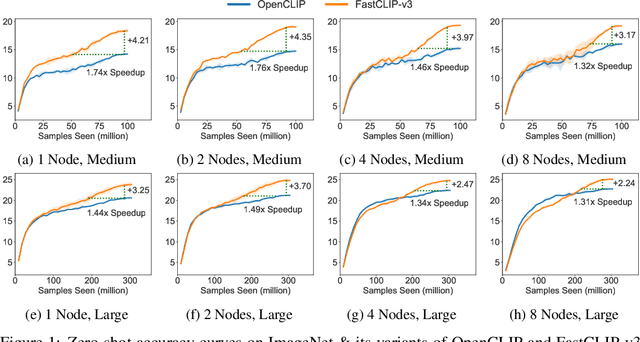
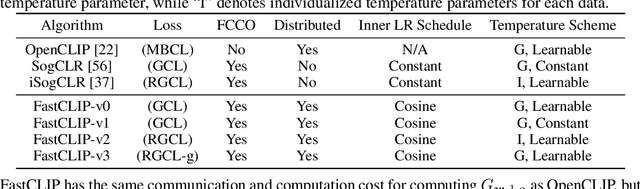

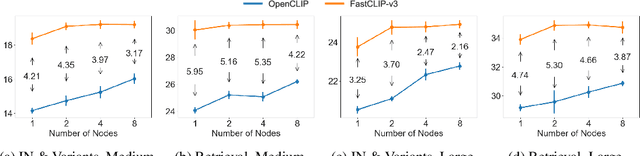
Existing studies of training state-of-the-art Contrastive Language-Image Pretraining (CLIP) models on large-scale data involve hundreds of or even thousands of GPUs due to the requirement of a large batch size. However, such a large amount of resources is not accessible to most people. While advanced compositional optimization techniques for optimizing global contrastive losses have been demonstrated effective for removing the requirement of large batch size, their performance on large-scale data remains underexplored and not optimized. To bridge the gap, this paper explores several aspects of CLIP training with limited resources (e.g., up to tens of GPUs). First, we introduce FastCLIP, a general CLIP training framework built on advanced compositional optimization techniques while designed and optimized for the distributed setting. Our framework is equipped with an efficient gradient reduction strategy to reduce communication overhead. Second, to further boost training efficiency, we investigate three components of the framework from an optimization perspective: the schedule of the inner learning rate, the update rules of the temperature parameter and the model parameters, respectively. Experiments on different strategies for each component shed light on how to conduct CLIP training more efficiently. Finally, we benchmark the performance of FastCLIP and the state-of-the-art training baseline (OpenCLIP) on different compute scales up to 32 GPUs on 8 nodes, and three data scales ranging from 2.7 million, 9.1 million to 315 million image-text pairs to demonstrate the significant improvement of FastCLIP in the resource-limited setting. We release the code of FastCLIP at https://github.com/Optimization-AI/fast_clip .
GWLZ: A Group-wise Learning-based Lossy Compression Framework for Scientific Data
Apr 20, 2024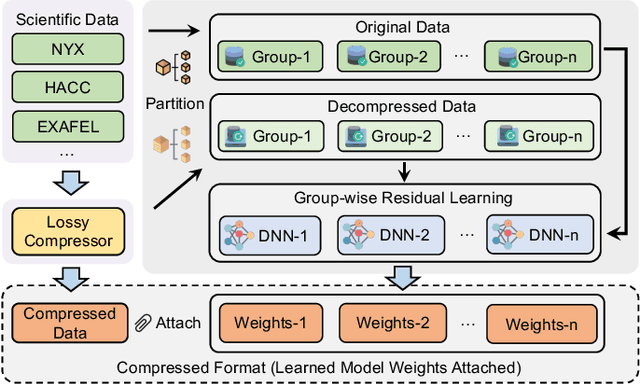
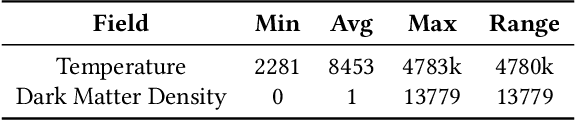
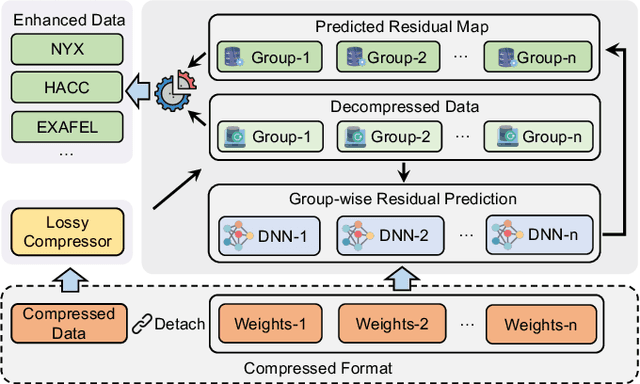
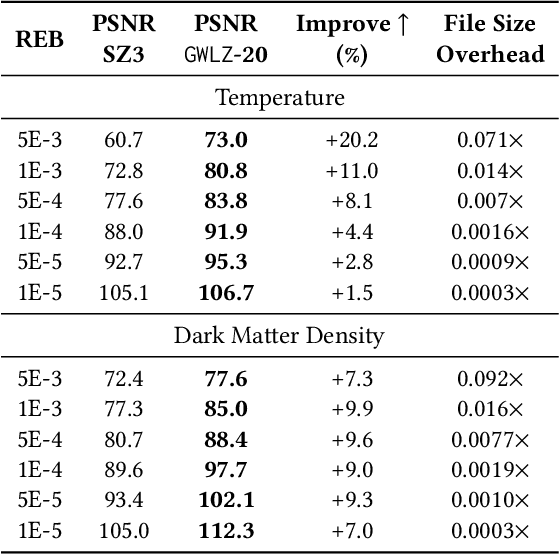
The rapid expansion of computational capabilities and the ever-growing scale of modern HPC systems present formidable challenges in managing exascale scientific data. Faced with such vast datasets, traditional lossless compression techniques prove insufficient in reducing data size to a manageable level while preserving all information intact. In response, researchers have turned to error-bounded lossy compression methods, which offer a balance between data size reduction and information retention. However, despite their utility, these compressors employing conventional techniques struggle with limited reconstruction quality. To address this issue, we draw inspiration from recent advancements in deep learning and propose GWLZ, a novel group-wise learning-based lossy compression framework with multiple lightweight learnable enhancer models. Leveraging a group of neural networks, GWLZ significantly enhances the decompressed data reconstruction quality with negligible impact on the compression efficiency. Experimental results on different fields from the Nyx dataset demonstrate remarkable improvements by GWLZ, achieving up to 20% quality enhancements with negligible overhead as low as 0.0003x.
Benchmarking and In-depth Performance Study of Large Language Models on Habana Gaudi Processors
Sep 29, 2023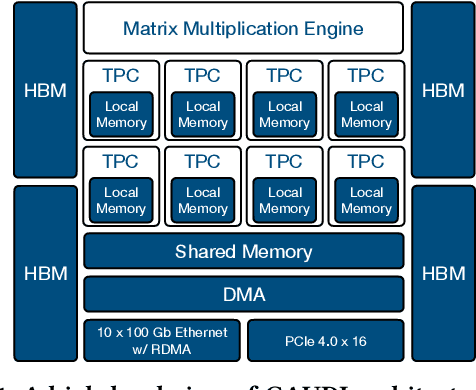
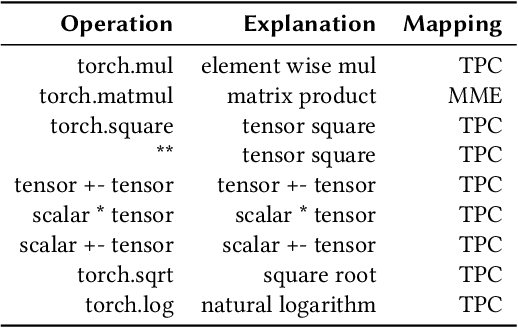

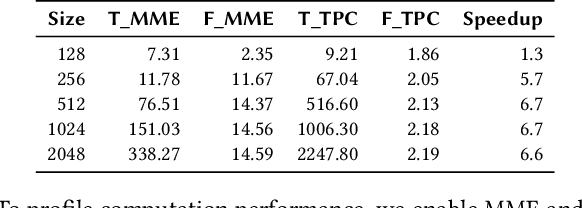
Transformer models have achieved remarkable success in various machine learning tasks but suffer from high computational complexity and resource requirements. The quadratic complexity of the self-attention mechanism further exacerbates these challenges when dealing with long sequences and large datasets. Specialized AI hardware accelerators, such as the Habana GAUDI architecture, offer a promising solution to tackle these issues. GAUDI features a Matrix Multiplication Engine (MME) and a cluster of fully programmable Tensor Processing Cores (TPC). This paper explores the untapped potential of using GAUDI processors to accelerate Transformer-based models, addressing key challenges in the process. Firstly, we provide a comprehensive performance comparison between the MME and TPC components, illuminating their relative strengths and weaknesses. Secondly, we explore strategies to optimize MME and TPC utilization, offering practical insights to enhance computational efficiency. Thirdly, we evaluate the performance of Transformers on GAUDI, particularly in handling long sequences and uncovering performance bottlenecks. Lastly, we evaluate the end-to-end performance of two Transformer-based large language models (LLM) on GAUDI. The contributions of this work encompass practical insights for practitioners and researchers alike. We delve into GAUDI's capabilities for Transformers through systematic profiling, analysis, and optimization exploration. Our study bridges a research gap and offers a roadmap for optimizing Transformer-based model training on the GAUDI architecture.