 Add to Chrome
 Add to Firefox
 Add to Edge
ALTO: Adaptive LoRA Tuning and Orchestration for Heterogeneous LoRA Training Workloads
Apr 07, 2026
Low-Rank Adaptation (LoRA) is now the dominant method for parameter-efficient fine-tuning of large language models, but achieving a high-quality adapter often requires systematic hyperparameter tuning because LoRA performance is highly sensitive to configuration choices. In practice, this leads to many concurrent LoRA jobs, often spanning heterogeneous tasks in multi-tenant environments. Existing systems largely handle these jobs independently, which both wastes computation on weak candidates and leaves GPUs underutilized. We present ALTO (Adaptive LoRA Tuning and Orchestration), a co-designed training system that accelerates LoRA hyperparameter tuning while enabling efficient cluster sharing across heterogeneous tasks. The central insight behind ALTO is that when multiple tuning jobs run concurrently over a shared frozen backbone, they expose optimization opportunities that single-job designs cannot exploit. Building on this, ALTO monitors loss trajectories to terminate unpromising configurations early, uses fused grouped GEMM together with a new rank-local adapter parallelism to co-locate surviving adapters and reclaim freed GPU capacity, and combines intra-task and inter-task scheduling to improve multi-task placement by leveraging the predictable duration of LoRA jobs. Extensive evaluation shows that ALTO achieves up to $13.8\times$ speedup over state-of-the-art without sacrificing adapter quality.

TIDE: Text-Informed Dynamic Extrapolation with Step-Aware Temperature Control for Diffusion Transformers
Mar 09, 2026Diffusion Transformer (DiT) faces challenges when generating images with higher resolution compared at training resolution, causing especially structural degradation due to attention dilution. Previous approaches attempt to mitigate this by sharpening attention distributions, but fail to preserve fine-grained semantic details and introduce obvious artifacts. In this work, we analyze the characteristics of DiTs and propose TIDE, a training-free text-to-image (T2I) extrapolation method that enables generation with arbitrary resolution and aspect ratio without additional sampling overhead. We identify the core factor for prompt information loss, and introduce a text anchoring mechanism to correct the imbalance between text and image tokens. To further eliminate artifacts, we design a dynamic temperature control mechanism that leverages the pattern of spectral progression in the diffusion process. Extensive evaluations demonstrate that TIDE delivers high-quality resolution extrapolation capability and integrates seamlessly with existing state-of-the-art methods.
SDiT: Semantic Region-Adaptive for Diffusion Transformers
Jan 18, 2026Diffusion Transformers (DiTs) achieve state-of-the-art performance in text-to-image synthesis but remain computationally expensive due to the iterative nature of denoising and the quadratic cost of global attention. In this work, we observe that denoising dynamics are spatially non-uniform-background regions converge rapidly while edges and textured areas evolve much more actively. Building on this insight, we propose SDiT, a Semantic Region-Adaptive Diffusion Transformer that allocates computation according to regional complexity. SDiT introduces a training-free framework combining (1) semantic-aware clustering via fast Quickshift-based segmentation, (2) complexity-driven regional scheduling to selectively update informative areas, and (3) boundary-aware refinement to maintain spatial coherence. Without any model retraining or architectural modification, SDiT achieves up to 3.0x acceleration while preserving nearly identical perceptual and semantic quality to full-attention inference.
SuperGen: An Efficient Ultra-high-resolution Video Generation System with Sketching and Tiling
Aug 25, 2025Diffusion models have recently achieved remarkable success in generative tasks (e.g., image and video generation), and the demand for high-quality content (e.g., 2K/4K videos) is rapidly increasing across various domains. However, generating ultra-high-resolution videos on existing standard-resolution (e.g., 720p) platforms remains challenging due to the excessive re-training requirements and prohibitively high computational and memory costs. To this end, we introduce SuperGen, an efficient tile-based framework for ultra-high-resolution video generation. SuperGen features a novel training-free algorithmic innovation with tiling to successfully support a wide range of resolutions without additional training efforts while significantly reducing both memory footprint and computational complexity. Moreover, SuperGen incorporates a tile-tailored, adaptive, region-aware caching strategy that accelerates video generation by exploiting redundancy across denoising steps and spatial regions. SuperGen also integrates cache-guided, communication-minimized tile parallelism for enhanced throughput and minimized latency. Evaluations demonstrate that SuperGen harvests the maximum performance gains while achieving high output quality across various benchmarks.
Model Steering: Learning with a Reference Model Improves Generalization Bounds and Scaling Laws
May 13, 2025This paper formalizes an emerging learning paradigm that uses a trained model as a reference to guide and enhance the training of a target model through strategic data selection or weighting, named $\textbf{model steering}$. While ad-hoc methods have been used in various contexts, including the training of large foundation models, its underlying principles remain insufficiently understood, leading to sub-optimal performance. In this work, we propose a theory-driven framework for model steering called $\textbf{DRRho risk minimization}$, which is rooted in Distributionally Robust Optimization (DRO). Through a generalization analysis, we provide theoretical insights into why this approach improves generalization and data efficiency compared to training without a reference model. To the best of our knowledge, this is the first time such theoretical insights are provided for the new learning paradigm, which significantly enhance our understanding and practice of model steering. Building on these insights and the connection between contrastive learning and DRO, we introduce a novel method for Contrastive Language-Image Pretraining (CLIP) with a reference model, termed DRRho-CLIP. Extensive experiments validate the theoretical insights, reveal a superior scaling law compared to CLIP without a reference model, and demonstrate its strength over existing heuristic approaches.
Accelerating Communication in Deep Learning Recommendation Model Training with Dual-Level Adaptive Lossy Compression
Jul 05, 2024DLRM is a state-of-the-art recommendation system model that has gained widespread adoption across various industry applications. The large size of DLRM models, however, necessitates the use of multiple devices/GPUs for efficient training. A significant bottleneck in this process is the time-consuming all-to-all communication required to collect embedding data from all devices. To mitigate this, we introduce a method that employs error-bounded lossy compression to reduce the communication data size and accelerate DLRM training. We develop a novel error-bounded lossy compression algorithm, informed by an in-depth analysis of embedding data features, to achieve high compression ratios. Moreover, we introduce a dual-level adaptive strategy for error-bound adjustment, spanning both table-wise and iteration-wise aspects, to balance the compression benefits with the potential impacts on accuracy. We further optimize our compressor for PyTorch tensors on GPUs, minimizing compression overhead. Evaluation shows that our method achieves a 1.38$\times$ training speedup with a minimal accuracy impact.
FastCLIP: A Suite of Optimization Techniques to Accelerate CLIP Training with Limited Resources
Jul 01, 2024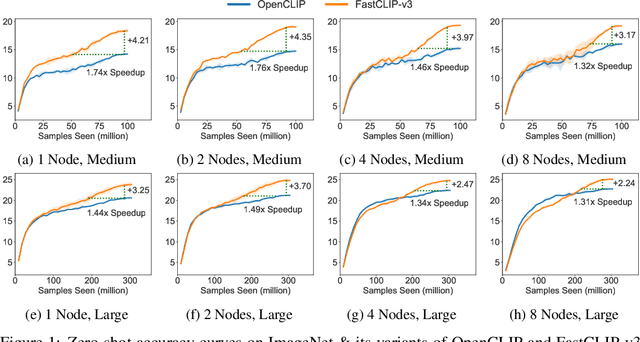
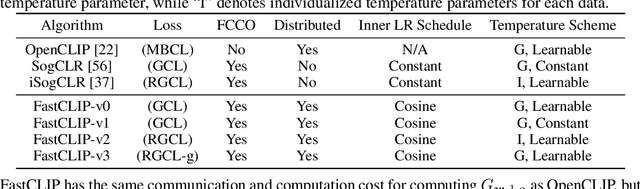

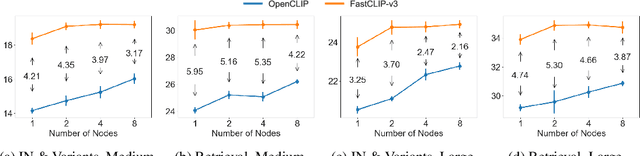
Existing studies of training state-of-the-art Contrastive Language-Image Pretraining (CLIP) models on large-scale data involve hundreds of or even thousands of GPUs due to the requirement of a large batch size. However, such a large amount of resources is not accessible to most people. While advanced compositional optimization techniques for optimizing global contrastive losses have been demonstrated effective for removing the requirement of large batch size, their performance on large-scale data remains underexplored and not optimized. To bridge the gap, this paper explores several aspects of CLIP training with limited resources (e.g., up to tens of GPUs). First, we introduce FastCLIP, a general CLIP training framework built on advanced compositional optimization techniques while designed and optimized for the distributed setting. Our framework is equipped with an efficient gradient reduction strategy to reduce communication overhead. Second, to further boost training efficiency, we investigate three components of the framework from an optimization perspective: the schedule of the inner learning rate, the update rules of the temperature parameter and the model parameters, respectively. Experiments on different strategies for each component shed light on how to conduct CLIP training more efficiently. Finally, we benchmark the performance of FastCLIP and the state-of-the-art training baseline (OpenCLIP) on different compute scales up to 32 GPUs on 8 nodes, and three data scales ranging from 2.7 million, 9.1 million to 315 million image-text pairs to demonstrate the significant improvement of FastCLIP in the resource-limited setting. We release the code of FastCLIP at https://github.com/Optimization-AI/fast_clip .