 Add to Chrome
 Add to Firefox
 Add to Edge
SAW-INT4: System-Aware 4-Bit KV-Cache Quantization for Real-World LLM Serving
Apr 21, 2026
KV-cache memory is a major bottleneck in real-world LLM serving, where systems must simultaneously support latency-sensitive small-batch requests and high-throughput concurrent workloads. Although many KV-cache compression methods improve offline accuracy or compression ratio, they often violate practical serving constraints such as paged memory layouts, regular memory access, and fused attention execution, limiting their effectiveness in deployment. In this work, we identify the minimal set of 4-bit KV-cache quantization methods that remain viable under these constraints. Our central finding is that a simple design--token-wise INT4 quantization with block-diagonal Hadamard rotation--consistently achieves the best accuracy-efficiency trade-off. Across multiple models and benchmarks, this approach recovers nearly all of the accuracy lost by naive INT4, while more complex methods such as vector quantization and Hessian-aware quantization provide only marginal additional gains once serving compatibility is taken into account. To make this practical, we implement a fused rotation-quantization kernel that integrates directly into paged KV-cache layouts and introduces zero measurable end-to-end overhead, matching plain INT4 throughput across concurrency levels. Our results show that effective KV-cache compression is fundamentally a systems co-design problem: under real serving constraints, lightweight block-diagonal Hadamard rotation is a viable method that delivers near-lossless accuracy without sacrificing serving efficiency.

SDP4Bit: Toward 4-bit Communication Quantization in Sharded Data Parallelism for LLM Training
Oct 20, 2024


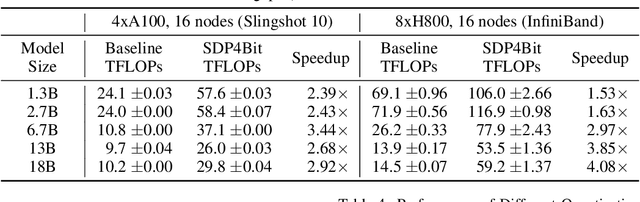
Recent years have witnessed a clear trend towards language models with an ever-increasing number of parameters, as well as the growing training overhead and memory usage. Distributed training, particularly through Sharded Data Parallelism (ShardedDP) which partitions optimizer states among workers, has emerged as a crucial technique to mitigate training time and memory usage. Yet, a major challenge in the scalability of ShardedDP is the intensive communication of weights and gradients. While compression techniques can alleviate this issue, they often result in worse accuracy. Driven by this limitation, we propose SDP4Bit (Toward 4Bit Communication Quantization in Sharded Data Parallelism for LLM Training), which effectively reduces the communication of weights and gradients to nearly 4 bits via two novel techniques: quantization on weight differences, and two-level gradient smooth quantization. Furthermore, SDP4Bit presents an algorithm-system co-design with runtime optimization to minimize the computation overhead of compression. In addition to the theoretical guarantees of convergence, we empirically evaluate the accuracy of SDP4Bit on the pre-training of GPT models with up to 6.7 billion parameters, and the results demonstrate a negligible impact on training loss. Furthermore, speed experiments show that SDP4Bit achieves up to 4.08$\times$ speedup in end-to-end throughput on a scale of 128 GPUs.