 Add to Chrome
 Add to Firefox
 Add to Edge
EHRBench: An Automated and Reliable EHR-based Benchmark for Clinical Decision Making with LLMs
May 28, 2026
Clinical decision-making (CDM) is central to real-world clinical workflows, where clinicians infer diagnoses, select treatments, or anticipate future health outcomes under incomplete evidence. LLMs are increasingly used to support these decisions due to strong language capabilities, broad biomedical knowledge, and efficiency, yet the reliability of LLMs on real-world clinical decision tasks remains insufficiently understood. To evaluate CDM models, especially LLM-based models, an ideal and practical medical decision benchmark should be constructed via an automated yet reliable pipeline to ensure both scale and quality. Moreover, the grounding of a CDM benchmark in real patient EHRs can better support evaluation on practical CDM tasks that require substantive biomedical knowledge and clinical inference. To fill the gaps, we introduce EHRBench, an automated and reliable EHR-grounded benchmark for evaluating LLM-based clinical decision-making at scale. To ensure scalability and reliability, EHRBench is constructed through an EHR-LLM-KB(knowledge-base) interaction pipeline. For efficiency, we use a specialized LLM to automatically convert encounter-level EHR trajectories into structured templates and deterministically instantiate the templates into QA items. In parallel, we apply systematic KB-based verification and enrichment to filter hallucinated or ambiguous relations and to improve reliability. Using this pipeline, we construct nearly 1M (960,067) QA items spanning three core inference-required clinical decision tasks: diagnosis, treatment, and prognosis. We benchmark more than 30 representative LLMs on EHRBench and provide detailed analyses of performance and robustness. The results show consistent capability trends across settings, further validating the reliability of EHRBench and highlighting actionable gaps toward clinically reliable LLM systems.

LLM-MINE: Large Language Model based Alzheimer's Disease and Related Dementias Phenotypes Mining from Clinical Notes
Mar 14, 2026Accurate extraction of Alzheimer's Disease and Related Dementias (ADRD) phenotypes from electronic health records (EHR) is critical for early-stage detection and disease staging. However, this information is usually embedded in unstructured textual data rather than tabular data, making it difficult to be extracted accurately. We therefore propose LLM-MINE, a Large Language Model-based phenotype mining framework for automatic extraction of ADRD phenotypes from clinical notes. Using two expert-defined phenotype lists, we evaluate the extracted phenotypes by examining their statistical significance across cohorts and their utility for unsupervised disease staging. Chi-square analyses confirm statistically significant phenotype differences across cohorts, with memory impairment being the strongest discriminator. Few-shot prompting with the combined phenotype lists achieves the best clustering performance (ARI=0.290, NMI=0.232), substantially outperforming biomedical NER and dictionary-based baselines. Our results demonstrate that LLM-based phenotype extraction is a promising tool for discovering clinically meaningful ADRD signals from unstructured notes.
MIRAGE: Knowledge Graph-Guided Cross-Cohort MRI Synthesis for Alzheimer's Disease Prediction
Mar 02, 2026Reliable Alzheimer's disease (AD) diagnosis increasingly relies on multimodal assessments combining structural Magnetic Resonance Imaging (MRI) and Electronic Health Records (EHR). However, deploying these models is bottlenecked by modality missingness, as MRI scans are expensive and frequently unavailable in many patient cohorts. Furthermore, synthesizing de novo 3D anatomical scans from sparse, high-dimensional tabular records is technically challenging and poses severe clinical risks. To address this, we introduce MIRAGE, a novel framework that reframes the missing-MRI problem as an anatomy-guided cross-modal latent distillation task. First, MIRAGE leverages a Biomedical Knowledge Graph (KG) and Graph Attention Networks to map heterogeneous EHR variables into a unified embedding space that can be propagated from cohorts with real MRIs to cohorts without them. To bridge the semantic gap and enforce physical spatial awareness, we employ a frozen pre-trained 3D U-Net decoder strictly as an auxiliary regularization engine. Supported by a novel cohort-aggregated skip feature compensation strategy, this decoder acts as a rigorous structural penalty, forcing 1D latent representations to encode biologically plausible, macro-level pathological semantics. By exclusively utilizing this distilled "diagnostic-surrogate" representation during inference, MIRAGE completely bypasses computationally expensive 3D voxel reconstruction. Experiments demonstrate that our framework successfully bridges the missing-modality gap, improving the AD classification rate by 13% compared to unimodal baselines in cohorts without real MRIs.
EpiQAL: Benchmarking Large Language Models in Epidemiological Question Answering for Enhanced Alignment and Reasoning
Jan 06, 2026Reliable epidemiological reasoning requires synthesizing study evidence to infer disease burden, transmission dynamics, and intervention effects at the population level. Existing medical question answering benchmarks primarily emphasize clinical knowledge or patient-level reasoning, yet few systematically evaluate evidence-grounded epidemiological inference. We present EpiQAL, the first diagnostic benchmark for epidemiological question answering across diverse diseases, comprising three subsets built from open-access literature. The subsets respectively evaluate text-grounded factual recall, multi-step inference linking document evidence with epidemiological principles, and conclusion reconstruction with the Discussion section withheld. Construction combines expert-designed taxonomy guidance, multi-model verification, and retrieval-based difficulty control. Experiments on ten open models reveal that current LLMs show limited performance on epidemiological reasoning, with multi-step inference posing the greatest challenge. Model rankings shift across subsets, and scale alone does not predict success. Chain-of-Thought prompting benefits multi-step inference but yields mixed results elsewhere. EpiQAL provides fine-grained diagnostic signals for evidence grounding, inferential reasoning, and conclusion reconstruction.
BioMedJImpact: A Comprehensive Dataset and LLM Pipeline for AI Engagement and Scientific Impact Analysis of Biomedical Journals
Nov 16, 2025Assessing journal impact is central to scholarly communication, yet existing open resources rarely capture how collaboration structures and artificial intelligence (AI) research jointly shape venue prestige in biomedicine. We present BioMedJImpact, a large-scale, biomedical-oriented dataset designed to advance journal-level analysis of scientific impact and AI engagement. Built from 1.74 million PubMed Central articles across 2,744 journals, BioMedJImpact integrates bibliometric indicators, collaboration features, and LLM-derived semantic indicators for AI engagement. Specifically, the AI engagement feature is extracted through a reproducible three-stage LLM pipeline that we propose. Using this dataset, we analyze how collaboration intensity and AI engagement jointly influence scientific impact across pre- and post-pandemic periods (2016-2019, 2020-2023). Two consistent trends emerge: journals with higher collaboration intensity, particularly those with larger and more diverse author teams, tend to achieve greater citation impact, and AI engagement has become an increasingly strong correlate of journal prestige, especially in quartile rankings. To further validate the three-stage LLM pipeline we proposed for deriving the AI engagement feature, we conduct human evaluation, confirming substantial agreement in AI relevance detection and consistent subfield classification. Together, these contributions demonstrate that BioMedJImpact serves as both a comprehensive dataset capturing the intersection of biomedicine and AI, and a validated methodological framework enabling scalable, content-aware scientometric analysis of scientific impact and innovation dynamics. Code is available at https://github.com/JonathanWry/BioMedJImpact.
KERAP: A Knowledge-Enhanced Reasoning Approach for Accurate Zero-shot Diagnosis Prediction Using Multi-agent LLMs
Jul 03, 2025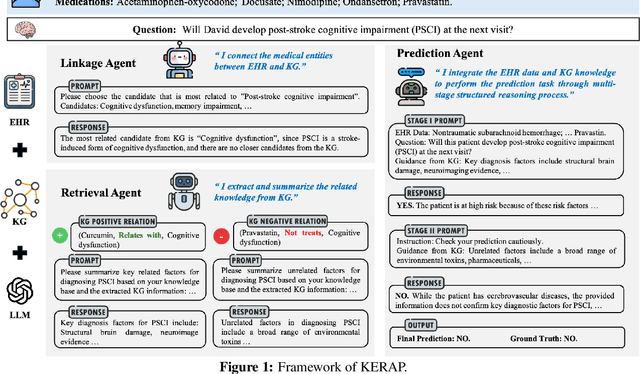
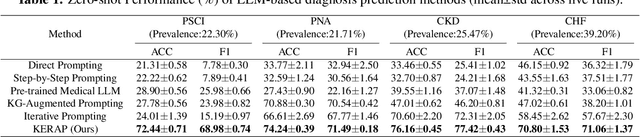

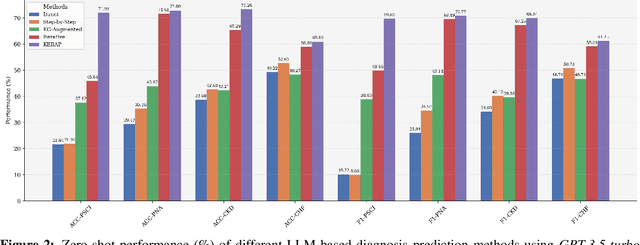
Medical diagnosis prediction plays a critical role in disease detection and personalized healthcare. While machine learning (ML) models have been widely adopted for this task, their reliance on supervised training limits their ability to generalize to unseen cases, particularly given the high cost of acquiring large, labeled datasets. Large language models (LLMs) have shown promise in leveraging language abilities and biomedical knowledge for diagnosis prediction. However, they often suffer from hallucinations, lack structured medical reasoning, and produce useless outputs. To address these challenges, we propose KERAP, a knowledge graph (KG)-enhanced reasoning approach that improves LLM-based diagnosis prediction through a multi-agent architecture. Our framework consists of a linkage agent for attribute mapping, a retrieval agent for structured knowledge extraction, and a prediction agent that iteratively refines diagnosis predictions. Experimental results demonstrate that KERAP enhances diagnostic reliability efficiently, offering a scalable and interpretable solution for zero-shot medical diagnosis prediction.
Evaluating the Impact of Lab Test Results on Large Language Models Generated Differential Diagnoses from Clinical Case Vignettes
Nov 01, 2024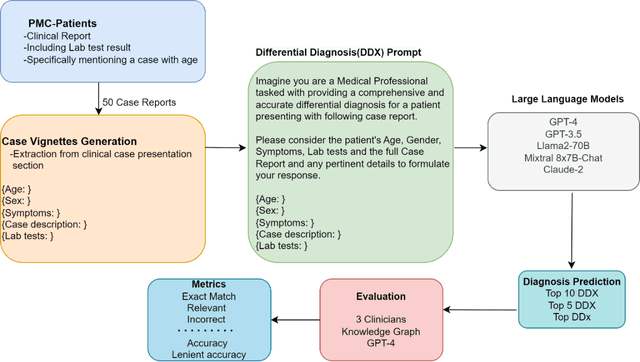
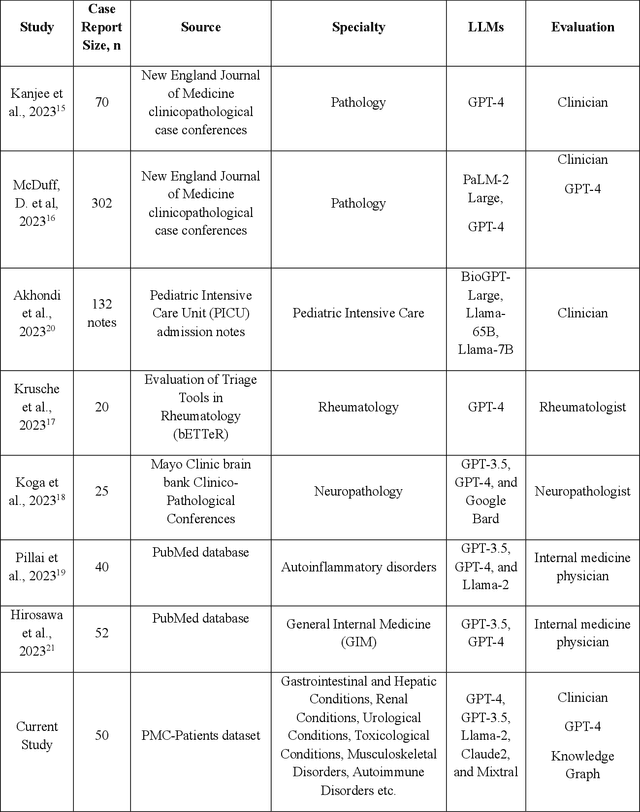
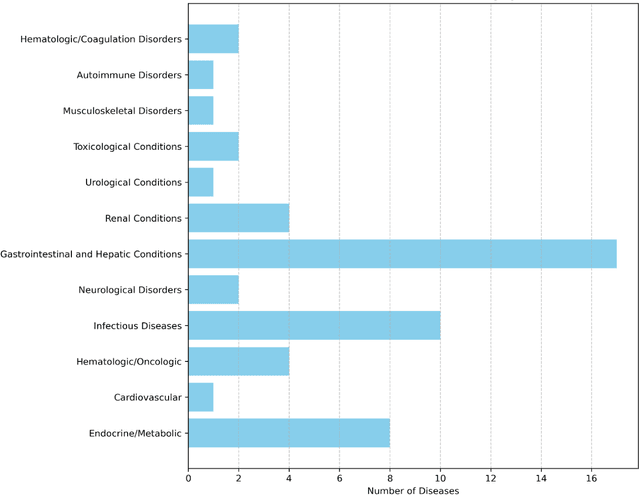
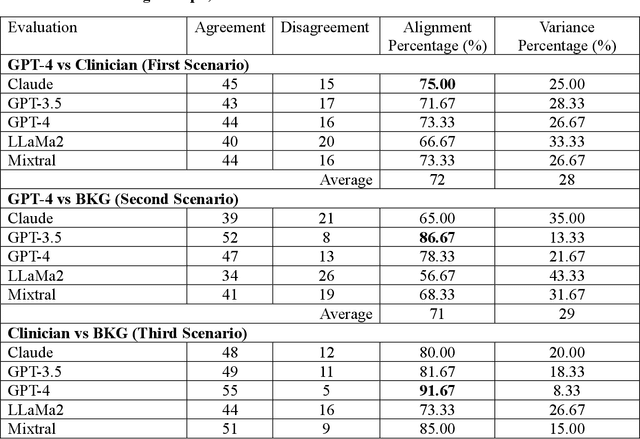
Differential diagnosis is crucial for medicine as it helps healthcare providers systematically distinguish between conditions that share similar symptoms. This study assesses the impact of lab test results on differential diagnoses (DDx) made by large language models (LLMs). Clinical vignettes from 50 case reports from PubMed Central were created incorporating patient demographics, symptoms, and lab results. Five LLMs GPT-4, GPT-3.5, Llama-2-70b, Claude-2, and Mixtral-8x7B were tested to generate Top 10, Top 5, and Top 1 DDx with and without lab data. A comprehensive evaluation involving GPT-4, a knowledge graph, and clinicians was conducted. GPT-4 performed best, achieving 55% accuracy for Top 1 diagnoses and 60% for Top 10 with lab data, with lenient accuracy up to 80%. Lab results significantly improved accuracy, with GPT-4 and Mixtral excelling, though exact match rates were low. Lab tests, including liver function, metabolic/toxicology panels, and serology/immune tests, were generally interpreted correctly by LLMs for differential diagnosis.
TACCO: Task-guided Co-clustering of Clinical Concepts and Patient Visits for Disease Subtyping based on EHR Data
Jun 14, 2024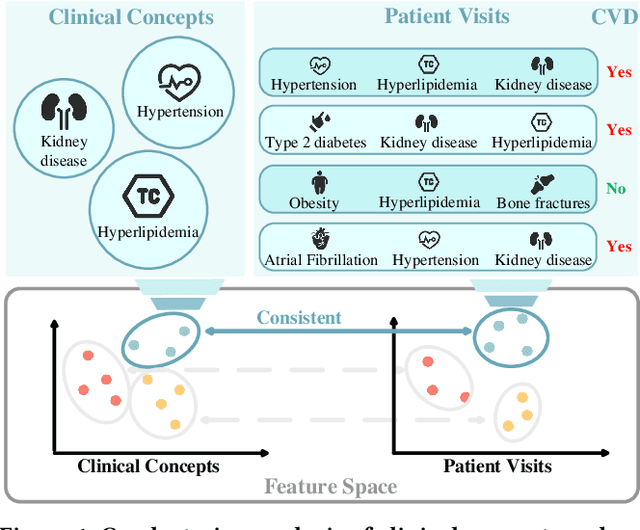

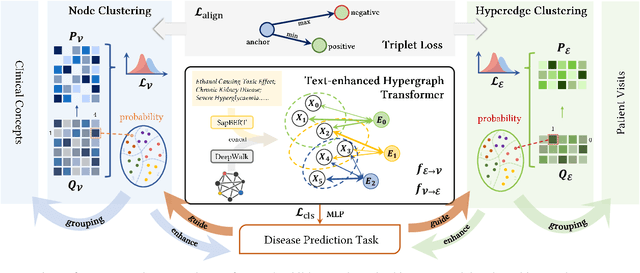

The growing availability of well-organized Electronic Health Records (EHR) data has enabled the development of various machine learning models towards disease risk prediction. However, existing risk prediction methods overlook the heterogeneity of complex diseases, failing to model the potential disease subtypes regarding their corresponding patient visits and clinical concept subgroups. In this work, we introduce TACCO, a novel framework that jointly discovers clusters of clinical concepts and patient visits based on a hypergraph modeling of EHR data. Specifically, we develop a novel self-supervised co-clustering framework that can be guided by the risk prediction task of specific diseases. Furthermore, we enhance the hypergraph model of EHR data with textual embeddings and enforce the alignment between the clusters of clinical concepts and patient visits through a contrastive objective. Comprehensive experiments conducted on the public MIMIC-III dataset and Emory internal CRADLE dataset over the downstream clinical tasks of phenotype classification and cardiovascular risk prediction demonstrate an average 31.25% performance improvement compared to traditional ML baselines and a 5.26% improvement on top of the vanilla hypergraph model without our co-clustering mechanism. In-depth model analysis, clustering results analysis, and clinical case studies further validate the improved utilities and insightful interpretations delivered by TACCO. Code is available at https://github.com/PericlesHat/TACCO.
PromptLink: Leveraging Large Language Models for Cross-Source Biomedical Concept Linking
May 13, 2024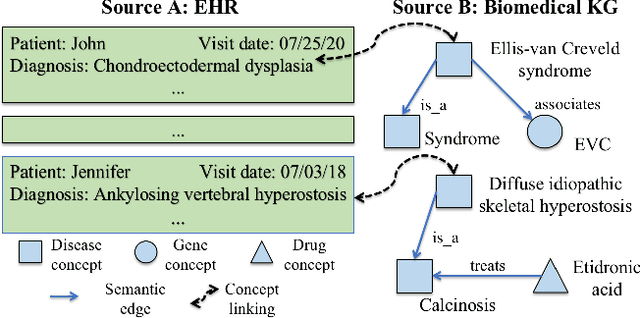
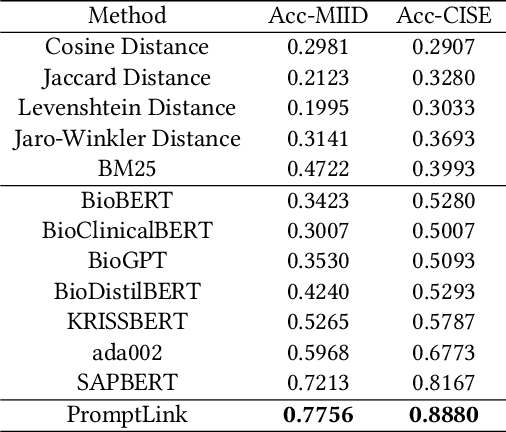
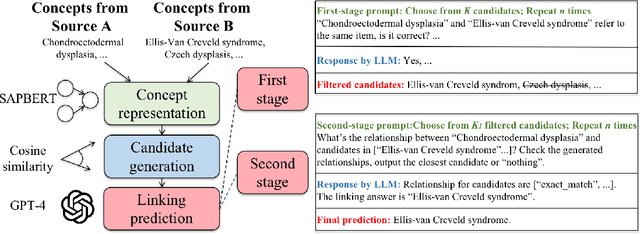

Linking (aligning) biomedical concepts across diverse data sources enables various integrative analyses, but it is challenging due to the discrepancies in concept naming conventions. Various strategies have been developed to overcome this challenge, such as those based on string-matching rules, manually crafted thesauri, and machine learning models. However, these methods are constrained by limited prior biomedical knowledge and can hardly generalize beyond the limited amounts of rules, thesauri, or training samples. Recently, large language models (LLMs) have exhibited impressive results in diverse biomedical NLP tasks due to their unprecedentedly rich prior knowledge and strong zero-shot prediction abilities. However, LLMs suffer from issues including high costs, limited context length, and unreliable predictions. In this research, we propose PromptLink, a novel biomedical concept linking framework that leverages LLMs. It first employs a biomedical-specialized pre-trained language model to generate candidate concepts that can fit in the LLM context windows. Then it utilizes an LLM to link concepts through two-stage prompts, where the first-stage prompt aims to elicit the biomedical prior knowledge from the LLM for the concept linking task and the second-stage prompt enforces the LLM to reflect on its own predictions to further enhance their reliability. Empirical results on the concept linking task between two EHR datasets and an external biomedical KG demonstrate the effectiveness of PromptLink. Furthermore, PromptLink is a generic framework without reliance on additional prior knowledge, context, or training data, making it well-suited for concept linking across various types of data sources. The source code is available at https://github.com/constantjxyz/PromptLink.