 Add to Chrome
 Add to Firefox
 Add to Edge
Attend Before Attention: Efficient and Scalable Video Understanding via Autoregressive Gazing
Mar 12, 2026
Multi-modal large language models (MLLMs) have advanced general-purpose video understanding but struggle with long, high-resolution videos -- they process every pixel equally in their vision transformers (ViTs) or LLMs despite significant spatiotemporal redundancy. We introduce AutoGaze, a lightweight module that removes redundant patches before processed by a ViT or an MLLM. Trained with next-token prediction and reinforcement learning, AutoGaze autoregressively selects a minimal set of multi-scale patches that can reconstruct the video within a user-specified error threshold, eliminating redundancy while preserving information. Empirically, AutoGaze reduces visual tokens by 4x-100x and accelerates ViTs and MLLMs by up to 19x, enabling scaling MLLMs to 1K-frame 4K-resolution videos and achieving superior results on video benchmarks (e.g., 67.0% on VideoMME). Furthermore, we introduce HLVid: the first high-resolution, long-form video QA benchmark with 5-minute 4K-resolution videos, where an MLLM scaled with AutoGaze improves over the baseline by 10.1% and outperforms the previous best MLLM by 4.5%. Project page: https://autogaze.github.io/.

$V_1$: Unifying Generation and Self-Verification for Parallel Reasoners
Mar 04, 2026Test-time scaling for complex reasoning tasks shows that leveraging inference-time compute, by methods such as independently sampling and aggregating multiple solutions, results in significantly better task outcomes. However, a critical bottleneck is verification: sampling is only effective if correct solutions can be reliably identified among candidates. While existing approaches typically evaluate candidates independently via scalar scoring, we demonstrate that models are substantially stronger at pairwise self-verification. Leveraging this insight, we introduce $V_1$, a framework that unifies generation and verification through efficient pairwise ranking. $V_1$ comprises two components: $V_1$-Infer, an uncertainty-guided algorithm using a tournament-based ranking that dynamically allocates self-verification compute to candidate pairs whose relative correctness is most uncertain; and $V_1$-PairRL, an RL framework that jointly trains a single model as both generator and pairwise self-verifier, ensuring the verifier adapts to the generator's evolving distribution. On code generation (LiveCodeBench, CodeContests, SWE-Bench) and math reasoning (AIME, HMMT) benchmarks, $V_1$-Infer improves Pass@1 by up to $10%$ over pointwise verification and outperforms recent test-time scaling methods while being significantly more efficient. Furthermore, $V_1$-PairRL achieves $7$--$9%$ test-time scaling gains over standard RL and pointwise joint training, and improves base Pass@1 by up to 8.7% over standard RL in a code-generation setting.
VisGym: Diverse, Customizable, Scalable Environments for Multimodal Agents
Jan 23, 2026Modern Vision-Language Models (VLMs) remain poorly characterized in multi-step visual interactions, particularly in how they integrate perception, memory, and action over long horizons. We introduce VisGym, a gymnasium of 17 environments for evaluating and training VLMs. The suite spans symbolic puzzles, real-image understanding, navigation, and manipulation, and provides flexible controls over difficulty, input representation, planning horizon, and feedback. We also provide multi-step solvers that generate structured demonstrations, enabling supervised finetuning. Our evaluations show that all frontier models struggle in interactive settings, achieving low success rates in both the easy (46.6%) and hard (26.0%) configurations. Our experiments reveal notable limitations: models struggle to effectively leverage long context, performing worse with an unbounded history than with truncated windows. Furthermore, we find that several text-based symbolic tasks become substantially harder once rendered visually. However, explicit goal observations, textual feedback, and exploratory demonstrations in partially observable or unknown-dynamics settings for supervised finetuning yield consistent gains, highlighting concrete failure modes and pathways for improving multi-step visual decision-making. Code, data, and models can be found at: https://visgym.github.io/.
Visually Prompted Benchmarks Are Surprisingly Fragile
Dec 19, 2025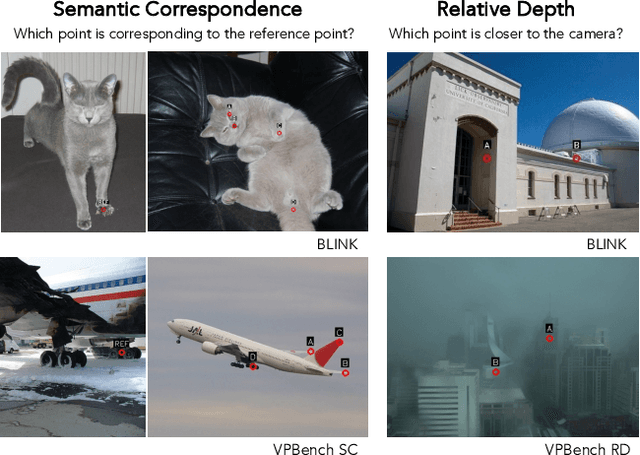
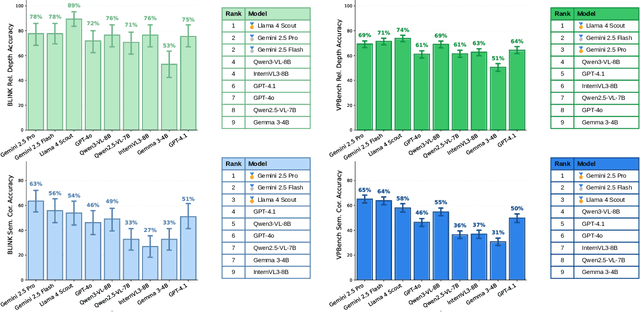
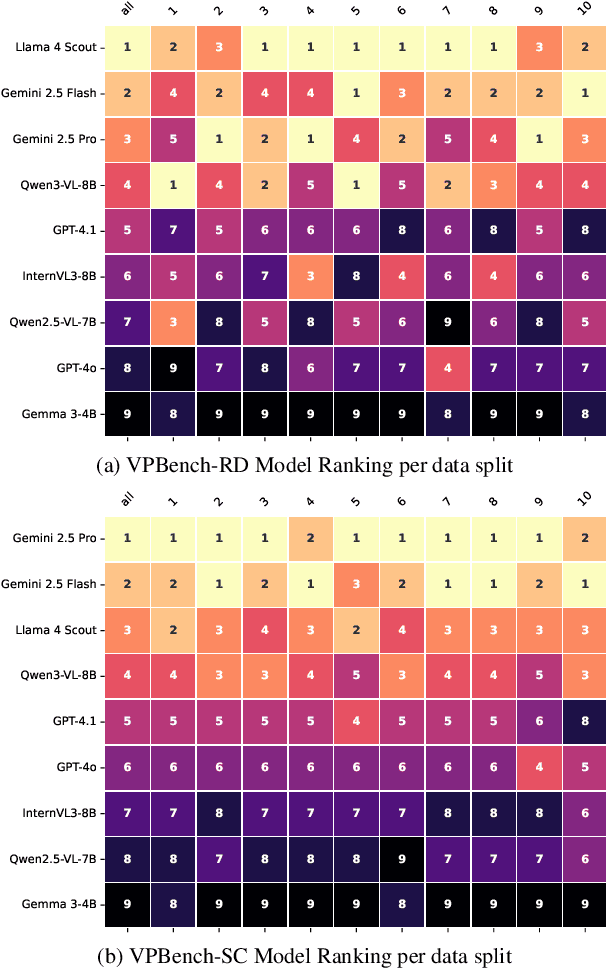
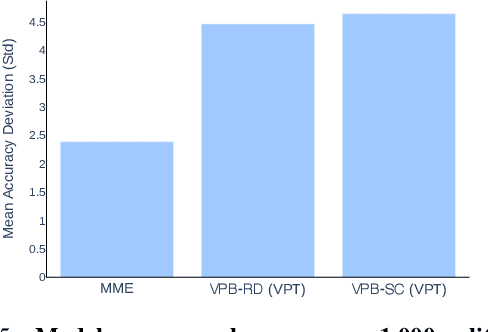
A key challenge in evaluating VLMs is testing models' ability to analyze visual content independently from their textual priors. Recent benchmarks such as BLINK probe visual perception through visual prompting, where questions about visual content are paired with coordinates to which the question refers, with the coordinates explicitly marked in the image itself. While these benchmarks are an important part of VLM evaluation, we find that existing models are surprisingly fragile to seemingly irrelevant details of visual prompting: simply changing a visual marker from red to blue can completely change rankings among models on a leaderboard. By evaluating nine commonly-used open- and closed-source VLMs on two visually prompted tasks, we demonstrate how details in benchmark setup, including visual marker design and dataset size, have a significant influence on model performance and leaderboard rankings. These effects can even be exploited to lift weaker models above stronger ones; for instance, slightly increasing the size of the visual marker results in open-source InternVL3-8B ranking alongside or better than much larger proprietary models like Gemini 2.5 Pro. We further show that low-level inference choices that are often ignored in benchmarking, such as JPEG compression levels in API calls, can also cause model lineup changes. These details have substantially larger impacts on visually prompted benchmarks than on conventional semantic VLM evaluations. To mitigate this instability, we curate existing datasets to create VPBench, a larger visually prompted benchmark with 16 visual marker variants. VPBench and additional analysis tools are released at https://lisadunlap.github.io/vpbench/.
Describe Anything: Detailed Localized Image and Video Captioning
Apr 22, 2025Generating detailed and accurate descriptions for specific regions in images and videos remains a fundamental challenge for vision-language models. We introduce the Describe Anything Model (DAM), a model designed for detailed localized captioning (DLC). DAM preserves both local details and global context through two key innovations: a focal prompt, which ensures high-resolution encoding of targeted regions, and a localized vision backbone, which integrates precise localization with its broader context. To tackle the scarcity of high-quality DLC data, we propose a Semi-supervised learning (SSL)-based Data Pipeline (DLC-SDP). DLC-SDP starts with existing segmentation datasets and expands to unlabeled web images using SSL. We introduce DLC-Bench, a benchmark designed to evaluate DLC without relying on reference captions. DAM sets new state-of-the-art on 7 benchmarks spanning keyword-level, phrase-level, and detailed multi-sentence localized image and video captioning.
Learning Adaptive Parallel Reasoning with Language Models
Apr 21, 2025Scaling inference-time computation has substantially improved the reasoning capabilities of language models. However, existing methods have significant limitations: serialized chain-of-thought approaches generate overly long outputs, leading to increased latency and exhausted context windows, while parallel methods such as self-consistency suffer from insufficient coordination, resulting in redundant computations and limited performance gains. To address these shortcomings, we propose Adaptive Parallel Reasoning (APR), a novel reasoning framework that enables language models to orchestrate both serialized and parallel computations end-to-end. APR generalizes existing reasoning methods by enabling adaptive multi-threaded inference using spawn() and join() operations. A key innovation is our end-to-end reinforcement learning strategy, optimizing both parent and child inference threads to enhance task success rate without requiring predefined reasoning structures. Experiments on the Countdown reasoning task demonstrate significant benefits of APR: (1) higher performance within the same context window (83.4% vs. 60.0% at 4k context); (2) superior scalability with increased computation (80.1% vs. 66.6% at 20k total tokens); (3) improved accuracy at equivalent latency (75.2% vs. 57.3% at approximately 5,000ms). APR represents a step towards enabling language models to autonomously optimize their reasoning processes through adaptive allocation of computation.
TULIP: Towards Unified Language-Image Pretraining
Mar 19, 2025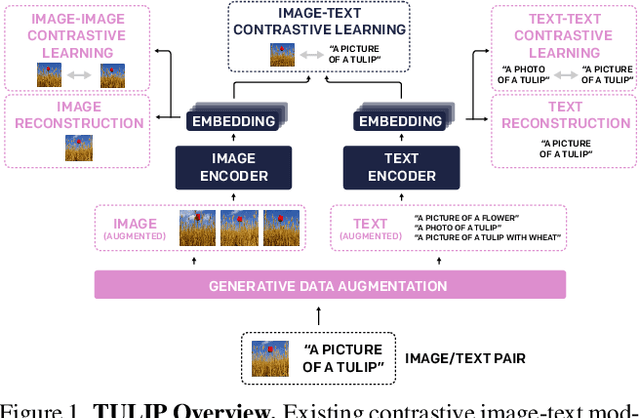
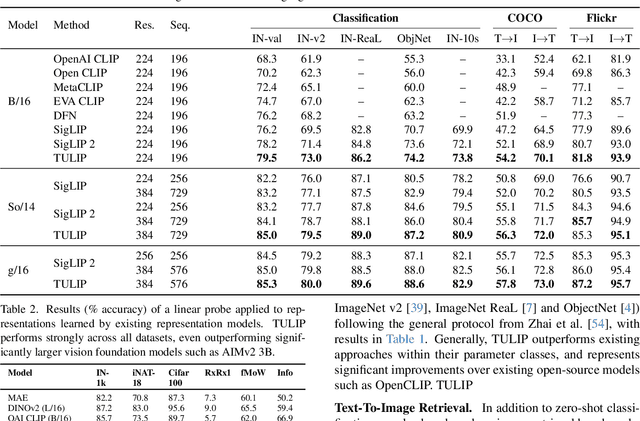
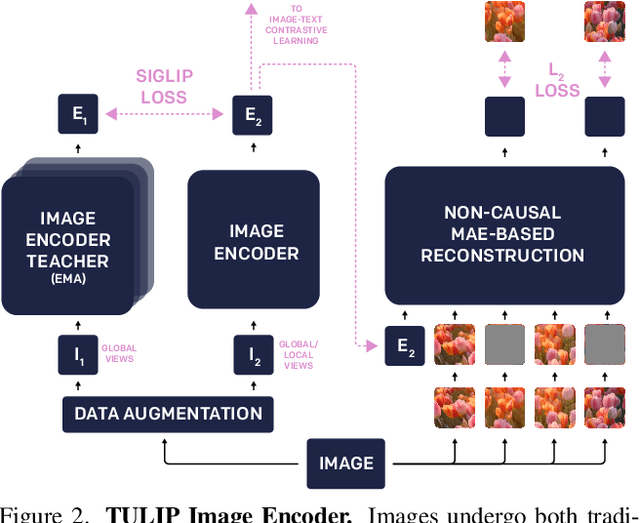
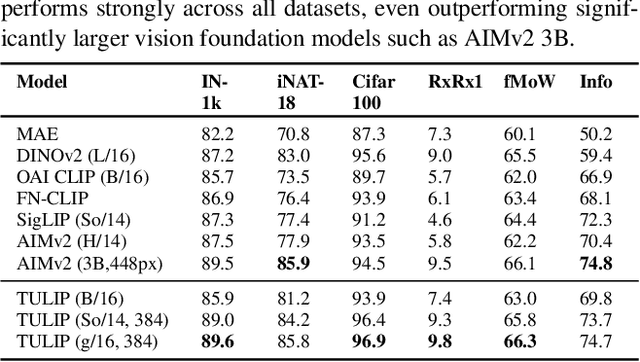
Despite the recent success of image-text contrastive models like CLIP and SigLIP, these models often struggle with vision-centric tasks that demand high-fidelity image understanding, such as counting, depth estimation, and fine-grained object recognition. These models, by performing language alignment, tend to prioritize high-level semantics over visual understanding, weakening their image understanding. On the other hand, vision-focused models are great at processing visual information but struggle to understand language, limiting their flexibility for language-driven tasks. In this work, we introduce TULIP, an open-source, drop-in replacement for existing CLIP-like models. Our method leverages generative data augmentation, enhanced image-image and text-text contrastive learning, and image/text reconstruction regularization to learn fine-grained visual features while preserving global semantic alignment. Our approach, scaling to over 1B parameters, outperforms existing state-of-the-art (SOTA) models across multiple benchmarks, establishing a new SOTA zero-shot performance on ImageNet-1K, delivering up to a $2\times$ enhancement over SigLIP on RxRx1 in linear probing for few-shot classification, and improving vision-language models, achieving over $3\times$ higher scores than SigLIP on MMVP. Our code/checkpoints are available at https://tulip-berkeley.github.io
Atlas: Multi-Scale Attention Improves Long Context Image Modeling
Mar 16, 2025Efficiently modeling massive images is a long-standing challenge in machine learning. To this end, we introduce Multi-Scale Attention (MSA). MSA relies on two key ideas, (i) multi-scale representations (ii) bi-directional cross-scale communication. MSA creates O(log N) scales to represent the image across progressively coarser features and leverages cross-attention to propagate information across scales. We then introduce Atlas, a novel neural network architecture based on MSA. We demonstrate that Atlas significantly improves the compute-performance tradeoff of long-context image modeling in a high-resolution variant of ImageNet 100. At 1024px resolution, Atlas-B achieves 91.04% accuracy, comparable to ConvNext-B (91.92%) while being 4.3x faster. Atlas is 2.95x faster and 7.38% better than FasterViT, 2.25x faster and 4.96% better than LongViT. In comparisons against MambaVision-S, we find Atlas-S achieves 5%, 16% and 32% higher accuracy at 1024px, 2048px and 4096px respectively, while obtaining similar runtimes. Code for reproducing our experiments and pretrained models is available at https://github.com/yalalab/atlas.
Rethinking Patch Dependence for Masked Autoencoders
Jan 25, 2024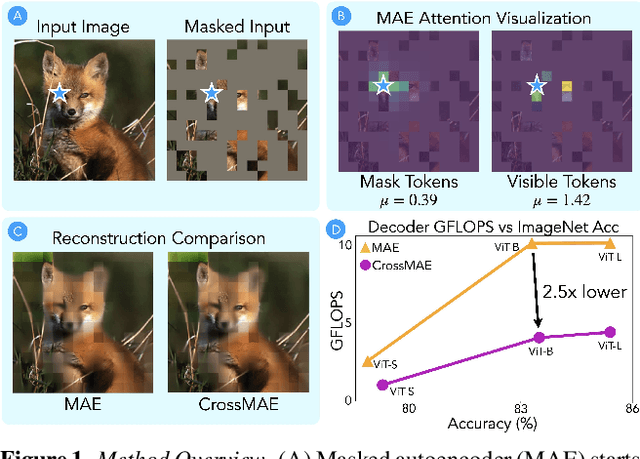
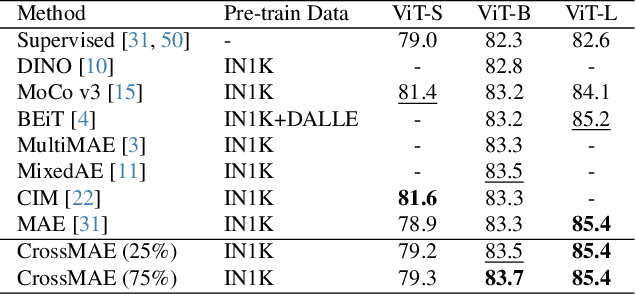
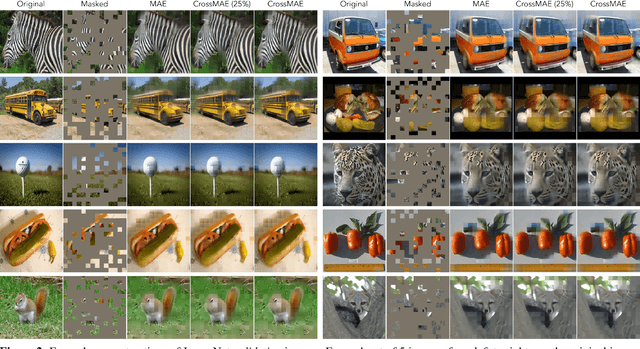
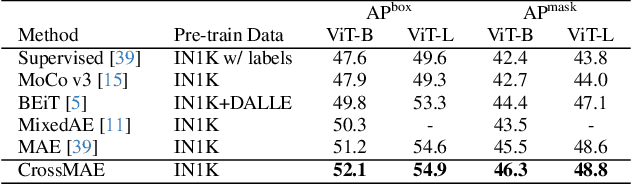
In this work, we re-examine inter-patch dependencies in the decoding mechanism of masked autoencoders (MAE). We decompose this decoding mechanism for masked patch reconstruction in MAE into self-attention and cross-attention. Our investigations suggest that self-attention between mask patches is not essential for learning good representations. To this end, we propose a novel pretraining framework: Cross-Attention Masked Autoencoders (CrossMAE). CrossMAE's decoder leverages only cross-attention between masked and visible tokens, with no degradation in downstream performance. This design also enables decoding only a small subset of mask tokens, boosting efficiency. Furthermore, each decoder block can now leverage different encoder features, resulting in improved representation learning. CrossMAE matches MAE in performance with 2.5 to 3.7$\times$ less decoding compute. It also surpasses MAE on ImageNet classification and COCO instance segmentation under the same compute. Code and models: https://crossmae.github.io
Unsupervised Universal Image Segmentation
Dec 28, 2023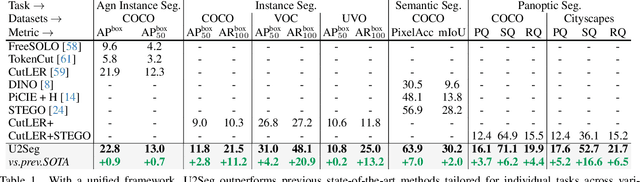

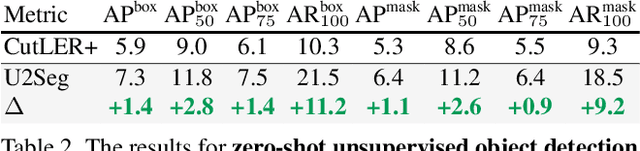
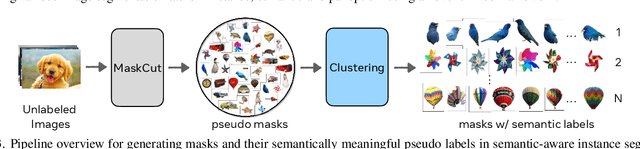
Several unsupervised image segmentation approaches have been proposed which eliminate the need for dense manually-annotated segmentation masks; current models separately handle either semantic segmentation (e.g., STEGO) or class-agnostic instance segmentation (e.g., CutLER), but not both (i.e., panoptic segmentation). We propose an Unsupervised Universal Segmentation model (U2Seg) adept at performing various image segmentation tasks -- instance, semantic and panoptic -- using a novel unified framework. U2Seg generates pseudo semantic labels for these segmentation tasks via leveraging self-supervised models followed by clustering; each cluster represents different semantic and/or instance membership of pixels. We then self-train the model on these pseudo semantic labels, yielding substantial performance gains over specialized methods tailored to each task: a +2.6 AP$^{\text{box}}$ boost vs. CutLER in unsupervised instance segmentation on COCO and a +7.0 PixelAcc increase (vs. STEGO) in unsupervised semantic segmentation on COCOStuff. Moreover, our method sets up a new baseline for unsupervised panoptic segmentation, which has not been previously explored. U2Seg is also a strong pretrained model for few-shot segmentation, surpassing CutLER by +5.0 AP$^{\text{mask}}$ when trained on a low-data regime, e.g., only 1% COCO labels. We hope our simple yet effective method can inspire more research on unsupervised universal image segmentation.