 Add to Chrome
 Add to Firefox
 Add to Edge
LOME: Learning Human-Object Manipulation with Action-Conditioned Egocentric World Model
Mar 28, 2026
Learning human-object manipulation presents significant challenges due to its fine-grained and contact-rich nature of the motions involved. Traditional physics-based animation requires extensive modeling and manual setup, and more importantly, it neither generalizes well across diverse object morphologies nor scales effectively to real-world environment. To address these limitations, we introduce LOME, an egocentric world model that can generate realistic human-object interactions as videos conditioned on an input image, a text prompt, and per-frame human actions, including both body poses and hand gestures. LOME injects strong and precise action guidance into object manipulation by jointly estimating spatial human actions and the environment contexts during training. After finetuning a pretrained video generative model on videos of diverse egocentric human-object interactions, LOME demonstrates not only high action-following accuracy and strong generalization to unseen scenarios, but also realistic physical consequences of hand-object interactions, e.g., liquid flowing from a bottle into a mug after executing a ``pouring'' action. Extensive experiments demonstrate that our video-based framework significantly outperforms state-of-the-art image based and video-based action-conditioned methods and Image/Text-to-Video (I/T2V) generative model in terms of both temporal consistency and motion control. LOME paves the way for photorealistic AR/VR experiences and scalable robotic training, without being limited to simulated environments or relying on explicit 3D/4D modeling.

S^2VG: 3D Stereoscopic and Spatial Video Generation via Denoising Frame Matrix
Aug 11, 2025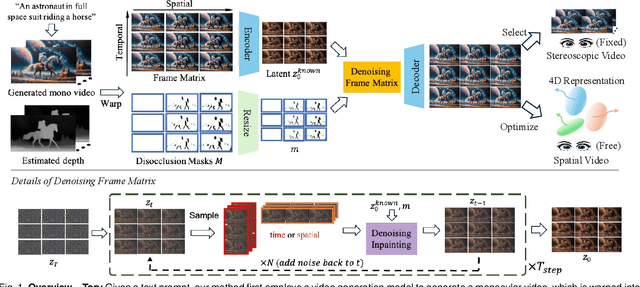

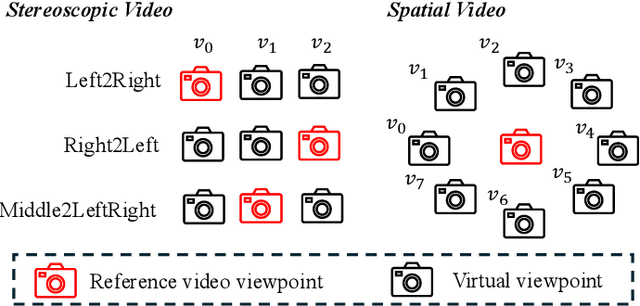

While video generation models excel at producing high-quality monocular videos, generating 3D stereoscopic and spatial videos for immersive applications remains an underexplored challenge. We present a pose-free and training-free method that leverages an off-the-shelf monocular video generation model to produce immersive 3D videos. Our approach first warps the generated monocular video into pre-defined camera viewpoints using estimated depth information, then applies a novel \textit{frame matrix} inpainting framework. This framework utilizes the original video generation model to synthesize missing content across different viewpoints and timestamps, ensuring spatial and temporal consistency without requiring additional model fine-tuning. Moreover, we develop a \dualupdate~scheme that further improves the quality of video inpainting by alleviating the negative effects propagated from disoccluded areas in the latent space. The resulting multi-view videos are then adapted into stereoscopic pairs or optimized into 4D Gaussians for spatial video synthesis. We validate the efficacy of our proposed method by conducting experiments on videos from various generative models, such as Sora, Lumiere, WALT, and Zeroscope. The experiments demonstrate that our method has a significant improvement over previous methods. Project page at: https://daipengwa.github.io/S-2VG_ProjectPage/
EVER: Exact Volumetric Ellipsoid Rendering for Real-time View Synthesis
Oct 02, 2024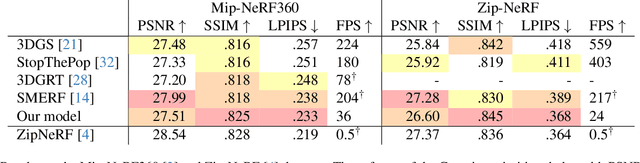
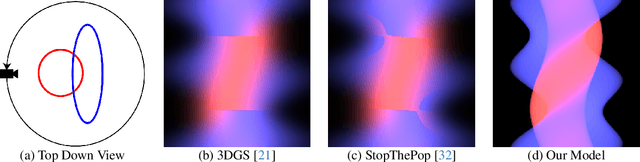
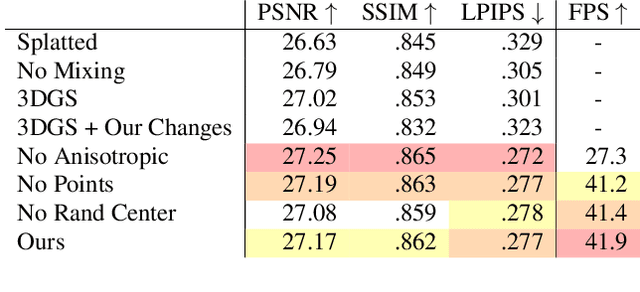
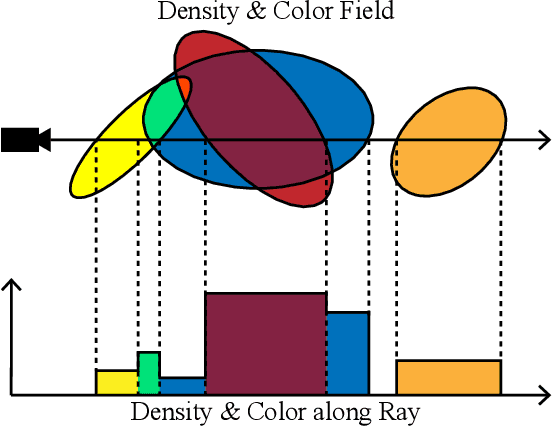
We present Exact Volumetric Ellipsoid Rendering (EVER), a method for real-time differentiable emission-only volume rendering. Unlike recent rasterization based approach by 3D Gaussian Splatting (3DGS), our primitive based representation allows for exact volume rendering, rather than alpha compositing 3D Gaussian billboards. As such, unlike 3DGS our formulation does not suffer from popping artifacts and view dependent density, but still achieves frame rates of $\sim\!30$ FPS at 720p on an NVIDIA RTX4090. Since our approach is built upon ray tracing it enables effects such as defocus blur and camera distortion (e.g. such as from fisheye cameras), which are difficult to achieve by rasterization. We show that our method is more accurate with fewer blending issues than 3DGS and follow-up work on view-consistent rendering, especially on the challenging large-scale scenes from the Zip-NeRF dataset where it achieves sharpest results among real-time techniques.
LightAvatar: Efficient Head Avatar as Dynamic Neural Light Field
Sep 26, 2024
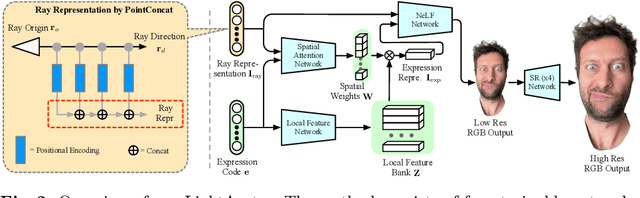


Recent works have shown that neural radiance fields (NeRFs) on top of parametric models have reached SOTA quality to build photorealistic head avatars from a monocular video. However, one major limitation of the NeRF-based avatars is the slow rendering speed due to the dense point sampling of NeRF, preventing them from broader utility on resource-constrained devices. We introduce LightAvatar, the first head avatar model based on neural light fields (NeLFs). LightAvatar renders an image from 3DMM parameters and a camera pose via a single network forward pass, without using mesh or volume rendering. The proposed approach, while being conceptually appealing, poses a significant challenge towards real-time efficiency and training stability. To resolve them, we introduce dedicated network designs to obtain proper representations for the NeLF model and maintain a low FLOPs budget. Meanwhile, we tap into a distillation-based training strategy that uses a pretrained avatar model as teacher to synthesize abundant pseudo data for training. A warping field network is introduced to correct the fitting error in the real data so that the model can learn better. Extensive experiments suggest that our method can achieve new SOTA image quality quantitatively or qualitatively, while being significantly faster than the counterparts, reporting 174.1 FPS (512x512 resolution) on a consumer-grade GPU (RTX3090) with no customized optimization.
SVG: 3D Stereoscopic Video Generation via Denoising Frame Matrix
Jun 29, 2024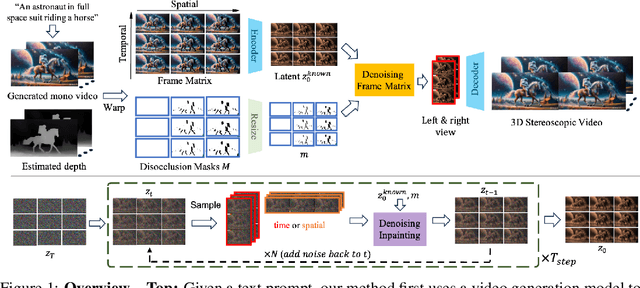
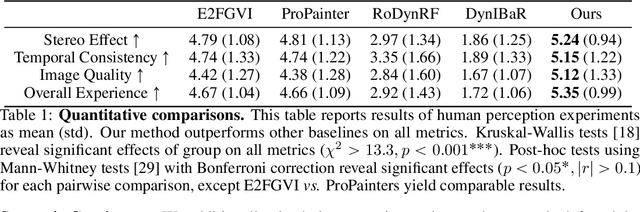
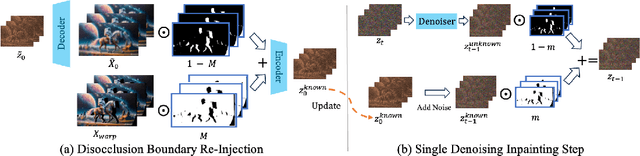

Video generation models have demonstrated great capabilities of producing impressive monocular videos, however, the generation of 3D stereoscopic video remains under-explored. We propose a pose-free and training-free approach for generating 3D stereoscopic videos using an off-the-shelf monocular video generation model. Our method warps a generated monocular video into camera views on stereoscopic baseline using estimated video depth, and employs a novel frame matrix video inpainting framework. The framework leverages the video generation model to inpaint frames observed from different timestamps and views. This effective approach generates consistent and semantically coherent stereoscopic videos without scene optimization or model fine-tuning. Moreover, we develop a disocclusion boundary re-injection scheme that further improves the quality of video inpainting by alleviating the negative effects propagated from disoccluded areas in the latent space. We validate the efficacy of our proposed method by conducting experiments on videos from various generative models, including Sora [4 ], Lumiere [2], WALT [8 ], and Zeroscope [ 42]. The experiments demonstrate that our method has a significant improvement over previous methods. The code will be released at \url{https://daipengwa.github.io/SVG_ProjectPage}.
MagicMirror: Fast and High-Quality Avatar Generation with a Constrained Search Space
Apr 01, 2024


We introduce a novel framework for 3D human avatar generation and personalization, leveraging text prompts to enhance user engagement and customization. Central to our approach are key innovations aimed at overcoming the challenges in photo-realistic avatar synthesis. Firstly, we utilize a conditional Neural Radiance Fields (NeRF) model, trained on a large-scale unannotated multi-view dataset, to create a versatile initial solution space that accelerates and diversifies avatar generation. Secondly, we develop a geometric prior, leveraging the capabilities of Text-to-Image Diffusion Models, to ensure superior view invariance and enable direct optimization of avatar geometry. These foundational ideas are complemented by our optimization pipeline built on Variational Score Distillation (VSD), which mitigates texture loss and over-saturation issues. As supported by our extensive experiments, these strategies collectively enable the creation of custom avatars with unparalleled visual quality and better adherence to input text prompts. You can find more results and videos in our website: https://syntec-research.github.io/MagicMirror
GaussianFlow: Splatting Gaussian Dynamics for 4D Content Creation
Mar 19, 2024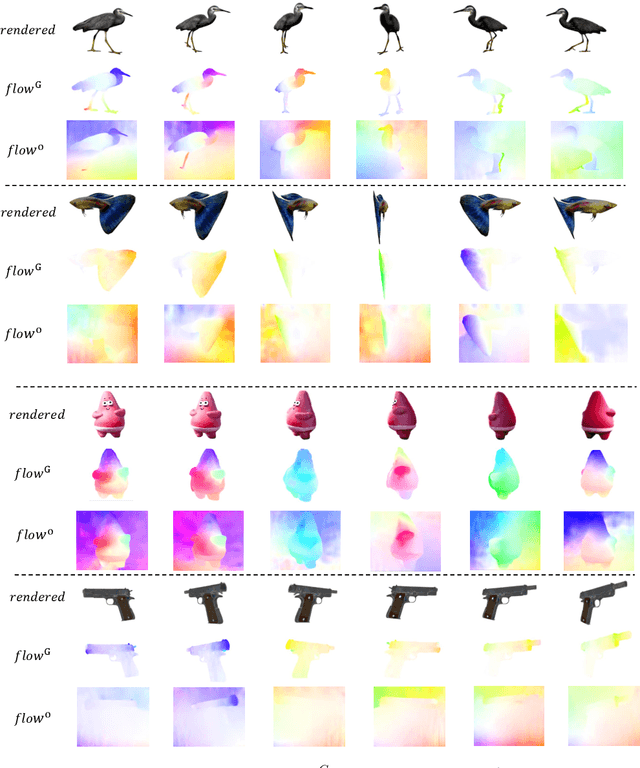
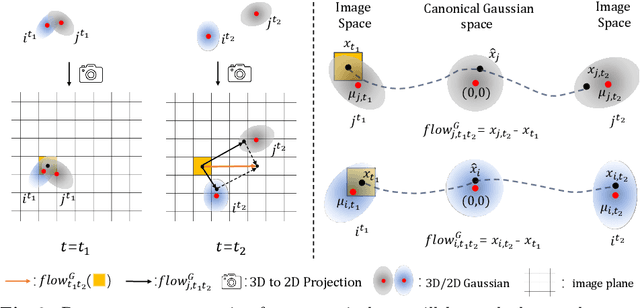
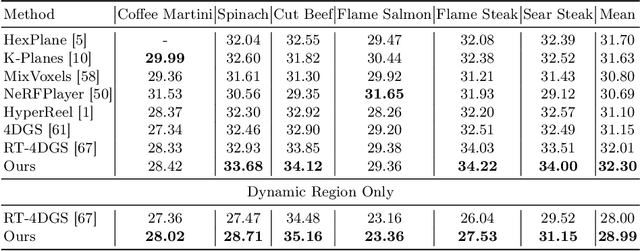
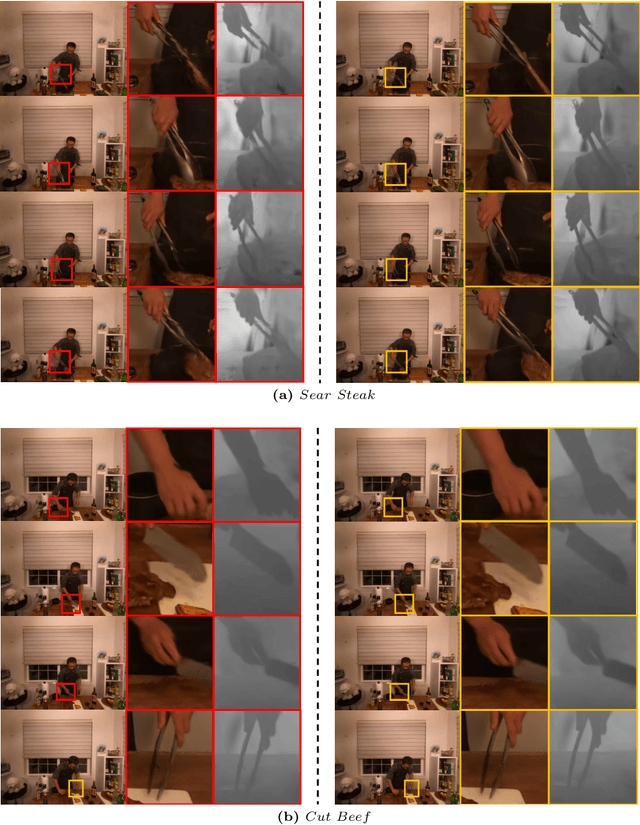
Creating 4D fields of Gaussian Splatting from images or videos is a challenging task due to its under-constrained nature. While the optimization can draw photometric reference from the input videos or be regulated by generative models, directly supervising Gaussian motions remains underexplored. In this paper, we introduce a novel concept, Gaussian flow, which connects the dynamics of 3D Gaussians and pixel velocities between consecutive frames. The Gaussian flow can be efficiently obtained by splatting Gaussian dynamics into the image space. This differentiable process enables direct dynamic supervision from optical flow. Our method significantly benefits 4D dynamic content generation and 4D novel view synthesis with Gaussian Splatting, especially for contents with rich motions that are hard to be handled by existing methods. The common color drifting issue that happens in 4D generation is also resolved with improved Guassian dynamics. Superior visual quality on extensive experiments demonstrates our method's effectiveness. Quantitative and qualitative evaluations show that our method achieves state-of-the-art results on both tasks of 4D generation and 4D novel view synthesis. Project page: https://zerg-overmind.github.io/GaussianFlow.github.io/
One2Avatar: Generative Implicit Head Avatar For Few-shot User Adaptation
Feb 19, 2024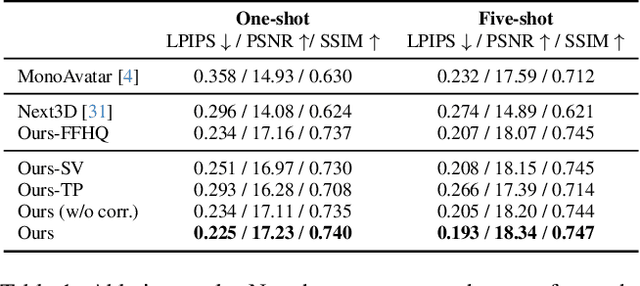

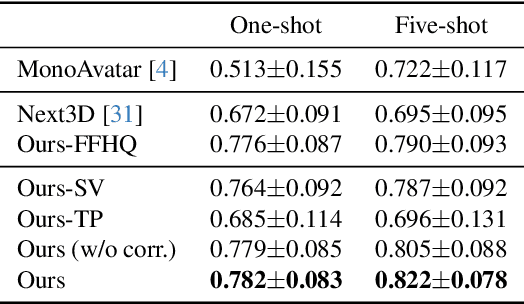

Traditional methods for constructing high-quality, personalized head avatars from monocular videos demand extensive face captures and training time, posing a significant challenge for scalability. This paper introduces a novel approach to create high quality head avatar utilizing only a single or a few images per user. We learn a generative model for 3D animatable photo-realistic head avatar from a multi-view dataset of expressions from 2407 subjects, and leverage it as a prior for creating personalized avatar from few-shot images. Different from previous 3D-aware face generative models, our prior is built with a 3DMM-anchored neural radiance field backbone, which we show to be more effective for avatar creation through auto-decoding based on few-shot inputs. We also handle unstable 3DMM fitting by jointly optimizing the 3DMM fitting and camera calibration that leads to better few-shot adaptation. Our method demonstrates compelling results and outperforms existing state-of-the-art methods for few-shot avatar adaptation, paving the way for more efficient and personalized avatar creation.
MVDD: Multi-View Depth Diffusion Models
Dec 19, 2023Denoising diffusion models have demonstrated outstanding results in 2D image generation, yet it remains a challenge to replicate its success in 3D shape generation. In this paper, we propose leveraging multi-view depth, which represents complex 3D shapes in a 2D data format that is easy to denoise. We pair this representation with a diffusion model, MVDD, that is capable of generating high-quality dense point clouds with 20K+ points with fine-grained details. To enforce 3D consistency in multi-view depth, we introduce an epipolar line segment attention that conditions the denoising step for a view on its neighboring views. Additionally, a depth fusion module is incorporated into diffusion steps to further ensure the alignment of depth maps. When augmented with surface reconstruction, MVDD can also produce high-quality 3D meshes. Furthermore, MVDD stands out in other tasks such as depth completion, and can serve as a 3D prior, significantly boosting many downstream tasks, such as GAN inversion. State-of-the-art results from extensive experiments demonstrate MVDD's excellent ability in 3D shape generation, depth completion, and its potential as a 3D prior for downstream tasks.
Gaussian3Diff: 3D Gaussian Diffusion for 3D Full Head Synthesis and Editing
Dec 19, 2023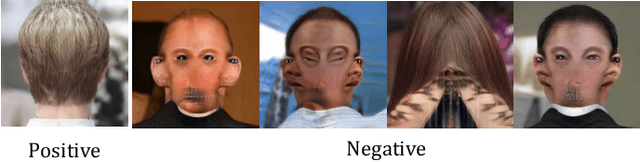
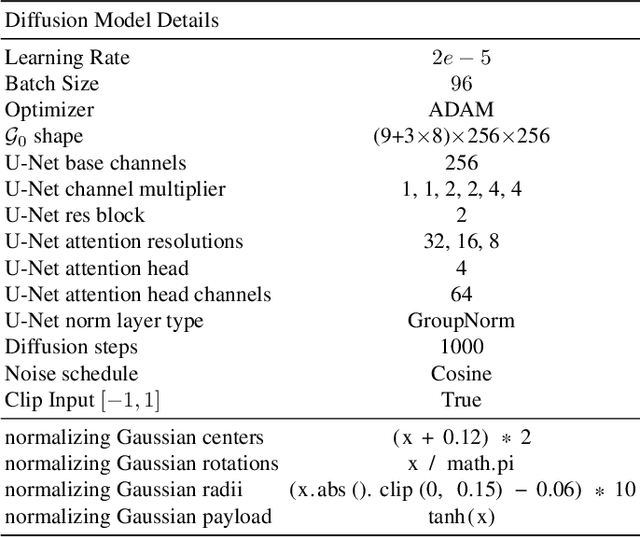
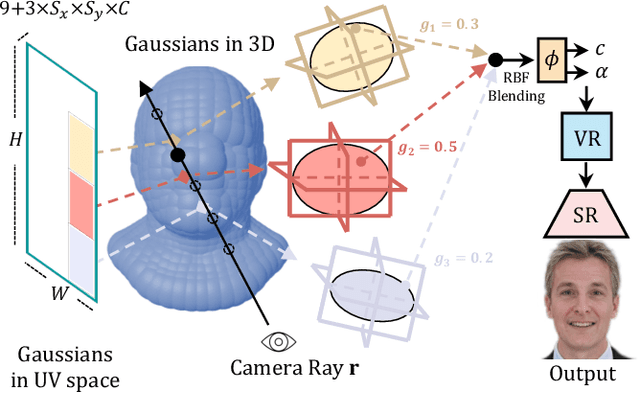
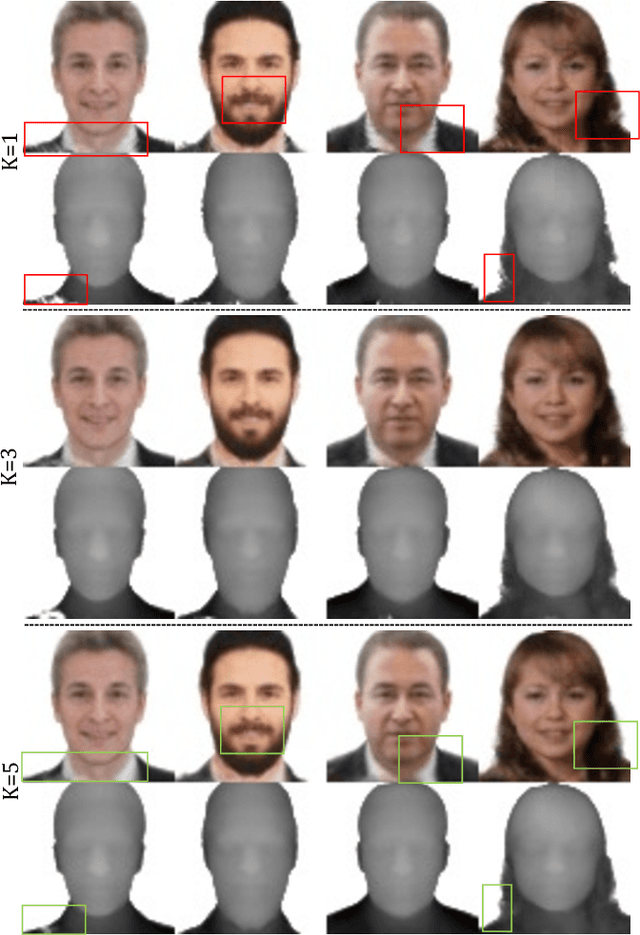
We present a novel framework for generating photorealistic 3D human head and subsequently manipulating and reposing them with remarkable flexibility. The proposed approach leverages an implicit function representation of 3D human heads, employing 3D Gaussians anchored on a parametric face model. To enhance representational capabilities and encode spatial information, we embed a lightweight tri-plane payload within each Gaussian rather than directly storing color and opacity. Additionally, we parameterize the Gaussians in a 2D UV space via a 3DMM, enabling effective utilization of the diffusion model for 3D head avatar generation. Our method facilitates the creation of diverse and realistic 3D human heads with fine-grained editing over facial features and expressions. Extensive experiments demonstrate the effectiveness of our method.