 Add to Chrome
 Add to Firefox
 Add to Edge
VEPHand: View-Efficient Photometric Hand Performance Capture at Scale
Jun 18, 2026
Robust, high-fidelity 3D hand capture, while fundamental to digital human creation, remains challenging with practical multi-view systems that balance rich photometry with the geometric ambiguities of reconstruction arising from limited viewpoint density. This paper presents an end-to-end pipeline for dynamic hand performance capture and registration, specifically designed for view-efficient setups ($\sim$20 views). We address key challenges with two primary innovations. First, to overcome reconstruction difficulties like limited view overlap and background clutter, our mask-free neural method robustly extracts detailed hand geometry and appearance from unmasked images using scene parameterization and scenario-specific density regularization. Second, addressing registration challenges such as accurately capturing non-linear skin deformations and ensuring plausible results during severe self-contact, we propose a physics-inspired framework. It aligns reconstructions to a personalized hand model by optimizing intrinsic volumetric offsets within its canonical tetrahedral mesh, alongside pose parameters. This approach, supported by robust losses and optimization, captures fine surface deformations, ensures plausible results under severe articulation and self-contact, and demonstrates strong tolerance to input noise. We demonstrate the scalability and robustness of our automated pipeline on an extensive dataset of over 12,000 sequences, from which we also derive a large-scale, high-quality synthetic 2D/3D hand dataset for training downstream tasks. This showcases its effectiveness for single hands, intricate two-hand interactions, and natural hand-object manipulations. Our method achieves state-of-the-art reconstruction fidelity in view-efficient, unmasked scenarios and highly accurate registration. Our project page are available at https://vephand.github.io/.

Spectral Graphormer: Spectral Graph-based Transformer for Egocentric Two-Hand Reconstruction using Multi-View Color Images
Aug 21, 2023We propose a novel transformer-based framework that reconstructs two high fidelity hands from multi-view RGB images. Unlike existing hand pose estimation methods, where one typically trains a deep network to regress hand model parameters from single RGB image, we consider a more challenging problem setting where we directly regress the absolute root poses of two-hands with extended forearm at high resolution from egocentric view. As existing datasets are either infeasible for egocentric viewpoints or lack background variations, we create a large-scale synthetic dataset with diverse scenarios and collect a real dataset from multi-calibrated camera setup to verify our proposed multi-view image feature fusion strategy. To make the reconstruction physically plausible, we propose two strategies: (i) a coarse-to-fine spectral graph convolution decoder to smoothen the meshes during upsampling and (ii) an optimisation-based refinement stage at inference to prevent self-penetrations. Through extensive quantitative and qualitative evaluations, we show that our framework is able to produce realistic two-hand reconstructions and demonstrate the generalisation of synthetic-trained models to real data, as well as real-time AR/VR applications.
I Wish I Didn't Say That! Analyzing and Predicting Deleted Messages in Twitter
May 14, 2013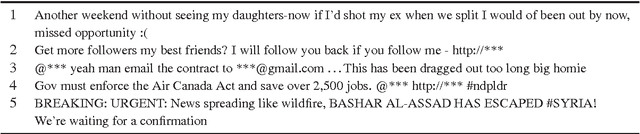
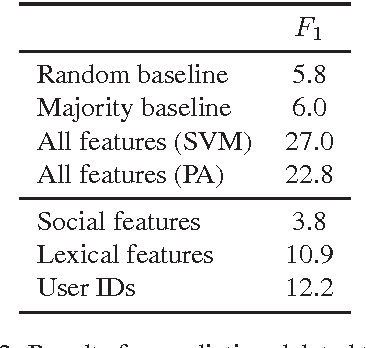

Twitter has become a major source of data for social media researchers. One important aspect of Twitter not previously considered are {\em deletions} -- removal of tweets from the stream. Deletions can be due to a multitude of reasons such as privacy concerns, rashness or attempts to undo public statements. We show how deletions can be automatically predicted ahead of time and analyse which tweets are likely to be deleted and how.