 Add to Chrome
 Add to Firefox
 Add to Edge
GNM Head: A Generative aNthropometric Model of the human head
Jul 26, 2026
Parametric models of the human head are essential tools traditionally used in computer vision and graphics for animation, rendering, and reconstruction. More recently, they serve as crucial conditioning signals within generative large vision models, allowing for tight spatial control of generated imagery. However, existing publicly available models are typically limited in anatomical scope, modeling only outer geometry while ignoring intra-oral and ocular structures, and frequently suffer from reduced geometric quality stemming from low-fidelity input datasets. In this report we introduce a new parametric model dubbed Generative aNthropometric Model (GNM), named as a homophone of the human genome. GNM encompasses the head, face, neck, eyeballs, teeth, and tongue, and it is built on an extensive database of high-resolution 3D scans combined with high-quality anatomy specific artist-made samples. This report details the data provenance, the model architecture including the specialized sub-models for the ocular and intra-oral structures, and shows its SotA performance on fitting target 3D face scans. To foster community innovation, the complete GNM framework is made publicly available.

How to Build Digital Humans? From Priors to Photorealistic Avatars
Jul 05, 2026This state-of-the-art report provides an overview of controllable 3D human avatar creation. We describe current 3D avatar systems, which typically consist of three stages: (i) learning priors of human appearance and motion, (ii) creating a personalized avatar, and (iii) animating the avatar. To limit the scope, we focus on the prior learning and avatar creation stages. We define current avatar representations and introduce a taxonomy that categorizes existing work along multiple axes, including body regions and employed priors. We review methods for full-body and head avatars, as well as layered representations that decompose the body into components such as hands, hair, and garments. Finally, we outline common underlying principles, reference key literature for newcomers, and discuss open challenges and future research directions.
VEPHand: View-Efficient Photometric Hand Performance Capture at Scale
Jun 18, 2026Robust, high-fidelity 3D hand capture, while fundamental to digital human creation, remains challenging with practical multi-view systems that balance rich photometry with the geometric ambiguities of reconstruction arising from limited viewpoint density. This paper presents an end-to-end pipeline for dynamic hand performance capture and registration, specifically designed for view-efficient setups ($\sim$20 views). We address key challenges with two primary innovations. First, to overcome reconstruction difficulties like limited view overlap and background clutter, our mask-free neural method robustly extracts detailed hand geometry and appearance from unmasked images using scene parameterization and scenario-specific density regularization. Second, addressing registration challenges such as accurately capturing non-linear skin deformations and ensuring plausible results during severe self-contact, we propose a physics-inspired framework. It aligns reconstructions to a personalized hand model by optimizing intrinsic volumetric offsets within its canonical tetrahedral mesh, alongside pose parameters. This approach, supported by robust losses and optimization, captures fine surface deformations, ensures plausible results under severe articulation and self-contact, and demonstrates strong tolerance to input noise. We demonstrate the scalability and robustness of our automated pipeline on an extensive dataset of over 12,000 sequences, from which we also derive a large-scale, high-quality synthetic 2D/3D hand dataset for training downstream tasks. This showcases its effectiveness for single hands, intricate two-hand interactions, and natural hand-object manipulations. Our method achieves state-of-the-art reconstruction fidelity in view-efficient, unmasked scenarios and highly accurate registration. Our project page are available at https://vephand.github.io/.
Topologically Consistent Multi-view 3D Head Reconstruction via Coarse-Guided Layered Surface Sampling
May 29, 2026We present SHELLS (Semantic Head Estimation via Layered Local Sampling), an efficient feed-forward framework for 3D head reconstruction in dense semantic correspondence from multi-view images. Existing methods typically refine vertices independently via localized feature volumes. This approach couples memory-intensive feature sampling to mesh resolution, which limits scalability for dense topologies (> 10k vertices) and introduces surface noise. In contrast, SHELLS decouples feature extraction from mesh resolution via a hierarchical sampling strategy. We extract multi-view features using a DINOv2 backbone with LoRA adaptation, projectively sample a sparse global feature cloud, and predict an intermediate coarse mesh. This coarse prior guides the construction of layered, surface-aware sampling shells that serve as a discrete search space for the final reconstruction. SHELLS maintains surface consistency while using 88% less inference GPU memory (2.4GB vs. 20GB) than volumetric baselines. It reduces median registration error by 21% to 29% with a 3.5x inference speedup (0.08s vs. 0.29s) for 18k-vertex meshes. Notably, our model is trained exclusively on synthetic data yet generalizes effectively to real-world captures, eliminating the need for the costly, pre-registered multi-view datasets common in prior work.
3DRealHead: Few-Shot Detailed Head Avatar
Apr 14, 2026The human face is central to communication. For immersive applications, the digital presence of a person should mirror the physical reality, capturing the users idiosyncrasies and detailed facial expressions. However, current 3D head avatar methods often struggle to faithfully reproduce the identity and facial expressions, despite having multi-view data or learned priors. Learning priors that capture the diversity of human appearances, especially, for regions with highly person-specific features, like the mouth and teeth region is challenging as the underlying training data is limited. In addition, many of the avatar methods are purely relying on 3D morphable model-based expression control which strongly limits expressivity. To address these challenges, we are introducing 3DRealHead, a few-shot head avatar reconstruction method with a novel expression control signal that is extracted from a monocular video stream of the subject. Specifically, the subject can take a few pictures of themselves, recover a 3D head avatar and drive it with a consumer-level webcam. The avatar reconstruction is enabled via a novel few-shot inversion process of a 3D human head prior which is represented as a Style U-Net that emits 3D Gaussian primitives which can be rendered under novel views. The prior is learned on the NeRSemble dataset. For animating the avatar, the U-Net is conditioned on 3DMM-based facial expression signals, as well as features of the mouth region extracted from the driving video. These additional mouth features allow us to recover facial expressions that cannot be represented by the 3DMM leading to a higher expressivity and closer resemblance to the physical reality.
Representing 3D Faces with Learnable B-Spline Volumes
Apr 14, 2026We present CUBE (Control-based Unified B-spline Encoding), a new geometric representation for human faces that combines B-spline volumes with learned features, and demonstrate its use as a decoder for 3D scan registration and monocular 3D face reconstruction. Unlike existing B-spline representations with 3D control points, CUBE is parametrized by a lattice (e.g., 8 x 8 x 8) of high-dimensional control features, increasing the model's expressivity. These features define a continuous, two-stage mapping from a 3D parametric domain to 3D Euclidean space via an intermediate feature space. First, high-dimensional control features are locally blended using the B-spline bases, yielding a high-dimensional feature vector whose first three values define a 3D base mesh. A small MLP then processes this feature vector to predict a residual displacement from the base shape, yielding the final refined 3D coordinates. To reconstruct 3D surfaces in dense semantic correspondence, CUBE is queried at 3D coordinates sampled from a fixed template mesh. Crucially, CUBE retains the local support property of traditional B-spline representations, enabling local surface editing by updating individual control features. We demonstrate the strengths of this representation by training transformer-based encoders to predict CUBE's control features from unstructured point clouds and monocular images, achieving state-of-the-art scan registration results compared to recent baselines.
Feed-forward Gaussian Registration for Head Avatar Creation and Editing
Mar 16, 2026We present MATCH (Multi-view Avatars from Topologically Corresponding Heads), a multi-view Gaussian registration method for high-quality head avatar creation and editing. State-of-the-art multi-view head avatar methods require time-consuming head tracking followed by expensive avatar optimization, often resulting in a total creation time of more than one day. MATCH, in contrast, directly predicts Gaussian splat textures in correspondence from calibrated multi-view images in just 0.5 seconds per frame, without requiring data preprocessing. The learned intra-subject correspondence across frames enables fast creation of personalized head avatars, while correspondence across subjects supports applications such as expression transfer, optimization-free tracking, semantic editing, and identity interpolation. We establish these correspondences end-to-end using a transformer-based model that predicts Gaussian splat textures in the fixed UV layout of a template mesh. To achieve this, we introduce a novel registration-guided attention block, where each UV-map token attends exclusively to image tokens depicting its corresponding mesh region. This design improves efficiency and performance compared to dense cross-view attention. MATCH outperforms existing methods in novel-view synthesis, geometry registration, and head avatar generation, while making avatar creation 10 times faster than the closest competing baseline. The code and model weights are available on the project website.
TeGA: Texture Space Gaussian Avatars for High-Resolution Dynamic Head Modeling
May 08, 2025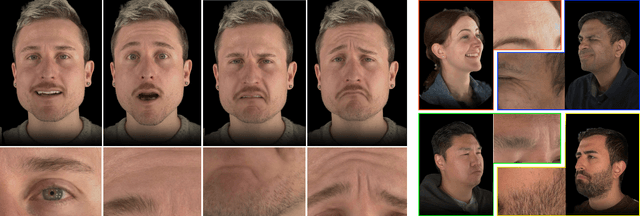
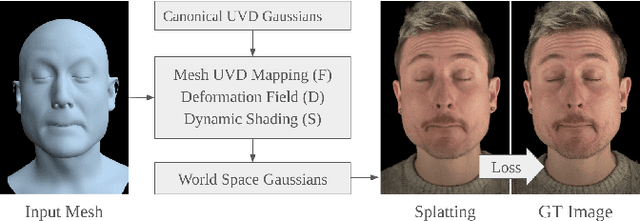
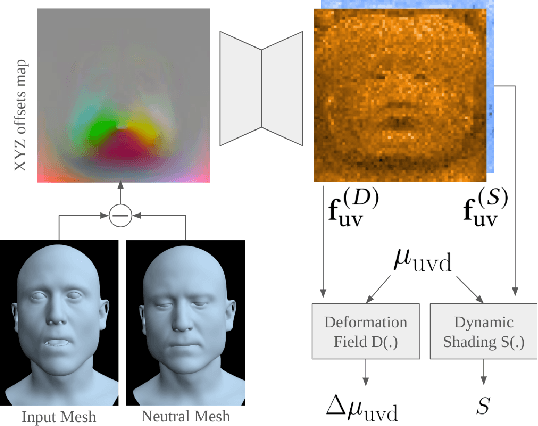

Sparse volumetric reconstruction and rendering via 3D Gaussian splatting have recently enabled animatable 3D head avatars that are rendered under arbitrary viewpoints with impressive photorealism. Today, such photoreal avatars are seen as a key component in emerging applications in telepresence, extended reality, and entertainment. Building a photoreal avatar requires estimating the complex non-rigid motion of different facial components as seen in input video images; due to inaccurate motion estimation, animatable models typically present a loss of fidelity and detail when compared to their non-animatable counterparts, built from an individual facial expression. Also, recent state-of-the-art models are often affected by memory limitations that reduce the number of 3D Gaussians used for modeling, leading to lower detail and quality. To address these problems, we present a new high-detail 3D head avatar model that improves upon the state of the art, largely increasing the number of 3D Gaussians and modeling quality for rendering at 4K resolution. Our high-quality model is reconstructed from multiview input video and builds on top of a mesh-based 3D morphable model, which provides a coarse deformation layer for the head. Photoreal appearance is modelled by 3D Gaussians embedded within the continuous UVD tangent space of this mesh, allowing for more effective densification where most needed. Additionally, these Gaussians are warped by a novel UVD deformation field to capture subtle, localized motion. Our key contribution is the novel deformable Gaussian encoding and overall fitting procedure that allows our head model to preserve appearance detail, while capturing facial motion and other transient high-frequency features such as skin wrinkling.
Pixels2Points: Fusing 2D and 3D Features for Facial Skin Segmentation
Apr 28, 2025Face registration deforms a template mesh to closely fit a 3D face scan, the quality of which commonly degrades in non-skin regions (e.g., hair, beard, accessories), because the optimized template-to-scan distance pulls the template mesh towards the noisy scan surface. Improving registration quality requires a clean separation of skin and non-skin regions on the scan mesh. Existing image-based (2D) or scan-based (3D) segmentation methods however perform poorly. Image-based segmentation outputs multi-view inconsistent masks, and they cannot account for scan inaccuracies or scan-image misalignment, while scan-based methods suffer from lower spatial resolution compared to images. In this work, we introduce a novel method that accurately separates skin from non-skin geometry on 3D human head scans. For this, our method extracts features from multi-view images using a frozen image foundation model and aggregates these features in 3D. These lifted 2D features are then fused with 3D geometric features extracted from the scan mesh, to then predict a segmentation mask directly on the scan mesh. We show that our segmentations improve the registration accuracy over pure 2D or 3D segmentation methods by 8.89% and 14.3%, respectively. Although trained only on synthetic data, our model generalizes well to real data.
Synthetic Prior for Few-Shot Drivable Head Avatar Inversion
Jan 12, 2025We present SynShot, a novel method for the few-shot inversion of a drivable head avatar based on a synthetic prior. We tackle two major challenges. First, training a controllable 3D generative network requires a large number of diverse sequences, for which pairs of images and high-quality tracked meshes are not always available. Second, state-of-the-art monocular avatar models struggle to generalize to new views and expressions, lacking a strong prior and often overfitting to a specific viewpoint distribution. Inspired by machine learning models trained solely on synthetic data, we propose a method that learns a prior model from a large dataset of synthetic heads with diverse identities, expressions, and viewpoints. With few input images, SynShot fine-tunes the pretrained synthetic prior to bridge the domain gap, modeling a photorealistic head avatar that generalizes to novel expressions and viewpoints. We model the head avatar using 3D Gaussian splatting and a convolutional encoder-decoder that outputs Gaussian parameters in UV texture space. To account for the different modeling complexities over parts of the head (e.g., skin vs hair), we embed the prior with explicit control for upsampling the number of per-part primitives. Compared to state-of-the-art monocular methods that require thousands of real training images, SynShot significantly improves novel view and expression synthesis.