 Add to Chrome
 Add to Firefox
 Add to Edge
Oxygen-TryOn: Fashion-Native Foundation Model for Any-item Virtual Try-On
Jul 23, 2026
We present Oxygen-TryOn, a unified foundation model for any-item virtual try-on. Rather than repurposing a general-purpose image editor, Oxygen-TryOn is fashion-native, built for try-on through a dedicated data engine and try-on-specific training. Given one or more reference items (clean product shots or in-the-wild worn-on photos) and a single target subject image, it synthesizes a photorealistic image of the subject wearing the items across virtually any fashion category. Prior systems handle a single garment category in a studio setting, and recent multi-reference methods remain garment-centric; in contrast, Oxygen-TryOn supports diverse items and scenarios, including full- and half-body views, a variable number of references, and free multi-item composition, while faithfully preserving both subject identity and item appearance. Instead of mask-based inpainting, we reformulate try-on as a multi-reference, understanding-driven generation task. We build a data engine that collects, manufactures, annotates, and filters high-quality try-on data at scale, and design a three-stage recipe of continued pre-training (CPT), supervised fine-tuning (SFT), and reinforcement learning (RL). The RL stage uses a hybrid reward combining an in-house try-on reward model with a proprietary, rubric-guided general-purpose model, jointly supervising fine-grained consistency and instruction-level quality. It also follows general editing instructions (e.g., pose changes) in the same pass. Across public benchmarks and our in-house Oxygen-TryOn Bench, it achieves state-of-the-art consistency and realism on single-item try-on and leads on multi-item try-on, matching or surpassing both leading proprietary systems (Nano Banana Pro, GPT-Image-2, Seedream5 Lite) and open-source models (FLUX.2).

Discrete Prior-based Temporal-coherent Content Prediction for Blind Face Video Restoration
Jan 17, 2025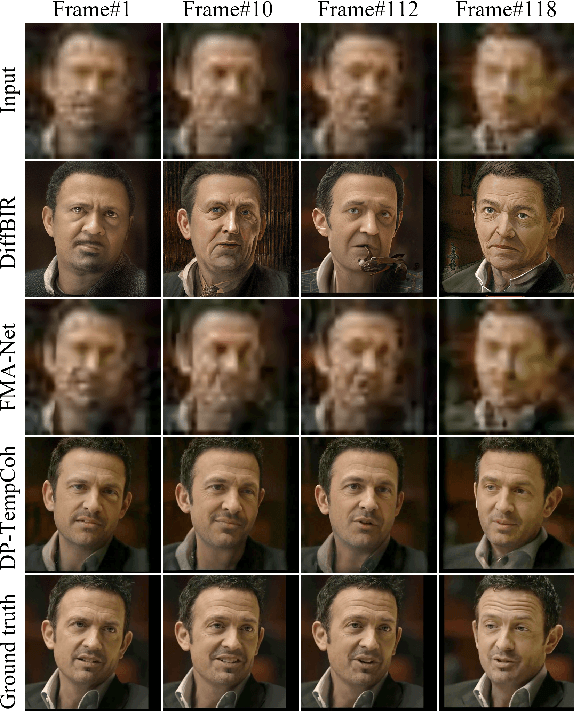
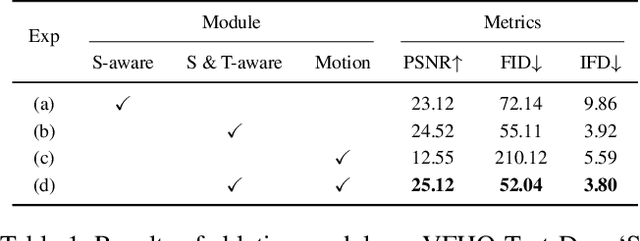
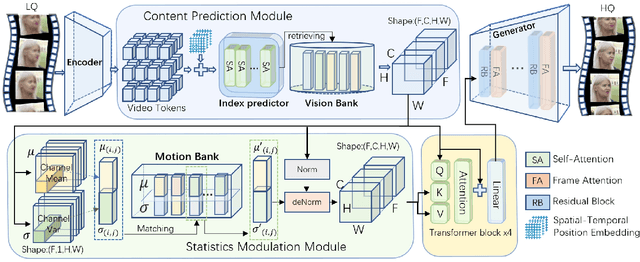
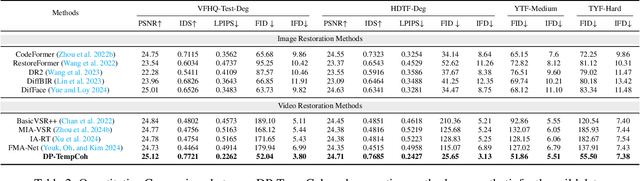
Blind face video restoration aims to restore high-fidelity details from videos subjected to complex and unknown degradations. This task poses a significant challenge of managing temporal heterogeneity while at the same time maintaining stable face attributes. In this paper, we introduce a Discrete Prior-based Temporal-Coherent content prediction transformer to address the challenge, and our model is referred to as DP-TempCoh. Specifically, we incorporate a spatial-temporal-aware content prediction module to synthesize high-quality content from discrete visual priors, conditioned on degraded video tokens. To further enhance the temporal coherence of the predicted content, a motion statistics modulation module is designed to adjust the content, based on discrete motion priors in terms of cross-frame mean and variance. As a result, the statistics of the predicted content can match with that of real videos over time. By performing extensive experiments, we verify the effectiveness of the design elements and demonstrate the superior performance of our DP-TempCoh in both synthetically and naturally degraded video restoration.