 Add to Chrome
 Add to Firefox
 Add to Edge
JoyAI-Video-Edit: Real-Time Open-Ended Video Editing with Autoregressive Diffusion
Aug 04, 2026
Real-time video editing requires low-latency causal generation with bounded computational resources while preserving source fidelity and long-term temporal consistency. We present JoyAI-Video-Edit, a 16B-parameter autoregressive diffusion framework for real-time, open-ended video editing without access to future frames or a predefined video duration. Our method combines chunk-wise autoregressive adaptation, Source-Anchored Distribution Matching Distillation (SA-DMD), and Long-Horizon Autoregressive Distillation to reduce train--inference mismatch, preserve source fidelity during two-step generation, and mitigate accumulated temporal drift. Extensive automatic and human evaluations show that JoyAI-Video-Edit substantially outperforms existing streaming editors and remains competitive with strong offline systems on both short and long videos. The complete system achieves end-to-end 720p video editing at approximately 30 FPS on a single Nvidia B200 GPU. Code is available at https://github.com/jd-opensource/JoyAI-Video-Edit.

ShotCrop$^3$: Cropping Human-Centric Images into Cinematic Triple-Shot Compositions
Jun 04, 2026Prior work on aesthetic composition typically produces a single aesthetically pleasing crop, overlooking the narrative value of composing multiple shots from one scene. In practice, multi-shot composition is critical for downstream creative workflows: commercial posters often require multiple crops with different emphases (e.g., context, subject, and emotion/product details) to present key story beats. Therefore, we propose \textbf{Triple-Shot Compositions (TSC)}, a composition task that generates a three-shot set -- establishing, medium, and close-up -- from a single human-centric image, each paired with a brief shot description to support visual narration. To learn TSC with limited expert annotations, we introduce \textbf{ShotCrop} which undergoes a three-stage training process: it first applies Chain-of-Thought supervised fine-tuning to establish basic reasoning and aesthetic shot-cropping skills, then performs semi-supervised fine-tuning with high-confidence pseudo labels to further enhance aesthetic capability, and is finally optimized with Group Relative Policy Optimization for \textbf{ShotCrop} (GRPO-S) using a composite reward tailored for it. Specifically, our pseudo-labeling strategy combines MLLM-based scoring, aesthetic assessment, and CLIP similarity to retain high-confidence training signals. In addition, we present TSC-Bench, a benchmark of 1.2k expert-annotated test cases. Notably, ShotCrop achieves an average improvement of \textbf{2.82} times over GPT-5 in shot localization accuracy.
HP-Edit: A Human-Preference Post-Training Framework for Image Editing
Apr 21, 2026Common image editing tasks typically adopt powerful generative diffusion models as the leading paradigm for real-world content editing. Meanwhile, although reinforcement learning (RL) methods such as Diffusion-DPO and Flow-GRPO have further improved generation quality, efficiently applying Reinforcement Learning from Human Feedback (RLHF) to diffusion-based editing remains largely unexplored, due to a lack of scalable human-preference datasets and frameworks tailored to diverse editing needs. To fill this gap, we propose HP-Edit, a post-training framework for Human Preference-aligned Editing, and introduce RealPref-50K, a real-world dataset across eight common tasks and balancing common object editing. Specifically, HP-Edit leverages a small amount of human-preference scoring data and a pretrained visual large language model (VLM) to develop HP-Scorer--an automatic, human preference-aligned evaluator. We then use HP-Scorer both to efficiently build a scalable preference dataset and to serve as the reward function for post-training the editing model. We also introduce RealPref-Bench, a benchmark for evaluating real-world editing performance. Extensive experiments demonstrate that our approach significantly enhances models such as Qwen-Image-Edit-2509, aligning their outputs more closely with human preference.
Reinforced Diffusion: Learning to Push the Limits of Anisotropic Diffusion for Image Denoising
Dec 30, 2025Image denoising is an important problem in low-level vision and serves as a critical module for many image recovery tasks. Anisotropic diffusion is a wide family of image denoising approaches with promising performance. However, traditional anisotropic diffusion approaches use explicit diffusion operators which are not well adapted to complex image structures. As a result, their performance is limited compared to recent learning-based approaches. In this work, we describe a trainable anisotropic diffusion framework based on reinforcement learning. By modeling the denoising process as a series of naive diffusion actions with order learned by deep Q-learning, we propose an effective diffusion-based image denoiser. The diffusion actions selected by deep Q-learning at different iterations indeed composite a stochastic anisotropic diffusion process with strong adaptivity to different image structures, which enjoys improvement over the traditional ones. The proposed denoiser is applied to removing three types of often-seen noise. The experiments show that it outperforms existing diffusion-based methods and competes with the representative deep CNN-based methods.
Towards Flexible, Scalable, and Adaptive Multi-Modal Conditioned Face Synthesis
Dec 26, 2023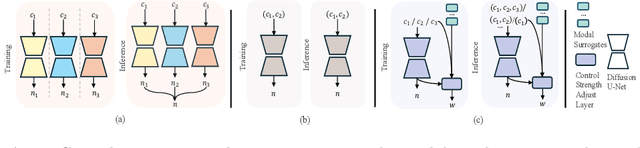

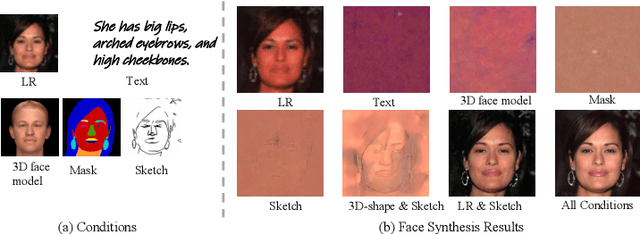
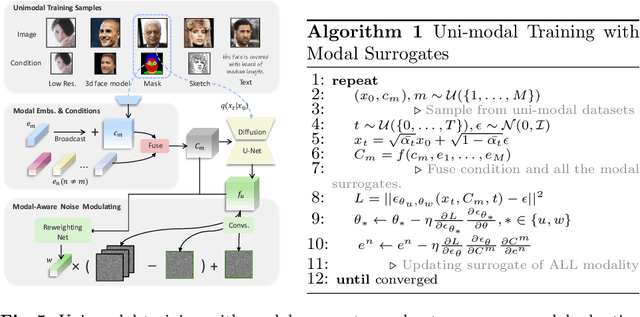
Recent progress in multi-modal conditioned face synthesis has enabled the creation of visually striking and accurately aligned facial images. Yet, current methods still face issues with scalability, limited flexibility, and a one-size-fits-all approach to control strength, not accounting for the differing levels of conditional entropy, a measure of unpredictability in data given some condition, across modalities. To address these challenges, we introduce a novel uni-modal training approach with modal surrogates, coupled with an entropy-aware modal-adaptive modulation, to support flexible, scalable, and scalable multi-modal conditioned face synthesis network. Our uni-modal training with modal surrogate that only leverage uni-modal data, use modal surrogate to decorate condition with modal-specific characteristic and serve as linker for inter-modal collaboration , fully learns each modality control in face synthesis process as well as inter-modal collaboration. The entropy-aware modal-adaptive modulation finely adjust diffusion noise according to modal-specific characteristics and given conditions, enabling well-informed step along denoising trajectory and ultimately leading to synthesis results of high fidelity and quality. Our framework improves multi-modal face synthesis under various conditions, surpassing current methods in image quality and fidelity, as demonstrated by our thorough experimental results.