 Add to Chrome
 Add to Firefox
 Add to Edge
ETAS: An Effect-Typed Language for Agent Systems
Jul 20, 2026
ETAS is a programming language for agent systems that treats model-backed agents, tool calls, prompts, typed memory, human approvals, policies, and execution traces as semantic program elements rather than library conventions. It separates deterministic computation from agentic nondeterminism and externally visible actions while preserving a direct programming style. We present the core design of ETAS. Its static semantics assigns ordinary types through spec conformance and tracks each computation with two behavioral indices: an escaping effect row and a persistent abstraction of the typed action trace it may request. Specs form a terminating compile-time constraint calculus: type specs provide evidence for polymorphism and resource facts, callable specs constrain function and stage shapes, and trace specs express allow, deny, and temporal constraints. Typing checks requested traces against compiled monitors and emits residual obligations when dynamic resources preclude a complete static proof. The dynamic semantics distinguish requested, handled, denied, and committed events; handlers interpret typed actions without making their requests invisible to authorization or audit. We formalize a core calculus and state preservation, progress, type/effect soundness, handler trace-transparency, and policy safety. We also implement ETAS in Rust with a command-line interface, typed HIR checks, effect and policy diagnostics, handler checks, and trace-aware execution hooks. ETAS provides a programming-language foundation for reasoning about authorization, nondeterminism, recovery, and audit evidence before and during agent execution.

WebGen-R1: Incentivizing Large Language Models to Generate Functional and Aesthetic Websites with Reinforcement Learning
Apr 22, 2026While Large Language Models (LLMs) excel at function-level code generation, project-level tasks such as generating functional and visually aesthetic multi-page websites remain highly challenging. Existing works are often limited to single-page static websites, while agentic frameworks typically rely on multi-turn execution with proprietary models, leading to substantial token costs, high latency, and brittle integration. Training a small LLM end-to-end with reinforcement learning (RL) is a promising alternative, yet it faces a critical bottleneck in designing reliable and computationally feasible rewards for website generation. Unlike single-file coding tasks that can be verified by unit tests, website generation requires evaluating inherently subjective aesthetics, cross-page interactions, and functional correctness. To this end, we propose WebGen-R1, an end-to-end RL framework tailored for project-level website generation. We first introduce a scaffold-driven structured generation paradigm that constrains the large open-ended action space and preserves architectural integrity. We then design a novel cascaded multimodal reward that seamlessly couples structural guarantees with execution-grounded functional feedback and vision-based aesthetic supervision. Extensive experiments demonstrate that our WebGen-R1 substantially transforms a 7B base model from generating nearly nonfunctional websites into producing deployable, aesthetically aligned multi-page websites. Remarkably, our WebGen-R1 not only consistently outperforms heavily scaled open-source models (up to 72B), but also rivals the state-of-the-art DeepSeek-R1 (671B) in functional success, while substantially exceeding it in valid rendering and aesthetic alignment. These results position WebGen-R1 as a viable path for scaling small open models from function-level code generation to project-level web application generation.
CodePivot: Bootstrapping Multilingual Transpilation in LLMs via Reinforcement Learning without Parallel Corpora
Apr 20, 2026Transpilation, or code translation, aims to convert source code from one programming language (PL) to another. It is beneficial for many downstream applications, from modernizing large legacy codebases to augmenting data for low-resource PLs. Recent large language model (LLM)-based approaches have demonstrated immense potential for code translation. Among these approaches, training-based methods are particularly important because LLMs currently do not effectively adapt to domain-specific settings that suffer from a lack of knowledge without targeted training. This limitation is evident in transpilation tasks involving low-resource PLs. However, existing training-based approaches rely on a pairwise transpilation paradigm, making it impractical to support a diverse range of PLs. This limitation is particularly prominent for low-resource PLs due to a scarcity of training data. Furthermore, these methods suffer from suboptimal reinforcement learning (RL) reward formulations. To address these limitations, we propose CodePivot, a training framework that leverages Python as an intermediate representation (IR), augmented by a novel RL reward mechanism, Aggressive-Partial-Functional reward, to bootstrap the model's multilingual transpilation ability without requiring parallel corpora. Experiments involving 10 PLs show that the resulting 7B model, trained on Python-to-Others tasks, consistently improves performance across both general and low-resource PL-related transpilation tasks. It outperforms substantially larger mainstream models with hundreds of billions more parameters, such as Deepseek-R1 and Qwen3-235B-A22B-Instruct-2507, on Python-to-Others tasks and Others-to-All tasks, respectively. In addition, it outperforms its counterpart trained directly on Any-to-Any tasks on general transpilation tasks. The code and data are available at https://github.com/lishangyu-hkust/CodePivot.
TAROT: Test-driven and Capability-adaptive Curriculum Reinforcement Fine-tuning for Code Generation with Large Language Models
Feb 17, 2026Large Language Models (LLMs) are changing the coding paradigm, known as vibe coding, yet synthesizing algorithmically sophisticated and robust code still remains a critical challenge. Incentivizing the deep reasoning capabilities of LLMs is essential to overcoming this hurdle. Reinforcement Fine-Tuning (RFT) has emerged as a promising strategy to address this need. However, most existing approaches overlook the heterogeneous difficulty and granularity inherent in test cases, leading to an imbalanced distribution of reward signals and consequently biased gradient updates during training. To address this, we propose Test-driven and cApability-adaptive cuRriculum reinfOrcement fine-Tuning (TAROT). TAROT systematically constructs, for each problem, a four-tier test suite (basic, intermediate, complex, edge), providing a controlled difficulty landscape for curriculum design and evaluation. Crucially, TAROT decouples curriculum progression from raw reward scores, enabling capability-conditioned evaluation and principled selection from a portfolio of curriculum policies rather than incidental test-case difficulty composition. This design fosters stable optimization and more efficient competency acquisition. Extensive experimental results reveal that the optimal curriculum for RFT in code generation is closely tied to a model's inherent capability, with less capable models achieving greater gains with an easy-to-hard progression, whereas more competent models excel under a hard-first curriculum. TAROT provides a reproducible method that adaptively tailors curriculum design to a model's capability, thereby consistently improving the functional correctness and robustness of the generated code. All code and data are released to foster reproducibility and advance community research at https://github.com/deep-diver/TAROT.
OSVBench: Benchmarking LLMs on Specification Generation Tasks for Operating System Verification
Apr 29, 2025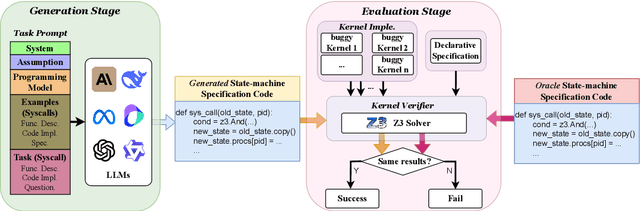
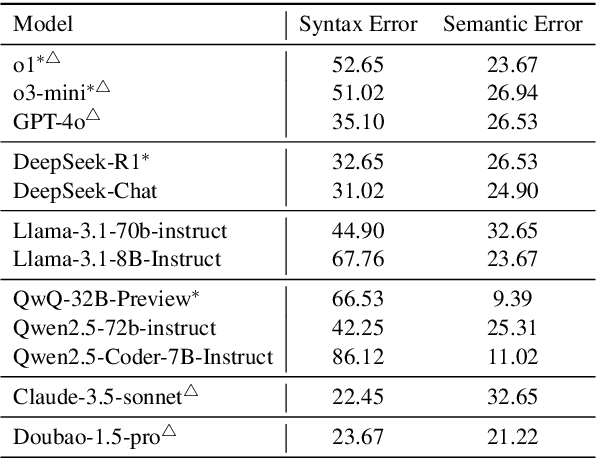
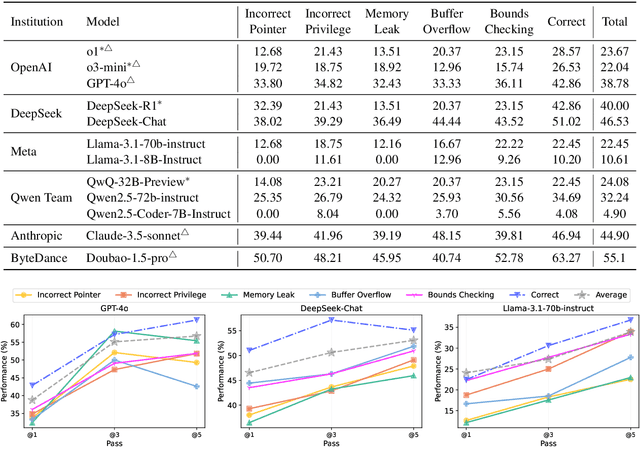
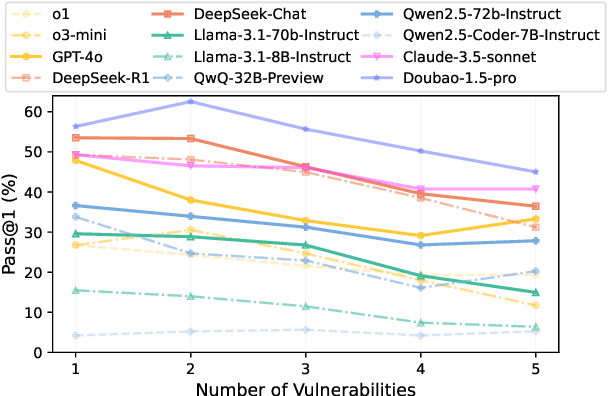
We introduce OSVBench, a new benchmark for evaluating Large Language Models (LLMs) in generating complete specification code pertaining to operating system kernel verification tasks. The benchmark first defines the specification generation problem into a program synthesis problem within a confined scope of syntax and semantics by providing LLMs with the programming model. The LLMs are required to understand the provided verification assumption and the potential syntax and semantics space to search for, then generate the complete specification for the potentially buggy operating system code implementation under the guidance of the high-level functional description of the operating system. This benchmark is built upon a real-world operating system kernel, Hyperkernel, and consists of 245 complex specification generation tasks in total, each is a long context task of about 20k-30k tokens. Our comprehensive evaluation of 12 LLMs exhibits the limited performance of the current LLMs on the specification generation tasks for operating system verification. Significant disparities in their performance on the benchmark highlight differences in their ability to handle long-context code generation tasks. The evaluation toolkit and benchmark are available at https://github.com/lishangyu-hkust/OSVBench.