 Add to Chrome
 Add to Firefox
 Add to Edge
BLSP-Emo: Towards Empathetic Large Speech-Language Models
Jun 06, 2024
The recent release of GPT-4o showcased the potential of end-to-end multimodal models, not just in terms of low latency but also in their ability to understand and generate expressive speech with rich emotions. While the details are unknown to the open research community, it likely involves significant amounts of curated data and compute, neither of which is readily accessible. In this paper, we present BLSP-Emo (Bootstrapped Language-Speech Pretraining with Emotion support), a novel approach to developing an end-to-end speech-language model capable of understanding both semantics and emotions in speech and generate empathetic responses. BLSP-Emo utilizes existing speech recognition (ASR) and speech emotion recognition (SER) datasets through a two-stage process. The first stage focuses on semantic alignment, following recent work on pretraining speech-language models using ASR data. The second stage performs emotion alignment with the pretrained speech-language model on an emotion-aware continuation task constructed from SER data. Our experiments demonstrate that the BLSP-Emo model excels in comprehending speech and delivering empathetic responses, both in instruction-following tasks and conversations.

Diver: Large Language Model Decoding with Span-Level Mutual Information Verification
Jun 04, 2024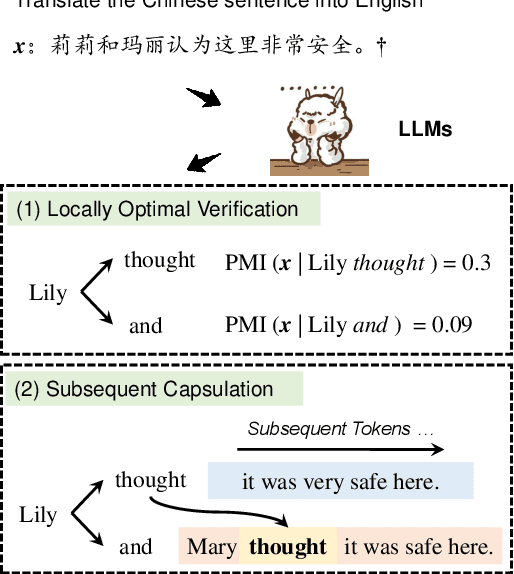
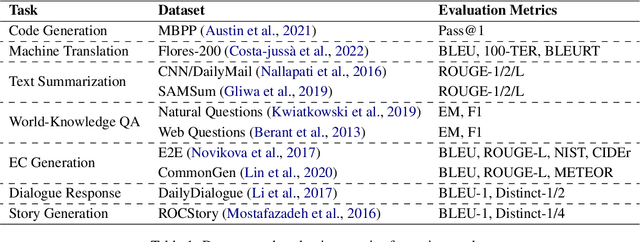
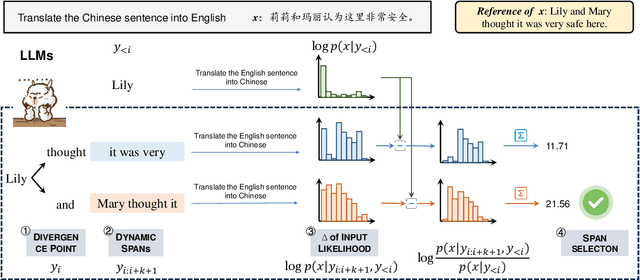
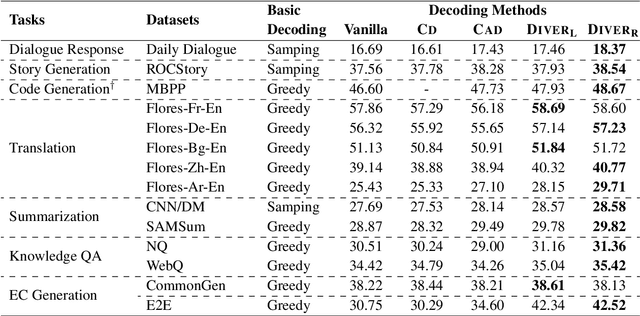
Large language models (LLMs) have shown impressive capabilities in adapting to various tasks when provided with task-specific instructions. However, LLMs using standard decoding strategies often struggle with deviations from the inputs. Intuitively, compliant LLM outputs should reflect the information present in the input, which can be measured by point-wise mutual information (PMI) scores. Therefore, we propose Diver, a novel approach that enhances LLM Decoding through span-level PMI verification. During inference, Diver first identifies divergence steps that may lead to multiple candidate spans. Subsequently, it calculates the PMI scores by assessing the log-likelihood gains of the input if the candidate spans are generated. Finally, the optimal span is selected based on the PMI re-ranked output distributions. We evaluate our method across various downstream tasks, and empirical results demonstrate that Diver significantly outperforms existing decoding methods in both performance and versatility.
GECO: Generative Image-to-3D within a SECOnd
May 30, 2024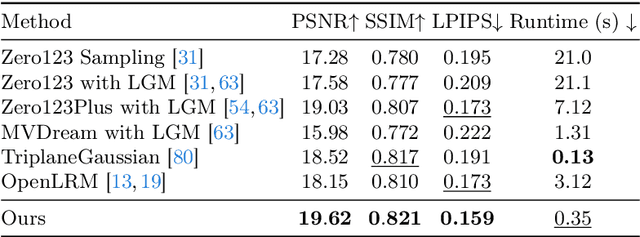
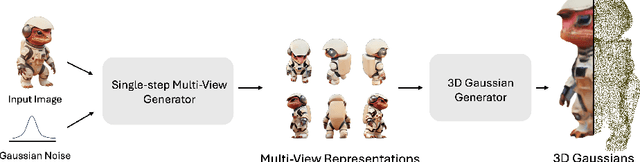
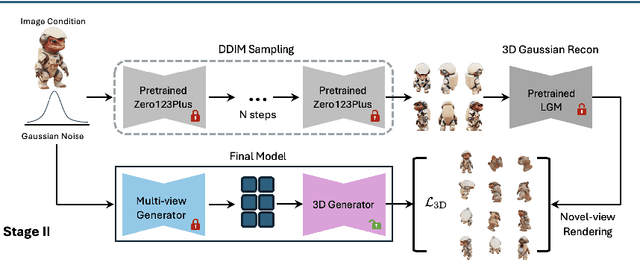
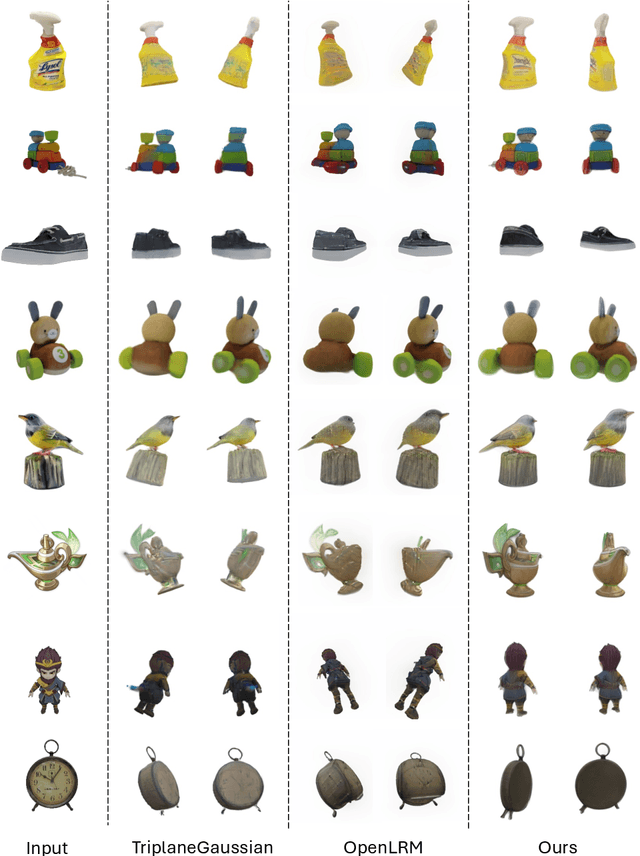
3D generation has seen remarkable progress in recent years. Existing techniques, such as score distillation methods, produce notable results but require extensive per-scene optimization, impacting time efficiency. Alternatively, reconstruction-based approaches prioritize efficiency but compromise quality due to their limited handling of uncertainty. We introduce GECO, a novel method for high-quality 3D generative modeling that operates within a second. Our approach addresses the prevalent issues of uncertainty and inefficiency in current methods through a two-stage approach. In the initial stage, we train a single-step multi-view generative model with score distillation. Then, a second-stage distillation is applied to address the challenge of view inconsistency from the multi-view prediction. This two-stage process ensures a balanced approach to 3D generation, optimizing both quality and efficiency. Our comprehensive experiments demonstrate that GECO achieves high-quality image-to-3D generation with an unprecedented level of efficiency.
BLSP-KD: Bootstrapping Language-Speech Pre-training via Knowledge Distillation
May 29, 2024Recent end-to-end approaches have shown promise in extending large language models (LLMs) to speech inputs, but face limitations in directly assessing and optimizing alignment quality and fail to achieve fine-grained alignment due to speech-text length mismatch. We introduce BLSP-KD, a novel approach for Bootstrapping Language-Speech Pretraining via Knowledge Distillation, which addresses these limitations through two key techniques. First, it optimizes speech-text alignment by minimizing the divergence between the LLM's next-token prediction distributions for speech and text inputs using knowledge distillation. Second, it employs a continuous-integrate-andfire strategy to segment speech into tokens that correspond one-to-one with text tokens, enabling fine-grained alignment. We also introduce Partial LoRA (PLoRA), a new adaptation method supporting LLM finetuning for speech inputs under knowledge distillation. Quantitative evaluation shows that BLSP-KD outperforms previous end-to-end baselines and cascaded systems with comparable scale of parameters, facilitating general instruction-following capabilities for LLMs with speech inputs. This approach provides new possibilities for extending LLMs to spoken language interactions.
TRANSIC: Sim-to-Real Policy Transfer by Learning from Online Correction
May 16, 2024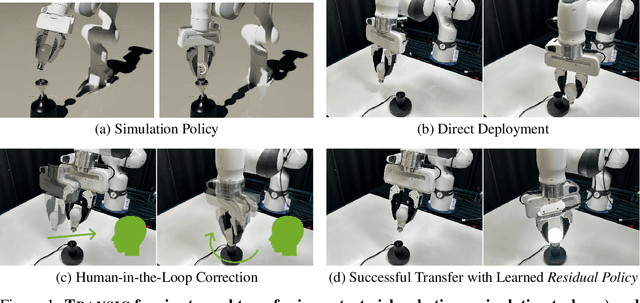

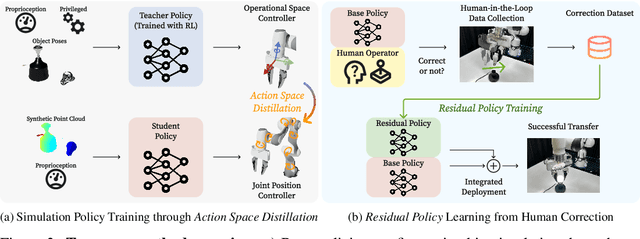
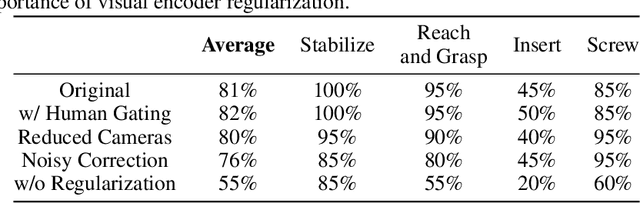
Learning in simulation and transferring the learned policy to the real world has the potential to enable generalist robots. The key challenge of this approach is to address simulation-to-reality (sim-to-real) gaps. Previous methods often require domain-specific knowledge a priori. We argue that a straightforward way to obtain such knowledge is by asking humans to observe and assist robot policy execution in the real world. The robots can then learn from humans to close various sim-to-real gaps. We propose TRANSIC, a data-driven approach to enable successful sim-to-real transfer based on a human-in-the-loop framework. TRANSIC allows humans to augment simulation policies to overcome various unmodeled sim-to-real gaps holistically through intervention and online correction. Residual policies can be learned from human corrections and integrated with simulation policies for autonomous execution. We show that our approach can achieve successful sim-to-real transfer in complex and contact-rich manipulation tasks such as furniture assembly. Through synergistic integration of policies learned in simulation and from humans, TRANSIC is effective as a holistic approach to addressing various, often coexisting sim-to-real gaps. It displays attractive properties such as scaling with human effort. Videos and code are available at https://transic-robot.github.io/
iMTSP: Solving Min-Max Multiple Traveling Salesman Problem with Imperative Learning
May 01, 2024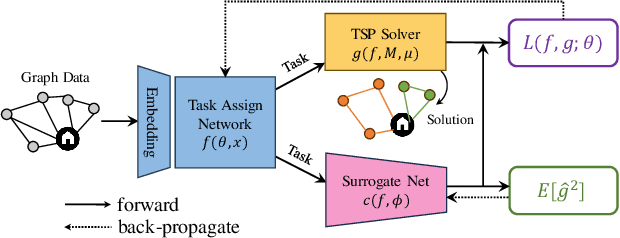
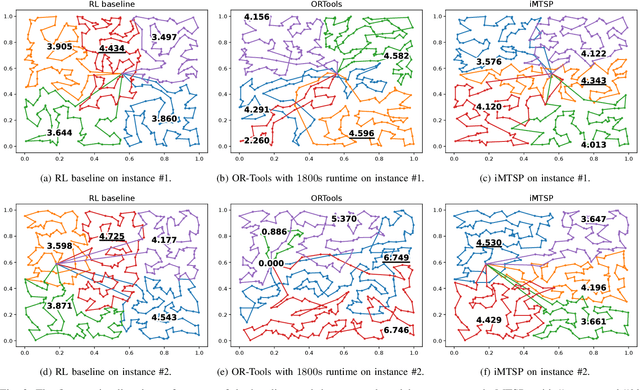
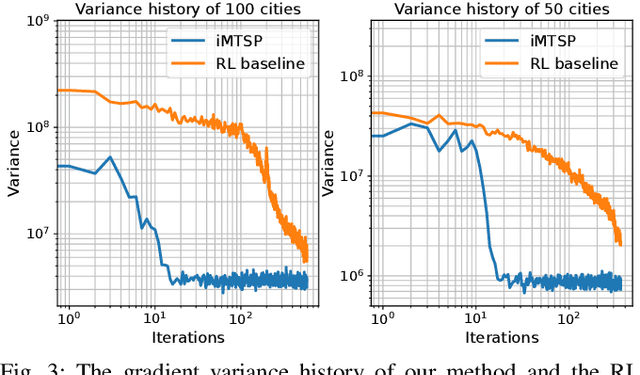
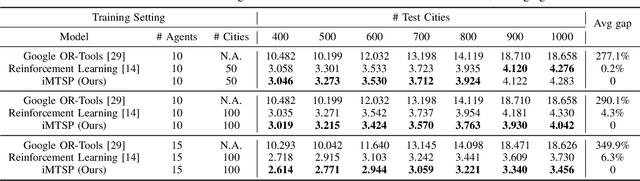
This paper considers a Min-Max Multiple Traveling Salesman Problem (MTSP), where the goal is to find a set of tours, one for each agent, to collectively visit all the cities while minimizing the length of the longest tour. Though MTSP has been widely studied, obtaining near-optimal solutions for large-scale problems is still challenging due to its NP-hardness. Recent efforts in data-driven methods face challenges of the need for hard-to-obtain supervision and issues with high variance in gradient estimations, leading to slow convergence and highly suboptimal solutions. We address these issues by reformulating MTSP as a bilevel optimization problem, using the concept of imperative learning (IL). This involves introducing an allocation network that decomposes the MTSP into multiple single-agent traveling salesman problems (TSPs). The longest tour from these TSP solutions is then used to self-supervise the allocation network, resulting in a new self-supervised, bilevel, end-to-end learning framework, which we refer to as imperative MTSP (iMTSP). Additionally, to tackle the high-variance gradient issues during the optimization, we introduce a control variate-based gradient estimation algorithm. Our experiments showed that these innovative designs enable our gradient estimator to converge 20% faster than the advanced reinforcement learning baseline and find up to 80% shorter tour length compared with Google OR-Tools MTSP solver, especially in large-scale problems (e.g. 1000 cities and 15 agents).
GeoReF: Geometric Alignment Across Shape Variation for Category-level Object Pose Refinement
Apr 17, 2024Object pose refinement is essential for robust object pose estimation. Previous work has made significant progress towards instance-level object pose refinement. Yet, category-level pose refinement is a more challenging problem due to large shape variations within a category and the discrepancies between the target object and the shape prior. To address these challenges, we introduce a novel architecture for category-level object pose refinement. Our approach integrates an HS-layer and learnable affine transformations, which aims to enhance the extraction and alignment of geometric information. Additionally, we introduce a cross-cloud transformation mechanism that efficiently merges diverse data sources. Finally, we push the limits of our model by incorporating the shape prior information for translation and size error prediction. We conducted extensive experiments to demonstrate the effectiveness of the proposed framework. Through extensive quantitative experiments, we demonstrate significant improvement over the baseline method by a large margin across all metrics.
Efficient Interactive LLM Serving with Proxy Model-based Sequence Length Prediction
Apr 12, 2024Large language models (LLMs) have been driving a new wave of interactive AI applications across numerous domains. However, efficiently serving LLM inference requests is challenging due to their unpredictable execution times originating from the autoregressive nature of generative models. Existing LLM serving systems exploit first-come-first-serve (FCFS) scheduling, suffering from head-of-line blocking issues. To address the non-deterministic nature of LLMs and enable efficient interactive LLM serving, we present a speculative shortest-job-first (SSJF) scheduler that uses a light proxy model to predict LLM output sequence lengths. Our open-source SSJF implementation does not require changes to memory management or batching strategies. Evaluations on real-world datasets and production workload traces show that SSJF reduces average job completion times by 30.5-39.6% and increases throughput by 2.2-3.6x compared to FCFS schedulers, across no batching, dynamic batching, and continuous batching settings.
AirShot: Efficient Few-Shot Detection for Autonomous Exploration
Apr 07, 2024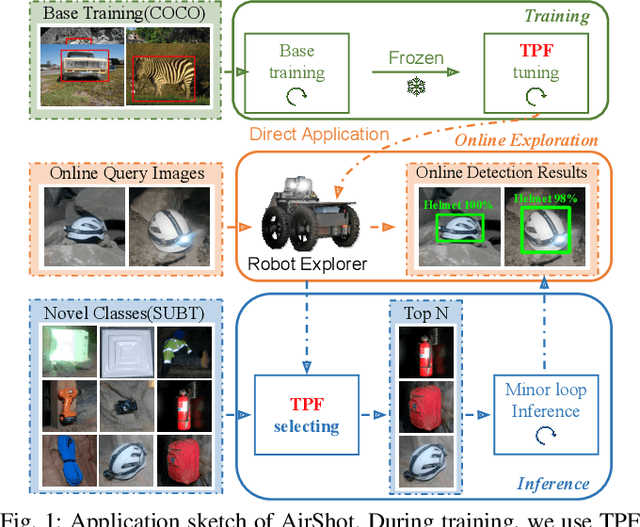
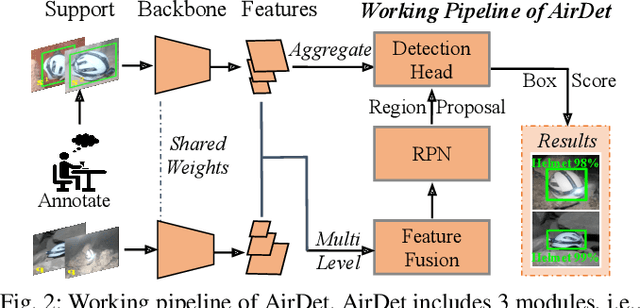
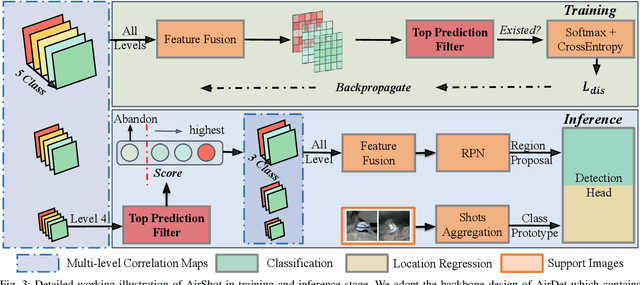
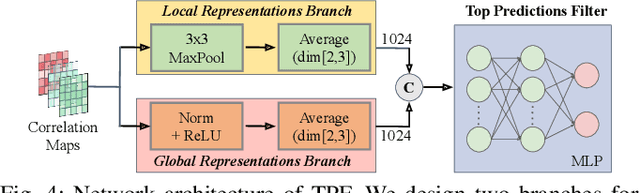
Few-shot object detection has drawn increasing attention in the field of robotic exploration, where robots are required to find unseen objects with a few online provided examples. Despite recent efforts have been made to yield online processing capabilities, slow inference speeds of low-powered robots fail to meet the demands of real-time detection-making them impractical for autonomous exploration. Existing methods still face performance and efficiency challenges, mainly due to unreliable features and exhaustive class loops. In this work, we propose a new paradigm AirShot, and discover that, by fully exploiting the valuable correlation map, AirShot can result in a more robust and faster few-shot object detection system, which is more applicable to robotics community. The core module Top Prediction Filter (TPF) can operate on multi-scale correlation maps in both the training and inference stages. During training, TPF supervises the generation of a more representative correlation map, while during inference, it reduces looping iterations by selecting top-ranked classes, thus cutting down on computational costs with better performance. Surprisingly, this dual functionality exhibits general effectiveness and efficiency on various off-the-shelf models. Exhaustive experiments on COCO2017, VOC2014, and SubT datasets demonstrate that TPF can significantly boost the efficacy and efficiency of most off-the-shelf models, achieving up to 36.4% precision improvements along with 56.3% faster inference speed. Code and Data are at: https://github.com/ImNotPrepared/AirShot.
Salient Sparse Visual Odometry With Pose-Only Supervision
Apr 06, 2024Visual Odometry (VO) is vital for the navigation of autonomous systems, providing accurate position and orientation estimates at reasonable costs. While traditional VO methods excel in some conditions, they struggle with challenges like variable lighting and motion blur. Deep learning-based VO, though more adaptable, can face generalization problems in new environments. Addressing these drawbacks, this paper presents a novel hybrid visual odometry (VO) framework that leverages pose-only supervision, offering a balanced solution between robustness and the need for extensive labeling. We propose two cost-effective and innovative designs: a self-supervised homographic pre-training for enhancing optical flow learning from pose-only labels and a random patch-based salient point detection strategy for more accurate optical flow patch extraction. These designs eliminate the need for dense optical flow labels for training and significantly improve the generalization capability of the system in diverse and challenging environments. Our pose-only supervised method achieves competitive performance on standard datasets and greater robustness and generalization ability in extreme and unseen scenarios, even compared to dense optical flow-supervised state-of-the-art methods.