 Add to Chrome
 Add to Firefox
 Add to Edge
PDP: Physics-Based Character Animation via Diffusion Policy
Jun 03, 2024
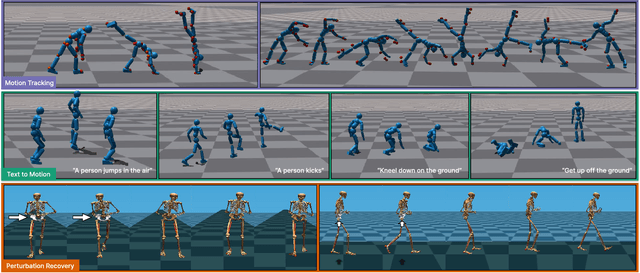

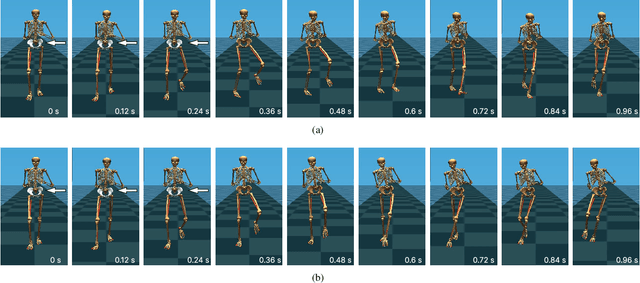

Generating diverse and realistic human motion that can physically interact with an environment remains a challenging research area in character animation. Meanwhile, diffusion-based methods, as proposed by the robotics community, have demonstrated the ability to capture highly diverse and multi-modal skills. However, naively training a diffusion policy often results in unstable motions for high-frequency, under-actuated control tasks like bipedal locomotion due to rapidly accumulating compounding errors, pushing the agent away from optimal training trajectories. The key idea lies in using RL policies not just for providing optimal trajectories but for providing corrective actions in sub-optimal states, giving the policy a chance to correct for errors caused by environmental stimulus, model errors, or numerical errors in simulation. Our method, Physics-Based Character Animation via Diffusion Policy (PDP), combines reinforcement learning (RL) and behavior cloning (BC) to create a robust diffusion policy for physics-based character animation. We demonstrate PDP on perturbation recovery, universal motion tracking, and physics-based text-to-motion synthesis.

SpringGrasp: Synthesizing Compliant, Dexterous Grasps under Shape Uncertainty
Apr 25, 2024Generating stable and robust grasps on arbitrary objects is critical for dexterous robotic hands, marking a significant step towards advanced dexterous manipulation. Previous studies have mostly focused on improving differentiable grasping metrics with the assumption of precisely known object geometry. However, shape uncertainty is ubiquitous due to noisy and partial shape observations, which introduce challenges in grasp planning. We propose, SpringGrasp planner, a planner that considers uncertain observations of the object surface for synthesizing compliant dexterous grasps. A compliant dexterous grasp could minimize the effect of unexpected contact with the object, leading to more stable grasp with shape-uncertain objects. We introduce an analytical and differentiable metric, SpringGrasp metric, that evaluates the dynamic behavior of the entire compliant grasping process. Planning with SpringGrasp planner, our method achieves a grasp success rate of 89% from two viewpoints and 84% from a single viewpoints in experiment with a real robot on 14 common objects. Compared with a force-closure based planner, our method achieves at least 18% higher grasp success rate.
One-Shot Transfer of Long-Horizon Extrinsic Manipulation Through Contact Retargeting
Apr 11, 2024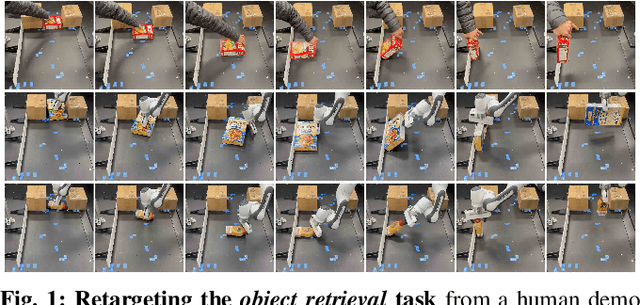
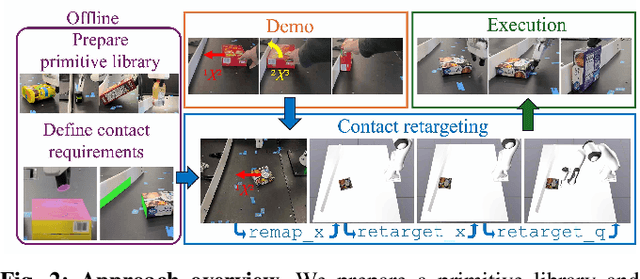
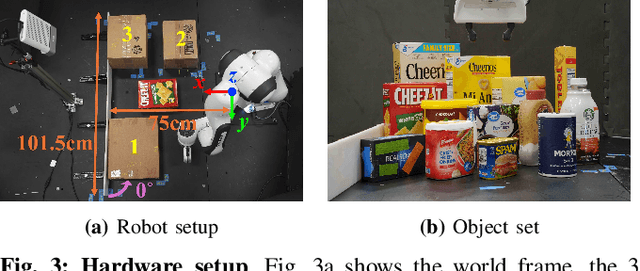
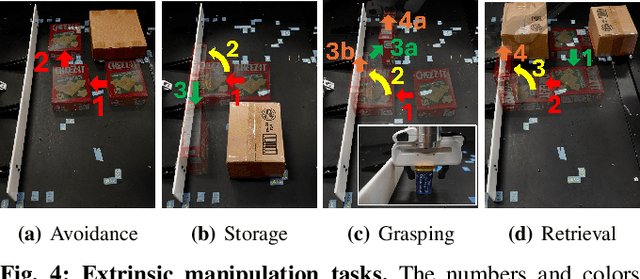
Extrinsic manipulation, the use of environment contacts to achieve manipulation objectives, enables strategies that are otherwise impossible with a parallel jaw gripper. However, orchestrating a long-horizon sequence of contact interactions between the robot, object, and environment is notoriously challenging due to the scene diversity, large action space, and difficult contact dynamics. We observe that most extrinsic manipulation are combinations of short-horizon primitives, each of which depend strongly on initializing from a desirable contact configuration to succeed. Therefore, we propose to generalize one extrinsic manipulation trajectory to diverse objects and environments by retargeting contact requirements. We prepare a single library of robust short-horizon, goal-conditioned primitive policies, and design a framework to compose state constraints stemming from contacts specifications of each primitive. Given a test scene and a single demo prescribing the primitive sequence, our method enforces the state constraints on the test scene and find intermediate goal states using inverse kinematics. The goals are then tracked by the primitive policies. Using a 7+1 DoF robotic arm-gripper system, we achieved an overall success rate of 80.5% on hardware over 4 long-horizon extrinsic manipulation tasks, each with up to 4 primitives. Our experiments cover 10 objects and 6 environment configurations. We further show empirically that our method admits a wide range of demonstrations, and that contact retargeting is indeed the key to successfully combining primitives for long-horizon extrinsic manipulation. Code and additional details are available at stanford-tml.github.io/extrinsic-manipulation.
Egocentric Scene-aware Human Trajectory Prediction
Mar 30, 2024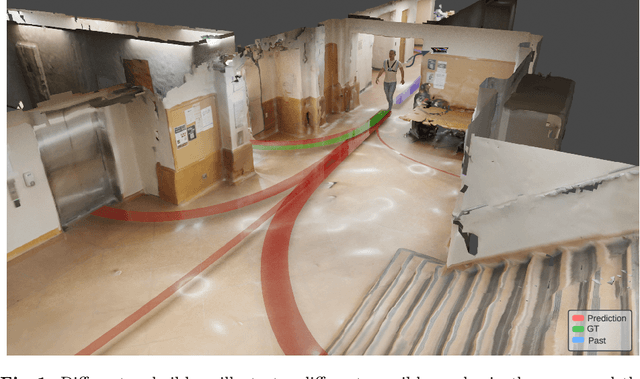
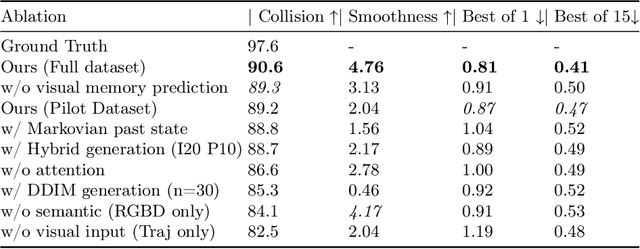
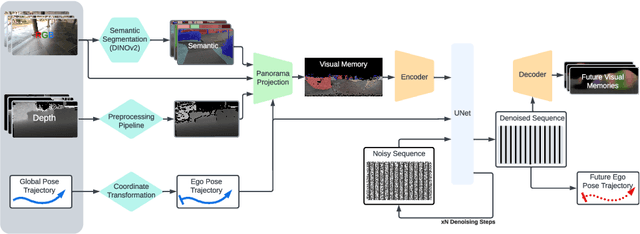

Wearable collaborative robots stand to assist human wearers who need fall prevention assistance or wear exoskeletons. Such a robot needs to be able to predict the ego motion of the wearer based on egocentric vision and the surrounding scene. In this work, we leveraged body-mounted cameras and sensors to anticipate the trajectory of human wearers through complex surroundings. To facilitate research in ego-motion prediction, we have collected a comprehensive walking scene navigation dataset centered on the user's perspective. We present a method to predict human motion conditioning on the surrounding static scene. Our method leverages a diffusion model to produce a distribution of potential future trajectories, taking into account the user's observation of the environment. We introduce a compact representation to encode the user's visual memory of the surroundings, as well as an efficient sample-generating technique to speed up real-time inference of a diffusion model. We ablate our model and compare it to baselines, and results show that our model outperforms existing methods on key metrics of collision avoidance and trajectory mode coverage.
BEHAVIOR-1K: A Human-Centered, Embodied AI Benchmark with 1,000 Everyday Activities and Realistic Simulation
Mar 14, 2024


We present BEHAVIOR-1K, a comprehensive simulation benchmark for human-centered robotics. BEHAVIOR-1K includes two components, guided and motivated by the results of an extensive survey on "what do you want robots to do for you?". The first is the definition of 1,000 everyday activities, grounded in 50 scenes (houses, gardens, restaurants, offices, etc.) with more than 9,000 objects annotated with rich physical and semantic properties. The second is OMNIGIBSON, a novel simulation environment that supports these activities via realistic physics simulation and rendering of rigid bodies, deformable bodies, and liquids. Our experiments indicate that the activities in BEHAVIOR-1K are long-horizon and dependent on complex manipulation skills, both of which remain a challenge for even state-of-the-art robot learning solutions. To calibrate the simulation-to-reality gap of BEHAVIOR-1K, we provide an initial study on transferring solutions learned with a mobile manipulator in a simulated apartment to its real-world counterpart. We hope that BEHAVIOR-1K's human-grounded nature, diversity, and realism make it valuable for embodied AI and robot learning research. Project website: https://behavior.stanford.edu.
DexCap: Scalable and Portable Mocap Data Collection System for Dexterous Manipulation
Mar 12, 2024Imitation learning from human hand motion data presents a promising avenue for imbuing robots with human-like dexterity in real-world manipulation tasks. Despite this potential, substantial challenges persist, particularly with the portability of existing hand motion capture (mocap) systems and the difficulty of translating mocap data into effective control policies. To tackle these issues, we introduce DexCap, a portable hand motion capture system, alongside DexIL, a novel imitation algorithm for training dexterous robot skills directly from human hand mocap data. DexCap offers precise, occlusion-resistant tracking of wrist and finger motions based on SLAM and electromagnetic field together with 3D observations of the environment. Utilizing this rich dataset, DexIL employs inverse kinematics and point cloud-based imitation learning to replicate human actions with robot hands. Beyond learning from human motion, DexCap also offers an optional human-in-the-loop correction mechanism to refine and further improve robot performance. Through extensive evaluation across six dexterous manipulation tasks, our approach not only demonstrates superior performance but also showcases the system's capability to effectively learn from in-the-wild mocap data, paving the way for future data collection methods for dexterous manipulation. More details can be found at https://dex-cap.github.io
Iterative Motion Editing with Natural Language
Dec 15, 2023


Text-to-motion diffusion models can generate realistic animations from text prompts, but do not support fine-grained motion editing controls. In this paper we present a method for using natural language to iteratively specify local edits to existing character animations, a task that is common in most computer animation workflows. Our key idea is to represent a space of motion edits using a set of kinematic motion operators that have well-defined semantics for how to modify specific frames of a target motion. We provide an algorithm that leverages pre-existing language models to translate textual descriptions of motion edits to sequences of motion editing operators (MEOs). Given new keyframes produced by the MEOs, we use diffusion-based keyframe interpolation to generate final motions. Through a user study and quantitative evaluation, we demonstrate that our system can perform motion edits that respect the animator's editing intent, remain faithful to the original animation (they edit the original animation, not dramatically change it), and yield realistic character animation results.
Controllable Human-Object Interaction Synthesis
Dec 06, 2023
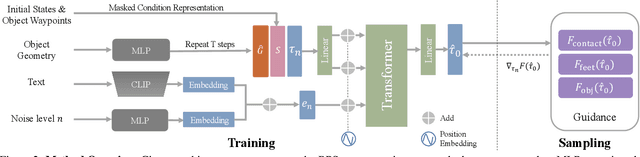

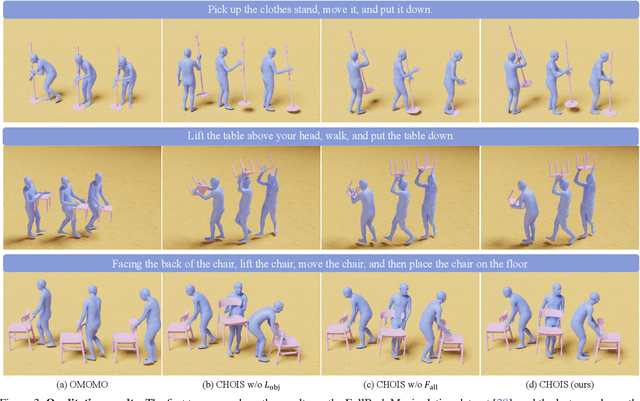
Synthesizing semantic-aware, long-horizon, human-object interaction is critical to simulate realistic human behaviors. In this work, we address the challenging problem of generating synchronized object motion and human motion guided by language descriptions in 3D scenes. We propose Controllable Human-Object Interaction Synthesis (CHOIS), an approach that generates object motion and human motion simultaneously using a conditional diffusion model given a language description, initial object and human states, and sparse object waypoints. While language descriptions inform style and intent, waypoints ground the motion in the scene and can be effectively extracted using high-level planning methods. Naively applying a diffusion model fails to predict object motion aligned with the input waypoints and cannot ensure the realism of interactions that require precise hand-object contact and appropriate contact grounded by the floor. To overcome these problems, we introduce an object geometry loss as additional supervision to improve the matching between generated object motion and input object waypoints. In addition, we design guidance terms to enforce contact constraints during the sampling process of the trained diffusion model.
Learning to Design and Use Tools for Robotic Manipulation
Nov 01, 2023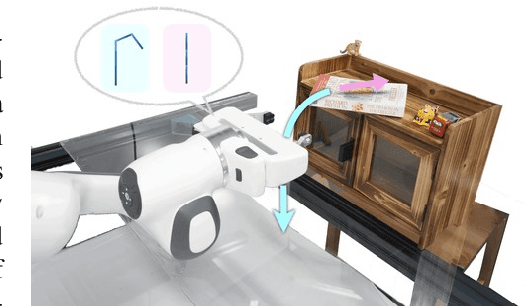
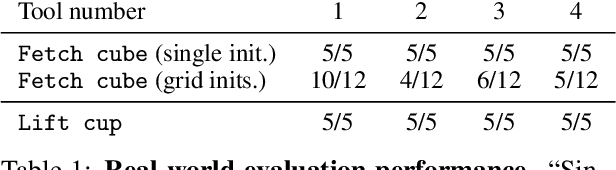
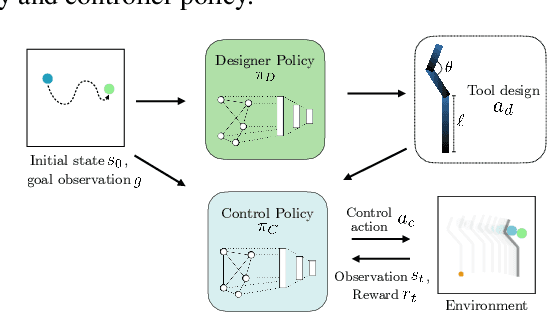

When limited by their own morphologies, humans and some species of animals have the remarkable ability to use objects from the environment toward accomplishing otherwise impossible tasks. Robots might similarly unlock a range of additional capabilities through tool use. Recent techniques for jointly optimizing morphology and control via deep learning are effective at designing locomotion agents. But while outputting a single morphology makes sense for locomotion, manipulation involves a variety of strategies depending on the task goals at hand. A manipulation agent must be capable of rapidly prototyping specialized tools for different goals. Therefore, we propose learning a designer policy, rather than a single design. A designer policy is conditioned on task information and outputs a tool design that helps solve the task. A design-conditioned controller policy can then perform manipulation using these tools. In this work, we take a step towards this goal by introducing a reinforcement learning framework for jointly learning these policies. Through simulated manipulation tasks, we show that this framework is more sample efficient than prior methods in multi-goal or multi-variant settings, can perform zero-shot interpolation or fine-tuning to tackle previously unseen goals, and allows tradeoffs between the complexity of design and control policies under practical constraints. Finally, we deploy our learned policies onto a real robot. Please see our supplementary video and website at https://robotic-tool-design.github.io/ for visualizations.
State of the Art on Diffusion Models for Visual Computing
Oct 11, 2023The field of visual computing is rapidly advancing due to the emergence of generative artificial intelligence (AI), which unlocks unprecedented capabilities for the generation, editing, and reconstruction of images, videos, and 3D scenes. In these domains, diffusion models are the generative AI architecture of choice. Within the last year alone, the literature on diffusion-based tools and applications has seen exponential growth and relevant papers are published across the computer graphics, computer vision, and AI communities with new works appearing daily on arXiv. This rapid growth of the field makes it difficult to keep up with all recent developments. The goal of this state-of-the-art report (STAR) is to introduce the basic mathematical concepts of diffusion models, implementation details and design choices of the popular Stable Diffusion model, as well as overview important aspects of these generative AI tools, including personalization, conditioning, inversion, among others. Moreover, we give a comprehensive overview of the rapidly growing literature on diffusion-based generation and editing, categorized by the type of generated medium, including 2D images, videos, 3D objects, locomotion, and 4D scenes. Finally, we discuss available datasets, metrics, open challenges, and social implications. This STAR provides an intuitive starting point to explore this exciting topic for researchers, artists, and practitioners alike.