 Add to Chrome
 Add to Firefox
 Add to Edge
Cloak: Zero-Shot Cross-Embodiment Manipulation by Masking the End-Effector from the VLA
Jun 22, 2026
We present Cloak, a training recipe that endows a Vision-Language-Action (VLA) model with zero-shot cross-embodiment transfer by cloaking the end-effector from its own wrist camera. The end-effector occupies a large and consistent region of the wrist view and masking it allows for embodiment-agnostic visual reasoning. Cloak renders a mask in simulation from the robot's known geometry, accurately and in real time, with no segmentation or generative models. During training, we augment the mask so the model generalizes to embodiments unseen at training time. We demonstrate the recipe with Cloak-VLA, a VLA trained with Cloak on a single parallel-jaw gripper dataset. No data of new embodiments is ever collected. Cloak-VLA transfers zero-shot to various unseen embodiments, including another gripper, another arm, and a five-fingered hand, while preserving the source embodiment's performance. By decoupling the wrist view from its own embodiment, Cloak allows data to outlive the hardware it was collected on.

GentleHumanoid: Learning Upper-body Compliance for Contact-rich Human and Object Interaction
Nov 06, 2025Humanoid robots are expected to operate in human-centered environments where safe and natural physical interaction is essential. However, most recent reinforcement learning (RL) policies emphasize rigid tracking and suppress external forces. Existing impedance-augmented approaches are typically restricted to base or end-effector control and focus on resisting extreme forces rather than enabling compliance. We introduce GentleHumanoid, a framework that integrates impedance control into a whole-body motion tracking policy to achieve upper-body compliance. At its core is a unified spring-based formulation that models both resistive contacts (restoring forces when pressing against surfaces) and guiding contacts (pushes or pulls sampled from human motion data). This formulation ensures kinematically consistent forces across the shoulder, elbow, and wrist, while exposing the policy to diverse interaction scenarios. Safety is further supported through task-adjustable force thresholds. We evaluate our approach in both simulation and on the Unitree G1 humanoid across tasks requiring different levels of compliance, including gentle hugging, sit-to-stand assistance, and safe object manipulation. Compared to baselines, our policy consistently reduces peak contact forces while maintaining task success, resulting in smoother and more natural interactions. These results highlight a step toward humanoid robots that can safely and effectively collaborate with humans and handle objects in real-world environments.
PDP: Physics-Based Character Animation via Diffusion Policy
Jun 03, 2024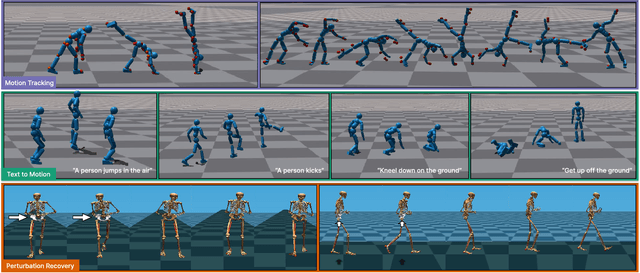

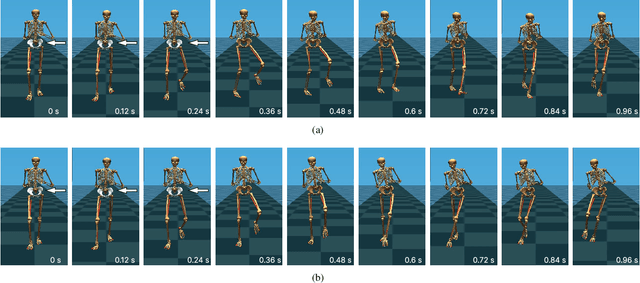

Generating diverse and realistic human motion that can physically interact with an environment remains a challenging research area in character animation. Meanwhile, diffusion-based methods, as proposed by the robotics community, have demonstrated the ability to capture highly diverse and multi-modal skills. However, naively training a diffusion policy often results in unstable motions for high-frequency, under-actuated control tasks like bipedal locomotion due to rapidly accumulating compounding errors, pushing the agent away from optimal training trajectories. The key idea lies in using RL policies not just for providing optimal trajectories but for providing corrective actions in sub-optimal states, giving the policy a chance to correct for errors caused by environmental stimulus, model errors, or numerical errors in simulation. Our method, Physics-Based Character Animation via Diffusion Policy (PDP), combines reinforcement learning (RL) and behavior cloning (BC) to create a robust diffusion policy for physics-based character animation. We demonstrate PDP on perturbation recovery, universal motion tracking, and physics-based text-to-motion synthesis.