 Add to Chrome
 Add to Firefox
 Add to Edge
MSA-UNet3+: Multi-Scale Attention UNet3+ with New Supervised Prototypical Contrastive Loss for Coronary DSA Image Segmentation
Apr 07, 2025
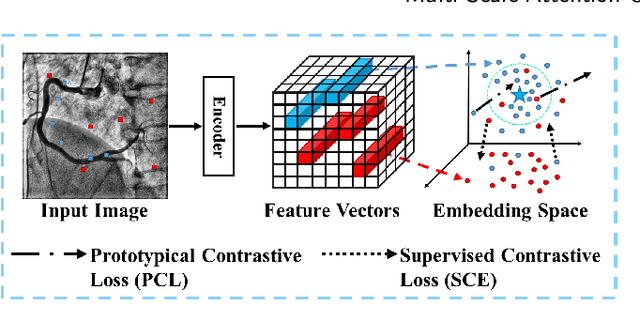
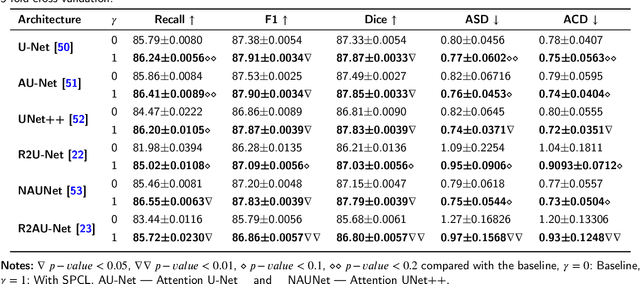
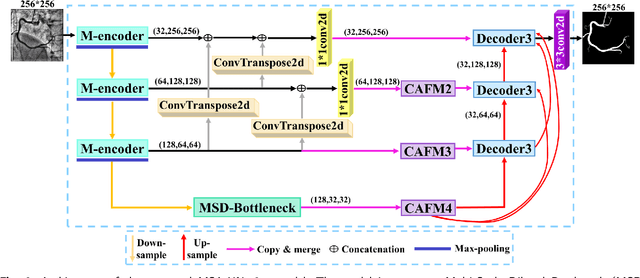
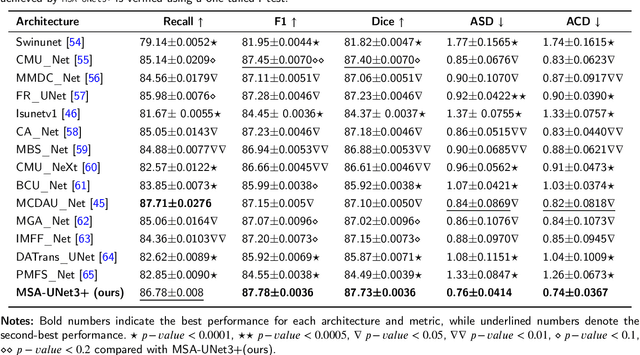
The accurate segmentation of coronary Digital Subtraction Angiography (DSA) images is essential for diagnosing and treating coronary artery diseases. Despite advances in deep learning-based segmentation, challenges such as low contrast, noise, overlapping structures, high intra-class variance, and class imbalance limit precise vessel delineation. To overcome these limitations, we propose the MSA-UNet3+: a Multi-Scale Attention enhanced UNet3+ architecture for coronary DSA image segmentation. The framework combined Multi-Scale Dilated Bottleneck (MSD-Bottleneck) with Contextual Attention Fusion Module (CAFM), which not only enhances multi-scale feature extraction but also preserve fine-grained details, and improve contextual understanding. Furthermore, we propose a new Supervised Prototypical Contrastive Loss (SPCL), which combines supervised and prototypical contrastive learning to minimize class imbalance and high intra-class variance by focusing on hard-to-classified background samples. Experiments carried out on a private coronary DSA dataset demonstrate that MSA-UNet3+ outperforms state-of-the-art methods, achieving a Dice coefficient of 87.73%, an F1-score of 87.78%, and significantly reduced Average Surface Distance (ASD) and Average Contour Distance (ACD). The developed framework provides clinicians with precise vessel segmentation, enabling accurate identification of coronary stenosis and supporting informed diagnostic and therapeutic decisions. The code will be released at the following GitHub profile link https://github.com/rayanmerghani/MSA-UNet3plus.

Instruction-Aligned Visual Attention for Mitigating Hallucinations in Large Vision-Language Models
Mar 24, 2025Despite the significant success of Large Vision-Language models(LVLMs), these models still suffer hallucinations when describing images, generating answers that include non-existent objects. It is reported that these models tend to over-focus on certain irrelevant image tokens that do not contain critical information for answering the question and distort the output. To address this, we propose an Instruction-Aligned Visual Attention(IAVA) approach, which identifies irrelevant tokens by comparing changes in attention weights under two different instructions. By applying contrastive decoding, we dynamically adjust the logits generated from original image tokens and irrelevant image tokens, reducing the model's over-attention to irrelevant information. The experimental results demonstrate that IAVA consistently outperforms existing decoding techniques on benchmarks such as MME, POPE, and TextVQA in mitigating object hallucinations. Our IAVA approach is available online at https://github.com/Lee-lab558/IAVA.
Multi-modal Multi-platform Person Re-Identification: Benchmark and Method
Mar 21, 2025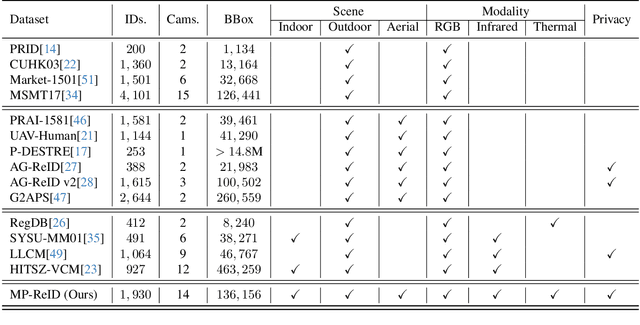
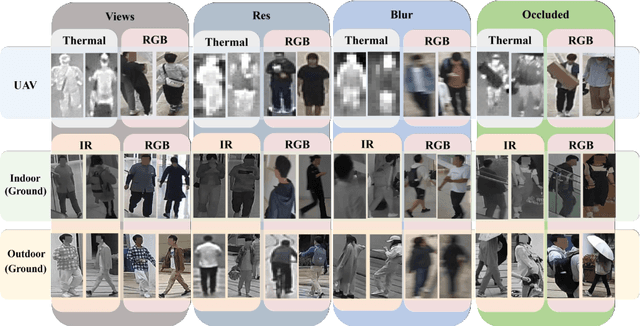
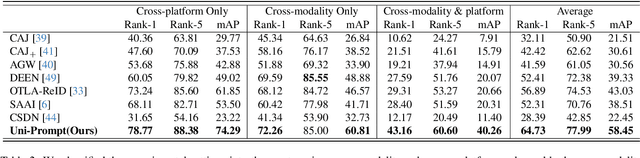
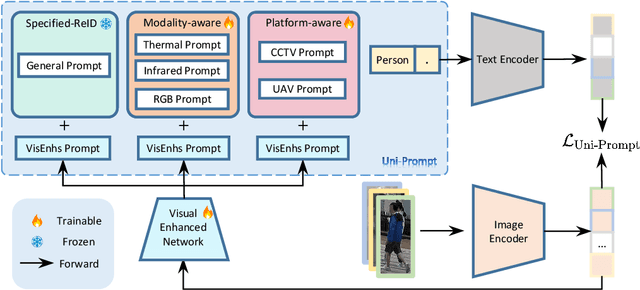
Conventional person re-identification (ReID) research is often limited to single-modality sensor data from static cameras, which fails to address the complexities of real-world scenarios where multi-modal signals are increasingly prevalent. For instance, consider an urban ReID system integrating stationary RGB cameras, nighttime infrared sensors, and UAVs equipped with dynamic tracking capabilities. Such systems face significant challenges due to variations in camera perspectives, lighting conditions, and sensor modalities, hindering effective person ReID. To address these challenges, we introduce the MP-ReID benchmark, a novel dataset designed specifically for multi-modality and multi-platform ReID. This benchmark uniquely compiles data from 1,930 identities across diverse modalities, including RGB, infrared, and thermal imaging, captured by both UAVs and ground-based cameras in indoor and outdoor environments. Building on this benchmark, we introduce Uni-Prompt ReID, a framework with specific-designed prompts, tailored for cross-modality and cross-platform scenarios. Our method consistently outperforms state-of-the-art approaches, establishing a robust foundation for future research in complex and dynamic ReID environments. Our dataset are available at:https://mp-reid.github.io/.
UMIT: Unifying Medical Imaging Tasks via Vision-Language Models
Mar 20, 2025


With the rapid advancement of deep learning, particularly in the field of medical image analysis, an increasing number of Vision-Language Models (VLMs) are being widely applied to solve complex health and biomedical challenges. However, existing research has primarily focused on specific tasks or single modalities, which limits their applicability and generalization across diverse medical scenarios. To address this challenge, we propose UMIT, a unified multi-modal, multi-task VLM designed specifically for medical imaging tasks. UMIT is able to solve various tasks, including visual question answering, disease detection, and medical report generation. In addition, it is applicable to multiple imaging modalities (e.g., X-ray, CT and PET), covering a wide range of applications from basic diagnostics to complex lesion analysis. Moreover, UMIT supports both English and Chinese, expanding its applicability globally and ensuring accessibility to healthcare services in different linguistic contexts. To enhance the model's adaptability and task-handling capability, we design a unique two-stage training strategy and fine-tune UMIT with designed instruction templates. Through extensive empirical evaluation, UMIT outperforms previous methods in five tasks across multiple datasets. The performance of UMIT indicates that it can significantly enhance diagnostic accuracy and workflow efficiency, thus providing effective solutions for medical imaging applications.
DRoPE: Directional Rotary Position Embedding for Efficient Agent Interaction Modeling
Mar 19, 2025Accurate and efficient modeling of agent interactions is essential for trajectory generation, the core of autonomous driving systems. Existing methods, scene-centric, agent-centric, and query-centric frameworks, each present distinct advantages and drawbacks, creating an impossible triangle among accuracy, computational time, and memory efficiency. To break this limitation, we propose Directional Rotary Position Embedding (DRoPE), a novel adaptation of Rotary Position Embedding (RoPE), originally developed in natural language processing. Unlike traditional relative position embedding (RPE), which introduces significant space complexity, RoPE efficiently encodes relative positions without explicitly increasing complexity but faces inherent limitations in handling angular information due to periodicity. DRoPE overcomes this limitation by introducing a uniform identity scalar into RoPE's 2D rotary transformation, aligning rotation angles with realistic agent headings to naturally encode relative angular information. We theoretically analyze DRoPE's correctness and efficiency, demonstrating its capability to simultaneously optimize trajectory generation accuracy, time complexity, and space complexity. Empirical evaluations compared with various state-of-the-art trajectory generation models, confirm DRoPE's good performance and significantly reduced space complexity, indicating both theoretical soundness and practical effectiveness. The video documentation is available at https://drope-traj.github.io/.
Robot Skin with Touch and Bend Sensing using Electrical Impedance Tomography
Mar 17, 2025Flexible electronic skins that simultaneously sense touch and bend are desired in several application areas, such as to cover articulated robot structures. This paper introduces a flexible tactile sensor based on Electrical Impedance Tomography (EIT), capable of simultaneously detecting and measuring contact forces and flexion of the sensor. The sensor integrates a magnetic hydrogel composite and utilizes EIT to reconstruct internal conductivity distributions. Real-time estimation is achieved through the one-step Gauss-Newton method, which dynamically updates reference voltages to accommodate sensor deformation. A convolutional neural network is employed to classify interactions, distinguishing between touch, bending, and idle states using pre-reconstructed images. Experimental results demonstrate an average touch localization error of 5.4 mm (SD 2.2 mm) and average bending angle estimation errors of 1.9$^\circ$ (SD 1.6$^\circ$). The proposed adaptive reference method effectively distinguishes between single- and multi-touch scenarios while compensating for deformation effects. This makes the sensor a promising solution for multimodal sensing in robotics and human-robot collaboration.
Proxy-Tuning: Tailoring Multimodal Autoregressive Models for Subject-Driven Image Generation
Mar 13, 2025


Multimodal autoregressive (AR) models, based on next-token prediction and transformer architecture, have demonstrated remarkable capabilities in various multimodal tasks including text-to-image (T2I) generation. Despite their strong performance in general T2I tasks, our research reveals that these models initially struggle with subject-driven image generation compared to dominant diffusion models. To address this limitation, we introduce Proxy-Tuning, leveraging diffusion models to enhance AR models' capabilities in subject-specific image generation. Our method reveals a striking weak-to-strong phenomenon: fine-tuned AR models consistently outperform their diffusion model supervisors in both subject fidelity and prompt adherence. We analyze this performance shift and identify scenarios where AR models excel, particularly in multi-subject compositions and contextual understanding. This work not only demonstrates impressive results in subject-driven AR image generation, but also unveils the potential of weak-to-strong generalization in the image generation domain, contributing to a deeper understanding of different architectures' strengths and limitations.
VLForgery Face Triad: Detection, Localization and Attribution via Multimodal Large Language Models
Mar 08, 2025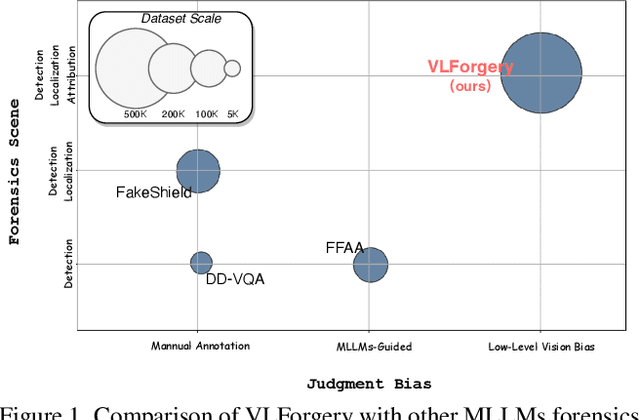
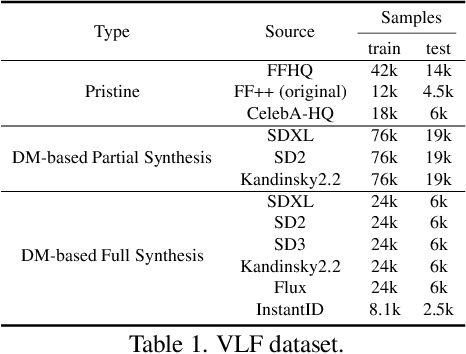
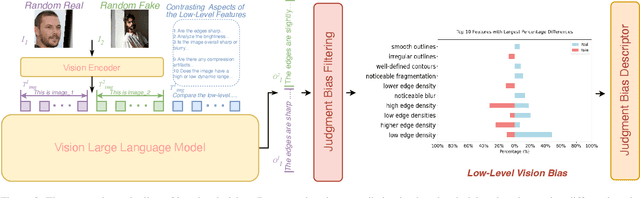
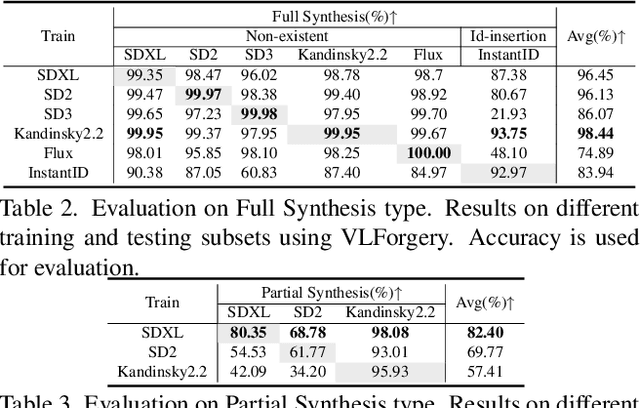
Faces synthesized by diffusion models (DMs) with high-quality and controllable attributes pose a significant challenge for Deepfake detection. Most state-of-the-art detectors only yield a binary decision, incapable of forgery localization, attribution of forgery methods, and providing analysis on the cause of forgeries. In this work, we integrate Multimodal Large Language Models (MLLMs) within DM-based face forensics, and propose a fine-grained analysis triad framework called VLForgery, that can 1) predict falsified facial images; 2) locate the falsified face regions subjected to partial synthesis; and 3) attribute the synthesis with specific generators. To achieve the above goals, we introduce VLF (Visual Language Forensics), a novel and diverse synthesis face dataset designed to facilitate rich interactions between Visual and Language modalities in MLLMs. Additionally, we propose an extrinsic knowledge-guided description method, termed EkCot, which leverages knowledge from the image generation pipeline to enable MLLMs to quickly capture image content. Furthermore, we introduce a low-level vision comparison pipeline designed to identify differential features between real and fake that MLLMs can inherently understand. These features are then incorporated into EkCot, enhancing its ability to analyze forgeries in a structured manner, following the sequence of detection, localization, and attribution. Extensive experiments demonstrate that VLForgery outperforms other state-of-the-art forensic approaches in detection accuracy, with additional potential for falsified region localization and attribution analysis.
EVE: Towards End-to-End Video Subtitle Extraction with Vision-Language Models
Mar 06, 2025The advent of Large Vision-Language Models (LVLMs) has advanced the video-based tasks, such as video captioning and video understanding. Some previous research indicates that taking texts in videos as input can further improve the performance of video understanding. As a type of indispensable information in short videos or movies, subtitles can assist LVLMs to better understand videos. Most existing methods for video subtitle extraction are based on a multi-stage framework, handling each frame independently. They can hardly exploit the temporal information of videos. Although some LVLMs exhibit the robust OCR capability, predicting accurate timestamps for subtitle texts is still challenging. In this paper, we propose an End-to-end Video Subtitle Extraction method, called EVE, which consists of three modules: a vision encoder, an adapter module, and a large language model. To effectively compress the visual tokens from the vision encoder, we propose a novel adapter InterleavedVT to interleave two modalities. It contains a visual compressor and a textual region compressor. The proposed InterleavedVT exploits both the merits of average pooling and Q-Former in token compression. Taking the temporal information of videos into account, we introduce a sliding-window mechanism in the textual region compressor. To benchmark the video subtitle extraction task, we propose a large dataset ViSa including 2.5M videos. Extensive experiments on ViSa demonstrate that the proposed EVE can outperform existing open-sourced tools and LVLMs.
Small but Mighty: Enhancing Time Series Forecasting with Lightweight LLMs
Mar 05, 2025While LLMs have demonstrated remarkable potential in time series forecasting, their practical deployment remains constrained by excessive computational demands and memory footprints. Existing LLM-based approaches typically suffer from three critical limitations: Inefficient parameter utilization in handling numerical time series patterns; Modality misalignment between continuous temporal signals and discrete text embeddings; and Inflexibility for real-time expert knowledge integration. We present SMETimes, the first systematic investigation of sub-3B parameter SLMs for efficient and accurate time series forecasting. Our approach centers on three key innovations: A statistically-enhanced prompting mechanism that bridges numerical time series with textual semantics through descriptive statistical features; A adaptive fusion embedding architecture that aligns temporal patterns with language model token spaces through learnable parameters; And a dynamic mixture-of-experts framework enabled by SLMs' computational efficiency, adaptively combining base predictions with domain-specific models. Extensive evaluations across seven benchmark datasets demonstrate that our 3B-parameter SLM achieves state-of-the-art performance on five primary datasets while maintaining 3.8x faster training and 5.2x lower memory consumption compared to 7B-parameter LLM baselines. Notably, the proposed model exhibits better learning capabilities, achieving 12.3% lower MSE than conventional LLM. Ablation studies validate that our statistical prompting and cross-modal fusion modules respectively contribute 15.7% and 18.2% error reduction in long-horizon forecasting tasks. By redefining the efficiency-accuracy trade-off landscape, this work establishes SLMs as viable alternatives to resource-intensive LLMs for practical time series forecasting. Code and models are available at https://github.com/xiyan1234567/SMETimes.