 Add to Chrome
 Add to Firefox
 Add to Edge
Toward Geometry-Scalable Whole-Body Touch for Humanoids: A 3D-Printed Conformal EIT Skin
Aug 03, 2026
Whole-body tactile sensing is a prerequisite for humanoids that operate in contact-rich human environments, but conventional taxel arrays scale poorly with surface area, wiring complexity, and robot-specific curvature. We present a conformal electrical impedance tomography tactile skin fabricated through a geometry-adaptable additive-manufacturing workflow. A flexible conductive TPU layer forms a continuous sensing domain, while contact-induced coupling with conductive patches produces boundary voltage changes that are reconstructed using a one-step Gauss-Newton EIT solver. We first characterize the electromechanical design space of the layered structure and show that low-resistance contact-enhancement patches and a porous conductive TPU sensing layer improve sensitivity while preserving printability. We then validate contact localization on a planar prototype, a curved U-shaped prototype, and a qualitative iCub-face-shaped geometry. The curved sensor achieves a mean localization error of 6 mm over 18 contact positions without supervised post-processing. These results suggest that additively manufactured tomographic skins can reduce the morphology-specific redesign burden for humanoid tactile coverage and provide a practical route toward large-area contact sensing for human-centered deployment.

Design and Human Evaluation of Tactile Withdrawal Reflexes for a Skin-Covered Robot Arm
Jul 24, 2026Nociception is a protective biological mechanism that links harmful stimulation to a reaction. This paper investigates artificial nociception for a robotic arm with whole-body tactile sensing. We present a complete pipeline that maps pressure changes from sensitive skin on a robot manipulator to bio-inspired withdrawal motions. The system first converts skin pressure into a scalar pain gain using a nonlinear continuous model. We compare three reflexes: (i) uniform reflex moves four robot joints by a fixed amount, whereby the withdrawal is approximated by a movement of the arm "toward the base", independent of where the robot was touched; (ii) biologically motivated location-dependent joint-space withdrawal derived from human withdrawal reflex characteristics; (iii) Cartesian space withdrawal along the surface normal of the contacted skin pad. All behaviors are integrated in a reflex controller that interrupts the task, executes the withdrawal, and returns to a pre-contact pose. A user study with 15 participants compared the strategies using Godspeed questionnaire subscales, custom perceived-naturalness and safety items, forced-choice comparisons, and qualitative feedback. Interestingly, participants rated more highly the uniform reflex behavior over one or both competitors on the anthropomorphism, animacy, and likeability Godspeed subscales and on the Naturalness and Realism custom scale. When asked to compare the conditions, the uniform reflex was scored best in "felt safest", "most human-like", and "most natural". This suggests that predictability of the robot behavior is key for user acceptance. The Cartesian reflex was judged the most appropriate reaction to touch. The bio-inspired reflex did not lead any evaluated measure. This may be partly attributed to the embodiment gap between the robot arm and human arm and participants having different expectations from a robot manipulator.
A Human-Inspired Thumb-Index Robotic Hand with Strain Gauges Embedded in Soft Joints
Jun 19, 2026Human hand grasp adaptation depends mainly on the synergy between physical structure and biological feedback. Inspired by this biomechanical principle, the Safe Thumb-Index Robotic (STIR) Hand was developed as a minimal, lightweight, and low-cost two-digit prototype featuring an asymmetric thumb-index configuration. By pairing an underactuated, tendon-driven mechanical design with flexible strain gauges embedded into silicone-encapsulated soft joints, the system achieves passive grasp adaptation while establishing both internal proprioception and external perception. Unsupervised analysis was carried out on a dataset of the STIR hand grasping 20 different objects, along with an object classification task and an ablation study to highlight the contribution of the soft joint sensors. The object classification task discriminated object size, shape, and material stiffness with a high classification accuracy. In contrast to traditional industrial grippers and robotic hands, the STIR Hand demonstrates that sensorized compliant joints significantly improve overall sensitivity and ensure safe grasping, while remaining independent of additional fingertip tactile elements or external vision systems. Finally, a comparison to similar devices grasping identical objects validates the utility of the STIR Hand.
Infant Spontaneous Movement Noise Improves Exploration in Deep RL
Jun 16, 2026Exploration in deep reinforcement learning (RL) is commonly implemented as temporally uncorrelated white noise. However, recent works show that temporally correlated colored noise can improve exploration efficiency by producing smooth trajectories with better coverage of the state space. We inquire whether action noise inspired by infant spontaneous movements can also improve exploration in deep RL. We find that the power spectral densities of babies' end-effector velocities follow a colored noise process where the spectral exponent increases with age. Inspired by this developmental pattern, we introduce a mechanism that progressively increases the temporal auto-correlation of exploration noise during RL training, matching the infant statistics. Experiments across several RL environments show that infant-inspired noise produces structured exploratory behavior and can improve learning efficiency compared to conventional exploration strategies. These findings suggest that human motor and cognitive development can provide useful guidance for designing learning mechanisms in artificial agents. Our code is available at https://github.com/trieschlab/baby-noise-rl.
Neuromorphic visual attention for Sign-language recognition on SpiNNaker
May 07, 2026Sign-language recognition has achieved substantial gains in classification accuracy in recent years; however, the latency and power requirements of most existing methods limit their suitability for real-time deployment. Neuromorphic sensing and processing offer an alternative paradigm based on sparse, event-driven computation that supports low-latency and energy-efficient perception. In this work, we introduce an end-to-end neuromorphic architecture for American Sign Language (ASL) fingerspelling recognition that integrates a spiking visual attention mechanism for online region-of-interest extraction with a compact spiking neural network deployed on the SpiNNaker neuromorphic platform. We benchmark the proposed system against two datasets: a synthetically generated event-based version of the Sign Language MNIST dataset and a natively recorded ASL-DVS dataset, whilst providing a comprehensive overview of Sign-language recognition and related work. This work yields competitive performance in simulation (92.27%) and comparable performance on neuromorphic hardware deployment (83.1%), while achieving the most energy-efficient architecture (0.565 mW) and low latency (3 ms) across all benchmarked approaches. Despite its compact design, the system demonstrates the suitability of task-dependent visual attention applications for edge deployment.
ShapeGrasp: Simultaneous Visuo-Haptic Shape Completion and Grasping for Improved Robot Manipulation
May 04, 2026Humans grasp unfamiliar objects by combining an initial visual estimate with tactile and proprioceptive feedback during interaction. We present ShapeGrasp, a robotic implementation of this approach. The proposed method is an iterative grasp-and-complete pipeline that couples implicit surface visuo-haptic shape completion (creation of full 3D shape from partial information) with physics-based grasp planning. From a single RGB-D view, ShapeGrasp infers a complete shape (point cloud or triangular mesh), generates candidate grasps via rigid-body simulation, and executes the best feasible grasp. Each grasp attempt yields additional geometric constraints -- tactile surface contacts and space occupied by the gripper body -- which are fused to update the object shape. Failures trigger pose re-estimation and regrasping using the refined shape. We evaluate ShapeGrasp in the real world using two different robots and grippers. To the best of our knowledge, this is the first approach that updates shape representations following a real-world grasp. We achieved superior results over baselines for both grippers (grasp success rate of 84% with a three-finger gripper and 91% with a two-finger gripper), while improving the 3D shape reconstruction quality in all evaluation metrics used.
The body is not there to compute: Comment on "Informational embodiment: Computational role of information structure in codes and robots" by Pitti et al
Dec 28, 2025Applying the lens of computation and information has been instrumental in driving the technological progress of our civilization as well as in empowering our understanding of the world around us. The digital computer was and for many still is the leading metaphor for how our mind operates. Information theory (IT) has also been important in our understanding of how nervous systems encode and process information. The target article deploys information and computation to bodies: to understand why they have evolved in particular ways (animal bodies) and to design optimal bodies (robots). In this commentary, I argue that the main role of bodies is not to compute.
* Comment on Pitti, A., Austin, M., Nakajima, K., & Kuniyoshi, Y. (2025). Informational Embodiment: Computational role of information structure in codes and robots. Physics of Life Reviews 53, 262-276. https://doi.org/10.1016/j.plrev.2025.03.018. Also available as arXiv:2408.12950
BLANKET: Anonymizing Faces in Infant Video Recordings
Dec 17, 2025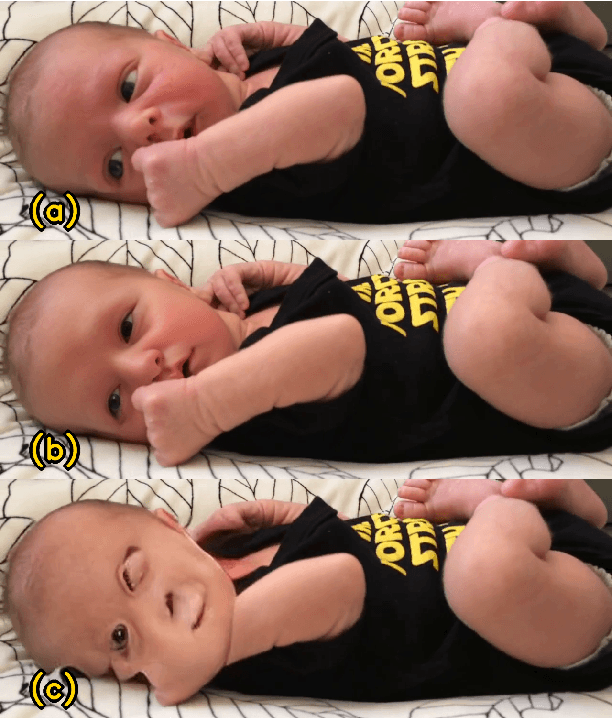
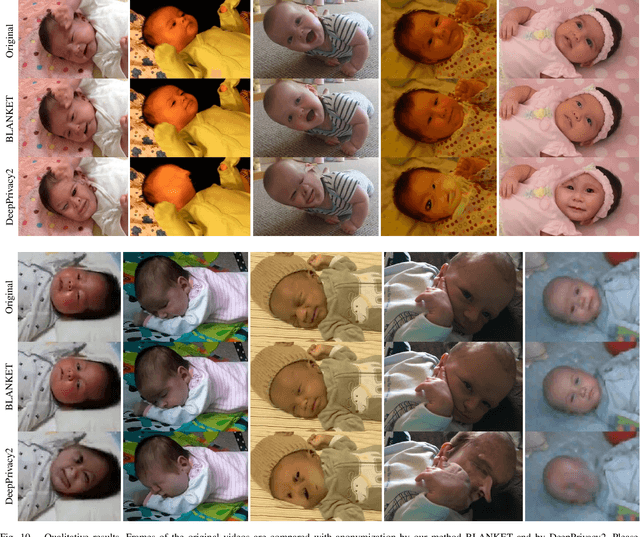
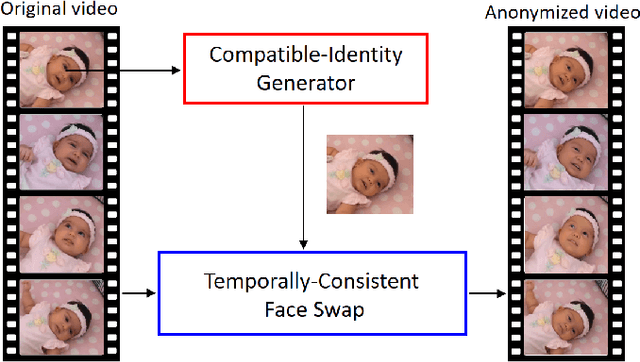
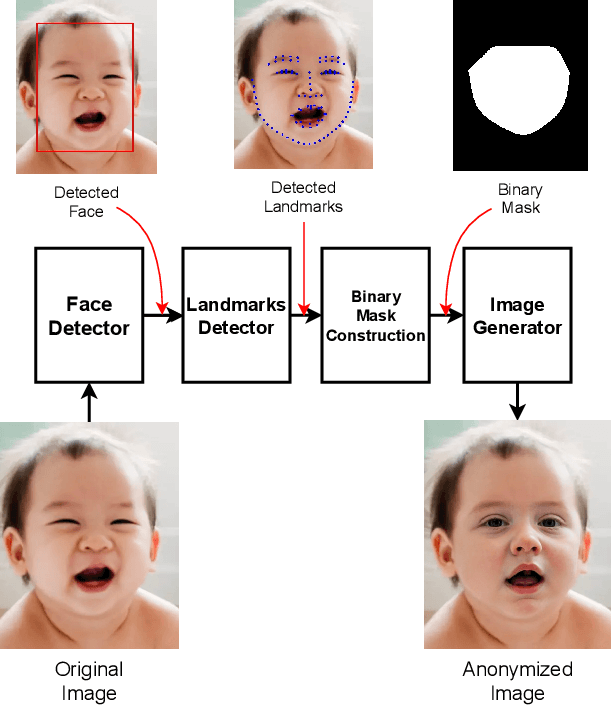
Ensuring the ethical use of video data involving human subjects, particularly infants, requires robust anonymization methods. We propose BLANKET (Baby-face Landmark-preserving ANonymization with Keypoint dEtection consisTency), a novel approach designed to anonymize infant faces in video recordings while preserving essential facial attributes. Our method comprises two stages. First, a new random face, compatible with the original identity, is generated via inpainting using a diffusion model. Second, the new identity is seamlessly incorporated into each video frame through temporally consistent face swapping with authentic expression transfer. The method is evaluated on a dataset of short video recordings of babies and is compared to the popular anonymization method, DeepPrivacy2. Key metrics assessed include the level of de-identification, preservation of facial attributes, impact on human pose estimation (as an example of a downstream task), and presence of artifacts. Both methods alter the identity, and our method outperforms DeepPrivacy2 in all other respects. The code is available as an easy-to-use anonymization demo at https://github.com/ctu-vras/blanket-infant-face-anonym.
* Project website: https://github.com/ctu-vras/blanket-infant-face-anonym
No Need to Look! Locating and Grasping Objects by a Robot Arm Covered with Sensitive Skin
Aug 25, 2025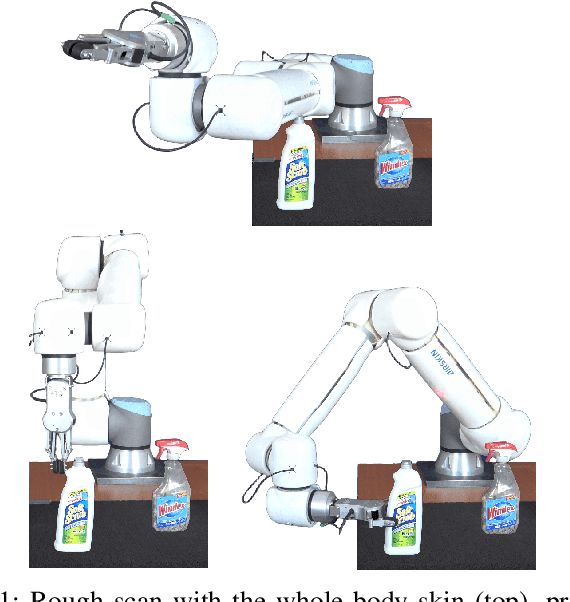
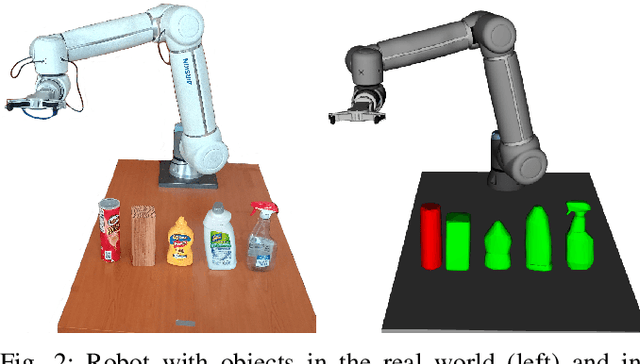
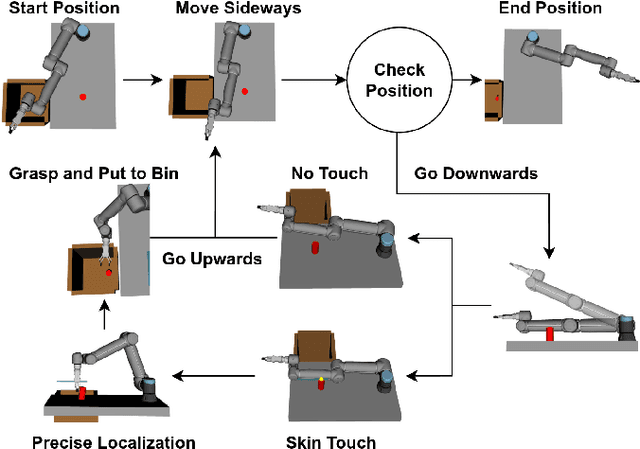
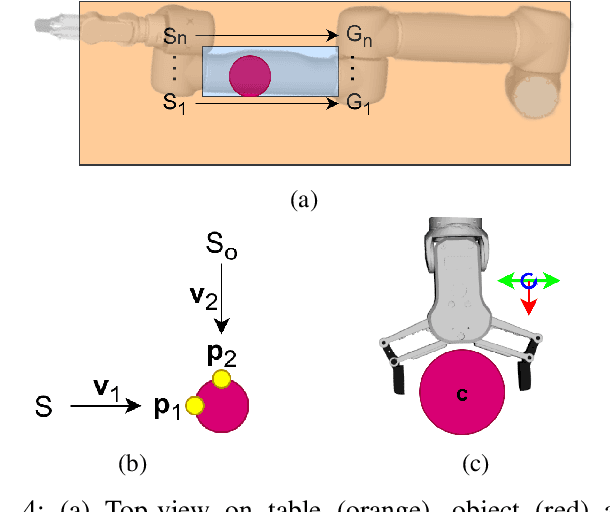
Locating and grasping of objects by robots is typically performed using visual sensors. Haptic feedback from contacts with the environment is only secondary if present at all. In this work, we explored an extreme case of searching for and grasping objects in complete absence of visual input, relying on haptic feedback only. The main novelty lies in the use of contacts over the complete surface of a robot manipulator covered with sensitive skin. The search is divided into two phases: (1) coarse workspace exploration with the complete robot surface, followed by (2) precise localization using the end-effector equipped with a force/torque sensor. We systematically evaluated this method in simulation and on the real robot, demonstrating that diverse objects can be located, grasped, and put in a basket. The overall success rate on the real robot for one object was 85.7\% with failures mainly while grasping specific objects. The method using whole-body contacts is six times faster compared to a baseline that uses haptic feedback only on the end-effector. We also show locating and grasping multiple objects on the table. This method is not restricted to our specific setup and can be deployed on any platform with the ability of sensing contacts over the entire body surface. This work holds promise for diverse applications in areas with challenging visual perception (due to lighting, dust, smoke, occlusion) such as in agriculture when fruits or vegetables need to be located inside foliage and picked.
Embodied AI in Machine Learning -- is it Really Embodied?
May 15, 2025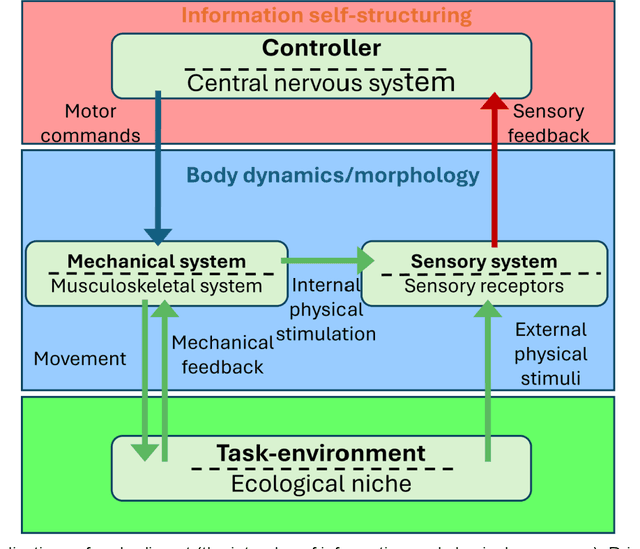
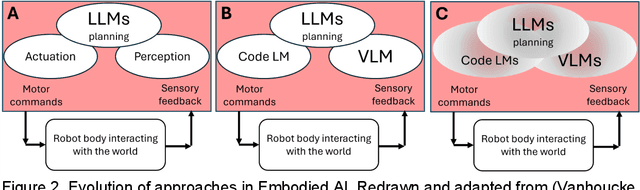
Embodied Artificial Intelligence (Embodied AI) is gaining momentum in the machine learning communities with the goal of leveraging current progress in AI (deep learning, transformers, large language and visual-language models) to empower robots. In this chapter we put this work in the context of "Good Old-Fashioned Artificial Intelligence" (GOFAI) (Haugeland, 1989) and the behavior-based or embodied alternatives (R. A. Brooks 1991; Pfeifer and Scheier 2001). We claim that the AI-powered robots are only weakly embodied and inherit some of the problems of GOFAI. Moreover, we review and critically discuss the possibility of cross-embodiment learning (Padalkar et al. 2024). We identify fundamental roadblocks and propose directions on how to make progress.