 Add to Chrome
 Add to Firefox
 Add to Edge
Certified Robust Models with Slack Control and Large Lipschitz Constants
Sep 12, 2023
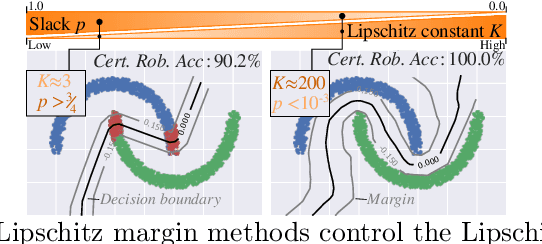
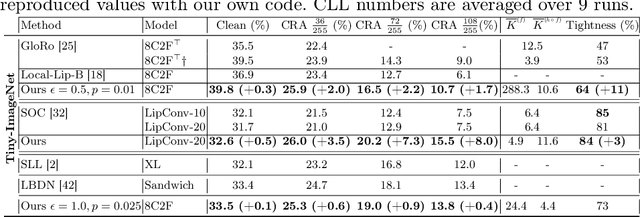
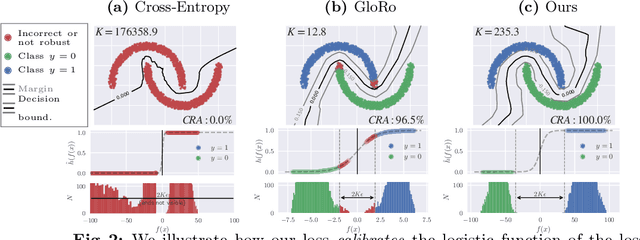
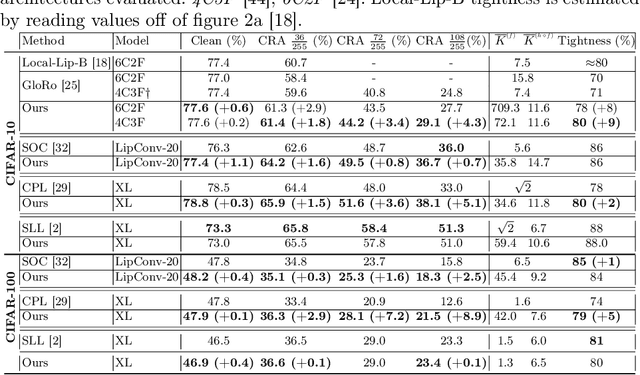
Despite recent success, state-of-the-art learning-based models remain highly vulnerable to input changes such as adversarial examples. In order to obtain certifiable robustness against such perturbations, recent work considers Lipschitz-based regularizers or constraints while at the same time increasing prediction margin. Unfortunately, this comes at the cost of significantly decreased accuracy. In this paper, we propose a Calibrated Lipschitz-Margin Loss (CLL) that addresses this issue and improves certified robustness by tackling two problems: Firstly, commonly used margin losses do not adjust the penalties to the shrinking output distribution; caused by minimizing the Lipschitz constant $K$. Secondly, and most importantly, we observe that minimization of $K$ can lead to overly smooth decision functions. This limits the model's complexity and thus reduces accuracy. Our CLL addresses these issues by explicitly calibrating the loss w.r.t. margin and Lipschitz constant, thereby establishing full control over slack and improving robustness certificates even with larger Lipschitz constants. On CIFAR-10, CIFAR-100 and Tiny-ImageNet, our models consistently outperform losses that leave the constant unattended. On CIFAR-100 and Tiny-ImageNet, CLL improves upon state-of-the-art deterministic $L_2$ robust accuracies. In contrast to current trends, we unlock potential of much smaller models without $K=1$ constraints.

SimNP: Learning Self-Similarity Priors Between Neural Points
Sep 07, 2023Existing neural field representations for 3D object reconstruction either (1) utilize object-level representations, but suffer from low-quality details due to conditioning on a global latent code, or (2) are able to perfectly reconstruct the observations, but fail to utilize object-level prior knowledge to infer unobserved regions. We present SimNP, a method to learn category-level self-similarities, which combines the advantages of both worlds by connecting neural point radiance fields with a category-level self-similarity representation. Our contribution is two-fold. (1) We design the first neural point representation on a category level by utilizing the concept of coherent point clouds. The resulting neural point radiance fields store a high level of detail for locally supported object regions. (2) We learn how information is shared between neural points in an unconstrained and unsupervised fashion, which allows to derive unobserved regions of an object during the reconstruction process from given observations. We show that SimNP is able to outperform previous methods in reconstructing symmetric unseen object regions, surpassing methods that build upon category-level or pixel-aligned radiance fields, while providing semantic correspondences between instances
Object-Centric Multiple Object Tracking
Sep 05, 2023
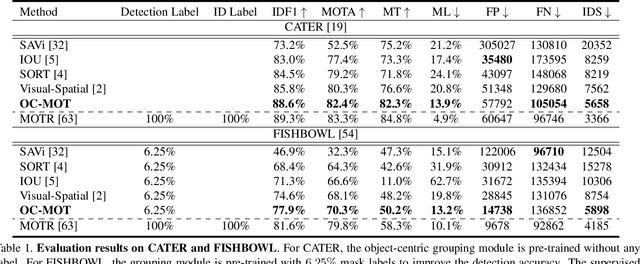


Unsupervised object-centric learning methods allow the partitioning of scenes into entities without additional localization information and are excellent candidates for reducing the annotation burden of multiple-object tracking (MOT) pipelines. Unfortunately, they lack two key properties: objects are often split into parts and are not consistently tracked over time. In fact, state-of-the-art models achieve pixel-level accuracy and temporal consistency by relying on supervised object detection with additional ID labels for the association through time. This paper proposes a video object-centric model for MOT. It consists of an index-merge module that adapts the object-centric slots into detection outputs and an object memory module that builds complete object prototypes to handle occlusions. Benefited from object-centric learning, we only require sparse detection labels (0%-6.25%) for object localization and feature binding. Relying on our self-supervised Expectation-Maximization-inspired loss for object association, our approach requires no ID labels. Our experiments significantly narrow the gap between the existing object-centric model and the fully supervised state-of-the-art and outperform several unsupervised trackers.
UniTR: A Unified and Efficient Multi-Modal Transformer for Bird's-Eye-View Representation
Aug 15, 2023Jointly processing information from multiple sensors is crucial to achieving accurate and robust perception for reliable autonomous driving systems. However, current 3D perception research follows a modality-specific paradigm, leading to additional computation overheads and inefficient collaboration between different sensor data. In this paper, we present an efficient multi-modal backbone for outdoor 3D perception named UniTR, which processes a variety of modalities with unified modeling and shared parameters. Unlike previous works, UniTR introduces a modality-agnostic transformer encoder to handle these view-discrepant sensor data for parallel modal-wise representation learning and automatic cross-modal interaction without additional fusion steps. More importantly, to make full use of these complementary sensor types, we present a novel multi-modal integration strategy by both considering semantic-abundant 2D perspective and geometry-aware 3D sparse neighborhood relations. UniTR is also a fundamentally task-agnostic backbone that naturally supports different 3D perception tasks. It sets a new state-of-the-art performance on the nuScenes benchmark, achieving +1.1 NDS higher for 3D object detection and +12.0 higher mIoU for BEV map segmentation with lower inference latency. Code will be available at https://github.com/Haiyang-W/UniTR .
MTR++: Multi-Agent Motion Prediction with Symmetric Scene Modeling and Guided Intention Querying
Jun 30, 2023Motion prediction is crucial for autonomous driving systems to understand complex driving scenarios and make informed decisions. However, this task is challenging due to the diverse behaviors of traffic participants and complex environmental contexts. In this paper, we propose Motion TRansformer (MTR) frameworks to address these challenges. The initial MTR framework utilizes a transformer encoder-decoder structure with learnable intention queries, enabling efficient and accurate prediction of future trajectories. By customizing intention queries for distinct motion modalities, MTR improves multimodal motion prediction while reducing reliance on dense goal candidates. The framework comprises two essential processes: global intention localization, identifying the agent's intent to enhance overall efficiency, and local movement refinement, adaptively refining predicted trajectories for improved accuracy. Moreover, we introduce an advanced MTR++ framework, extending the capability of MTR to simultaneously predict multimodal motion for multiple agents. MTR++ incorporates symmetric context modeling and mutually-guided intention querying modules to facilitate future behavior interaction among multiple agents, resulting in scene-compliant future trajectories. Extensive experimental results demonstrate that the MTR framework achieves state-of-the-art performance on the highly-competitive motion prediction benchmarks, while the MTR++ framework surpasses its precursor, exhibiting enhanced performance and efficiency in predicting accurate multimodal future trajectories for multiple agents.
B-cos Alignment for Inherently Interpretable CNNs and Vision Transformers
Jun 19, 2023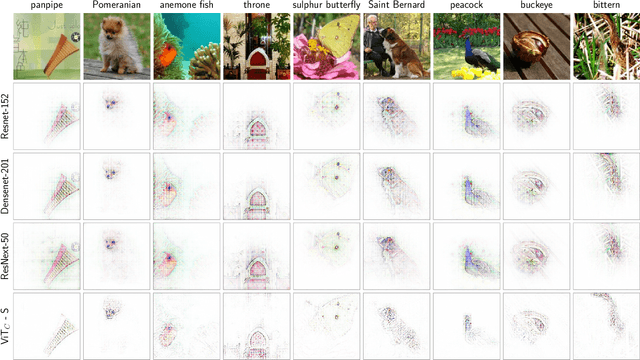
We present a new direction for increasing the interpretability of deep neural networks (DNNs) by promoting weight-input alignment during training. For this, we propose to replace the linear transformations in DNNs by our novel B-cos transformation. As we show, a sequence (network) of such transformations induces a single linear transformation that faithfully summarises the full model computations. Moreover, the B-cos transformation is designed such that the weights align with relevant signals during optimisation. As a result, those induced linear transformations become highly interpretable and highlight task-relevant features. Importantly, the B-cos transformation is designed to be compatible with existing architectures and we show that it can easily be integrated into virtually all of the latest state of the art models for computer vision - e.g. ResNets, DenseNets, ConvNext models, as well as Vision Transformers - by combining the B-cos-based explanations with normalisation and attention layers, all whilst maintaining similar accuracy on ImageNet. Finally, we show that the resulting explanations are of high visual quality and perform well under quantitative interpretability metrics.
HGFormer: Hierarchical Grouping Transformer for Domain Generalized Semantic Segmentation
May 22, 2023Current semantic segmentation models have achieved great success under the independent and identically distributed (i.i.d.) condition. However, in real-world applications, test data might come from a different domain than training data. Therefore, it is important to improve model robustness against domain differences. This work studies semantic segmentation under the domain generalization setting, where a model is trained only on the source domain and tested on the unseen target domain. Existing works show that Vision Transformers are more robust than CNNs and show that this is related to the visual grouping property of self-attention. In this work, we propose a novel hierarchical grouping transformer (HGFormer) to explicitly group pixels to form part-level masks and then whole-level masks. The masks at different scales aim to segment out both parts and a whole of classes. HGFormer combines mask classification results at both scales for class label prediction. We assemble multiple interesting cross-domain settings by using seven public semantic segmentation datasets. Experiments show that HGFormer yields more robust semantic segmentation results than per-pixel classification methods and flat grouping transformers, and outperforms previous methods significantly. Code will be available at https://github.com/dingjiansw101/HGFormer.
Self-supervised Pre-training with Masked Shape Prediction for 3D Scene Understanding
May 08, 2023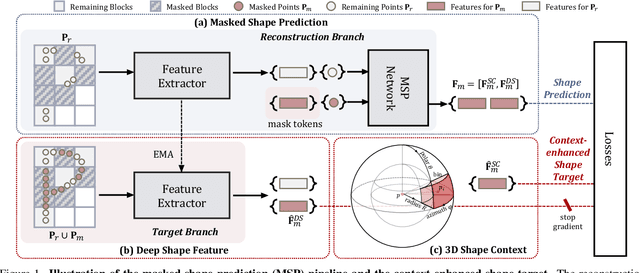
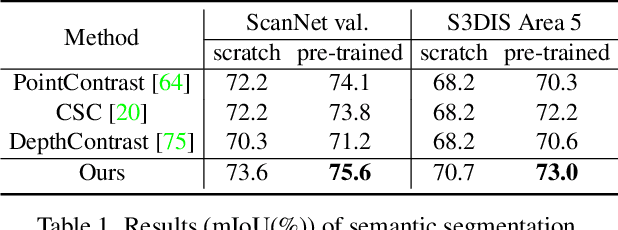
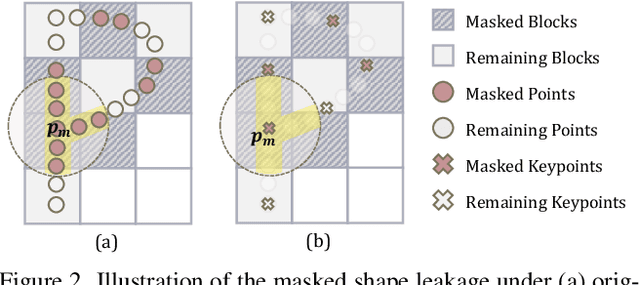
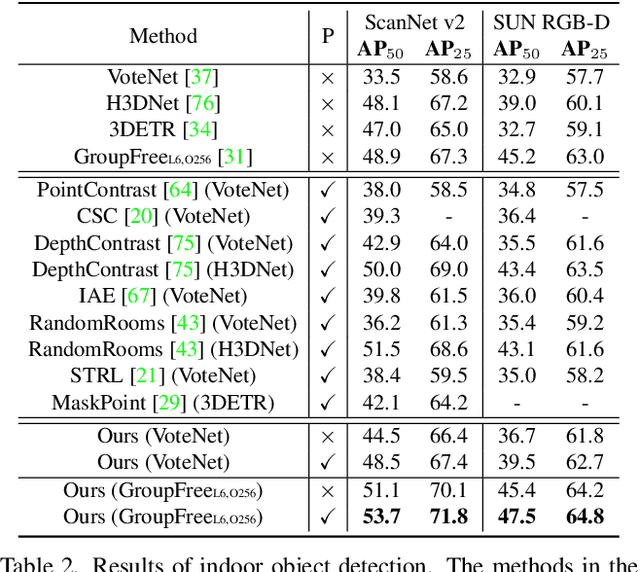
Masked signal modeling has greatly advanced self-supervised pre-training for language and 2D images. However, it is still not fully explored in 3D scene understanding. Thus, this paper introduces Masked Shape Prediction (MSP), a new framework to conduct masked signal modeling in 3D scenes. MSP uses the essential 3D semantic cue, i.e., geometric shape, as the prediction target for masked points. The context-enhanced shape target consisting of explicit shape context and implicit deep shape feature is proposed to facilitate exploiting contextual cues in shape prediction. Meanwhile, the pre-training architecture in MSP is carefully designed to alleviate the masked shape leakage from point coordinates. Experiments on multiple 3D understanding tasks on both indoor and outdoor datasets demonstrate the effectiveness of MSP in learning good feature representations to consistently boost downstream performance.
Continual Detection Transformer for Incremental Object Detection
Apr 06, 2023
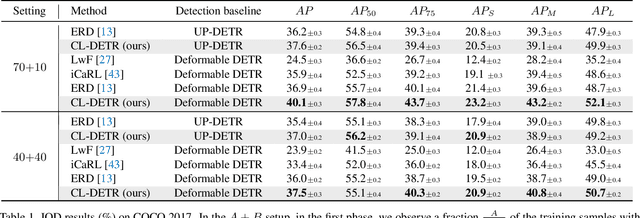
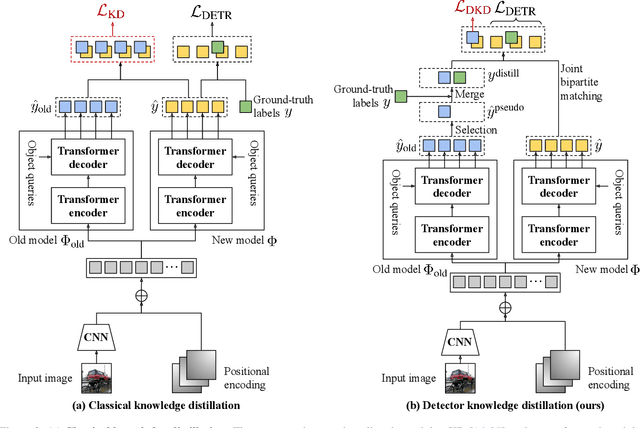
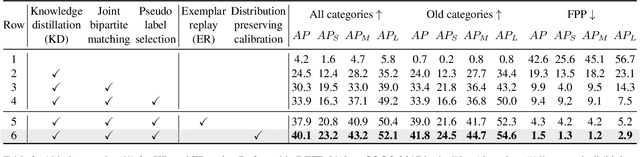
Incremental object detection (IOD) aims to train an object detector in phases, each with annotations for new object categories. As other incremental settings, IOD is subject to catastrophic forgetting, which is often addressed by techniques such as knowledge distillation (KD) and exemplar replay (ER). However, KD and ER do not work well if applied directly to state-of-the-art transformer-based object detectors such as Deformable DETR and UP-DETR. In this paper, we solve these issues by proposing a ContinuaL DEtection TRansformer (CL-DETR), a new method for transformer-based IOD which enables effective usage of KD and ER in this context. First, we introduce a Detector Knowledge Distillation (DKD) loss, focusing on the most informative and reliable predictions from old versions of the model, ignoring redundant background predictions, and ensuring compatibility with the available ground-truth labels. We also improve ER by proposing a calibration strategy to preserve the label distribution of the training set, therefore better matching training and testing statistics. We conduct extensive experiments on COCO 2017 and demonstrate that CL-DETR achieves state-of-the-art results in the IOD setting.
Robustifying Token Attention for Vision Transformers
Apr 04, 2023Despite the success of vision transformers (ViTs), they still suffer from significant drops in accuracy in the presence of common corruptions, such as noise or blur. Interestingly, we observe that the attention mechanism of ViTs tends to rely on few important tokens, a phenomenon we call token overfocusing. More critically, these tokens are not robust to corruptions, often leading to highly diverging attention patterns. In this paper, we intend to alleviate this overfocusing issue and make attention more stable through two general techniques: First, our Token-aware Average Pooling (TAP) module encourages the local neighborhood of each token to take part in the attention mechanism. Specifically, TAP learns average pooling schemes for each token such that the information of potentially important tokens in the neighborhood can adaptively be taken into account. Second, we force the output tokens to aggregate information from a diverse set of input tokens rather than focusing on just a few by using our Attention Diversification Loss (ADL). We achieve this by penalizing high cosine similarity between the attention vectors of different tokens. In experiments, we apply our methods to a wide range of transformer architectures and improve robustness significantly. For example, we improve corruption robustness on ImageNet-C by 2.4% while simultaneously improving accuracy by 0.4% based on state-of-the-art robust architecture FAN. Also, when finetuning on semantic segmentation tasks, we improve robustness on CityScapes-C by 2.4% and ACDC by 3.1%.