 Add to Chrome
 Add to Firefox
 Add to Edge
Dynamic Inverse Rendering for Enhanced Material-Lighting Decomposition
Jul 10, 2026
Decomposing outgoing surface radiance into material and illumination during inverse rendering is essential for applications such as relighting and augmented reality, yet it is severely ill-posed since multiple combinations can result in the same observed colour. Capturing an object under multiple lighting conditions usually helps resolve this ambiguity as it constrains the optimization towards correct solutions. In this work, we explore the potential of reconstructing rigidly moving objects -- which provides observations of diverse light-surface interactions -- to resolve the material-lighting ambiguity in inverse rendering. For this purpose, we introduce a relightable approach that marries object tracking and reconstruction with inverse rendering for general rigidly moving objects. Our experimental analysis on synthetic data demonstrates that motion can be an advantage for disentangling material and lighting: the reconstructed material is significantly more accurate when the object is observed under rigid motion than when it is static. Moreover, results on RGB videos of real hand-held objects show that our pipeline preserves this advantage even under noisy real-world conditions.

Emergence of a Shared Canonical Object Frame from In-the-Wild Videos
Jun 29, 2026Comparing object orientations and positions across different instances requires their poses to be expressed in a shared canonical frame. Establishing such frames has traditionally required manual annotation, creating a scaling bottleneck that limits category and instance diversity. We show that a shared canonical frame can instead emerge from self-supervised training on object-centric videos captured in the wild, using only noisy camera poses from Structure-from-Motion. Our key idea is to route all training sequences through a shared geometric bottleneck: a coarse canonical mesh that carries no category-specific detail. By learning dense correspondences from image pixels to this mesh, and estimating per-sequence alignments from noisy SfM geometry, a common canonical frame emerges from multi-view consistency and the semantic priors of the feature extractor, without any canonical pose labels or category conditioning. Trained in a self-supervised manner on 160,000 in-the-wild object videos, our method achieves competitive accuracy on category-level pose estimation benchmarks compared to methods that rely on canonical pose supervision. The code and checkpoint is available on https://github.com/Fischer-Tom/Emergent-Canonical-Frame/.
Hoi3DGen: Generating High-Quality Human-Object-Interactions in 3D
Mar 12, 2026Modeling and generating 3D human-object interactions from text is crucial for applications in AR, XR, and gaming. Existing approaches often rely on score distillation from text-to-image models, but their results suffer from the Janus problem and do not follow text prompts faithfully due to the scarcity of high-quality interaction data. We introduce Hoi3DGen, a framework that generates high-quality textured meshes of human-object interaction that follow the input interaction descriptions precisely. We first curate realistic and high-quality interaction data leveraging multimodal large language models, and then create a full text-to-3D pipeline, which achieves orders-of-magnitude improvements in interaction fidelity. Our method surpasses baselines by 4-15x in text consistency and 3-7x in 3D model quality, exhibiting strong generalization to diverse categories and interaction types, while maintaining high-quality 3D generation.
CLIP is All You Need for Human-like Semantic Representations in Stable Diffusion
Nov 11, 2025Latent diffusion models such as Stable Diffusion achieve state-of-the-art results on text-to-image generation tasks. However, the extent to which these models have a semantic understanding of the images they generate is not well understood. In this work, we investigate whether the internal representations used by these models during text-to-image generation contain semantic information that is meaningful to humans. To do so, we perform probing on Stable Diffusion with simple regression layers that predict semantic attributes for objects and evaluate these predictions against human annotations. Surprisingly, we find that this success can actually be attributed to the text encoding occurring in CLIP rather than the reverse diffusion process. We demonstrate that groups of specific semantic attributes have markedly different decoding accuracy than the average, and are thus represented to different degrees. Finally, we show that attributes become more difficult to disambiguate from one another during the inverse diffusion process, further demonstrating the strongest semantic representation of object attributes in CLIP. We conclude that the separately trained CLIP vision-language model is what determines the human-like semantic representation, and that the diffusion process instead takes the role of a visual decoder.
3DFroMLLM: 3D Prototype Generation only from Pretrained Multimodal LLMs
Aug 12, 2025Recent Multi-Modal Large Language Models (MLLMs) have demonstrated strong capabilities in learning joint representations from text and images. However, their spatial reasoning remains limited. We introduce 3DFroMLLM, a novel framework that enables the generation of 3D object prototypes directly from MLLMs, including geometry and part labels. Our pipeline is agentic, comprising a designer, coder, and visual inspector operating in a refinement loop. Notably, our approach requires no additional training data or detailed user instructions. Building on prior work in 2D generation, we demonstrate that rendered images produced by our framework can be effectively used for image classification pretraining tasks and outperforms previous methods by 15%. As a compelling real-world use case, we show that the generated prototypes can be leveraged to improve fine-grained vision-language models by using the rendered, part-labeled prototypes to fine-tune CLIP for part segmentation and achieving a 55% accuracy improvement without relying on any additional human-labeled data.
Imaging for All-Day Wearable Smart Glasses
Apr 17, 2025In recent years smart glasses technology has rapidly advanced, opening up entirely new areas for mobile computing. We expect future smart glasses will need to be all-day wearable, adopting a small form factor to meet the requirements of volume, weight, fashionability and social acceptability, which puts significant constraints on the space of possible solutions. Additional challenges arise due to the fact that smart glasses are worn in arbitrary environments while their wearer moves and performs everyday activities. In this paper, we systematically analyze the space of imaging from smart glasses and derive several fundamental limits that govern this imaging domain. We discuss the impact of these limits on achievable image quality and camera module size -- comparing in particular to related devices such as mobile phones. We then propose a novel distributed imaging approach that allows to minimize the size of the individual camera modules when compared to a standard monolithic camera design. Finally, we demonstrate the properties of this novel approach in a series of experiments using synthetic data as well as images captured with two different prototype implementations.
TikZero: Zero-Shot Text-Guided Graphics Program Synthesis
Mar 14, 2025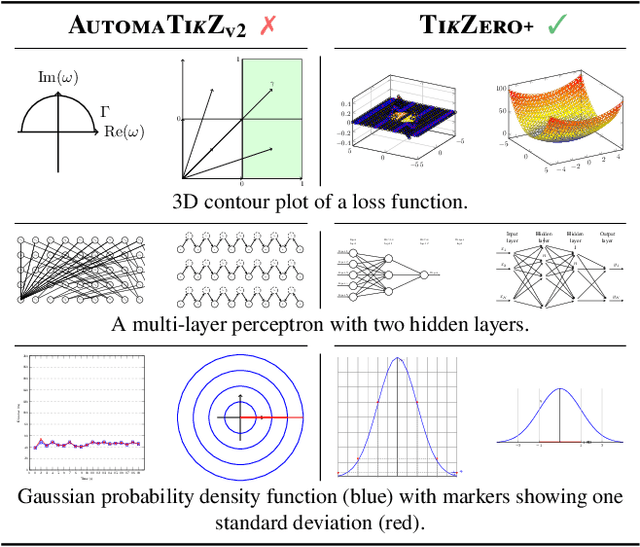
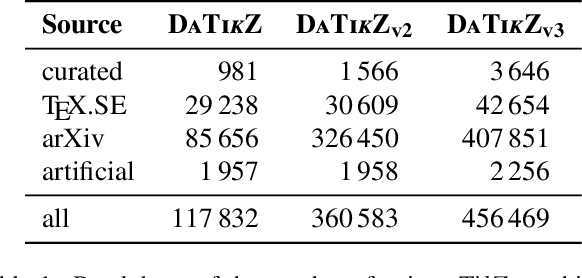
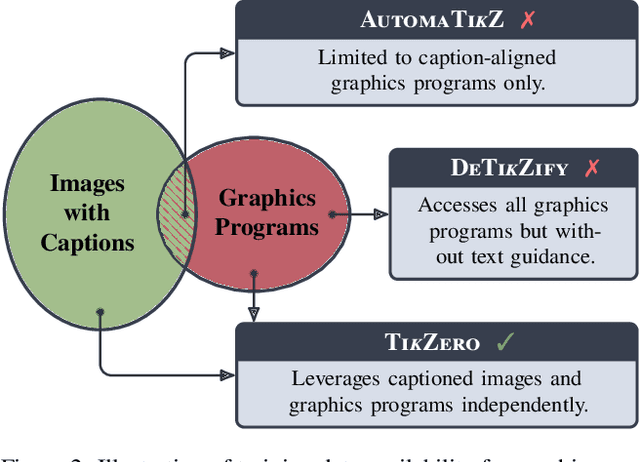
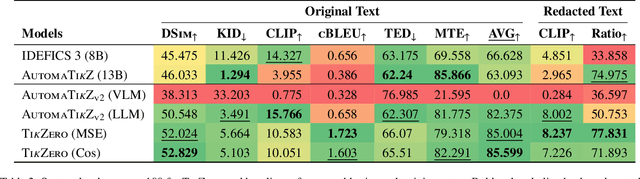
With the rise of generative AI, synthesizing figures from text captions becomes a compelling application. However, achieving high geometric precision and editability requires representing figures as graphics programs in languages like TikZ, and aligned training data (i.e., graphics programs with captions) remains scarce. Meanwhile, large amounts of unaligned graphics programs and captioned raster images are more readily available. We reconcile these disparate data sources by presenting TikZero, which decouples graphics program generation from text understanding by using image representations as an intermediary bridge. It enables independent training on graphics programs and captioned images and allows for zero-shot text-guided graphics program synthesis during inference. We show that our method substantially outperforms baselines that can only operate with caption-aligned graphics programs. Furthermore, when leveraging caption-aligned graphics programs as a complementary training signal, TikZero matches or exceeds the performance of much larger models, including commercial systems like GPT-4o. Our code, datasets, and select models are publicly available.
SLayR: Scene Layout Generation with Rectified Flow
Dec 06, 2024


We introduce SLayR, Scene Layout Generation with Rectified flow. State-of-the-art text-to-image models achieve impressive results. However, they generate images end-to-end, exposing no fine-grained control over the process. SLayR presents a novel transformer-based rectified flow model for layout generation over a token space that can be decoded into bounding boxes and corresponding labels, which can then be transformed into images using existing models. We show that established metrics for generated images are inconclusive for evaluating their underlying scene layout, and introduce a new benchmark suite, including a carefully designed repeatable human-evaluation procedure that assesses the plausibility and variety of generated layouts. In contrast to previous works, which perform well in either high variety or plausibility, we show that our approach performs well on both of these axes at the same time. It is also at least 5x times smaller in the number of parameters and 37% faster than the baselines. Our complete text-to-image pipeline demonstrates the added benefits of an interpretable and editable intermediate representation.
Spurfies: Sparse Surface Reconstruction using Local Geometry Priors
Aug 29, 2024


We introduce Spurfies, a novel method for sparse-view surface reconstruction that disentangles appearance and geometry information to utilize local geometry priors trained on synthetic data. Recent research heavily focuses on 3D reconstruction using dense multi-view setups, typically requiring hundreds of images. However, these methods often struggle with few-view scenarios. Existing sparse-view reconstruction techniques often rely on multi-view stereo networks that need to learn joint priors for geometry and appearance from a large amount of data. In contrast, we introduce a neural point representation that disentangles geometry and appearance to train a local geometry prior using a subset of the synthetic ShapeNet dataset only. During inference, we utilize this surface prior as additional constraint for surface and appearance reconstruction from sparse input views via differentiable volume rendering, restricting the space of possible solutions. We validate the effectiveness of our method on the DTU dataset and demonstrate that it outperforms previous state of the art by 35% in surface quality while achieving competitive novel view synthesis quality. Moreover, in contrast to previous works, our method can be applied to larger, unbounded scenes, such as Mip-NeRF 360.
iNeMo: Incremental Neural Mesh Models for Robust Class-Incremental Learning
Jul 12, 2024Different from human nature, it is still common practice today for vision tasks to train deep learning models only initially and on fixed datasets. A variety of approaches have recently addressed handling continual data streams. However, extending these methods to manage out-of-distribution (OOD) scenarios has not effectively been investigated. On the other hand, it has recently been shown that non-continual neural mesh models exhibit strong performance in generalizing to such OOD scenarios. To leverage this decisive property in a continual learning setting, we propose incremental neural mesh models that can be extended with new meshes over time. In addition, we present a latent space initialization strategy that enables us to allocate feature space for future unseen classes in advance and a positional regularization term that forces the features of the different classes to consistently stay in respective latent space regions. We demonstrate the effectiveness of our method through extensive experiments on the Pascal3D and ObjectNet3D datasets and show that our approach outperforms the baselines for classification by $2-6\%$ in the in-domain and by $6-50\%$ in the OOD setting. Our work also presents the first incremental learning approach for pose estimation. Our code and model can be found at https://github.com/Fischer-Tom/iNeMo.