 Add to Chrome
 Add to Firefox
 Add to Edge
Driving Intents Amplify Planning-Oriented Reinforcement Learning
May 14, 2026
Continuous-action policies trained on a single demonstrated trajectory per scene suffer from mode collapse: samples cluster around the demonstrated maneuver and the policy cannot represent semantically distinct alternatives. Under preference-based evaluation, this caps best-of-N performance -- even oracle selection cannot recover what the sampling distribution does not contain. We introduce DIAL, a two-stage Driving-Intent-Amplified reinforcement Learning framework for preference-aligned continuous-action driving policies. In the first stage, DIAL conditions the flow-matching action head on a discrete intent label with classifier-free guidance (CFG), which expands the sampling distribution along distinct maneuver modes and breaks single-demonstration mode collapse. In the second stage, DIAL carries this expanded distribution into preference RL through multi-intent GRPO, which spans all intent classes within every preference group and prevents fine-tuning from re-collapsing around the currently preferred mode. Instantiated for end-to-end driving with eight rule-derived intents and evaluated on WOD-E2E: competitive Vision-to-Action (VA) and Vision-Language-Action (VLA) Supervised Finetuning (SFT) baselines plateau below the human-driven demonstration at best-of-128, with the strongest prior (RAP) capping at Rater Feedback Score (RFS) 8.5 even with best-of-64; intent-CFG sampling lifts this ceiling to RFS 9.14 at best-of-128, surpassing both the prior best (RAP 8.5) and the human-driven demonstration (8.13) for the first time; and multi-intent GRPO improves held-out RFS from 7.681 to 8.211, while every single-intent baseline peaks lower and degrades by training end. These results suggest that the bottleneck of preference RL on continuous-action policies trained from demonstrations is not only how to update the policy, but to expand and preserve the sampling distribution being optimized.

Action Emergence from Streaming Intent
May 14, 2026We formalize action emergence as a target capability for end-to-end autonomous driving: the ability to generate physically feasible, semantically appropriate, and safety-compliant actions in arbitrary, long-tail traffic scenes through scene-conditioned reasoning rather than retrieval or interpolation of learned scene-action mappings. We show that previous paradigms cannot deliver action emergence: autoregressive trajectory decoders collapse the inherently multimodal future into a single averaged output, while diffusion and flow-matching generators express multimodality but are not steerable by reasoned intent. We propose Streaming Intent as a concrete way to approach action emergence: a mechanism that makes driving intent (i) semantically streamed through a continuous chain-of-thought that causally derives the intent from scene understanding, and (ii) temporally streamed across clips so that intent commitments remain coherent along the driving horizon. We realize Streaming Intent in a VLA model we call SI (Streaming Intent). SI autoregressively decodes a four-step chain-of-thought and emits an intent token; the decoded intent then drives classifier-free guidance (CFG) on a flow-matching action head, requiring only two denoising steps to generate the final trajectory. On the Waymo End-to-End benchmark, SI achieves competitive aggregate performance, with an RFS score of 7.96 on the validation set and 7.74 on the test set. Beyond aggregate metrics, the model demonstrates -- to our knowledge for the first time in a fully end-to-end VLA -- intent-faithful controllability: for a fixed scene, varying the intent class at inference yields qualitatively distinct yet consistently high-quality plans, arising purely from data-driven learning without any pre-built trajectory bank or hand-coded post-hoc selector.
SecBench: A Comprehensive Multi-Dimensional Benchmarking Dataset for LLMs in Cybersecurity
Dec 30, 2024

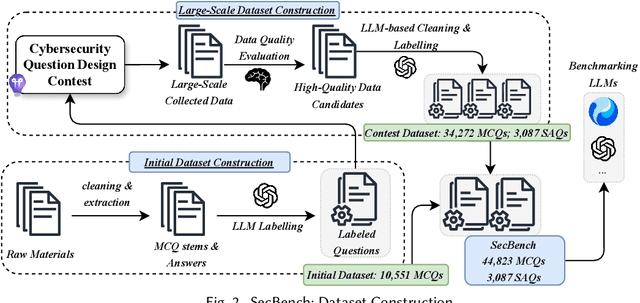
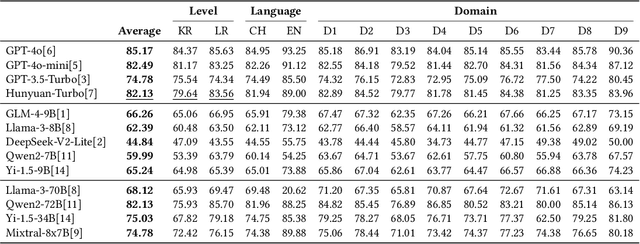
Evaluating Large Language Models (LLMs) is crucial for understanding their capabilities and limitations across various applications, including natural language processing and code generation. Existing benchmarks like MMLU, C-Eval, and HumanEval assess general LLM performance but lack focus on specific expert domains such as cybersecurity. Previous attempts to create cybersecurity datasets have faced limitations, including insufficient data volume and a reliance on multiple-choice questions (MCQs). To address these gaps, we propose SecBench, a multi-dimensional benchmarking dataset designed to evaluate LLMs in the cybersecurity domain. SecBench includes questions in various formats (MCQs and short-answer questions (SAQs)), at different capability levels (Knowledge Retention and Logical Reasoning), in multiple languages (Chinese and English), and across various sub-domains. The dataset was constructed by collecting high-quality data from open sources and organizing a Cybersecurity Question Design Contest, resulting in 44,823 MCQs and 3,087 SAQs. Particularly, we used the powerful while cost-effective LLMs to (1). label the data and (2). constructing a grading agent for automatic evaluation of SAQs.Benchmarking results on 13 SOTA LLMs demonstrate the usability of SecBench, which is arguably the largest and most comprehensive benchmark dataset for LLMs in cybersecurity. More information about SecBench can be found at our website, and the dataset can be accessed via the artifact link.