 Add to Chrome
 Add to Firefox
 Add to Edge
Proto Successor Measure: Representing the Space of All Possible Solutions of Reinforcement Learning
Nov 29, 2024
Having explored an environment, intelligent agents should be able to transfer their knowledge to most downstream tasks within that environment. Referred to as "zero-shot learning," this ability remains elusive for general-purpose reinforcement learning algorithms. While recent works have attempted to produce zero-shot RL agents, they make assumptions about the nature of the tasks or the structure of the MDP. We present \emph{Proto Successor Measure}: the basis set for all possible solutions of Reinforcement Learning in a dynamical system. We provably show that any possible policy can be represented using an affine combination of these policy independent basis functions. Given a reward function at test time, we simply need to find the right set of linear weights to combine these basis corresponding to the optimal policy. We derive a practical algorithm to learn these basis functions using only interaction data from the environment and show that our approach can produce the optimal policy at test time for any given reward function without additional environmental interactions. Project page: https://agarwalsiddhant10.github.io/projects/psm.html.

AMAGO-2: Breaking the Multi-Task Barrier in Meta-Reinforcement Learning with Transformers
Nov 17, 2024
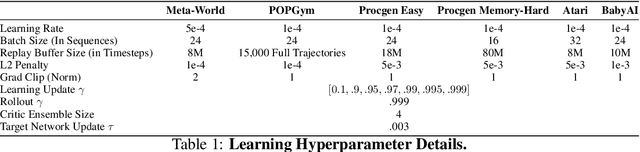


Language models trained on diverse datasets unlock generalization by in-context learning. Reinforcement Learning (RL) policies can achieve a similar effect by meta-learning within the memory of a sequence model. However, meta-RL research primarily focuses on adapting to minor variations of a single task. It is difficult to scale towards more general behavior without confronting challenges in multi-task optimization, and few solutions are compatible with meta-RL's goal of learning from large training sets of unlabeled tasks. To address this challenge, we revisit the idea that multi-task RL is bottlenecked by imbalanced training losses created by uneven return scales across different tasks. We build upon recent advancements in Transformer-based (in-context) meta-RL and evaluate a simple yet scalable solution where both an agent's actor and critic objectives are converted to classification terms that decouple optimization from the current scale of returns. Large-scale comparisons in Meta-World ML45, Multi-Game Procgen, Multi-Task POPGym, Multi-Game Atari, and BabyAI find that this design unlocks significant progress in online multi-task adaptation and memory problems without explicit task labels.
Online Intrinsic Rewards for Decision Making Agents from Large Language Model Feedback
Oct 30, 2024Automatically synthesizing dense rewards from natural language descriptions is a promising paradigm in reinforcement learning (RL), with applications to sparse reward problems, open-ended exploration, and hierarchical skill design. Recent works have made promising steps by exploiting the prior knowledge of large language models (LLMs). However, these approaches suffer from important limitations: they are either not scalable to problems requiring billions of environment samples; or are limited to reward functions expressible by compact code, which may require source code and have difficulty capturing nuanced semantics; or require a diverse offline dataset, which may not exist or be impossible to collect. In this work, we address these limitations through a combination of algorithmic and systems-level contributions. We propose ONI, a distributed architecture that simultaneously learns an RL policy and an intrinsic reward function using LLM feedback. Our approach annotates the agent's collected experience via an asynchronous LLM server, which is then distilled into an intrinsic reward model. We explore a range of algorithmic choices for reward modeling with varying complexity, including hashing, classification, and ranking models. By studying their relative tradeoffs, we shed light on questions regarding intrinsic reward design for sparse reward problems. Our approach achieves state-of-the-art performance across a range of challenging, sparse reward tasks from the NetHack Learning Environment in a simple unified process, solely using the agent's gathered experience, without requiring external datasets nor source code. We make our code available at \url{URL} (coming soon).
SkiLD: Unsupervised Skill Discovery Guided by Factor Interactions
Oct 24, 2024


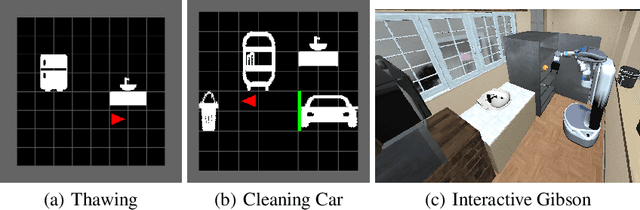
Unsupervised skill discovery carries the promise that an intelligent agent can learn reusable skills through autonomous, reward-free environment interaction. Existing unsupervised skill discovery methods learn skills by encouraging distinguishable behaviors that cover diverse states. However, in complex environments with many state factors (e.g., household environments with many objects), learning skills that cover all possible states is impossible, and naively encouraging state diversity often leads to simple skills that are not ideal for solving downstream tasks. This work introduces Skill Discovery from Local Dependencies (Skild), which leverages state factorization as a natural inductive bias to guide the skill learning process. The key intuition guiding Skild is that skills that induce <b>diverse interactions</b> between state factors are often more valuable for solving downstream tasks. To this end, Skild develops a novel skill learning objective that explicitly encourages the mastering of skills that effectively induce different interactions within an environment. We evaluate Skild in several domains with challenging, long-horizon sparse reward tasks including a realistic simulated household robot domain, where Skild successfully learns skills with clear semantic meaning and shows superior performance compared to existing unsupervised reinforcement learning methods that only maximize state coverage.
Learning a Fast Mixing Exogenous Block MDP using a Single Trajectory
Oct 03, 2024


In order to train agents that can quickly adapt to new objectives or reward functions, efficient unsupervised representation learning in sequential decision-making environments can be important. Frameworks such as the Exogenous Block Markov Decision Process (Ex-BMDP) have been proposed to formalize this representation-learning problem (Efroni et al., 2022b). In the Ex-BMDP framework, the agent's high-dimensional observations of the environment have two latent factors: a controllable factor, which evolves deterministically within a small state space according to the agent's actions, and an exogenous factor, which represents time-correlated noise, and can be highly complex. The goal of the representation learning problem is to learn an encoder that maps from observations into the controllable latent space, as well as the dynamics of this space. Efroni et al. (2022b) has shown that this is possible with a sample complexity that depends only on the size of the controllable latent space, and not on the size of the noise factor. However, this prior work has focused on the episodic setting, where the controllable latent state resets to a specific start state after a finite horizon. By contrast, if the agent can only interact with the environment in a single continuous trajectory, prior works have not established sample-complexity bounds. We propose STEEL, the first provably sample-efficient algorithm for learning the controllable dynamics of an Ex-BMDP from a single trajectory, in the function approximation setting. STEEL has a sample complexity that depends only on the sizes of the controllable latent space and the encoder function class, and (at worst linearly) on the mixing time of the exogenous noise factor. We prove that STEEL is correct and sample-efficient, and demonstrate STEEL on two toy problems. Code is available at: https://github.com/midi-lab/steel.
CAT: Caution Aware Transfer in Reinforcement Learning via Distributional Risk
Aug 16, 2024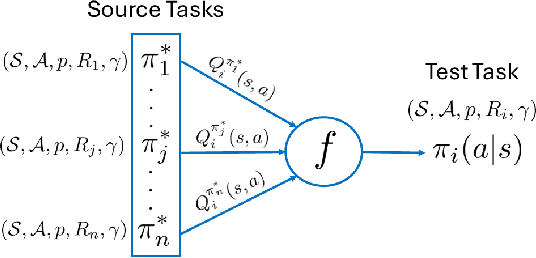
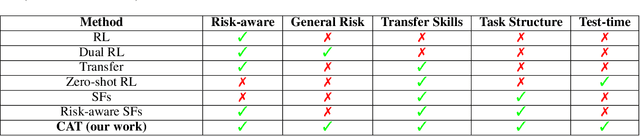

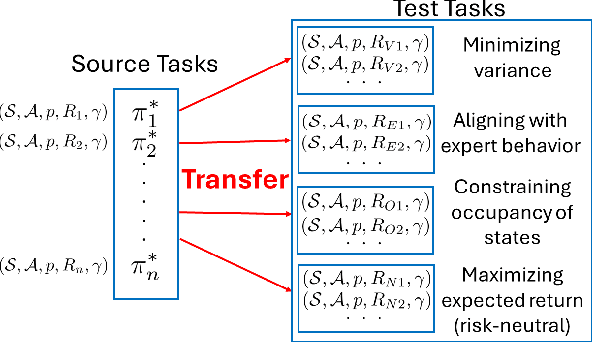
Transfer learning in reinforcement learning (RL) has become a pivotal strategy for improving data efficiency in new, unseen tasks by utilizing knowledge from previously learned tasks. This approach is especially beneficial in real-world deployment scenarios where computational resources are constrained and agents must adapt rapidly to novel environments. However, current state-of-the-art methods often fall short in ensuring safety during the transfer process, particularly when unforeseen risks emerge in the deployment phase. In this work, we address these limitations by introducing a novel Caution-Aware Transfer Learning (CAT) framework. Unlike traditional approaches that limit risk considerations to mean-variance, we define "caution" as a more generalized and comprehensive notion of risk. Our core innovation lies in optimizing a weighted sum of reward return and caution-based on state-action occupancy measures-during the transfer process, allowing for a rich representation of diverse risk factors. To the best of our knowledge, this is the first work to explore the optimization of such a generalized risk notion within the context of transfer RL. Our contributions are threefold: (1) We propose a Caution-Aware Transfer (CAT) framework that evaluates source policies within the test environment and constructs a new policy that balances reward maximization and caution. (2) We derive theoretical sub-optimality bounds for our method, providing rigorous guarantees of its efficacy. (3) We empirically validate CAT, demonstrating that it consistently outperforms existing methods by delivering safer policies under varying risk conditions in the test tasks.
Diffusion-DICE: In-Sample Diffusion Guidance for Offline Reinforcement Learning
Jul 29, 2024


One important property of DIstribution Correction Estimation (DICE) methods is that the solution is the optimal stationary distribution ratio between the optimized and data collection policy. In this work, we show that DICE-based methods can be viewed as a transformation from the behavior distribution to the optimal policy distribution. Based on this, we propose a novel approach, Diffusion-DICE, that directly performs this transformation using diffusion models. We find that the optimal policy's score function can be decomposed into two terms: the behavior policy's score function and the gradient of a guidance term which depends on the optimal distribution ratio. The first term can be obtained from a diffusion model trained on the dataset and we propose an in-sample learning objective to learn the second term. Due to the multi-modality contained in the optimal policy distribution, the transformation in Diffusion-DICE may guide towards those local-optimal modes. We thus generate a few candidate actions and carefully select from them to approach global-optimum. Different from all other diffusion-based offline RL methods, the guide-then-select paradigm in Diffusion-DICE only uses in-sample actions for training and brings minimal error exploitation in the value function. We use a didatic toycase example to show how previous diffusion-based methods fail to generate optimal actions due to leveraging these errors and how Diffusion-DICE successfully avoids that. We then conduct extensive experiments on benchmark datasets to show the strong performance of Diffusion-DICE.
Unified Auto-Encoding with Masked Diffusion
Jun 25, 2024At the core of both successful generative and self-supervised representation learning models there is a reconstruction objective that incorporates some form of image corruption. Diffusion models implement this approach through a scheduled Gaussian corruption process, while masked auto-encoder models do so by masking patches of the image. Despite their different approaches, the underlying similarity in their methodologies suggests a promising avenue for an auto-encoder capable of both de-noising tasks. We propose a unified self-supervised objective, dubbed Unified Masked Diffusion (UMD), that combines patch-based and noise-based corruption techniques within a single auto-encoding framework. Specifically, UMD modifies the diffusion transformer (DiT) training process by introducing an additional noise-free, high masking representation step in the diffusion noising schedule, and utilizes a mixed masked and noised image for subsequent timesteps. By integrating features useful for diffusion modeling and for predicting masked patch tokens, UMD achieves strong performance in downstream generative and representation learning tasks, including linear probing and class-conditional generation. This is achieved without the need for heavy data augmentations, multiple views, or additional encoders. Furthermore, UMD improves over the computational efficiency of prior diffusion based methods in total training time. We release our code at https://github.com/philippe-eecs/small-vision.
A Dual Approach to Imitation Learning from Observations with Offline Datasets
Jun 13, 2024


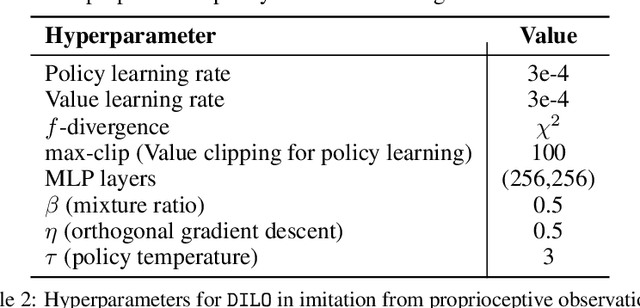
Demonstrations are an effective alternative to task specification for learning agents in settings where designing a reward function is difficult. However, demonstrating expert behavior in the action space of the agent becomes unwieldy when robots have complex, unintuitive morphologies. We consider the practical setting where an agent has a dataset of prior interactions with the environment and is provided with observation-only expert demonstrations. Typical learning from observations approaches have required either learning an inverse dynamics model or a discriminator as intermediate steps of training. Errors in these intermediate one-step models compound during downstream policy learning or deployment. We overcome these limitations by directly learning a multi-step utility function that quantifies how each action impacts the agent's divergence from the expert's visitation distribution. Using the principle of duality, we derive DILO(Dual Imitation Learning from Observations), an algorithm that can leverage arbitrary suboptimal data to learn imitating policies without requiring expert actions. DILO reduces the learning from observations problem to that of simply learning an actor and a critic, bearing similar complexity to vanilla offline RL. This allows DILO to gracefully scale to high dimensional observations, and demonstrate improved performance across the board. Project page (code and videos): $\href{https://hari-sikchi.github.io/dilo/}{\text{hari-sikchi.github.io/dilo/}}$
Robot Air Hockey: A Manipulation Testbed for Robot Learning with Reinforcement Learning
May 06, 2024


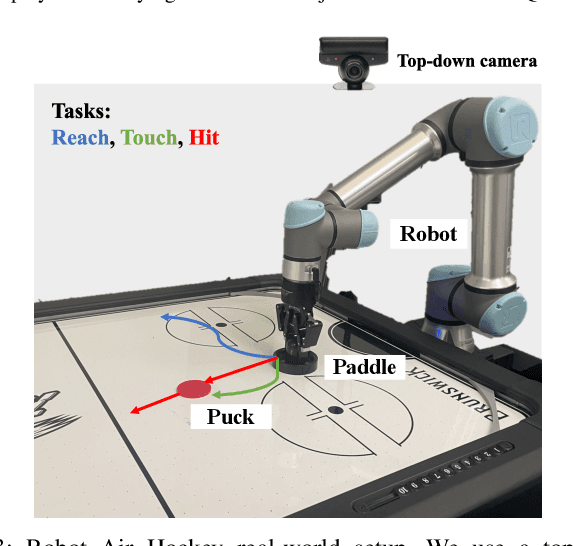
Reinforcement Learning is a promising tool for learning complex policies even in fast-moving and object-interactive domains where human teleoperation or hard-coded policies might fail. To effectively reflect this challenging category of tasks, we introduce a dynamic, interactive RL testbed based on robot air hockey. By augmenting air hockey with a large family of tasks ranging from easy tasks like reaching, to challenging ones like pushing a block by hitting it with a puck, as well as goal-based and human-interactive tasks, our testbed allows a varied assessment of RL capabilities. The robot air hockey testbed also supports sim-to-real transfer with three domains: two simulators of increasing fidelity and a real robot system. Using a dataset of demonstration data gathered through two teleoperation systems: a virtualized control environment, and human shadowing, we assess the testbed with behavior cloning, offline RL, and RL from scratch.