 Add to Chrome
 Add to Firefox
 Add to Edge
CollabEval: Statistically Efficient Collaborative Model Evaluation via Matrix Completion
Jul 06, 2026
Evaluating generative AI models is a routine, but resource-intensive, process that is conducted over and over again during the course of model development. In this work, we propose Collaborative Evaluation (CollabEval), a simple, effective, and principled method for exploiting dependencies between historical runs of different models on the same tasks to improve statistical efficiency. Specifically, our approach treats model evaluation as a matrix completion problem over an $M \times N$ matrix of evaluation scores, where $M$ is the total number of models and $N$ is the total number of evaluation prompts. We assume that a subset of these $M$ models are targeted for evaluation. For these target models only a small fraction, $p$, of prompts has been annotated with evaluation scores. Leveraging recent results in prediction-powered inference, we build a low-rank approximation of the score matrix, and use the reconstructed values as control variates in a manner that guarantees unbiased estimates of the true evaluation metric mean, in addition to statistically valid confidence intervals. Empirically, across a wide range of datasets, models, and sparsity levels $p$, we find that CollabEval substantially reduces the mean confidence interval size, and the mean squared error of the point estimate, compared to baseline methods at the same annotation budget.

Representational Similarity and Model Behavior in Multi-Agent Interaction
Jun 05, 2026Researchers have shown that neural similarity among humans predicts social closeness and cooperative success, whereas innovation often emerges from interactions among dissimilar individuals. We investigate whether these principles extend to artificial intelligence by examining interactions between large language models. In our experiments, 276 model pairs interact across eight games spanning both cooperation and novelty. We find that pairs with more similar representation spaces achieve significantly higher cooperation but exhibit reduced novelty and creativity. The effects of representational similarity on cooperation and novelty remain robust even after controlling for other factors such as performance disparity and model size. We also find that similarity in the early layers consistently shows the strongest association with cooperation and novelty, compared to the middle and later layers. This suggests that a central factor underlying these patterns could be the extent to which the two models share lexical and semantic grounding. Overall, representational similarity can be an important consideration in multi-agent system design.
Multiple-Prediction-Powered Inference
Mar 28, 2026Statistical estimation often involves tradeoffs between expensive, high-quality measurements and a variety of lower-quality proxies. We introduce Multiple-Prediction-Powered Inference (MultiPPI): a general framework for constructing statistically efficient estimates by optimally allocating resources across these diverse data sources. This work provides theoretical guarantees about the minimax optimality, finite-sample performance, and asymptotic normality of the MultiPPI estimator. Through experiments across three diverse large language model (LLM) evaluation scenarios, we show that MultiPPI consistently achieves lower estimation error than existing baselines. This advantage stems from its budget-adaptive allocation strategy, which strategically combines subsets of models by learning their complex cost and correlation structures.
MT-PingEval: Evaluating Multi-Turn Collaboration with Private Information Games
Feb 27, 2026We present a scalable methodology for evaluating language models in multi-turn interactions, using a suite of collaborative games that require effective communication about private information. This enables an interactive scaling analysis, in which a fixed token budget is divided over a variable number of turns. We find that in many cases, language models are unable to use interactive collaboration to improve over the non-interactive baseline scenario in which one agent attempts to summarize its information and the other agent immediately acts -- despite substantial headroom. This suggests that state-of-the-art models still suffer from significant weaknesses in planning and executing multi-turn collaborative conversations. We analyze the linguistic features of these dialogues, assessing the roles of sycophancy, information density, and discourse coherence. While there is no single linguistic explanation for the collaborative weaknesses of contemporary language models, we note that humans achieve comparable task success at superior token efficiency by producing dialogues that are more coherent than those produced by most language models. The proactive management of private information is a defining feature of real-world communication, and we hope that MT-PingEval will drive further work towards improving this capability.
Bridging Kolmogorov Complexity and Deep Learning: Asymptotically Optimal Description Length Objectives for Transformers
Sep 26, 2025

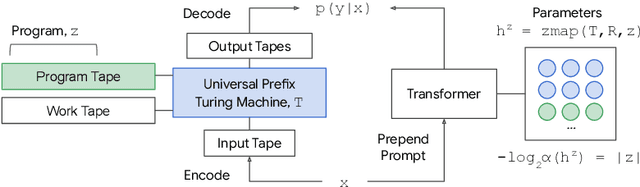
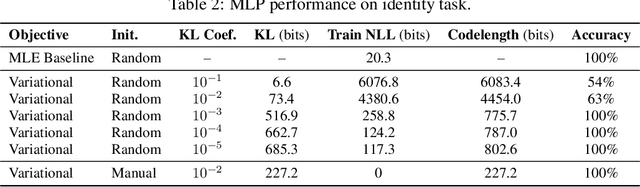
The Minimum Description Length (MDL) principle offers a formal framework for applying Occam's razor in machine learning. However, its application to neural networks such as Transformers is challenging due to the lack of a principled, universal measure for model complexity. This paper introduces the theoretical notion of asymptotically optimal description length objectives, grounded in the theory of Kolmogorov complexity. We establish that a minimizer of such an objective achieves optimal compression, for any dataset, up to an additive constant, in the limit as model resource bounds increase. We prove that asymptotically optimal objectives exist for Transformers, building on a new demonstration of their computational universality. We further show that such objectives can be tractable and differentiable by constructing and analyzing a variational objective based on an adaptive Gaussian mixture prior. Our empirical analysis shows that this variational objective selects for a low-complexity solution with strong generalization on an algorithmic task, but standard optimizers fail to find such solutions from a random initialization, highlighting key optimization challenges. More broadly, by providing a theoretical framework for identifying description length objectives with strong asymptotic guarantees, we outline a potential path towards training neural networks that achieve greater compression and generalization.
Cost-Optimal Active AI Model Evaluation
Jun 09, 2025The development lifecycle of generative AI systems requires continual evaluation, data acquisition, and annotation, which is costly in both resources and time. In practice, rapid iteration often makes it necessary to rely on synthetic annotation data because of the low cost, despite the potential for substantial bias. In this paper, we develop novel, cost-aware methods for actively balancing the use of a cheap, but often inaccurate, weak rater -- such as a model-based autorater that is designed to automatically assess the quality of generated content -- with a more expensive, but also more accurate, strong rater alternative such as a human. More specifically, the goal of our approach is to produce a low variance, unbiased estimate of the mean of the target "strong" rating, subject to some total annotation budget. Building on recent work in active and prediction-powered statistical inference, we derive a family of cost-optimal policies for allocating a given annotation budget between weak and strong raters so as to maximize statistical efficiency. Using synthetic and real-world data, we empirically characterize the conditions under which these policies yield improvements over prior methods. We find that, especially in tasks where there is high variability in the difficulty of examples, our policies can achieve the same estimation precision at a far lower total annotation budget than standard evaluation methods.
Don't lie to your friends: Learning what you know from collaborative self-play
Mar 18, 2025To be helpful assistants, AI agents must be aware of their own capabilities and limitations. This includes knowing when to answer from parametric knowledge versus using tools, when to trust tool outputs, and when to abstain or hedge. Such capabilities are hard to teach through supervised fine-tuning because they require constructing examples that reflect the agent's specific capabilities. We therefore propose a radically new approach to teaching agents what they know: \emph{collaborative self-play}. We construct multi-agent collaborations in which the group is rewarded for collectively arriving at correct answers. The desired meta-knowledge emerges from the incentives built into the structure of the interaction. We focus on small societies of agents that have access to heterogeneous tools (corpus-specific retrieval), and therefore must collaborate to maximize their success while minimizing their effort. Experiments show that group-level rewards for multi-agent communities can induce policies that \emph{transfer} to improve tool use and selective prediction in settings where individual agents are deployed in isolation.
InfAlign: Inference-aware language model alignment
Dec 27, 2024Language model alignment has become a critical step in training modern generative language models. The goal of alignment is to finetune a reference model such that the win rate of a sample from the aligned model over a sample from the reference model is high, subject to a KL divergence constraint. Today, we are increasingly using inference-time algorithms (e.g., Best-of-N, controlled decoding, tree search) to decode from language models rather than standard sampling. However, the alignment objective does not capture such inference-time decoding procedures. We show that the existing alignment framework is sub-optimal in view of such inference-time methods. We then modify the alignment objective and propose a framework for inference-aware alignment (IAPO). We prove that for any inference-time decoding algorithm, the optimal solution that optimizes the inference-time win rate of the aligned policy against the reference policy is the solution to the typical RLHF problem with a transformation of the reward. This motivates us to provide the KL-regularized calibrate-and-transform RL (CTRL) algorithm to solve this problem, which involves a reward calibration step and a KL-regularized reward maximization step with a transformation of the calibrated reward. We particularize our study to two important inference-time strategies: best-of-N sampling and best-of-N jailbreaking, where N responses are sampled from the model and the one with the highest or lowest reward is selected. We propose specific transformations for these strategies and demonstrate that our framework offers significant improvements over existing state-of-the-art methods for language model alignment. Empirically, we outperform baselines that are designed without taking inference-time decoding into consideration by 8-12% and 4-9% on inference-time win rates over the Anthropic helpfulness and harmlessness dialog benchmark datasets.
ALTA: Compiler-Based Analysis of Transformers
Oct 23, 2024


We propose a new programming language called ALTA and a compiler that can map ALTA programs to Transformer weights. ALTA is inspired by RASP, a language proposed by Weiss et al. (2021), and Tracr (Lindner et al., 2023), a compiler from RASP programs to Transformer weights. ALTA complements and extends this prior work, offering the ability to express loops and to compile programs to Universal Transformers, among other advantages. ALTA allows us to constructively show how Transformers can represent length-invariant algorithms for computing parity and addition, as well as a solution to the SCAN benchmark of compositional generalization tasks, without requiring intermediate scratchpad decoding steps. We also propose tools to analyze cases where the expressibility of an algorithm is established, but end-to-end training on a given training set fails to induce behavior consistent with the desired algorithm. To this end, we explore training from ALTA execution traces as a more fine-grained supervision signal. This enables additional experiments and theoretical analyses relating the learnability of various algorithms to data availability and modeling decisions, such as positional encodings. We make the ALTA framework -- language specification, symbolic interpreter, and weight compiler -- available to the community to enable further applications and insights.
Rewarding Progress: Scaling Automated Process Verifiers for LLM Reasoning
Oct 10, 2024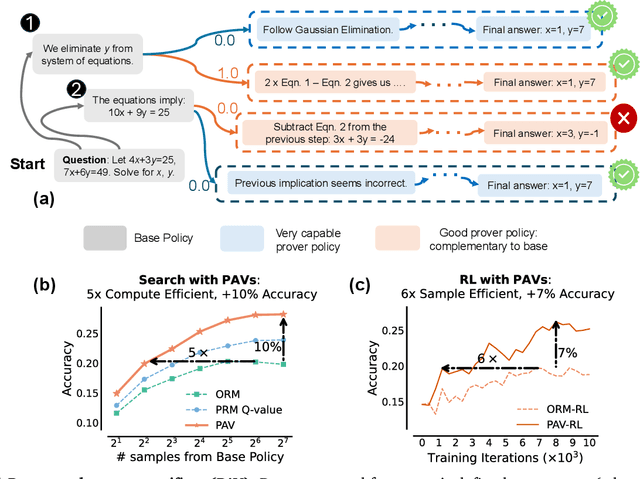

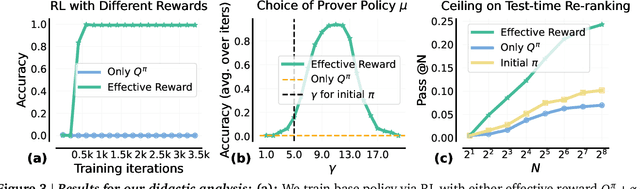
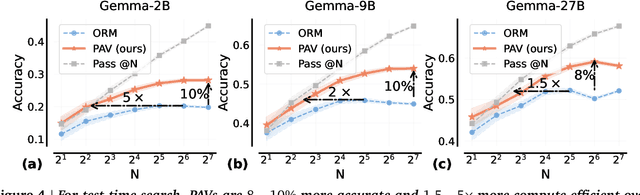
A promising approach for improving reasoning in large language models is to use process reward models (PRMs). PRMs provide feedback at each step of a multi-step reasoning trace, potentially improving credit assignment over outcome reward models (ORMs) that only provide feedback at the final step. However, collecting dense, per-step human labels is not scalable, and training PRMs from automatically-labeled data has thus far led to limited gains. To improve a base policy by running search against a PRM or using it as dense rewards for reinforcement learning (RL), we ask: "How should we design process rewards?". Our key insight is that, to be effective, the process reward for a step should measure progress: a change in the likelihood of producing a correct response in the future, before and after taking the step, corresponding to the notion of step-level advantages in RL. Crucially, this progress should be measured under a prover policy distinct from the base policy. We theoretically characterize the set of good provers and our results show that optimizing process rewards from such provers improves exploration during test-time search and online RL. In fact, our characterization shows that weak prover policies can substantially improve a stronger base policy, which we also observe empirically. We validate our claims by training process advantage verifiers (PAVs) to predict progress under such provers, and show that compared to ORMs, test-time search against PAVs is $>8\%$ more accurate, and $1.5-5\times$ more compute-efficient. Online RL with dense rewards from PAVs enables one of the first results with $5-6\times$ gain in sample efficiency, and $>6\%$ gain in accuracy, over ORMs.