 Add to Chrome
 Add to Firefox
 Add to Edge
$\oslash$ Source Models Leak What They Shouldn't $ rightarrow$: Unlearning Zero-Shot Transfer in Domain Adaptation Through Adversarial Optimization
Apr 09, 2026
The increasing adaptation of vision models across domains, such as satellite imagery and medical scans, has raised an emerging privacy risk: models may inadvertently retain and leak sensitive source-domain specific information in the target domain. This creates a compelling use case for machine unlearning to protect the privacy of sensitive source-domain data. Among adaptation techniques, source-free domain adaptation (SFDA) calls for an urgent need for machine unlearning (MU), where the source data itself is protected, yet the source model exposed during adaptation encodes its influence. Our experiments reveal that existing SFDA methods exhibit strong zero-shot performance on source-exclusive classes in the target domain, indicating they inadvertently leak knowledge of these classes into the target domain, even when they are not represented in the target data. We identify and address this risk by proposing an MU setting called SCADA-UL: Unlearning Source-exclusive ClAsses in Domain Adaptation. Existing MU methods do not address this setting as they are not designed to handle data distribution shifts. We propose a new unlearning method, where an adversarially generated forget class sample is unlearned by the model during the domain adaptation process using a novel rescaled labeling strategy and adversarial optimization. We also extend our study to two variants: a continual version of this problem setting and to one where the specific source classes to be forgotten may be unknown. Alongside theoretical interpretations, our comprehensive empirical results show that our method consistently outperforms baselines in the proposed setting while achieving retraining-level unlearning performance on benchmark datasets. Our code is available at https://github.com/D-Arnav/SCADA

Exact Unlearning of Finetuning Data via Model Merging at Scale
Apr 06, 2025Approximate unlearning has gained popularity as an approach to efficiently update an LLM so that it behaves (roughly) as if it was not trained on a subset of data to begin with. However, existing methods are brittle in practice and can easily be attacked to reveal supposedly unlearned information. To alleviate issues with approximate unlearning, we instead propose SIFT-Masks (SIgn-Fixed Tuning-Masks), an exact unlearning method based on model merging. SIFT-Masks addresses two key limitations of standard model merging: (1) merging a large number of tasks can severely harm utility; and (2) methods that boost utility by sharing extra information across tasks make exact unlearning prohibitively expensive. SIFT-Masks solves these issues by (1) applying local masks to recover task-specific performance; and (2) constraining finetuning to align with a global sign vector as a lightweight approach to determine masks independently before merging. Across four settings where we merge up to 500 models, SIFT-Masks improves accuracy by 5-80% over naive merging and uses up to 250x less compute for exact unlearning compared to other merging baselines.
Overcoming Data and Model Heterogeneities in Decentralized Federated Learning via Synthetic Anchors
May 19, 2024
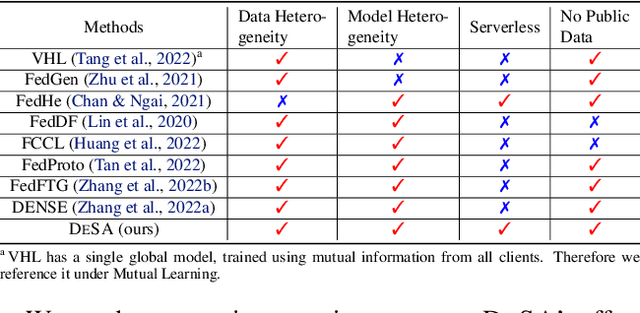

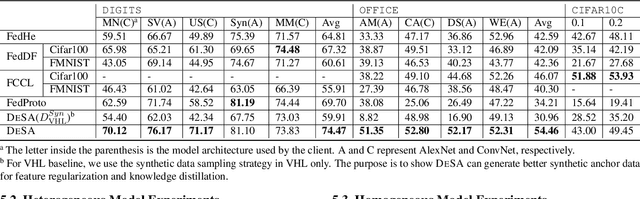
Conventional Federated Learning (FL) involves collaborative training of a global model while maintaining user data privacy. One of its branches, decentralized FL, is a serverless network that allows clients to own and optimize different local models separately, which results in saving management and communication resources. Despite the promising advancements in decentralized FL, it may reduce model generalizability due to lacking a global model. In this scenario, managing data and model heterogeneity among clients becomes a crucial problem, which poses a unique challenge that must be overcome: How can every client's local model learn generalizable representation in a decentralized manner? To address this challenge, we propose a novel Decentralized FL technique by introducing Synthetic Anchors, dubbed as DeSA. Based on the theory of domain adaptation and Knowledge Distillation (KD), we theoretically and empirically show that synthesizing global anchors based on raw data distribution facilitates mutual knowledge transfer. We further design two effective regularization terms for local training: 1) REG loss that regularizes the distribution of the client's latent embedding with the anchors and 2) KD loss that enables clients to learn from others. Through extensive experiments on diverse client data distributions, we showcase the effectiveness of DeSA in enhancing both inter- and intra-domain accuracy of each client.