 Add to Chrome
 Add to Firefox
 Add to Edge
facial
Papers and Code
Automated User Identification from Facial Thermograms with Siamese Networks
Dec 15, 2025
The article analyzes the use of thermal imaging technologies for biometric identification based on facial thermograms. It presents a comparative analysis of infrared spectral ranges (NIR, SWIR, MWIR, and LWIR). The paper also defines key requirements for thermal cameras used in biometric systems, including sensor resolution, thermal sensitivity, and a frame rate of at least 30 Hz. Siamese neural networks are proposed as an effective approach for automating the identification process. In experiments conducted on a proprietary dataset, the proposed method achieved an accuracy of approximately 80%. The study also examines the potential of hybrid systems that combine visible and infrared spectra to overcome the limitations of individual modalities. The results indicate that thermal imaging is a promising technology for developing reliable security systems.

Open-World Deepfake Attribution via Confidence-Aware Asymmetric Learning
Dec 14, 2025The proliferation of synthetic facial imagery has intensified the need for robust Open-World DeepFake Attribution (OW-DFA), which aims to attribute both known and unknown forgeries using labeled data for known types and unlabeled data containing a mixture of known and novel types. However, existing OW-DFA methods face two critical limitations: 1) A confidence skew that leads to unreliable pseudo-labels for novel forgeries, resulting in biased training. 2) An unrealistic assumption that the number of unknown forgery types is known *a priori*. To address these challenges, we propose a Confidence-Aware Asymmetric Learning (CAL) framework, which adaptively balances model confidence across known and novel forgery types. CAL mainly consists of two components: Confidence-Aware Consistency Regularization (CCR) and Asymmetric Confidence Reinforcement (ACR). CCR mitigates pseudo-label bias by dynamically scaling sample losses based on normalized confidence, gradually shifting the training focus from high- to low-confidence samples. ACR complements this by separately calibrating confidence for known and novel classes through selective learning on high-confidence samples, guided by their confidence gap. Together, CCR and ACR form a mutually reinforcing loop that significantly improves the model's OW-DFA performance. Moreover, we introduce a Dynamic Prototype Pruning (DPP) strategy that automatically estimates the number of novel forgery types in a coarse-to-fine manner, removing the need for unrealistic prior assumptions and enhancing the scalability of our methods to real-world OW-DFA scenarios. Extensive experiments on the standard OW-DFA benchmark and a newly extended benchmark incorporating advanced manipulations demonstrate that CAL consistently outperforms previous methods, achieving new state-of-the-art performance on both known and novel forgery attribution.
Feature Aggregation for Efficient Continual Learning of Complex Facial Expressions
Dec 13, 2025As artificial intelligence (AI) systems become increasingly embedded in our daily life, the ability to recognize and adapt to human emotions is essential for effective human-computer interaction. Facial expression recognition (FER) provides a primary channel for inferring affective states, but the dynamic and culturally nuanced nature of emotions requires models that can learn continuously without forgetting prior knowledge. In this work, we propose a hybrid framework for FER in a continual learning setting that mitigates catastrophic forgetting. Our approach integrates two complementary modalities: deep convolutional features and facial Action Units (AUs) derived from the Facial Action Coding System (FACS). The combined representation is modelled through Bayesian Gaussian Mixture Models (BGMMs), which provide a lightweight, probabilistic solution that avoids retraining while offering strong discriminative power. Using the Compound Facial Expression of Emotion (CFEE) dataset, we show that our model can first learn basic expressions and then progressively recognize compound expressions. Experiments demonstrate improved accuracy, stronger knowledge retention, and reduced forgetting. This framework contributes to the development of emotionally intelligent AI systems with applications in education, healthcare, and adaptive user interfaces.
A Hybrid Deep Learning Framework for Emotion Recognition in Children with Autism During NAO Robot-Mediated Interaction
Dec 13, 2025Understanding emotional responses in children with Autism Spectrum Disorder (ASD) during social interaction remains a critical challenge in both developmental psychology and human-robot interaction. This study presents a novel deep learning pipeline for emotion recognition in autistic children in response to a name-calling event by a humanoid robot (NAO), under controlled experimental settings. The dataset comprises of around 50,000 facial frames extracted from video recordings of 15 children with ASD. A hybrid model combining a fine-tuned ResNet-50-based Convolutional Neural Network (CNN) and a three-layer Graph Convolutional Network (GCN) trained on both visual and geometric features extracted from MediaPipe FaceMesh landmarks. Emotions were probabilistically labeled using a weighted ensemble of two models: DeepFace's and FER, each contributing to soft-label generation across seven emotion classes. Final classification leveraged a fused embedding optimized via Kullback-Leibler divergence. The proposed method demonstrates robust performance in modeling subtle affective responses and offers significant promise for affective profiling of ASD children in clinical and therapeutic human-robot interaction contexts, as the pipeline effectively captures micro emotional cues in neurodivergent children, addressing a major gap in autism-specific HRI research. This work represents the first such large-scale, real-world dataset and pipeline from India on autism-focused emotion analysis using social robotics, contributing an essential foundation for future personalized assistive technologies.
CLOAK: Contrastive Guidance for Latent Diffusion-Based Data Obfuscation
Dec 12, 2025Data obfuscation is a promising technique for mitigating attribute inference attacks by semi-trusted parties with access to time-series data emitted by sensors. Recent advances leverage conditional generative models together with adversarial training or mutual information-based regularization to balance data privacy and utility. However, these methods often require modifying the downstream task, struggle to achieve a satisfactory privacy-utility trade-off, or are computationally intensive, making them impractical for deployment on resource-constrained mobile IoT devices. We propose Cloak, a novel data obfuscation framework based on latent diffusion models. In contrast to prior work, we employ contrastive learning to extract disentangled representations, which guide the latent diffusion process to retain useful information while concealing private information. This approach enables users with diverse privacy needs to navigate the privacy-utility trade-off with minimal retraining. Extensive experiments on four public time-series datasets, spanning multiple sensing modalities, and a dataset of facial images demonstrate that Cloak consistently outperforms state-of-the-art obfuscation techniques and is well-suited for deployment in resource-constrained settings.
PersonaLive! Expressive Portrait Image Animation for Live Streaming
Dec 12, 2025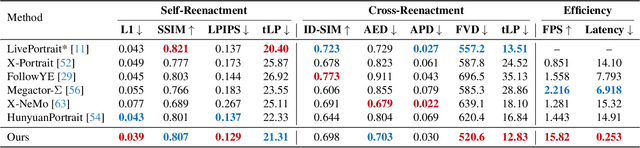
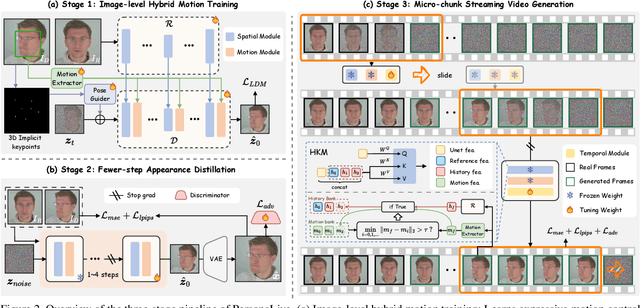
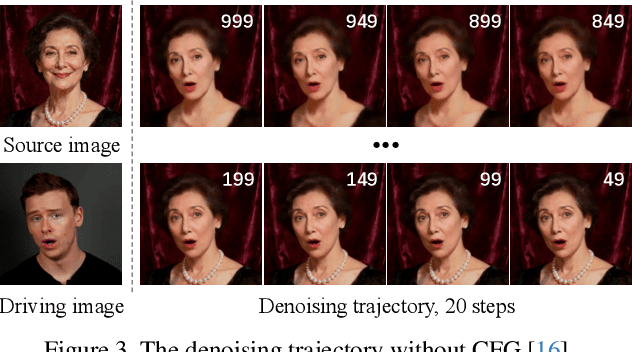
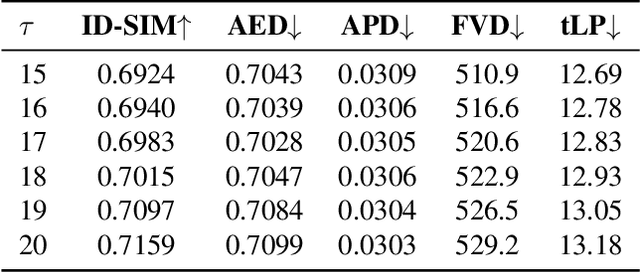
Current diffusion-based portrait animation models predominantly focus on enhancing visual quality and expression realism, while overlooking generation latency and real-time performance, which restricts their application range in the live streaming scenario. We propose PersonaLive, a novel diffusion-based framework towards streaming real-time portrait animation with multi-stage training recipes. Specifically, we first adopt hybrid implicit signals, namely implicit facial representations and 3D implicit keypoints, to achieve expressive image-level motion control. Then, a fewer-step appearance distillation strategy is proposed to eliminate appearance redundancy in the denoising process, greatly improving inference efficiency. Finally, we introduce an autoregressive micro-chunk streaming generation paradigm equipped with a sliding training strategy and a historical keyframe mechanism to enable low-latency and stable long-term video generation. Extensive experiments demonstrate that PersonaLive achieves state-of-the-art performance with up to 7-22x speedup over prior diffusion-based portrait animation models.
FactorPortrait: Controllable Portrait Animation via Disentangled Expression, Pose, and Viewpoint
Dec 12, 2025We introduce FactorPortrait, a video diffusion method for controllable portrait animation that enables lifelike synthesis from disentangled control signals of facial expressions, head movement, and camera viewpoints. Given a single portrait image, a driving video, and camera trajectories, our method animates the portrait by transferring facial expressions and head movements from the driving video while simultaneously enabling novel view synthesis from arbitrary viewpoints. We utilize a pre-trained image encoder to extract facial expression latents from the driving video as control signals for animation generation. Such latents implicitly capture nuanced facial expression dynamics with identity and pose information disentangled, and they are efficiently injected into the video diffusion transformer through our proposed expression controller. For camera and head pose control, we employ Plücker ray maps and normal maps rendered from 3D body mesh tracking. To train our model, we curate a large-scale synthetic dataset containing diverse combinations of camera viewpoints, head poses, and facial expression dynamics. Extensive experiments demonstrate that our method outperforms existing approaches in realism, expressiveness, control accuracy, and view consistency.
WildCap: Facial Appearance Capture in the Wild via Hybrid Inverse Rendering
Dec 12, 2025Existing methods achieve high-quality facial appearance capture under controllable lighting, which increases capture cost and limits usability. We propose WildCap, a novel method for high-quality facial appearance capture from a smartphone video recorded in the wild. To disentangle high-quality reflectance from complex lighting effects in in-the-wild captures, we propose a novel hybrid inverse rendering framework. Specifically, we first apply a data-driven method, i.e., SwitchLight, to convert the captured images into more constrained conditions and then adopt model-based inverse rendering. However, unavoidable local artifacts in network predictions, such as shadow-baking, are non-physical and thus hinder accurate inverse rendering of lighting and material. To address this, we propose a novel texel grid lighting model to explain non-physical effects as clean albedo illuminated by local physical lighting. During optimization, we jointly sample a diffusion prior for reflectance maps and optimize the lighting, effectively resolving scale ambiguity between local lights and albedo. Our method achieves significantly better results than prior arts in the same capture setup, closing the quality gap between in-the-wild and controllable recordings by a large margin. Our code will be released \href{https://yxuhan.github.io/WildCap/index.html}{\textcolor{magenta}{here}}.
KeyframeFace: From Text to Expressive Facial Keyframes
Dec 12, 2025Generating dynamic 3D facial animation from natural language requires understanding both temporally structured semantics and fine-grained expression changes. Existing datasets and methods mainly focus on speech-driven animation or unstructured expression sequences and therefore lack the semantic grounding and temporal structures needed for expressive human performance generation. In this work, we introduce KeyframeFace, a large-scale multimodal dataset designed for text-to-animation research through keyframe-level supervision. KeyframeFace provides 2,100 expressive scripts paired with monocular videos, per-frame ARKit coefficients, contextual backgrounds, complex emotions, manually defined keyframes, and multi-perspective annotations based on ARKit coefficients and images via Large Language Models (LLMs) and Multimodal Large Language Models (MLLMs). Beyond the dataset, we propose the first text-to-animation framework that explicitly leverages LLM priors for interpretable facial motion synthesis. This design aligns the semantic understanding capabilities of LLMs with the interpretable structure of ARKit's coefficients, enabling high-fidelity expressive animation. KeyframeFace and our LLM-based framework together establish a new foundation for interpretable, keyframe-guided, and context-aware text-to-animation. Code and data are available at https://github.com/wjc12345123/KeyframeFace.
Depth-Copy-Paste: Multimodal and Depth-Aware Compositing for Robust Face Detection
Dec 12, 2025Data augmentation is crucial for improving the robustness of face detection systems, especially under challenging conditions such as occlusion, illumination variation, and complex environments. Traditional copy paste augmentation often produces unrealistic composites due to inaccurate foreground extraction, inconsistent scene geometry, and mismatched background semantics. To address these limitations, we propose Depth Copy Paste, a multimodal and depth aware augmentation framework that generates diverse and physically consistent face detection training samples by copying full body person instances and pasting them into semantically compatible scenes. Our approach first employs BLIP and CLIP to jointly assess semantic and visual coherence, enabling automatic retrieval of the most suitable background images for the given foreground person. To ensure high quality foreground masks that preserve facial details, we integrate SAM3 for precise segmentation and Depth-Anything to extract only the non occluded visible person regions, preventing corrupted facial textures from being used in augmentation. For geometric realism, we introduce a depth guided sliding window placement mechanism that searches over the background depth map to identify paste locations with optimal depth continuity and scale alignment. The resulting composites exhibit natural depth relationships and improved visual plausibility. Extensive experiments show that Depth Copy Paste provides more diverse and realistic training data, leading to significant performance improvements in downstream face detection tasks compared with traditional copy paste and depth free augmentation methods.