 Add to Chrome
 Add to Firefox
 Add to Edge
Human vs. NAO: A Computational-Behavioral Framework for Quantifying Social Orienting in Autism and Typical Development
Mar 24, 2026
Responding to one's name is among the earliest-emerging social orienting behaviors and is one of the most prominent aspects in the detection of Autism Spectrum Disorder (ASD). Typically developing children exhibit near-reflexive orienting to their name, whereas children with ASD often demonstrate reduced frequency, increased latency, or atypical patterns of response. In this study, we examine differential responsiveness to quantify name-calling stimuli delivered by both human agents and NAO, a humanoid robot widely employed in socially assistive interventions for autism. The analysis focuses on multiple behavioral parameters, including eye contact, response latency, head and facial orientation shifts, and duration of sustained interest. Video-based computational methods were employed, incorporating face detection, eye region tracking, and spatio-temporal facial analysis, to obtain fine-grained measures of children's responses. By comparing neurotypical and neuroatypical groups under controlled human-robot conditions, this work aims to understand how the source and modality of social cues affect attentional dynamics in name-calling contexts. The findings advance both the theoretical understanding of social orienting deficits in autism and the applied development of robot-assisted assessment tools.

A Hybrid Deep Learning Framework for Emotion Recognition in Children with Autism During NAO Robot-Mediated Interaction
Dec 13, 2025Understanding emotional responses in children with Autism Spectrum Disorder (ASD) during social interaction remains a critical challenge in both developmental psychology and human-robot interaction. This study presents a novel deep learning pipeline for emotion recognition in autistic children in response to a name-calling event by a humanoid robot (NAO), under controlled experimental settings. The dataset comprises of around 50,000 facial frames extracted from video recordings of 15 children with ASD. A hybrid model combining a fine-tuned ResNet-50-based Convolutional Neural Network (CNN) and a three-layer Graph Convolutional Network (GCN) trained on both visual and geometric features extracted from MediaPipe FaceMesh landmarks. Emotions were probabilistically labeled using a weighted ensemble of two models: DeepFace's and FER, each contributing to soft-label generation across seven emotion classes. Final classification leveraged a fused embedding optimized via Kullback-Leibler divergence. The proposed method demonstrates robust performance in modeling subtle affective responses and offers significant promise for affective profiling of ASD children in clinical and therapeutic human-robot interaction contexts, as the pipeline effectively captures micro emotional cues in neurodivergent children, addressing a major gap in autism-specific HRI research. This work represents the first such large-scale, real-world dataset and pipeline from India on autism-focused emotion analysis using social robotics, contributing an essential foundation for future personalized assistive technologies.
A Hybrid Technique for Plant Disease Identification and Localisation in Real-time
Dec 27, 2024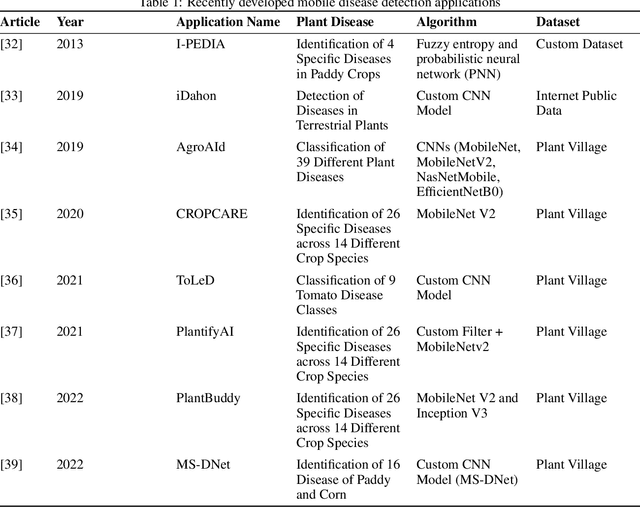
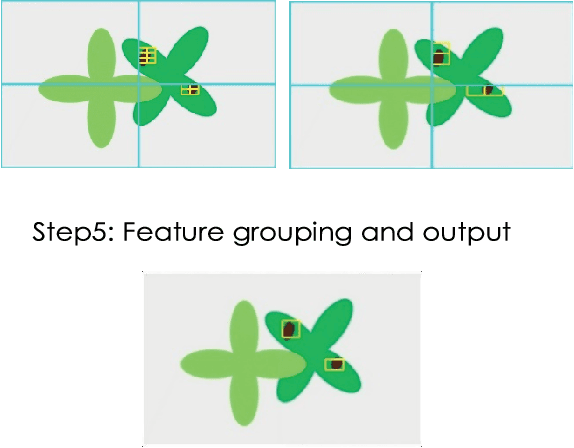
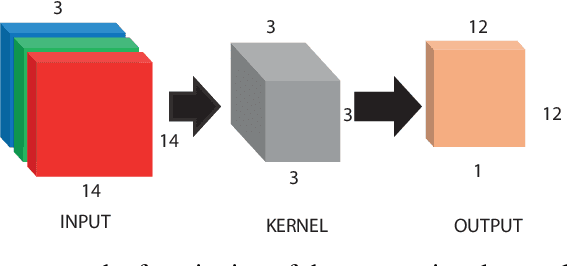
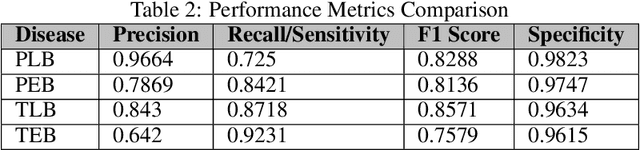
Over the past decade, several image-processing methods and algorithms have been proposed for identifying plant diseases based on visual data. DNN (Deep Neural Networks) have recently become popular for this task. Both traditional image processing and DNN-based methods encounter significant performance issues in real-time detection owing to computational limitations and a broad spectrum of plant disease features. This article proposes a novel technique for identifying and localising plant disease based on the Quad-Tree decomposition of an image and feature learning simultaneously. The proposed algorithm significantly improves accuracy and faster convergence in high-resolution images with relatively low computational load. Hence it is ideal for deploying the algorithm in a standalone processor in a remotely operated image acquisition and disease detection system, ideally mounted on drones and robots working on large agricultural fields. The technique proposed in this article is hybrid as it exploits the advantages of traditional image processing methods and DNN-based models at different scales, resulting in faster inference. The F1 score is approximately 0.80 for four disease classes corresponding to potato and tomato crops.
An anthropomorphic continuum robotic neck actuated by SMA spring-based multipennate muscle architecture
Sep 07, 2023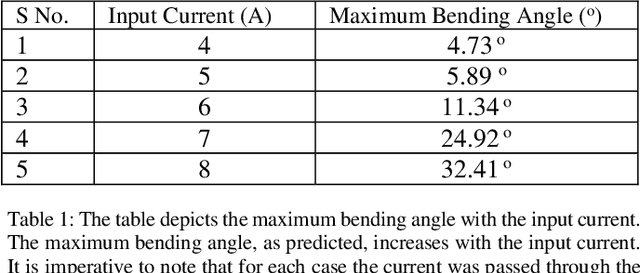
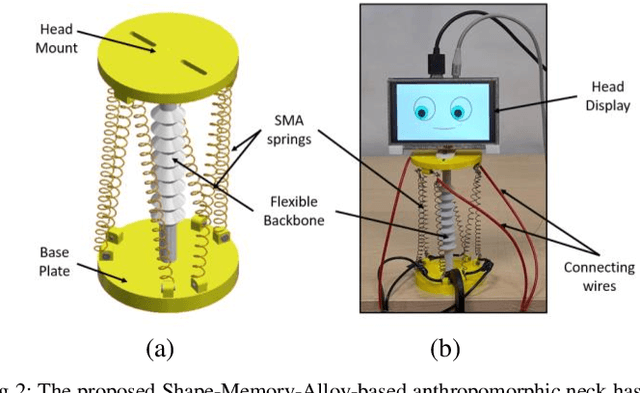
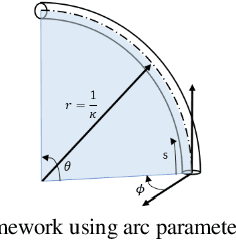
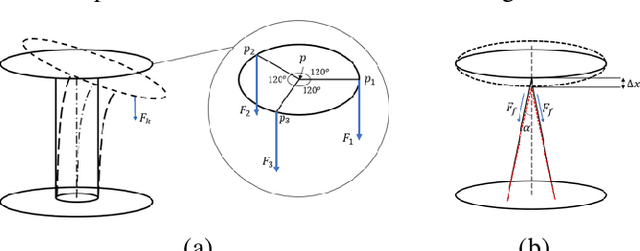
This work presents a novel Shape Memory Alloy spring actuated continuum robotic neck that derives inspiration from pennate muscle architecture. The proposed design has 2DOF, and experimental studies reveal that the designed joint can replicate the human head's anthropomorphic range of motion. We enumerate the analytical modelling for SMA actuators and the kinematic model of the proposed design configuration. A series of experiments were conducted to assess the performance of the anthropomorphic neck by measuring the range of motion with varying input currents. Furthermore, the experiments were conducted to validate the analytical model of the SMA Multiphysics and the continuum backbone. The existing humanoid necks have been powered by conventional actuators that have relatively low energy efficiency and are prone to wear. The current research envisages application of nonconventional actuator such as SMA springs with specific geometric configuration yielding high power to weight ratio that delivers smooth motion for continuum robots as demonstrated in this present work.