 Add to Chrome
 Add to Firefox
 Add to Edge
UVFaceFusion: Fast Multi-view Topologically Consistent Face Reconstruction in the Wild via UV-space Neural Fusion
Jul 21, 2026
Reconstructing high-fidelity facial geometry with an assigned topology is essential for digital avatar creation and animation, yet existing automated methods often trade off geometric fidelity and in-the-wild generalization. We present UVFaceFusion, a feed-forward framework for multi-view, fixed-topology face reconstruction from daily images. Our key idea is to replace heuristic topological optimization with learnable neural fusion in a canonical UV space. Given multi-view images, we first obtain dense point maps and facial UV correspondences of each view using VGGT and Pixel3DMM, respectively. Then, the view-specific point maps are lifted into the canonical UV domain and fused with a novel mask-aware neural fusion network. The network predicts a complete UV-space point map, from which a fixed-topology mesh is directly sampled. Although trained only on Ava-256, UVFaceFusion generalizes well to multiple public benchmarks and in-the-wild captures, benefiting from its canonical UV-space geometry-to-geometry fusion that reduces dependence on dataset-specific appearance and capture conditions. Experiments on various benchmarks show that UVFaceFusion achieves state-of-the-art reconstruction accuracy while reconstructing a mesh from 16 input views in less than 3 seconds on a single RTX 4090. Code is available at https://github.com/grignarder/UVFaceFusion.

Learning a Delighting Prior for Facial Appearance Capture in the Wild
May 07, 2026High-quality facial appearance capture has traditionally required costly studio recording. Recent works consider an in-the-wild smartphone-based setup; however, their model-based inverse rendering paradigm struggles with the complex disentanglement of reflectance from unknown illumination. To bridge this gap, we propose to shift the paradigm into training a powerful delighting network as a prior to constrain the optimization. We leverage the OLAT dataset and the rendered Light Stage scans for training, and propose Dataset Latent Modulation (DLM) to seamlessly integrate these heterogeneous data sources. Specifically, by conditioning the core network on learnable source-aware tokens, we decouple dataset-specific styles from physical delighting principles, enabling the emergence of a delighting prior that outperforms existing proprietary models. This powerful delighting prior enables a simple and automatic appearance capture pipeline that achieves high-quality reflectance estimation from casual video inputs, outperforming prior arts by a large margin. Furthermore, we leverage our appearance capture method to transform the multi-view NeRSemble dataset into NeRSemble-Scan, a large-scale collection of 4K-resolution relightable scans. By open-sourcing our model and the NeRSemble-Scan dataset, we democratize high-end facial capture and provide a new foundation for the research community to build photorealistic digital humans.
WildCap: Facial Appearance Capture in the Wild via Hybrid Inverse Rendering
Dec 12, 2025Existing methods achieve high-quality facial appearance capture under controllable lighting, which increases capture cost and limits usability. We propose WildCap, a novel method for high-quality facial appearance capture from a smartphone video recorded in the wild. To disentangle high-quality reflectance from complex lighting effects in in-the-wild captures, we propose a novel hybrid inverse rendering framework. Specifically, we first apply a data-driven method, i.e., SwitchLight, to convert the captured images into more constrained conditions and then adopt model-based inverse rendering. However, unavoidable local artifacts in network predictions, such as shadow-baking, are non-physical and thus hinder accurate inverse rendering of lighting and material. To address this, we propose a novel texel grid lighting model to explain non-physical effects as clean albedo illuminated by local physical lighting. During optimization, we jointly sample a diffusion prior for reflectance maps and optimize the lighting, effectively resolving scale ambiguity between local lights and albedo. Our method achieves significantly better results than prior arts in the same capture setup, closing the quality gap between in-the-wild and controllable recordings by a large margin. Our code will be released \href{https://yxuhan.github.io/WildCap/index.html}{\textcolor{magenta}{here}}.
High-Quality Mesh Blendshape Generation from Face Videos via Neural Inverse Rendering
Jan 16, 2024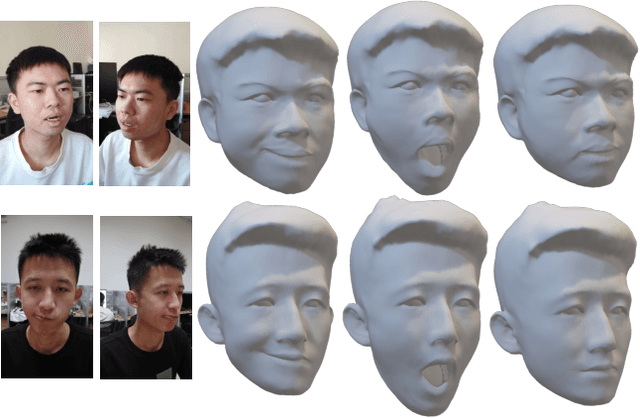
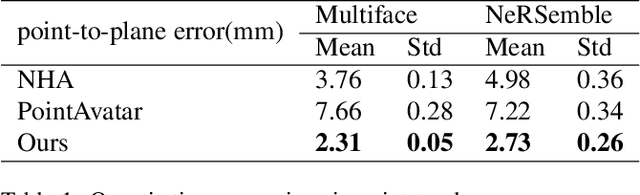
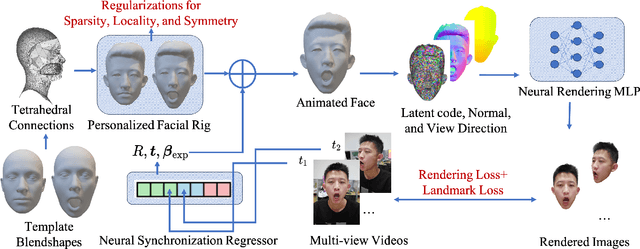
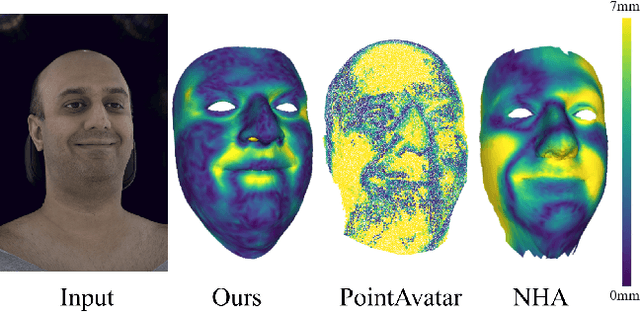
Readily editable mesh blendshapes have been widely used in animation pipelines, while recent advancements in neural geometry and appearance representations have enabled high-quality inverse rendering. Building upon these observations, we introduce a novel technique that reconstructs mesh-based blendshape rigs from single or sparse multi-view videos, leveraging state-of-the-art neural inverse rendering. We begin by constructing a deformation representation that parameterizes vertex displacements into differential coordinates with tetrahedral connections, allowing for high-quality vertex deformation on high-resolution meshes. By constructing a set of semantic regulations in this representation, we achieve joint optimization of blendshapes and expression coefficients. Furthermore, to enable a user-friendly multi-view setup with unsynchronized cameras, we propose a neural regressor to model time-varying motion parameters. This approach implicitly considers the time difference across multiple cameras, enhancing the accuracy of motion modeling. Experiments demonstrate that, with the flexible input of single or sparse multi-view videos, we reconstruct personalized high-fidelity blendshapes. These blendshapes are both geometrically and semantically accurate, and they are compatible with industrial animation pipelines. Code and data will be released.