 Add to Chrome
 Add to Firefox
 Add to Edge
facial
Papers and Code
Multi-Attribute guided Thermal Face Image Translation based on Latent Diffusion Model
Dec 24, 2025
Modern surveillance systems increasingly rely on multi-wavelength sensors and deep neural networks to recognize faces in infrared images captured at night. However, most facial recognition models are trained on visible light datasets, leading to substantial performance degradation on infrared inputs due to significant domain shifts. Early feature-based methods for infrared face recognition proved ineffective, prompting researchers to adopt generative approaches that convert infrared images into visible light images for improved recognition. This paradigm, known as Heterogeneous Face Recognition (HFR), faces challenges such as model and modality discrepancies, leading to distortion and feature loss in generated images. To address these limitations, this paper introduces a novel latent diffusion-based model designed to generate high-quality visible face images from thermal inputs while preserving critical identity features. A multi-attribute classifier is incorporated to extract key facial attributes from visible images, mitigating feature loss during infrared-to-visible image restoration. Additionally, we propose the Self-attn Mamba module, which enhances global modeling of cross-modal features and significantly improves inference speed. Experimental results on two benchmark datasets demonstrate the superiority of our approach, achieving state-of-the-art performance in both image quality and identity preservation.

LightTact: A Visual-Tactile Fingertip Sensor for Deformation-Independent Contact Sensing
Dec 23, 2025Contact often occurs without macroscopic surface deformation, such as during interaction with liquids, semi-liquids, or ultra-soft materials. Most existing tactile sensors rely on deformation to infer contact, making such light-contact interactions difficult to perceive robustly. To address this, we present LightTact, a visual-tactile fingertip sensor that makes contact directly visible via a deformation-independent, optics-based principle. LightTact uses an ambient-blocking optical configuration that suppresses both external light and internal illumination at non-contact regions, while transmitting only the diffuse light generated at true contacts. As a result, LightTact produces high-contrast raw images in which non-contact pixels remain near-black (mean gray value < 3) and contact pixels preserve the natural appearance of the contacting surface. Built on this, LightTact achieves accurate pixel-level contact segmentation that is robust to material properties, contact force, surface appearance, and environmental lighting. We further integrate LightTact on a robotic arm and demonstrate manipulation behaviors driven by extremely light contact, including water spreading, facial-cream dipping, and thin-film interaction. Finally, we show that LightTact's spatially aligned visual-tactile images can be directly interpreted by existing vision-language models, enabling resistor value reasoning for robotic sorting.
DVI: Disentangling Semantic and Visual Identity for Training-Free Personalized Generation
Dec 22, 2025Recent tuning-free identity customization methods achieve high facial fidelity but often overlook visual context, such as lighting, skin texture, and environmental tone. This limitation leads to ``Semantic-Visual Dissonance,'' where accurate facial geometry clashes with the input's unique atmosphere, causing an unnatural ``sticker-like'' effect. We propose **DVI (Disentangled Visual-Identity)**, a zero-shot framework that orthogonally disentangles identity into fine-grained semantic and coarse-grained visual streams. Unlike methods relying solely on semantic vectors, DVI exploits the inherent statistical properties of the VAE latent space, utilizing mean and variance as lightweight descriptors for global visual atmosphere. We introduce a **Parameter-Free Feature Modulation** mechanism that adaptively modulates semantic embeddings with these visual statistics, effectively injecting the reference's ``visual soul'' without training. Furthermore, a **Dynamic Temporal Granularity Scheduler** aligns with the diffusion process, prioritizing visual atmosphere in early denoising stages while refining semantic details later. Extensive experiments demonstrate that DVI significantly enhances visual consistency and atmospheric fidelity without parameter fine-tuning, maintaining robust identity preservation and outperforming state-of-the-art methods in IBench evaluations.
BabyFlow: 3D modeling of realistic and expressive infant faces
Dec 22, 2025Early detection of developmental disorders can be aided by analyzing infant craniofacial morphology, but modeling infant faces is challenging due to limited data and frequent spontaneous expressions. We introduce BabyFlow, a generative AI model that disentangles facial identity and expression, enabling independent control over both. Using normalizing flows, BabyFlow learns flexible, probabilistic representations that capture the complex, non-linear variability of expressive infant faces without restrictive linear assumptions. To address scarce and uncontrolled expressive data, we perform cross-age expression transfer, adapting expressions from adult 3D scans to enrich infant datasets with realistic and systematic expressive variants. As a result, BabyFlow improves 3D reconstruction accuracy, particularly in highly expressive regions such as the mouth, eyes, and nose, and supports synthesis and modification of infant expressions while preserving identity. Additionally, by integrating with diffusion models, BabyFlow generates high-fidelity 2D infant images with consistent 3D geometry, providing powerful tools for data augmentation and early facial analysis.
OmniMER: Indonesian Multimodal Emotion Recognition via Auxiliary-Enhanced LLM Adaptation
Dec 22, 2025Indonesian, spoken by over 200 million people, remains underserved in multimodal emotion recognition research despite its dominant presence on Southeast Asian social media platforms. We introduce IndoMER, the first multimodal emotion recognition benchmark for Indonesian, comprising 1,944 video segments from 203 speakers with temporally aligned text, audio, and visual annotations across seven emotion categories. The dataset exhibits realistic challenges including cross-modal inconsistency and long-tailed class distributions shaped by Indonesian cultural communication norms. To address these challenges, we propose OmniMER, a multimodal adaptation framework built upon Qwen2.5-Omni that enhances emotion recognition through three auxiliary modality-specific perception tasks: emotion keyword extraction for text, facial expression analysis for video, and prosody analysis for audio. These auxiliary tasks help the model identify emotion-relevant cues in each modality before fusion, reducing reliance on spurious correlations in low-resource settings. Experiments on IndoMER show that OmniMER achieves 0.582 Macro-F1 on sentiment classification and 0.454 on emotion recognition, outperforming the base model by 7.6 and 22.1 absolute points respectively. Cross-lingual evaluation on the Chinese CH-SIMS dataset further demonstrates the generalizability of the proposed framework. The dataset and code are publicly available. https://github.com/yanxm01/INDOMER
Bitbox: Behavioral Imaging Toolbox for Computational Analysis of Behavior from Videos
Dec 19, 2025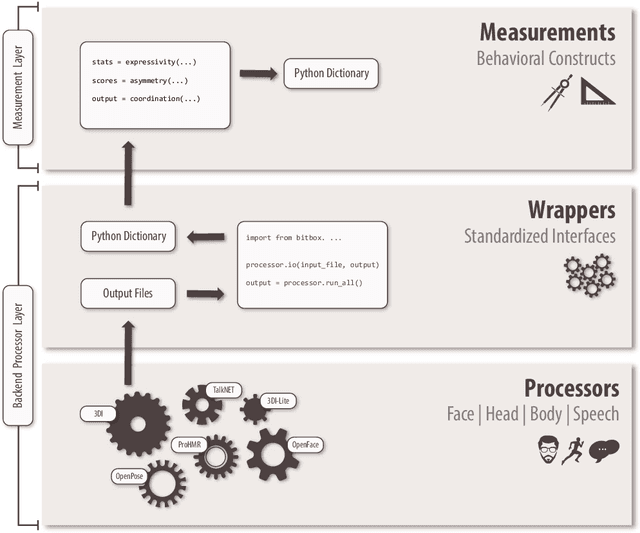
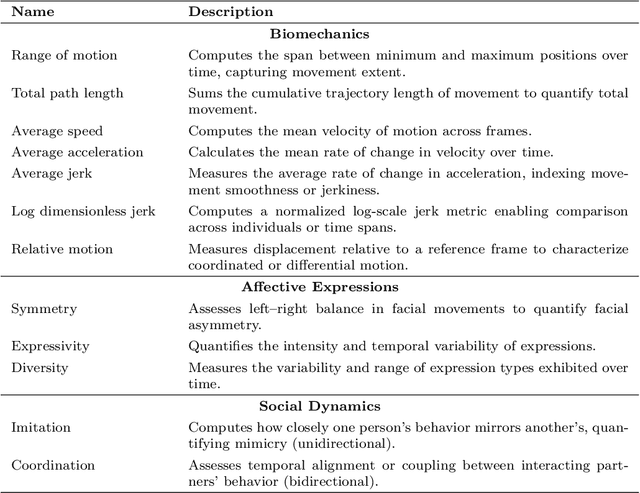
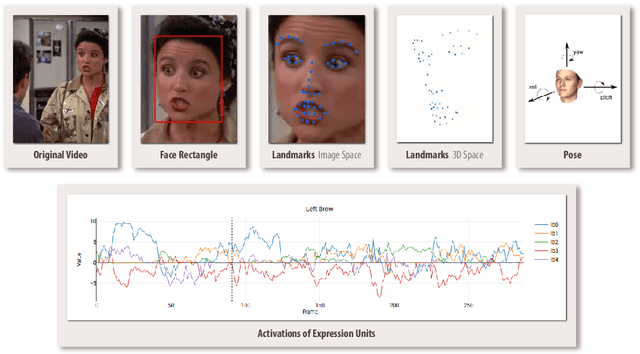
Computational measurement of human behavior from video has recently become feasible due to major advances in AI. These advances now enable granular and precise quantification of facial expression, head movement, body action, and other behavioral modalities and are increasingly used in psychology, psychiatry, neuroscience, and mental health research. However, mainstream adoption remains slow. Most existing methods and software are developed for engineering audiences, require specialized software stacks, and fail to provide behavioral measurements at a level directly useful for hypothesis-driven research. As a result, there is a large barrier to entry for researchers who wish to use modern, AI-based tools in their work. We introduce Bitbox, an open-source toolkit designed to remove this barrier and make advanced computational analysis directly usable by behavioral scientists and clinical researchers. Bitbox is guided by principles of reproducibility, modularity, and interpretability. It provides a standardized interface for extracting high-level behavioral measurements from video, leveraging multiple face, head, and body processors. The core modules have been tested and validated on clinical samples and are designed so that new measures can be added with minimal effort. Bitbox is intended to serve both sides of the translational gap. It gives behavioral researchers access to robust, high-level behavioral metrics without requiring engineering expertise, and it provides computer scientists a practical mechanism for disseminating methods to domains where their impact is most needed. We expect that Bitbox will accelerate integration of computational behavioral measurement into behavioral, clinical, and mental health research. Bitbox has been designed from the beginning as a community-driven effort that will evolve through contributions from both method developers and domain scientists.
FOODER: Real-time Facial Authentication and Expression Recognition
Dec 19, 2025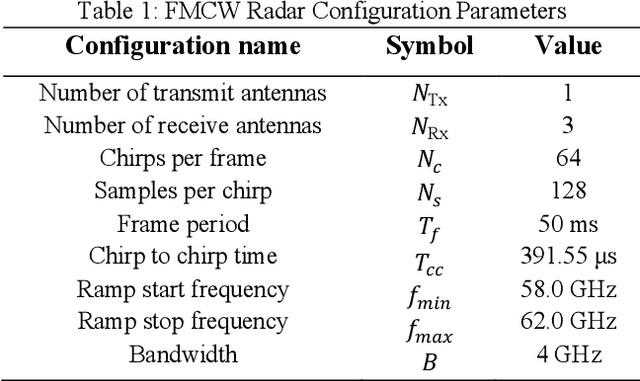
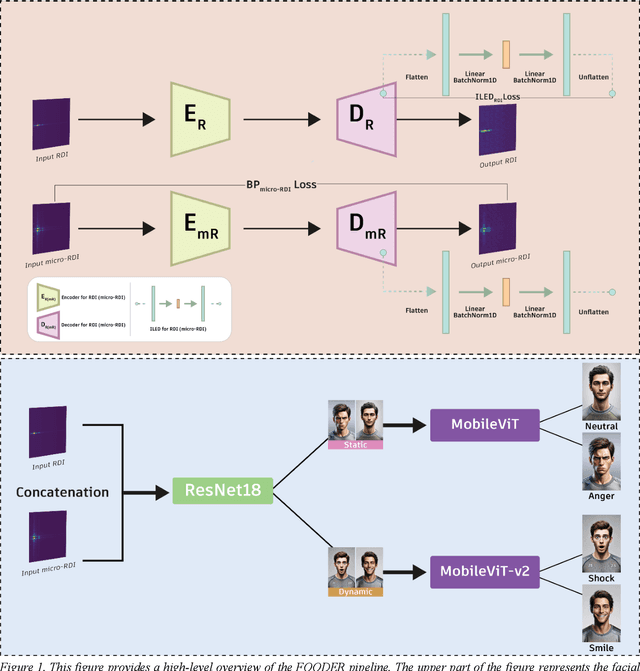
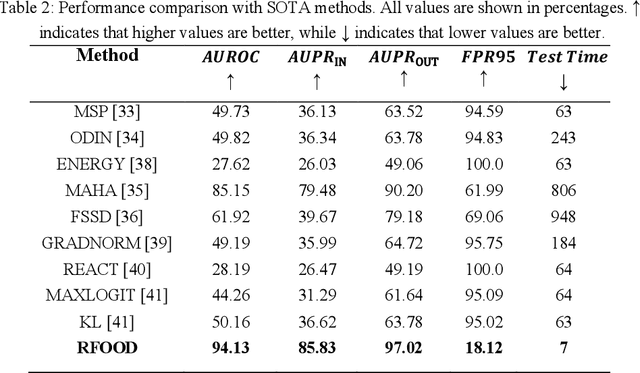
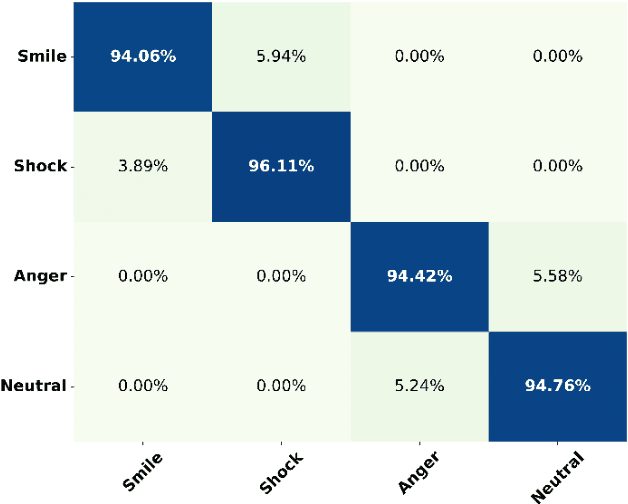
Out-of-distribution (OOD) detection is essential for the safe deployment of neural networks, as it enables the identification of samples outside the training domain. We present FOODER, a real-time, privacy-preserving radar-based framework that integrates OOD-based facial authentication with facial expression recognition. FOODER operates using low-cost frequency-modulated continuous-wave (FMCW) radar and exploits both range-Doppler and micro range-Doppler representations. The authentication module employs a multi-encoder multi-decoder architecture with Body Part (BP) and Intermediate Linear Encoder-Decoder (ILED) components to classify a single enrolled individual as in-distribution while detecting all other faces as OOD. Upon successful authentication, an expression recognition module is activated. Concatenated radar representations are processed by a ResNet block to distinguish between dynamic and static facial expressions. Based on this categorization, two specialized MobileViT networks are used to classify dynamic expressions (smile, shock) and static expressions (neutral, anger). This hierarchical design enables robust facial authentication and fine-grained expression recognition while preserving user privacy by relying exclusively on radar data. Experiments conducted on a dataset collected with a 60 GHz short-range FMCW radar demonstrate that FOODER achieves an AUROC of 94.13% and an FPR95 of 18.12% for authentication, along with an average expression recognition accuracy of 94.70%. FOODER outperforms state-of-the-art OOD detection methods and several transformer-based architectures while operating efficiently in real time.
Pix2NPHM: Learning to Regress NPHM Reconstructions From a Single Image
Dec 19, 2025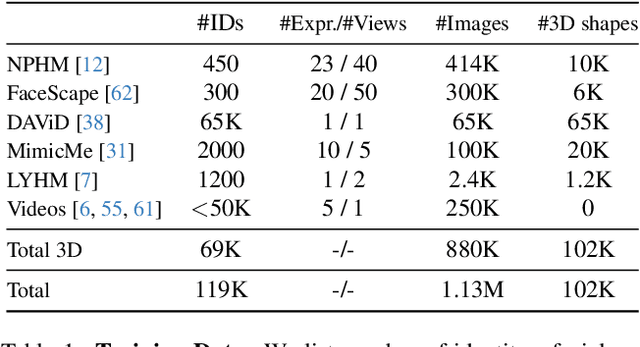
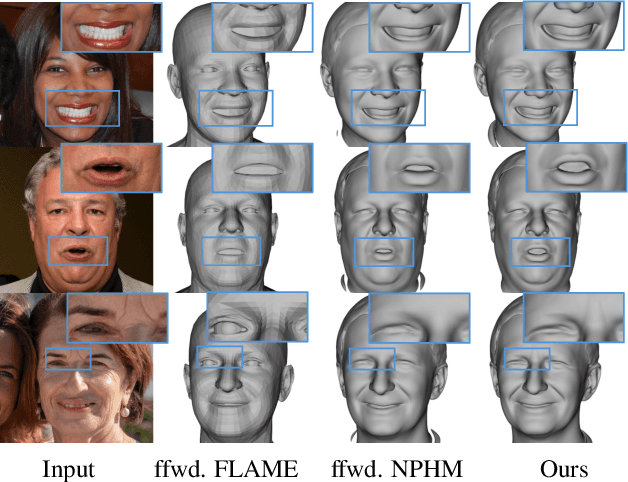
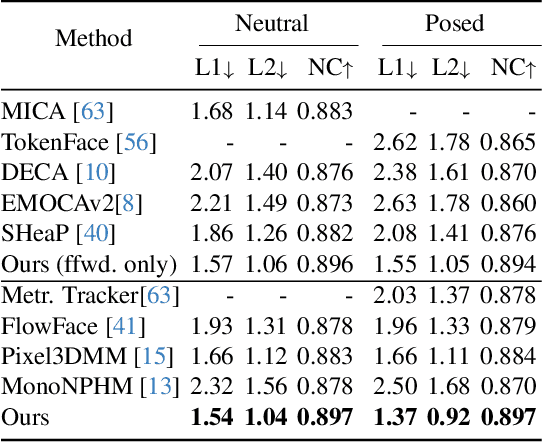
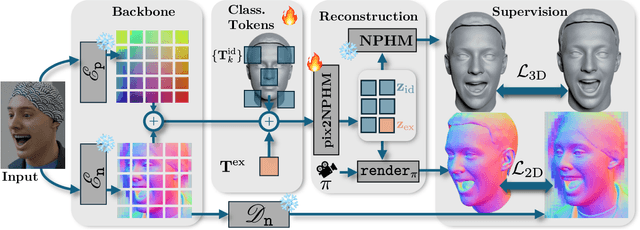
Neural Parametric Head Models (NPHMs) are a recent advancement over mesh-based 3d morphable models (3DMMs) to facilitate high-fidelity geometric detail. However, fitting NPHMs to visual inputs is notoriously challenging due to the expressive nature of their underlying latent space. To this end, we propose Pix2NPHM, a vision transformer (ViT) network that directly regresses NPHM parameters, given a single image as input. Compared to existing approaches, the neural parametric space allows our method to reconstruct more recognizable facial geometry and accurate facial expressions. For broad generalization, we exploit domain-specific ViTs as backbones, which are pretrained on geometric prediction tasks. We train Pix2NPHM on a mixture of 3D data, including a total of over 100K NPHM registrations that enable direct supervision in SDF space, and large-scale 2D video datasets, for which normal estimates serve as pseudo ground truth geometry. Pix2NPHM not only allows for 3D reconstructions at interactive frame rates, it is also possible to improve geometric fidelity by a subsequent inference-time optimization against estimated surface normals and canonical point maps. As a result, we achieve unprecedented face reconstruction quality that can run at scale on in-the-wild data.
FlashPortrait: 6x Faster Infinite Portrait Animation with Adaptive Latent Prediction
Dec 18, 2025Current diffusion-based acceleration methods for long-portrait animation struggle to ensure identity (ID) consistency. This paper presents FlashPortrait, an end-to-end video diffusion transformer capable of synthesizing ID-preserving, infinite-length videos while achieving up to 6x acceleration in inference speed. In particular, FlashPortrait begins by computing the identity-agnostic facial expression features with an off-the-shelf extractor. It then introduces a Normalized Facial Expression Block to align facial features with diffusion latents by normalizing them with their respective means and variances, thereby improving identity stability in facial modeling. During inference, FlashPortrait adopts a dynamic sliding-window scheme with weighted blending in overlapping areas, ensuring smooth transitions and ID consistency in long animations. In each context window, based on the latent variation rate at particular timesteps and the derivative magnitude ratio among diffusion layers, FlashPortrait utilizes higher-order latent derivatives at the current timestep to directly predict latents at future timesteps, thereby skipping several denoising steps and achieving 6x speed acceleration. Experiments on benchmarks show the effectiveness of FlashPortrait both qualitatively and quantitatively.
Evaluation of Generative Models for Emotional 3D Animation Generation in VR
Dec 18, 2025Social interactions incorporate nonverbal signals to convey emotions alongside speech, including facial expressions and body gestures. Generative models have demonstrated promising results in creating full-body nonverbal animations synchronized with speech; however, evaluations using statistical metrics in 2D settings fail to fully capture user-perceived emotions, limiting our understanding of model effectiveness. To address this, we evaluate emotional 3D animation generative models within a Virtual Reality (VR) environment, emphasizing user-centric metrics emotional arousal realism, naturalness, enjoyment, diversity, and interaction quality in a real-time human-agent interaction scenario. Through a user study (N=48), we examine perceived emotional quality for three state of the art speech-driven 3D animation methods across two emotions happiness (high arousal) and neutral (mid arousal). Additionally, we compare these generative models against real human expressions obtained via a reconstruction-based method to assess both their strengths and limitations and how closely they replicate real human facial and body expressions. Our results demonstrate that methods explicitly modeling emotions lead to higher recognition accuracy compared to those focusing solely on speech-driven synchrony. Users rated the realism and naturalness of happy animations significantly higher than those of neutral animations, highlighting the limitations of current generative models in handling subtle emotional states. Generative models underperformed compared to reconstruction-based methods in facial expression quality, and all methods received relatively low ratings for animation enjoyment and interaction quality, emphasizing the importance of incorporating user-centric evaluations into generative model development. Finally, participants positively recognized animation diversity across all generative models.