 Add to Chrome
 Add to Firefox
 Add to Edge
Micro-DualNet: Dual-Path Spatio-Temporal Network for Micro-Action Recognition
Apr 22, 2026
Micro-actions are subtle, localized movements lasting 1-3 seconds such as scratching one's head or tapping fingers. Such subtle actions are essential for social communication, ubiquitously used in natural interactions, and thus critical for fine-grained video understanding, yet remain poorly understood by current computer vision systems. We identify a fundamental challenge: micro-actions exhibit diverse spatio-temporal characteristics where some are defined by spatial configurations while others manifest through temporal dynamics. Existing methods that commit to a single spatio-temporal decomposition cannot accommodate this diversity. We propose a dual-path network that processes anatomically-grounded spatial entities through parallel Spatial-Temporal (ST) and Temporal-Spatial (TS) pathways. The ST path captures spatial configurations before modeling temporal dynamics, while the TS path inverts this order to prioritize temporal dynamics. Rather than fixed fusion, we introduce entity-level adaptive routing where each body part learns its optimal processing preference, complemented by Mutual Action Consistency (MAC) loss that enforces cross-path coherence. Extensive experiments demonstrate competitive performance on MA-52 dataset and state-of-the-art results on iMiGUE dataset. Our work reveals that architectural adaptation to the inherent complexity of micro-actions is essential for advancing fine-grained video understanding.

Bitbox: Behavioral Imaging Toolbox for Computational Analysis of Behavior from Videos
Dec 19, 2025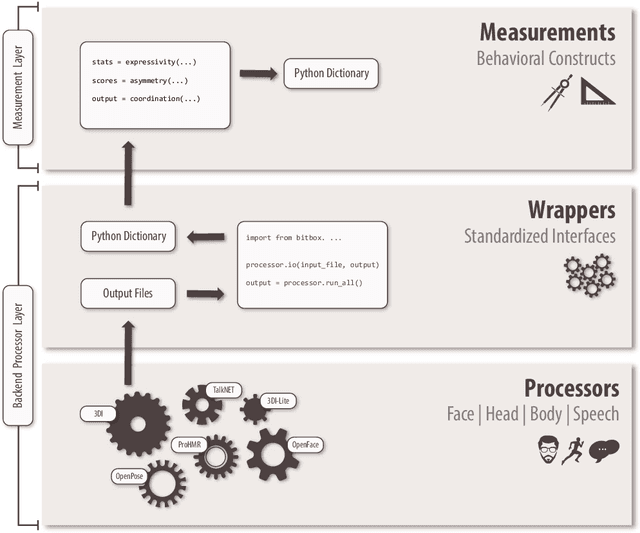
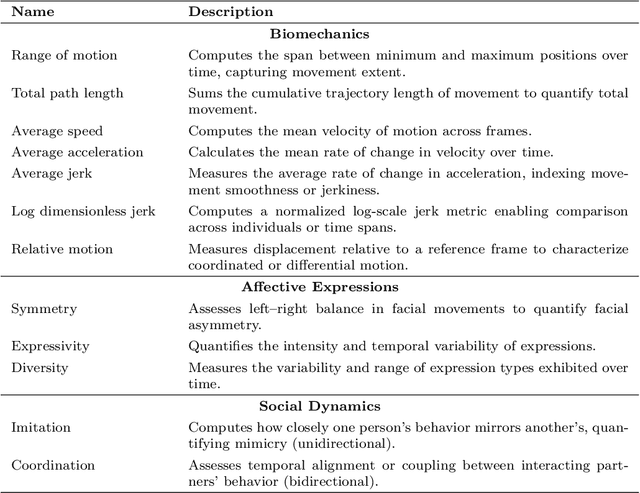
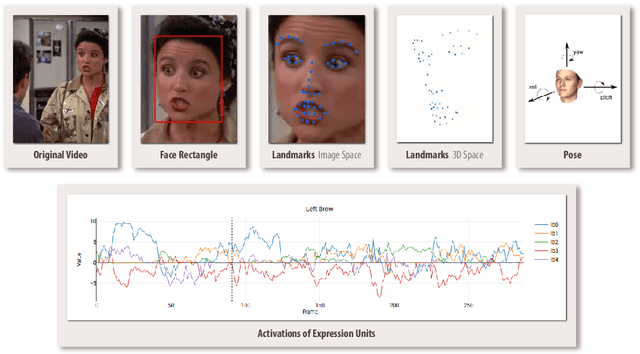
Computational measurement of human behavior from video has recently become feasible due to major advances in AI. These advances now enable granular and precise quantification of facial expression, head movement, body action, and other behavioral modalities and are increasingly used in psychology, psychiatry, neuroscience, and mental health research. However, mainstream adoption remains slow. Most existing methods and software are developed for engineering audiences, require specialized software stacks, and fail to provide behavioral measurements at a level directly useful for hypothesis-driven research. As a result, there is a large barrier to entry for researchers who wish to use modern, AI-based tools in their work. We introduce Bitbox, an open-source toolkit designed to remove this barrier and make advanced computational analysis directly usable by behavioral scientists and clinical researchers. Bitbox is guided by principles of reproducibility, modularity, and interpretability. It provides a standardized interface for extracting high-level behavioral measurements from video, leveraging multiple face, head, and body processors. The core modules have been tested and validated on clinical samples and are designed so that new measures can be added with minimal effort. Bitbox is intended to serve both sides of the translational gap. It gives behavioral researchers access to robust, high-level behavioral metrics without requiring engineering expertise, and it provides computer scientists a practical mechanism for disseminating methods to domains where their impact is most needed. We expect that Bitbox will accelerate integration of computational behavioral measurement into behavioral, clinical, and mental health research. Bitbox has been designed from the beginning as a community-driven effort that will evolve through contributions from both method developers and domain scientists.
Concurrence: A dependence criterion for time series, applied to biological data
Dec 17, 2025Measuring the statistical dependence between observed signals is a primary tool for scientific discovery. However, biological systems often exhibit complex non-linear interactions that currently cannot be captured without a priori knowledge or large datasets. We introduce a criterion for dependence, whereby two time series are deemed dependent if one can construct a classifier that distinguishes between temporally aligned vs. misaligned segments extracted from them. We show that this criterion, concurrence, is theoretically linked with dependence, and can become a standard approach for scientific analyses across disciplines, as it can expose relationships across a wide spectrum of signals (fMRI, physiological and behavioral data) without ad-hoc parameter tuning or large amounts of data.