 Add to Chrome
 Add to Firefox
 Add to Edge
Edit Fidelity Field: Semantics-Aware Region Isolation for Training-Free Scene Text Editing
Apr 19, 2026
Scene text editing (STE) has achieved remarkable progress in accurately rendering target text through diffusion-based methods. However, we identify a critical yet overlooked problem: edit spillover -- when editing a target text region, existing methods inadvertently modify non-target regions, particularly neighboring text. Through systematic evaluation on 50 real-world scenes across four categories, we reveal that state-of-the-art diffusion editing models exhibit a spillover rate of 94%, meaning nearly all non-target text regions are altered during editing. To address this, we propose the Edit Fidelity Field (EFF), a semantics-aware continuous field that controls per-pixel editing fidelity. Unlike binary masks, EFF leverages OCR-detected text regions to construct a four-zone field: Edit Core (fully editable), Transition Zone (smooth decay), Protected Zone (non-target text, explicitly locked), and Background (strictly preserved). EFF operates as a training-free, model-agnostic post-processing module applicable to any diffusion-based STE method. We further propose per-region spillover quantification, a novel evaluation protocol that measures edit leakage at each non-target text region individually. Experiments demonstrate that EFF reduces spillover rate from 94% to 25% while improving non-target region preservation by +91.4 dB PSNR.

AdaEdit: Adaptive Temporal and Channel Modulation for Flow-Based Image Editing
Mar 23, 2026Inversion-based image editing in flow matching models has emerged as a powerful paradigm for training-free, text-guided image manipulation. A central challenge in this paradigm is the injection dilemma: injecting source features during denoising preserves the background of the original image but simultaneously suppresses the model's ability to synthesize edited content. Existing methods address this with fixed injection strategies -- binary on/off temporal schedules, uniform spatial mixing ratios, and channel-agnostic latent perturbation -- that ignore the inherently heterogeneous nature of injection demand across both the temporal and channel dimensions. In this paper, we present AdaEdit, a training-free adaptive editing framework that resolves this dilemma through two complementary innovations. First, we propose a Progressive Injection Schedule that replaces hard binary cutoffs with continuous decay functions (sigmoid, cosine, or linear), enabling a smooth transition from source-feature preservation to target-feature generation and eliminating feature discontinuity artifacts. Second, we introduce Channel-Selective Latent Perturbation, which estimates per-channel importance based on the distributional gap between the inverted and random latents and applies differentiated perturbation strengths accordingly -- strongly perturbing edit-relevant channels while preserving structure-encoding channels. Extensive experiments on the PIE-Bench benchmark (700 images, 10 editing types) demonstrate that AdaEdit achieves an 8.7% reduction in LPIPS, a 2.6% improvement in SSIM, and a 2.3% improvement in PSNR over strong baselines, while maintaining competitive CLIP similarity. AdaEdit is fully plug-and-play and compatible with multiple ODE solvers including Euler, RF-Solver, and FireFlow. Code is available at https://github.com/leeguandong/AdaEdit
Edit Spillover as a Probe: Do Image Editing Models Implicitly Understand World Relations?
Mar 18, 2026Instruction-following image editing models are expected to modify only the specified region while keeping the rest of the image unchanged. However, in practice, we observe a pervasive phenomenon -- edit spillover: models alter semantically related but unspecified content outside the edit region. This raises a fundamental question -- does spillover reflect genuine implicit world understanding, or is it merely attention leakage? We propose EditSpilloverProbe, a systematic framework that repurposes edit spillover as a natural probe for world knowledge in image editing models. We introduce a spillover taxonomy (spatial, semantic, mixed, random), an automated detection-and-classification pipeline, and a benchmark dataset constructed from real-world Chinese text editing tasks, EditSpilloverBench. Systematic evaluation of 5 representative editing models reveals three core findings: (1) spillover rates vary dramatically across architectures, from 3.49% to 11.46%, with a 3.3x ratio; (2) absolute semantic spillover quantity reveals models' world understanding capability -- nano_banana produces the most semantic spillover (27.8 per image), while qwen_2511 has the most precise editing control but lower semantic spillover (16.3 per image), revealing a trade-off between editing control and world understanding; (3) spatial decay analysis shows spillover area density decays exponentially with distance, but the proportion of semantically relevant spillover remains constant (40%-58%), providing direct evidence that semantic spillover reflects genuine world understanding rather than spatial diffusion.
Frequency-Aware Error-Bounded Caching for Accelerating Diffusion Transformers
Mar 05, 2026Diffusion Transformers (DiTs) have emerged as the dominant architecture for high-quality image and video generation, yet their iterative denoising process incurs substantial computational cost during inference. Existing caching methods accelerate DiTs by reusing intermediate computations across timesteps, but they share a common limitation: treating the denoising process as uniform across time,depth, and feature dimensions. In this work, we identify three orthogonal axes of non-uniformity in DiT denoising: (1) temporal -- sensitivity to caching errors varies dramatically across the denoising trajectory; (2) depth -- consecutive caching decisions lead to cascading approximation errors; and (3) feature -- different components of the hidden state exhibit heterogeneous temporal dynamics. Based on these observations, we propose SpectralCache, a unified caching framework comprising Timestep-Aware Dynamic Scheduling (TADS), Cumulative Error Budgets (CEB), and Frequency-Decomposed Caching (FDC). On FLUX.1-schnell at 512x512 resolution, SpectralCache achieves 2.46x speedup with LPIPS 0.217 and SSIM 0.727, outperforming TeaCache (2.12x, LPIPS 0.215, SSIM 0.734) by 16% in speed while maintaining comparable quality (LPIPS difference < 1%). Our approach is training-free, plug-and-play, and compatible with existing DiT architectures.
Inject Where It Matters: Training-Free Spatially-Adaptive Identity Preservation for Text-to-Image Personalization
Feb 15, 2026Personalized text-to-image generation aims to integrate specific identities into arbitrary contexts. However, existing tuning-free methods typically employ Spatially Uniform Visual Injection, causing identity features to contaminate non-facial regions (e.g., backgrounds and lighting) and degrading text adherence. To address this without expensive fine-tuning, we propose SpatialID, a training-free spatially-adaptive identity modulation framework. SpatialID fundamentally decouples identity injection into face-relevant and context-free regions using a Spatial Mask Extractor derived from cross-attention responses. Furthermore, we introduce a Temporal-Spatial Scheduling strategy that dynamically adjusts spatial constraints - transitioning from Gaussian priors to attention-based masks and adaptive relaxation - to align with the diffusion generation dynamics. Extensive experiments on IBench demonstrate that SpatialID achieves state-of-the-art performance in text adherence (CLIP-T: 0.281), visual consistency (CLIP-I: 0.827), and image quality (IQ: 0.523), significantly eliminating background contamination while maintaining robust identity preservation.
FastUSP: A Multi-Level Collaborative Acceleration Framework for Distributed Diffusion Model Inference
Feb 11, 2026Large-scale diffusion models such as FLUX (12B parameters) and Stable Diffusion 3 (8B parameters) require multi-GPU parallelism for efficient inference. Unified Sequence Parallelism (USP), which combines Ulysses and Ring attention mechanisms, has emerged as the state-of-the-art approach for distributed attention computation. However, existing USP implementations suffer from significant inefficiencies including excessive kernel launch overhead and suboptimal computation-communication scheduling. In this paper, we propose \textbf{FastUSP}, a multi-level optimization framework that integrates compile-level optimization (graph compilation with CUDA Graphs and computation-communication reordering), communication-level optimization (FP8 quantized collective communication), and operator-level optimization (pipelined Ring attention with double buffering). We evaluate FastUSP on FLUX (12B) and Qwen-Image models across 2, 4, and 8 NVIDIA RTX 5090 GPUs. On FLUX, FastUSP achieves consistent \textbf{1.12$\times$--1.16$\times$} end-to-end speedup over baseline USP, with compile-level optimization contributing the dominant improvement. On Qwen-Image, FastUSP achieves \textbf{1.09$\times$} speedup on 2 GPUs; on 4--8 GPUs, we identify a PyTorch Inductor compatibility limitation with Ring attention that prevents compile optimization, while baseline USP scales to 1.30$\times$--1.46$\times$ of 2-GPU performance. We further provide a detailed analysis of the performance characteristics of distributed diffusion inference, revealing that kernel launch overhead -- rather than communication latency -- is the primary bottleneck on modern high-bandwidth GPU interconnects.
FlexID: Training-Free Flexible Identity Injection via Intent-Aware Modulation for Text-to-Image Generation
Feb 07, 2026Personalized text-to-image generation aims to seamlessly integrate specific identities into textual descriptions. However, existing training-free methods often rely on rigid visual feature injection, creating a conflict between identity fidelity and textual adaptability. To address this, we propose FlexID, a novel training-free framework utilizing intent-aware modulation. FlexID orthogonally decouples identity into two dimensions: a Semantic Identity Projector (SIP) that injects high-level priors into the language space, and a Visual Feature Anchor (VFA) that ensures structural fidelity within the latent space. Crucially, we introduce a Context-Aware Adaptive Gating (CAG) mechanism that dynamically modulates the weights of these streams based on editing intent and diffusion timesteps. By automatically relaxing rigid visual constraints when strong editing intent is detected, CAG achieves synergy between identity preservation and semantic variation. Extensive experiments on IBench demonstrate that FlexID achieves a state-of-the-art balance between identity consistency and text adherence, offering an efficient solution for complex narrative generation.
DVI: Disentangling Semantic and Visual Identity for Training-Free Personalized Generation
Dec 22, 2025Recent tuning-free identity customization methods achieve high facial fidelity but often overlook visual context, such as lighting, skin texture, and environmental tone. This limitation leads to ``Semantic-Visual Dissonance,'' where accurate facial geometry clashes with the input's unique atmosphere, causing an unnatural ``sticker-like'' effect. We propose **DVI (Disentangled Visual-Identity)**, a zero-shot framework that orthogonally disentangles identity into fine-grained semantic and coarse-grained visual streams. Unlike methods relying solely on semantic vectors, DVI exploits the inherent statistical properties of the VAE latent space, utilizing mean and variance as lightweight descriptors for global visual atmosphere. We introduce a **Parameter-Free Feature Modulation** mechanism that adaptively modulates semantic embeddings with these visual statistics, effectively injecting the reference's ``visual soul'' without training. Furthermore, a **Dynamic Temporal Granularity Scheduler** aligns with the diffusion process, prioritizing visual atmosphere in early denoising stages while refining semantic details later. Extensive experiments demonstrate that DVI significantly enhances visual consistency and atmospheric fidelity without parameter fine-tuning, maintaining robust identity preservation and outperforming state-of-the-art methods in IBench evaluations.
Hyperspectral Image Classification via Transformer-based Spectral-Spatial Attention Decoupling and Adaptive Gating
Jun 11, 2025Deep neural networks face several challenges in hyperspectral image classification, including high-dimensional data, sparse distribution of ground objects, and spectral redundancy, which often lead to classification overfitting and limited generalization capability. To more effectively extract and fuse spatial context with fine spectral information in hyperspectral image (HSI) classification, this paper proposes a novel network architecture called STNet. The core advantage of STNet stems from the dual innovative design of its Spatial-Spectral Transformer module: first, the fundamental explicit decoupling of spatial and spectral attention ensures targeted capture of key information in HSI; second, two functionally distinct gating mechanisms perform intelligent regulation at both the fusion level of attention flows (adaptive attention fusion gating) and the internal level of feature transformation (GFFN). This characteristic demonstrates superior feature extraction and fusion capabilities compared to traditional convolutional neural networks, while reducing overfitting risks in small-sample and high-noise scenarios. STNet enhances model representation capability without increasing network depth or width. The proposed method demonstrates superior performance on IN, UP, and KSC datasets, outperforming mainstream hyperspectral image classification approaches.
Dynamic 3D KAN Convolution with Adaptive Grid Optimization for Hyperspectral Image Classification
Apr 21, 2025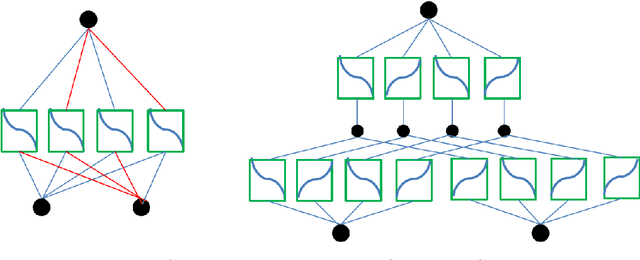
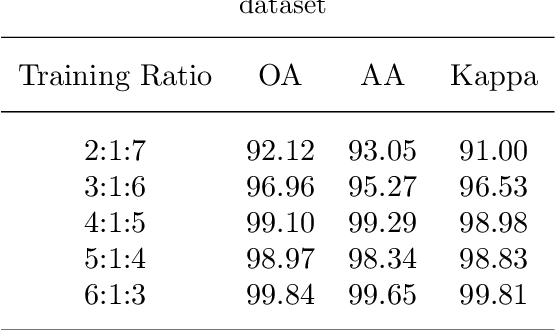
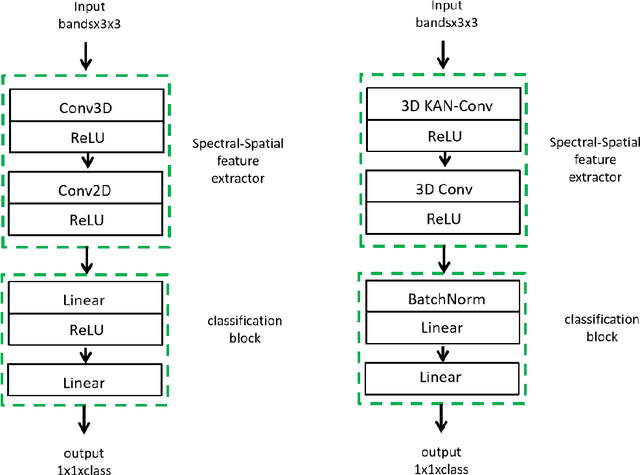
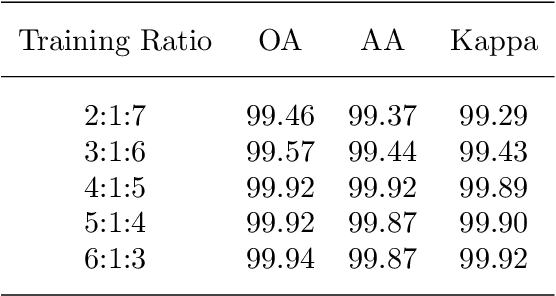
Deep neural networks face several challenges in hyperspectral image classification, including high-dimensional data, sparse distribution of ground objects, and spectral redundancy, which often lead to classification overfitting and limited generalization capability. To more efficiently adapt to ground object distributions while extracting image features without introducing excessive parameters and skipping redundant information, this paper proposes KANet based on an improved 3D-DenseNet model, consisting of 3D KAN Conv and an adaptive grid update mechanism. By introducing learnable univariate B-spline functions on network edges, specifically by flattening three-dimensional neighborhoods into vectors and applying B-spline-parameterized nonlinear activation functions to replace the fixed linear weights of traditional 3D convolutional kernels, we precisely capture complex spectral-spatial nonlinear relationships in hyperspectral data. Simultaneously, through a dynamic grid adjustment mechanism, we adaptively update the grid point positions of B-splines based on the statistical characteristics of input data, optimizing the resolution of spline functions to match the non-uniform distribution of spectral features, significantly improving the model's accuracy in high-dimensional data modeling and parameter efficiency, effectively alleviating the curse of dimensionality. This characteristic demonstrates superior neural scaling laws compared to traditional convolutional neural networks and reduces overfitting risks in small-sample and high-noise scenarios. KANet enhances model representation capability through a 3D dynamic expert convolution system without increasing network depth or width. The proposed method demonstrates superior performance on IN, UP, and KSC datasets, outperforming mainstream hyperspectral image classification approaches.