 Add to Chrome
 Add to Firefox
 Add to Edge
Evaluation of Generative Models for Emotional 3D Animation Generation in VR
Dec 18, 2025
Social interactions incorporate nonverbal signals to convey emotions alongside speech, including facial expressions and body gestures. Generative models have demonstrated promising results in creating full-body nonverbal animations synchronized with speech; however, evaluations using statistical metrics in 2D settings fail to fully capture user-perceived emotions, limiting our understanding of model effectiveness. To address this, we evaluate emotional 3D animation generative models within a Virtual Reality (VR) environment, emphasizing user-centric metrics emotional arousal realism, naturalness, enjoyment, diversity, and interaction quality in a real-time human-agent interaction scenario. Through a user study (N=48), we examine perceived emotional quality for three state of the art speech-driven 3D animation methods across two emotions happiness (high arousal) and neutral (mid arousal). Additionally, we compare these generative models against real human expressions obtained via a reconstruction-based method to assess both their strengths and limitations and how closely they replicate real human facial and body expressions. Our results demonstrate that methods explicitly modeling emotions lead to higher recognition accuracy compared to those focusing solely on speech-driven synchrony. Users rated the realism and naturalness of happy animations significantly higher than those of neutral animations, highlighting the limitations of current generative models in handling subtle emotional states. Generative models underperformed compared to reconstruction-based methods in facial expression quality, and all methods received relatively low ratings for animation enjoyment and interaction quality, emphasizing the importance of incorporating user-centric evaluations into generative model development. Finally, participants positively recognized animation diversity across all generative models.

Mind Meets Robots: A Review of EEG-Based Brain-Robot Interaction Systems
Mar 13, 2024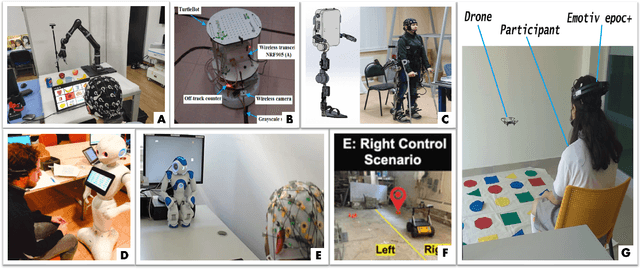

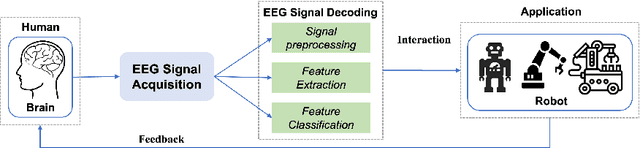
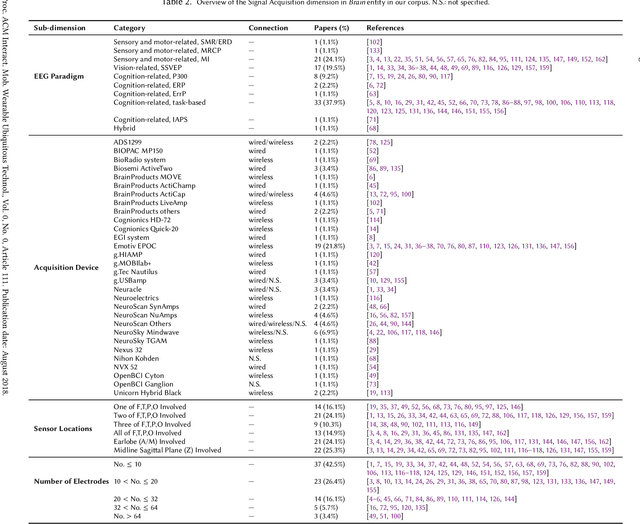
Brain-robot interaction (BRI) empowers individuals to control (semi-)automated machines through their brain activity, either passively or actively. In the past decade, BRI systems have achieved remarkable success, predominantly harnessing electroencephalogram (EEG) signals as the central component. This paper offers an up-to-date and exhaustive examination of 87 curated studies published during the last five years (2018-2023), focusing on identifying the research landscape of EEG-based BRI systems. This review aims to consolidate and underscore methodologies, interaction modes, application contexts, system evaluation, existing challenges, and potential avenues for future investigations in this domain. Based on our analysis, we present a BRI system model with three entities: Brain, Robot, and Interaction, depicting the internal relationships of a BRI system. We especially investigate the essence and principles on interaction modes between human brains and robots, a domain that has not yet been identified anywhere. We then discuss these entities with different dimensions encompassed. Within this model, we scrutinize and classify current research, reveal insights, specify challenges, and provide recommendations for future research trajectories in this field. Meanwhile, we envision our findings offer a design space for future human-robot interaction (HRI) research, informing the creation of efficient BRI frameworks.