 Add to Chrome
 Add to Firefox
 Add to Edge
Simultaneous Localization And Mapping
Papers and Code
ACE-SLAM: Scene Coordinate Regression for Neural Implicit Real-Time SLAM
Dec 16, 2025
We present a novel neural RGB-D Simultaneous Localization And Mapping (SLAM) system that learns an implicit map of the scene in real time. For the first time, we explore the use of Scene Coordinate Regression (SCR) as the core implicit map representation in a neural SLAM pipeline, a paradigm that trains a lightweight network to directly map 2D image features to 3D global coordinates. SCR networks provide efficient, low-memory 3D map representations, enable extremely fast relocalization, and inherently preserve privacy, making them particularly suitable for neural implicit SLAM. Our system is the first one to achieve strict real-time in neural implicit RGB-D SLAM by relying on a SCR-based representation. We introduce a novel SCR architecture specifically tailored for this purpose and detail the critical design choices required to integrate SCR into a live SLAM pipeline. The resulting framework is simple yet flexible, seamlessly supporting both sparse and dense features, and operates reliably in dynamic environments without special adaptation. We evaluate our approach on established synthetic and real-world benchmarks, demonstrating competitive performance against the state of the art. Project Page: https://github.com/ialzugaray/ace-slam

Odyssey: An Automotive Lidar-Inertial Odometry Dataset for GNSS-denied situations
Dec 16, 2025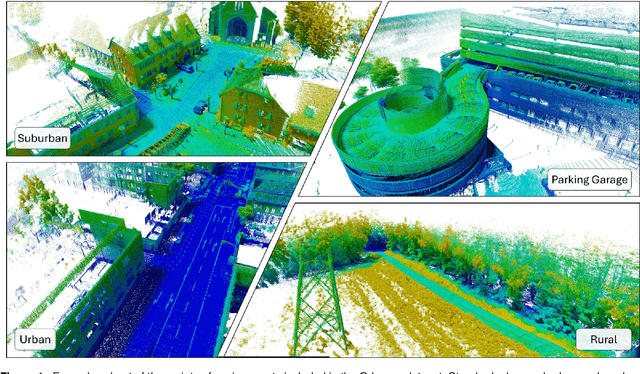
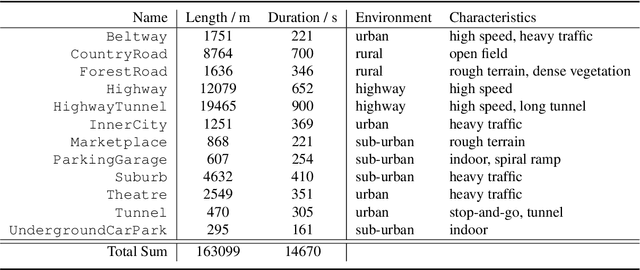
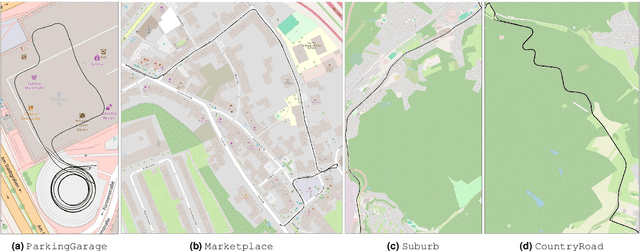
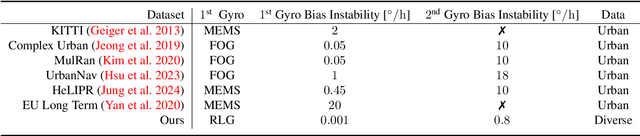
The development and evaluation of Lidar-Inertial Odometry (LIO) and Simultaneous Localization and Mapping (SLAM) systems requires a precise ground truth. The Global Navigation Satellite System (GNSS) is often used as a foundation for this, but its signals can be unreliable in obstructed environments due to multi-path effects or loss-of-signal. While existing datasets compensate for the sporadic loss of GNSS signals by incorporating Inertial Measurement Unit (IMU) measurements, the commonly used Micro-Electro-Mechanical Systems (MEMS) or Fiber Optic Gyroscope (FOG)-based systems do not permit the prolonged study of GNSS-denied environments. To close this gap, we present Odyssey, a LIO dataset with a focus on GNSS-denied environments such as tunnels and parking garages as well as other underrepresented, yet ubiquitous situations such as stop-and-go-traffic, bumpy roads and wide open fields. Our ground truth is derived from a navigation-grade Inertial Navigation System (INS) equipped with a Ring Laser Gyroscope (RLG), offering exceptional bias stability characteristics compared to IMUs used in existing datasets and enabling the prolonged and accurate study of GNSS-denied environments. This makes Odyssey the first publicly available dataset featuring a RLG-based INS. Besides providing data for LIO, we also support other tasks, such as place recognition, through the threefold repetition of all trajectories as well as the integration of external mapping data by providing precise geodetic coordinates. All data, dataloader and other material is available online at https://odyssey.uni-goettingen.de/ .
Navigation Around Unknown Space Objects Using Visible-Thermal Image Fusion
Dec 13, 2025As the popularity of on-orbit operations grows, so does the need for precise navigation around unknown resident space objects (RSOs) such as other spacecraft, orbital debris, and asteroids. The use of Simultaneous Localization and Mapping (SLAM) algorithms is often studied as a method to map out the surface of an RSO and find the inspector's relative pose using a lidar or conventional camera. However, conventional cameras struggle during eclipse or shadowed periods, and lidar, though robust to lighting conditions, tends to be heavier, bulkier, and more power-intensive. Thermal-infrared cameras can track the target RSO throughout difficult illumination conditions without these limitations. While useful, thermal-infrared imagery lacks the resolution and feature-richness of visible cameras. In this work, images of a target satellite in low Earth orbit are photo-realistically simulated in both visible and thermal-infrared bands. Pixel-level fusion methods are used to create visible/thermal-infrared composites that leverage the best aspects of each camera. Navigation errors from a monocular SLAM algorithm are compared between visible, thermal-infrared, and fused imagery in various lighting and trajectories. Fused imagery yields substantially improved navigation performance over visible-only and thermal-only methods.
D$^2$GSLAM: 4D Dynamic Gaussian Splatting SLAM
Dec 10, 2025Recent advances in Dense Simultaneous Localization and Mapping (SLAM) have demonstrated remarkable performance in static environments. However, dense SLAM in dynamic environments remains challenging. Most methods directly remove dynamic objects and focus solely on static scene reconstruction, which ignores the motion information contained in these dynamic objects. In this paper, we present D$^2$GSLAM, a novel dynamic SLAM system utilizing Gaussian representation, which simultaneously performs accurate dynamic reconstruction and robust tracking within dynamic environments. Our system is composed of four key components: (i) We propose a geometric-prompt dynamic separation method to distinguish between static and dynamic elements of the scene. This approach leverages the geometric consistency of Gaussian representation and scene geometry to obtain coarse dynamic regions. The regions then serve as prompts to guide the refinement of the coarse mask for achieving accurate motion mask. (ii) To facilitate accurate and efficient mapping of the dynamic scene, we introduce dynamic-static composite representation that integrates static 3D Gaussians with dynamic 4D Gaussians. This representation allows for modeling the transitions between static and dynamic states of objects in the scene for composite mapping and optimization. (iii) We employ a progressive pose refinement strategy that leverages both the multi-view consistency of static scene geometry and motion information from dynamic objects to achieve accurate camera tracking. (iv) We introduce a motion consistency loss, which leverages the temporal continuity in object motions for accurate dynamic modeling. Our D$^2$GSLAM demonstrates superior performance on dynamic scenes in terms of mapping and tracking accuracy, while also showing capability in accurate dynamic modeling.
OpenMonoGS-SLAM: Monocular Gaussian Splatting SLAM with Open-set Semantics
Dec 09, 2025Simultaneous Localization and Mapping (SLAM) is a foundational component in robotics, AR/VR, and autonomous systems. With the rising focus on spatial AI in recent years, combining SLAM with semantic understanding has become increasingly important for enabling intelligent perception and interaction. Recent efforts have explored this integration, but they often rely on depth sensors or closed-set semantic models, limiting their scalability and adaptability in open-world environments. In this work, we present OpenMonoGS-SLAM, the first monocular SLAM framework that unifies 3D Gaussian Splatting (3DGS) with open-set semantic understanding. To achieve our goal, we leverage recent advances in Visual Foundation Models (VFMs), including MASt3R for visual geometry and SAM and CLIP for open-vocabulary semantics. These models provide robust generalization across diverse tasks, enabling accurate monocular camera tracking and mapping, as well as a rich understanding of semantics in open-world environments. Our method operates without any depth input or 3D semantic ground truth, relying solely on self-supervised learning objectives. Furthermore, we propose a memory mechanism specifically designed to manage high-dimensional semantic features, which effectively constructs Gaussian semantic feature maps, leading to strong overall performance. Experimental results demonstrate that our approach achieves performance comparable to or surpassing existing baselines in both closed-set and open-set segmentation tasks, all without relying on supplementary sensors such as depth maps or semantic annotations.
Spatiotemporal Calibration and Ground Truth Estimation for High-Precision SLAM Benchmarking in Extended Reality
Dec 08, 2025Simultaneous localization and mapping (SLAM) plays a fundamental role in extended reality (XR) applications. As the standards for immersion in XR continue to increase, the demands for SLAM benchmarking have become more stringent. Trajectory accuracy is the key metric, and marker-based optical motion capture (MoCap) systems are widely used to generate ground truth (GT) because of their drift-free and relatively accurate measurements. However, the precision of MoCap-based GT is limited by two factors: the spatiotemporal calibration with the device under test (DUT) and the inherent jitter in the MoCap measurements. These limitations hinder accurate SLAM benchmarking, particularly for key metrics like rotation error and inter-frame jitter, which are critical for immersive XR experiences. This paper presents a novel continuous-time maximum likelihood estimator to address these challenges. The proposed method integrates auxiliary inertial measurement unit (IMU) data to compensate for MoCap jitter. Additionally, a variable time synchronization method and a pose residual based on screw congruence constraints are proposed, enabling precise spatiotemporal calibration across multiple sensors and the DUT. Experimental results demonstrate that our approach outperforms existing methods, achieving the precision necessary for comprehensive benchmarking of state-of-the-art SLAM algorithms in XR applications. Furthermore, we thoroughly validate the practicality of our method by benchmarking several leading XR devices and open-source SLAM algorithms. The code is publicly available at https://github.com/ylab-xrpg/xr-hpgt.
Inertial Magnetic SLAM Systems Using Low-Cost Sensors
Dec 10, 2025Spatially inhomogeneous magnetic fields offer a valuable, non-visual information source for positioning. Among systems leveraging this, magnetic field-based simultaneous localization and mapping (SLAM) systems are particularly attractive because they can provide positioning information and build a magnetic field map on the fly. Moreover, they have bounded error within mapped regions. However, state-of-the-art methods typically require low-drift odometry data provided by visual odometry or a wheel encoder, etc. This is because these systems need to minimize/reduce positioning errors while exploring, which happens when they are in unmapped regions. To address these limitations, this work proposes a loosely coupled and a tightly coupled inertial magnetic SLAM (IM-SLAM) system. The proposed systems use commonly available low-cost sensors: an inertial measurement unit (IMU), a magnetometer array, and a barometer. The use of non-visual data provides a significant advantage over visual-based systems, making it robust to low-visibility conditions. Both systems employ state-space representations, and magnetic field models on different scales. The difference lies in how they use a local and global magnetic field model. The loosely coupled system uses these models separately in two state-space models, while the tightly coupled system integrates them into one state-space model. Experiment results show that the tightly coupled IM-SLAM system achieves lower positioning errors than the loosely coupled system in most scenarios, with typical errors on the order of meters per 100 meters traveled. These results demonstrate the feasiblity of developing a full 3D IM-SLAM systems using low-cost sensors and the potential of applying these systems in emergency response scenarios such as mine/fire rescue.
Field-Space Autoencoder for Scalable Climate Emulators
Jan 21, 2026Kilometer-scale Earth system models are essential for capturing local climate change. However, these models are computationally expensive and produce petabyte-scale outputs, which limits their utility for applications such as probabilistic risk assessment. Here, we present the Field-Space Autoencoder, a scalable climate emulation framework based on a spherical compression model that overcomes these challenges. By utilizing Field-Space Attention, the model efficiently operates on native climate model output and therefore avoids geometric distortions caused by forcing spherical data onto Euclidean grids. This approach preserves physical structures significantly better than convolutional baselines. By producing a structured compressed field, it serves as a good baseline for downstream generative emulation. In addition, the model can perform zero-shot super-resolution that maps low-resolution large ensembles and scarce high-resolution data into a shared representation. We train a generative diffusion model on these compressed fields. The model can simultaneously learn internal variability from abundant low-resolution data and fine-scale physics from sparse high-resolution data. Our work bridges the gap between the high volume of low-resolution ensemble statistics and the scarcity of high-resolution physical detail.
Simultaneous Localization and 3D-Semi Dense Mapping for Micro Drones Using Monocular Camera and Inertial Sensors
Nov 18, 2025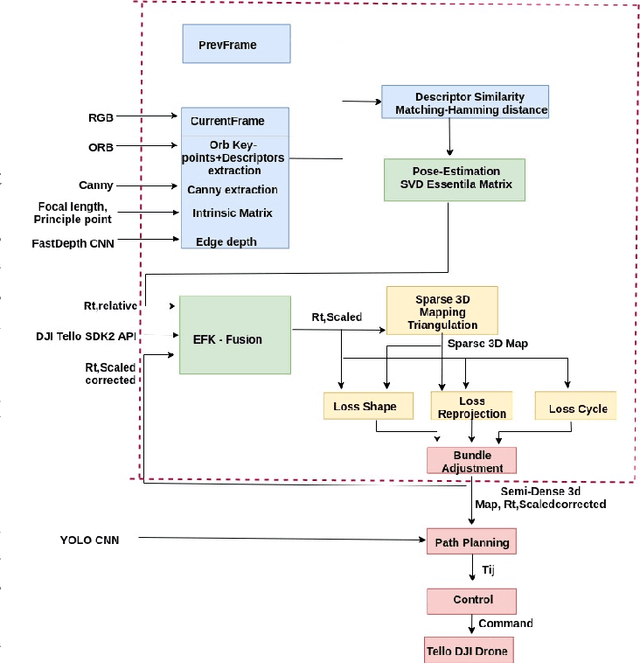
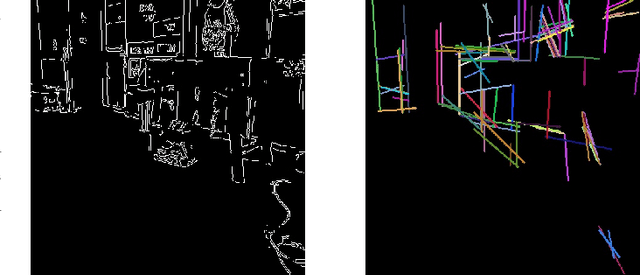
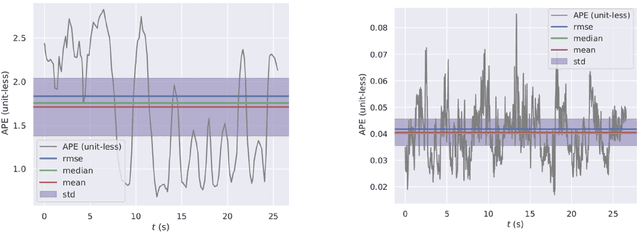
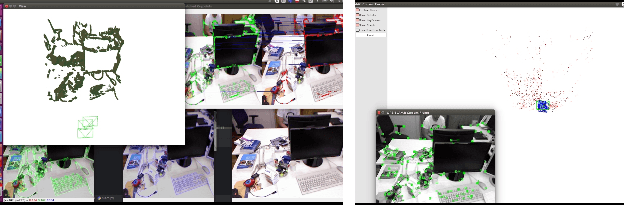
Monocular simultaneous localization and mapping (SLAM) algorithms estimate drone poses and build a 3D map using a single camera. Current algorithms include sparse methods that lack detailed geometry, while learning-driven approaches produce dense maps but are computationally intensive. Monocular SLAM also faces scale ambiguities, which affect its accuracy. To address these challenges, we propose an edge-aware lightweight monocular SLAM system combining sparse keypoint-based pose estimation with dense edge reconstruction. Our method employs deep learning-based depth prediction and edge detection, followed by optimization to refine keypoints and edges for geometric consistency, without relying on global loop closure or heavy neural computations. We fuse inertial data with vision by using an extended Kalman filter to resolve scale ambiguity and improve accuracy. The system operates in real time on low-power platforms, as demonstrated on a DJI Tello drone with a monocular camera and inertial sensors. In addition, we demonstrate robust autonomous navigation and obstacle avoidance in indoor corridors and on the TUM RGBD dataset. Our approach offers an effective, practical solution to real-time mapping and navigation in resource-constrained environments.
MA-SLAM: Active SLAM in Large-Scale Unknown Environment using Map Aware Deep Reinforcement Learning
Nov 18, 2025Active Simultaneous Localization and Mapping (Active SLAM) involves the strategic planning and precise control of a robotic system's movement in order to construct a highly accurate and comprehensive representation of its surrounding environment, which has garnered significant attention within the research community. While the current methods demonstrate efficacy in small and controlled settings, they face challenges when applied to large-scale and diverse environments, marked by extended periods of exploration and suboptimal paths of discovery. In this paper, we propose MA-SLAM, a Map-Aware Active SLAM system based on Deep Reinforcement Learning (DRL), designed to address the challenge of efficient exploration in large-scale environments. In pursuit of this objective, we put forward a novel structured map representation. By discretizing the spatial data and integrating the boundary points and the historical trajectory, the structured map succinctly and effectively encapsulates the visited regions, thereby serving as input for the deep reinforcement learning based decision module. Instead of sequentially predicting the next action step within the decision module, we have implemented an advanced global planner to optimize the exploration path by leveraging long-range target points. We conducted experiments in three simulation environments and deployed in a real unmanned ground vehicle (UGV), the results demonstrate that our approach significantly reduces both the duration and distance of exploration compared with state-of-the-art methods.