 Add to Chrome
 Add to Firefox
 Add to Edge
Vlog Dataset
Papers and Code
CAF-Mamba: Mamba-Based Cross-Modal Adaptive Attention Fusion for Multimodal Depression Detection
Jan 29, 2026
Depression is a prevalent mental health disorder that severely impairs daily functioning and quality of life. While recent deep learning approaches for depression detection have shown promise, most rely on limited feature types, overlook explicit cross-modal interactions, and employ simple concatenation or static weighting for fusion. To overcome these limitations, we propose CAF-Mamba, a novel Mamba-based cross-modal adaptive attention fusion framework. CAF-Mamba not only captures cross-modal interactions explicitly and implicitly, but also dynamically adjusts modality contributions through a modality-wise attention mechanism, enabling more effective multimodal fusion. Experiments on two in-the-wild benchmark datasets, LMVD and D-Vlog, demonstrate that CAF-Mamba consistently outperforms existing methods and achieves state-of-the-art performance.

VC-Bench: Pioneering the Video Connecting Benchmark with a Dataset and Evaluation Metrics
Jan 27, 2026While current video generation focuses on text or image conditions, practical applications like video editing and vlogging often need to seamlessly connect separate clips. In our work, we introduce Video Connecting, an innovative task that aims to generate smooth intermediate video content between given start and end clips. However, the absence of standardized evaluation benchmarks has hindered the development of this task. To bridge this gap, we proposed VC-Bench, a novel benchmark specifically designed for video connecting. It includes 1,579 high-quality videos collected from public platforms, covering 15 main categories and 72 subcategories to ensure diversity and structure. VC-Bench focuses on three core aspects: Video Quality Score VQS, Start-End Consistency Score SECS, and Transition Smoothness Score TSS. Together, they form a comprehensive framework that moves beyond conventional quality-only metrics. We evaluated multiple state-of-the-art video generation models on VC-Bench. Experimental results reveal significant limitations in maintaining start-end consistency and transition smoothness, leading to lower overall coherence and fluidity. We expect that VC-Bench will serve as a pioneering benchmark to inspire and guide future research in video connecting. The evaluation metrics and dataset are publicly available at: https://anonymous.4open.science/r/VC-Bench-1B67/.
MDD-Net: Multimodal Depression Detection through Mutual Transformer
Aug 11, 2025Depression is a major mental health condition that severely impacts the emotional and physical well-being of individuals. The simple nature of data collection from social media platforms has attracted significant interest in properly utilizing this information for mental health research. A Multimodal Depression Detection Network (MDD-Net), utilizing acoustic and visual data obtained from social media networks, is proposed in this work where mutual transformers are exploited to efficiently extract and fuse multimodal features for efficient depression detection. The MDD-Net consists of four core modules: an acoustic feature extraction module for retrieving relevant acoustic attributes, a visual feature extraction module for extracting significant high-level patterns, a mutual transformer for computing the correlations among the generated features and fusing these features from multiple modalities, and a detection layer for detecting depression using the fused feature representations. The extensive experiments are performed using the multimodal D-Vlog dataset, and the findings reveal that the developed multimodal depression detection network surpasses the state-of-the-art by up to 17.37% for F1-Score, demonstrating the greater performance of the proposed system. The source code is accessible at https://github.com/rezwanh001/Multimodal-Depression-Detection.
Scaling RL to Long Videos
Jul 10, 2025We introduce a full-stack framework that scales up reasoning in vision-language models (VLMs) to long videos, leveraging reinforcement learning. We address the unique challenges of long video reasoning by integrating three critical components: (1) a large-scale dataset, LongVideo-Reason, comprising 52K long video QA pairs with high-quality reasoning annotations across diverse domains such as sports, games, and vlogs; (2) a two-stage training pipeline that extends VLMs with chain-of-thought supervised fine-tuning (CoT-SFT) and reinforcement learning (RL); and (3) a training infrastructure for long video RL, named Multi-modal Reinforcement Sequence Parallelism (MR-SP), which incorporates sequence parallelism and a vLLM-based engine tailored for long video, using cached video embeddings for efficient rollout and prefilling. In experiments, LongVILA-R1-7B achieves strong performance on long video QA benchmarks such as VideoMME. It also outperforms Video-R1-7B and even matches Gemini-1.5-Pro across temporal reasoning, goal and purpose reasoning, spatial reasoning, and plot reasoning on our LongVideo-Reason-eval benchmark. Notably, our MR-SP system achieves up to 2.1x speedup on long video RL training. LongVILA-R1 demonstrates consistent performance gains as the number of input video frames scales. LongVILA-R1 marks a firm step towards long video reasoning in VLMs. In addition, we release our training system for public availability that supports RL training on various modalities (video, text, and audio), various models (VILA and Qwen series), and even image and video generation models. On a single A100 node (8 GPUs), it supports RL training on hour-long videos (e.g., 3,600 frames / around 256k tokens).
Moderating Harm: Benchmarking Large Language Models for Cyberbullying Detection in YouTube Comments
Jun 01, 2025As online platforms grow, comment sections increasingly host harassment that undermines user experience and well-being. This study benchmarks three leading large language models, OpenAI GPT-4.1, Google Gemini 1.5 Pro, and Anthropic Claude 3 Opus, on a corpus of 5,080 YouTube comments sampled from high-abuse threads in gaming, lifestyle, food vlog, and music channels. The dataset comprises 1,334 harmful and 3,746 non-harmful messages in English, Arabic, and Indonesian, annotated independently by two reviewers with substantial agreement (Cohen's kappa = 0.83). Using a unified prompt and deterministic settings, GPT-4.1 achieved the best overall balance with an F1 score of 0.863, precision of 0.887, and recall of 0.841. Gemini flagged the highest share of harmful posts (recall = 0.875) but its precision fell to 0.767 due to frequent false positives. Claude delivered the highest precision at 0.920 and the lowest false-positive rate of 0.022, yet its recall dropped to 0.720. Qualitative analysis showed that all three models struggle with sarcasm, coded insults, and mixed-language slang. These results underscore the need for moderation pipelines that combine complementary models, incorporate conversational context, and fine-tune for under-represented languages and implicit abuse. A de-identified version of the dataset and full prompts is publicly released to promote reproducibility and further progress in automated content moderation.
We Care: Multimodal Depression Detection and Knowledge Infused Mental Health Therapeutic Response Generation
Jun 15, 2024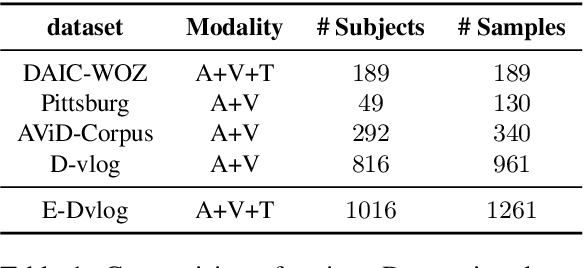
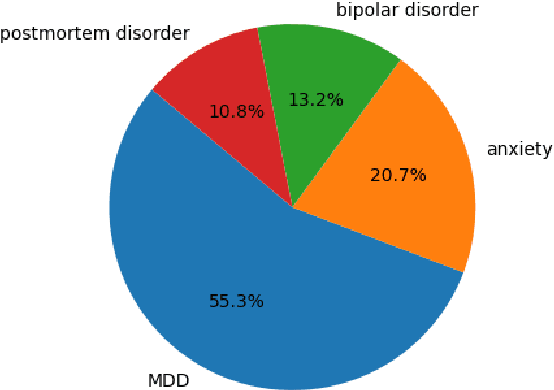
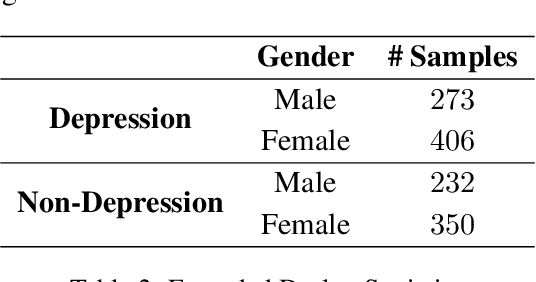

The detection of depression through non-verbal cues has gained significant attention. Previous research predominantly centred on identifying depression within the confines of controlled laboratory environments, often with the supervision of psychologists or counsellors. Unfortunately, datasets generated in such controlled settings may struggle to account for individual behaviours in real-life situations. In response to this limitation, we present the Extended D-vlog dataset, encompassing a collection of 1, 261 YouTube vlogs. Additionally, the emergence of large language models (LLMs) like GPT3.5, and GPT4 has sparked interest in their potential they can act like mental health professionals. Yet, the readiness of these LLM models to be used in real-life settings is still a concern as they can give wrong responses that can harm the users. We introduce a virtual agent serving as an initial contact for mental health patients, offering Cognitive Behavioral Therapy (CBT)-based responses. It comprises two core functions: 1. Identifying depression in individuals, and 2. Delivering CBT-based therapeutic responses. Our Mistral model achieved impressive scores of 70.1% and 30.9% for distortion assessment and classification, along with a Bert score of 88.7%. Moreover, utilizing the TVLT model on our Multimodal Extended D-vlog Dataset yielded outstanding results, with an impressive F1-score of 67.8%
A Reinforcement Learning-Based Automatic Video Editing Method Using Pre-trained Vision-Language Model
Nov 07, 2024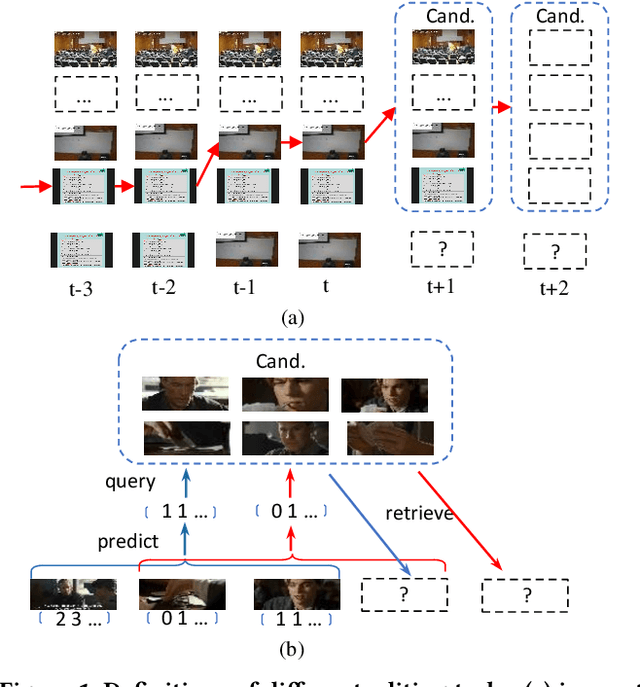

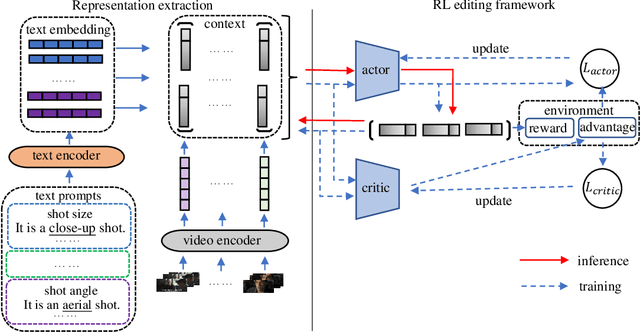

In this era of videos, automatic video editing techniques attract more and more attention from industry and academia since they can reduce workloads and lower the requirements for human editors. Existing automatic editing systems are mainly scene- or event-specific, e.g., soccer game broadcasting, yet the automatic systems for general editing, e.g., movie or vlog editing which covers various scenes and events, were rarely studied before, and converting the event-driven editing method to a general scene is nontrivial. In this paper, we propose a two-stage scheme for general editing. Firstly, unlike previous works that extract scene-specific features, we leverage the pre-trained Vision-Language Model (VLM) to extract the editing-relevant representations as editing context. Moreover, to close the gap between the professional-looking videos and the automatic productions generated with simple guidelines, we propose a Reinforcement Learning (RL)-based editing framework to formulate the editing problem and train the virtual editor to make better sequential editing decisions. Finally, we evaluate the proposed method on a more general editing task with a real movie dataset. Experimental results demonstrate the effectiveness and benefits of the proposed context representation and the learning ability of our RL-based editing framework.
MOGAM: A Multimodal Object-oriented Graph Attention Model for Depression Detection
Mar 21, 2024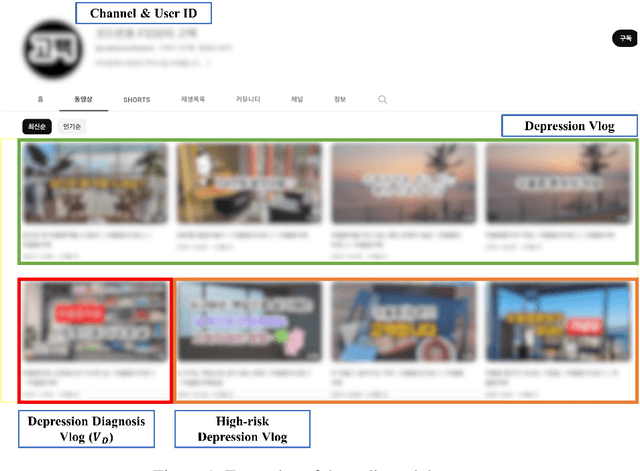
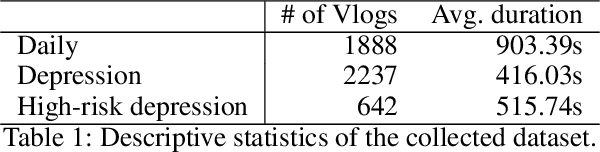
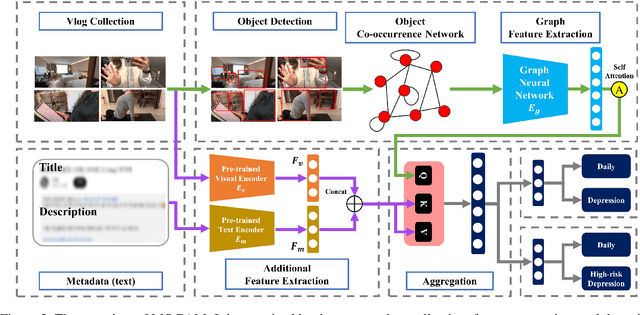
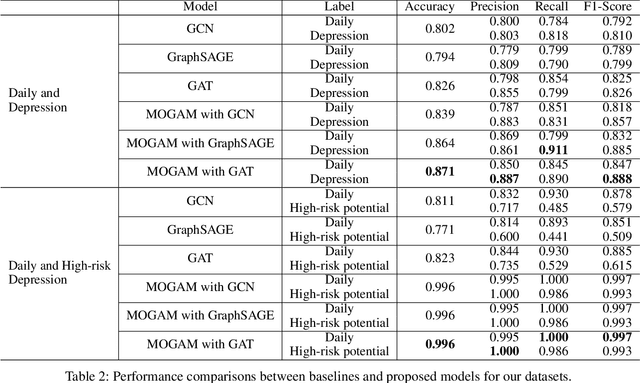
Early detection plays a crucial role in the treatment of depression. Therefore, numerous studies have focused on social media platforms, where individuals express their emotions, aiming to achieve early detection of depression. However, the majority of existing approaches often rely on specific features, leading to limited scalability across different types of social media datasets, such as text, images, or videos. To overcome this limitation, we introduce a Multimodal Object-Oriented Graph Attention Model (MOGAM), which can be applied to diverse types of data, offering a more scalable and versatile solution. Furthermore, to ensure that our model can capture authentic symptoms of depression, we only include vlogs from users with a clinical diagnosis. To leverage the diverse features of vlogs, we adopt a multimodal approach and collect additional metadata such as the title, description, and duration of the vlogs. To effectively aggregate these multimodal features, we employed a cross-attention mechanism. MOGAM achieved an accuracy of 0.871 and an F1-score of 0.888. Moreover, to validate the scalability of MOGAM, we evaluated its performance with a benchmark dataset and achieved comparable results with prior studies (0.61 F1-score). In conclusion, we believe that the proposed model, MOGAM, is an effective solution for detecting depression in social media, offering potential benefits in the early detection and treatment of this mental health condition.
Understanding Video Scenes through Text: Insights from Text-based Video Question Answering
Sep 11, 2023Researchers have extensively studied the field of vision and language, discovering that both visual and textual content is crucial for understanding scenes effectively. Particularly, comprehending text in videos holds great significance, requiring both scene text understanding and temporal reasoning. This paper focuses on exploring two recently introduced datasets, NewsVideoQA and M4-ViteVQA, which aim to address video question answering based on textual content. The NewsVideoQA dataset contains question-answer pairs related to the text in news videos, while M4-ViteVQA comprises question-answer pairs from diverse categories like vlogging, traveling, and shopping. We provide an analysis of the formulation of these datasets on various levels, exploring the degree of visual understanding and multi-frame comprehension required for answering the questions. Additionally, the study includes experimentation with BERT-QA, a text-only model, which demonstrates comparable performance to the original methods on both datasets, indicating the shortcomings in the formulation of these datasets. Furthermore, we also look into the domain adaptation aspect by examining the effectiveness of training on M4-ViteVQA and evaluating on NewsVideoQA and vice-versa, thereby shedding light on the challenges and potential benefits of out-of-domain training.
Human Action Co-occurrence in Lifestyle Vlogs using Graph Link Prediction
Sep 22, 2023We introduce the task of automatic human action co-occurrence identification, i.e., determine whether two human actions can co-occur in the same interval of time. We create and make publicly available the ACE (Action Co-occurrencE) dataset, consisting of a large graph of ~12k co-occurring pairs of visual actions and their corresponding video clips. We describe graph link prediction models that leverage visual and textual information to automatically infer if two actions are co-occurring. We show that graphs are particularly well suited to capture relations between human actions, and the learned graph representations are effective for our task and capture novel and relevant information across different data domains. The ACE dataset and the code introduced in this paper are publicly available at https://github.com/MichiganNLP/vlog_action_co-occurrence.