 Add to Chrome
 Add to Firefox
 Add to Edge
Structured3d
Papers and Code
PALMS+: Modular Image-Based Floor Plan Localization Leveraging Depth Foundation Model
Nov 12, 2025
Indoor localization in GPS-denied environments is crucial for applications like emergency response and assistive navigation. Vision-based methods such as PALMS enable infrastructure-free localization using only a floor plan and a stationary scan, but are limited by the short range of smartphone LiDAR and ambiguity in indoor layouts. We propose PALMS$+$, a modular, image-based system that addresses these challenges by reconstructing scale-aligned 3D point clouds from posed RGB images using a foundation monocular depth estimation model (Depth Pro), followed by geometric layout matching via convolution with the floor plan. PALMS$+$ outputs a posterior over the location and orientation, usable for direct or sequential localization. Evaluated on the Structured3D and a custom campus dataset consisting of 80 observations across four large campus buildings, PALMS$+$ outperforms PALMS and F3Loc in stationary localization accuracy -- without requiring any training. Furthermore, when integrated with a particle filter for sequential localization on 33 real-world trajectories, PALMS$+$ achieved lower localization errors compared to other methods, demonstrating robustness for camera-free tracking and its potential for infrastructure-free applications. Code and data are available at https://github.com/Head-inthe-Cloud/PALMS-Plane-based-Accessible-Indoor-Localization-Using-Mobile-Smartphones

An End-to-End Room Geometry Constrained Depth Estimation Framework for Indoor Panorama Images
Oct 09, 2025Predicting spherical pixel depth from monocular $360^{\circ}$ indoor panoramas is critical for many vision applications. However, existing methods focus on pixel-level accuracy, causing oversmoothed room corners and noise sensitivity. In this paper, we propose a depth estimation framework based on room geometry constraints, which extracts room geometry information through layout prediction and integrates those information into the depth estimation process through background segmentation mechanism. At the model level, our framework comprises a shared feature encoder followed by task-specific decoders for layout estimation, depth estimation, and background segmentation. The shared encoder extracts multi-scale features, which are subsequently processed by individual decoders to generate initial predictions: a depth map, a room layout map, and a background segmentation map. Furthermore, our framework incorporates two strategies: a room geometry-based background depth resolving strategy and a background-segmentation-guided fusion mechanism. The proposed room-geometry-based background depth resolving strategy leverages the room layout and the depth decoder's output to generate the corresponding background depth map. Then, a background-segmentation-guided fusion strategy derives fusion weights for the background and coarse depth maps from the segmentation decoder's predictions. Extensive experimental results on the Stanford2D3D, Matterport3D and Structured3D datasets show that our proposed methods can achieve significantly superior performance than current open-source methods. Our code is available at https://github.com/emiyaning/RGCNet.
CAGE: Continuity-Aware edGE Network Unlocks Robust Floorplan Reconstruction
Sep 18, 2025We present \textbf{CAGE} (\textit{Continuity-Aware edGE}) network, a \textcolor{red}{robust} framework for reconstructing vector floorplans directly from point-cloud density maps. Traditional corner-based polygon representations are highly sensitive to noise and incomplete observations, often resulting in fragmented or implausible layouts. Recent line grouping methods leverage structural cues to improve robustness but still struggle to recover fine geometric details. To address these limitations, we propose a \textit{native} edge-centric formulation, modeling each wall segment as a directed, geometrically continuous edge. This representation enables inference of coherent floorplan structures, ensuring watertight, topologically valid room boundaries while improving robustness and reducing artifacts. Towards this design, we develop a dual-query transformer decoder that integrates perturbed and latent queries within a denoising framework, which not only stabilizes optimization but also accelerates convergence. Extensive experiments on Structured3D and SceneCAD show that \textbf{CAGE} achieves state-of-the-art performance, with F1 scores of 99.1\% (rooms), 91.7\% (corners), and 89.3\% (angles). The method also demonstrates strong cross-dataset generalization, underscoring the efficacy of our architectural innovations. Code and pretrained models will be released upon acceptance.
ForesightNav: Learning Scene Imagination for Efficient Exploration
Apr 22, 2025Understanding how humans leverage prior knowledge to navigate unseen environments while making exploratory decisions is essential for developing autonomous robots with similar abilities. In this work, we propose ForesightNav, a novel exploration strategy inspired by human imagination and reasoning. Our approach equips robotic agents with the capability to predict contextual information, such as occupancy and semantic details, for unexplored regions. These predictions enable the robot to efficiently select meaningful long-term navigation goals, significantly enhancing exploration in unseen environments. We validate our imagination-based approach using the Structured3D dataset, demonstrating accurate occupancy prediction and superior performance in anticipating unseen scene geometry. Our experiments show that the imagination module improves exploration efficiency in unseen environments, achieving a 100% completion rate for PointNav and an SPL of 67% for ObjectNav on the Structured3D Validation split. These contributions demonstrate the power of imagination-driven reasoning for autonomous systems to enhance generalizable and efficient exploration.
RoIPoly: Vectorized Building Outline Extraction Using Vertex and Logit Embeddings
Jul 20, 2024Polygonal building outlines are crucial for geographic and cartographic applications. The existing approaches for outline extraction from aerial or satellite imagery are typically decomposed into subtasks, e.g., building masking and vectorization, or treat this task as a sequence-to-sequence prediction of ordered vertices. The former lacks efficiency, and the latter often generates redundant vertices, both resulting in suboptimal performance. To handle these issues, we propose a novel Region-of-Interest (RoI) query-based approach called RoIPoly. Specifically, we formulate each vertex as a query and constrain the query attention on the most relevant regions of a potential building, yielding reduced computational overhead and more efficient vertex level interaction. Moreover, we introduce a novel learnable logit embedding to facilitate vertex classification on the attention map; thus, no post-processing is needed for redundant vertex removal. We evaluated our method on the vectorized building outline extraction dataset CrowdAI and the 2D floorplan reconstruction dataset Structured3D. On the CrowdAI dataset, RoIPoly with a ResNet50 backbone outperforms existing methods with the same or better backbones on most MS-COCO metrics, especially on small buildings, and achieves competitive results in polygon quality and vertex redundancy without any post-processing. On the Structured3D dataset, our method achieves the second-best performance on most metrics among existing methods dedicated to 2D floorplan reconstruction, demonstrating our cross-domain generalization capability. The code will be released upon acceptance of this paper.
FRI-Net: Floorplan Reconstruction via Room-wise Implicit Representation
Jul 15, 2024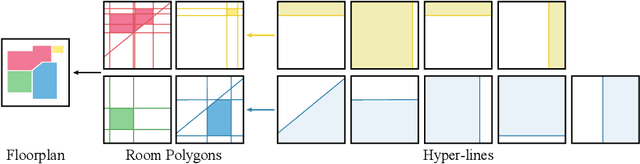
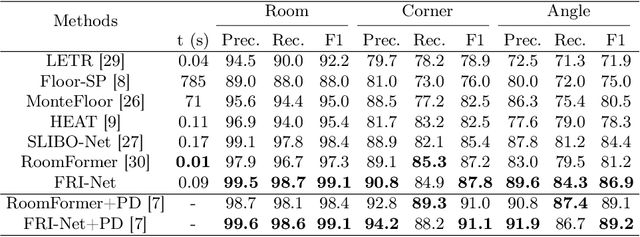
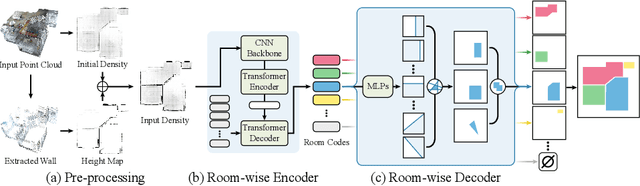
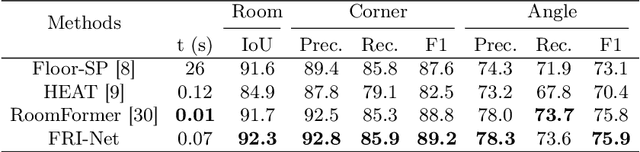
In this paper, we introduce a novel method called FRI-Net for 2D floorplan reconstruction from 3D point cloud. Existing methods typically rely on corner regression or box regression, which lack consideration for the global shapes of rooms. To address these issues, we propose a novel approach using a room-wise implicit representation with structural regularization to characterize the shapes of rooms in floorplans. By incorporating geometric priors of room layouts in floorplans into our training strategy, the generated room polygons are more geometrically regular. We have conducted experiments on two challenging datasets, Structured3D and SceneCAD. Our method demonstrates improved performance compared to state-of-the-art methods, validating the effectiveness of our proposed representation for floorplan reconstruction.
SphereDiffusion: Spherical Geometry-Aware Distortion Resilient Diffusion Model
Mar 15, 2024Controllable spherical panoramic image generation holds substantial applicative potential across a variety of domains.However, it remains a challenging task due to the inherent spherical distortion and geometry characteristics, resulting in low-quality content generation.In this paper, we introduce a novel framework of SphereDiffusion to address these unique challenges, for better generating high-quality and precisely controllable spherical panoramic images.For the spherical distortion characteristic, we embed the semantics of the distorted object with text encoding, then explicitly construct the relationship with text-object correspondence to better use the pre-trained knowledge of the planar images.Meanwhile, we employ a deformable technique to mitigate the semantic deviation in latent space caused by spherical distortion.For the spherical geometry characteristic, in virtue of spherical rotation invariance, we improve the data diversity and optimization objectives in the training process, enabling the model to better learn the spherical geometry characteristic.Furthermore, we enhance the denoising process of the diffusion model, enabling it to effectively use the learned geometric characteristic to ensure the boundary continuity of the generated images.With these specific techniques, experiments on Structured3D dataset show that SphereDiffusion significantly improves the quality of controllable spherical image generation and relatively reduces around 35% FID on average.
Windowed-FourierMixer: Enhancing Clutter-Free Room Modeling with Fourier Transform
Feb 28, 2024With the growing demand for immersive digital applications, the need to understand and reconstruct 3D scenes has significantly increased. In this context, inpainting indoor environments from a single image plays a crucial role in modeling the internal structure of interior spaces as it enables the creation of textured and clutter-free reconstructions. While recent methods have shown significant progress in room modeling, they rely on constraining layout estimators to guide the reconstruction process. These methods are highly dependent on the performance of the structure estimator and its generative ability in heavily occluded environments. In response to these issues, we propose an innovative approach based on a U-Former architecture and a new Windowed-FourierMixer block, resulting in a unified, single-phase network capable of effectively handle human-made periodic structures such as indoor spaces. This new architecture proves advantageous for tasks involving indoor scenes where symmetry is prevalent, allowing the model to effectively capture features such as horizon/ceiling height lines and cuboid-shaped rooms. Experiments show the proposed approach outperforms current state-of-the-art methods on the Structured3D dataset demonstrating superior performance in both quantitative metrics and qualitative results. Code and models will be made publicly available.
Ctrl-Room: Controllable Text-to-3D Room Meshes Generation with Layout Constraints
Oct 09, 2023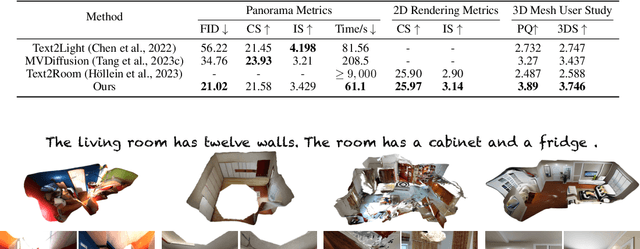
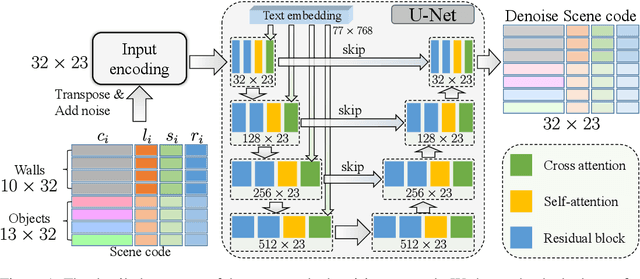
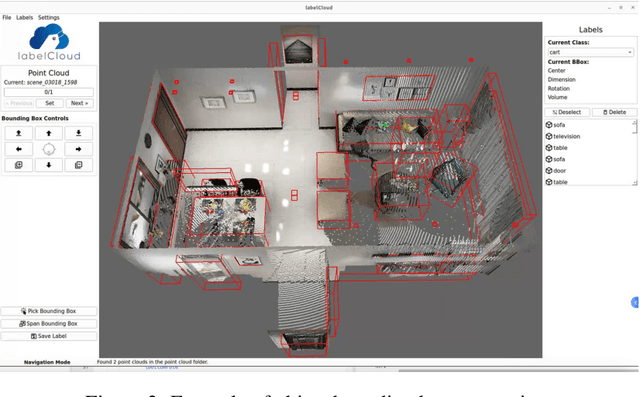
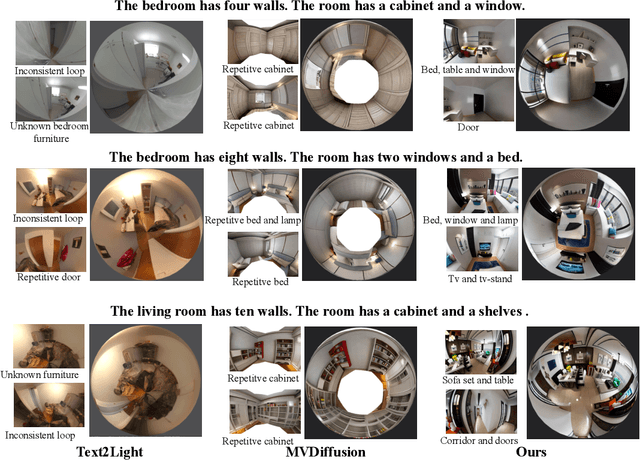
Text-driven 3D indoor scene generation could be useful for gaming, film industry, and AR/VR applications. However, existing methods cannot faithfully capture the room layout, nor do they allow flexible editing of individual objects in the room. To address these problems, we present Ctrl-Room, which is able to generate convincing 3D rooms with designer-style layouts and high-fidelity textures from just a text prompt. Moreover, Ctrl-Room enables versatile interactive editing operations such as resizing or moving individual furniture items. Our key insight is to separate the modeling of layouts and appearance. %how to model the room that takes into account both scene texture and geometry at the same time. To this end, Our proposed method consists of two stages, a `Layout Generation Stage' and an `Appearance Generation Stage'. The `Layout Generation Stage' trains a text-conditional diffusion model to learn the layout distribution with our holistic scene code parameterization. Next, the `Appearance Generation Stage' employs a fine-tuned ControlNet to produce a vivid panoramic image of the room guided by the 3D scene layout and text prompt. In this way, we achieve a high-quality 3D room with convincing layouts and lively textures. Benefiting from the scene code parameterization, we can easily edit the generated room model through our mask-guided editing module, without expensive editing-specific training. Extensive experiments on the Structured3D dataset demonstrate that our method outperforms existing methods in producing more reasonable, view-consistent, and editable 3D rooms from natural language prompts.
Single Frame Semantic Segmentation Using Multi-Modal Spherical Images
Aug 18, 2023In recent years, the research community has shown a lot of interest to panoramic images that offer a 360-degree directional perspective. Multiple data modalities can be fed, and complimentary characteristics can be utilized for more robust and rich scene interpretation based on semantic segmentation, to fully realize the potential. Existing research, however, mostly concentrated on pinhole RGB-X semantic segmentation. In this study, we propose a transformer-based cross-modal fusion architecture to bridge the gap between multi-modal fusion and omnidirectional scene perception. We employ distortion-aware modules to address extreme object deformations and panorama distortions that result from equirectangular representation. Additionally, we conduct cross-modal interactions for feature rectification and information exchange before merging the features in order to communicate long-range contexts for bi-modal and tri-modal feature streams. In thorough tests using combinations of four different modality types in three indoor panoramic-view datasets, our technique achieved state-of-the-art mIoU performance: 60.60% on Stanford2D3DS (RGB-HHA), 71.97% Structured3D (RGB-D-N), and 35.92% Matterport3D (RGB-D). We plan to release all codes and trained models soon.