 Add to Chrome
 Add to Firefox
 Add to Edge
Learning Adaptive Semantic Gaussian Allocation for 3D Occupancy
Jul 24, 2026
Semantic 3D Gaussians provide a compact representation for 3D semantic occupancy prediction by rendering semantic primitives into a voxel volume under voxel-wise supervision. Recent methods have improved the modeling ability and efficiency of this representation through more flexible primitive shapes, geometry-guided initialization, and progressive densification. However, these advances mainly determine how primitives are represented, initialized, or added, and do not explicitly address how to select the most useful Gaussians when their total number must be limited to control memory and computation. This imbalance creates an allocation bottleneck: redundant Gaussians remain in simple regions, while difficult regions receive insufficient semantic support. We propose the Semantic Gaussian Allocation Transformer (SAGFormer), which uses Gaussian attributes and local geometric-semantic features to score candidates and select a fixed final Gaussian set. Experiments on nuScenes-SurroundOcc and SSCBench-KITTI-360 show that SAGFormer improves occupancy prediction under the evaluated protocols and yields more semantically consistent and better-utilized Gaussian representations. Under similar final counts and raw coverage, it reduces semantic mixing, strengthens class-consistent voxel support, and produces fewer unused Gaussians. The results indicate that explicit capacity allocation is a useful complement to Gaussian refinement for semantic occupancy prediction.

T3HG-Editor: Text-driven 3D Human Garment Editing with Body Priors Embedded in SMPL-X
Jul 15, 2026While 3D Gaussian Editing (3DGE) has seen substantial progress, text-driven 3D human garment editing remains largely underexplored. Existing 3DGE works typically follow a paradigm that applies 2D editing techniques to multi-view rendered images and updates 3D Gaussians based on the modified images. Extending such methods to 3D human garment editing suffers from low-fidelity outcomes, caused by introduced distortions and garment inconsistencies. A promising breakthrough opportunity arises from the SMPL eXpressive (SMPL-X) model that embodies rich prior information for virtual humans. Motivated by this insight, we propose a text-driven 3D human garment editor termed T3HG-Editor, which delivers high-fidelity and garment consistent results by leveraging geometry and joint priors embedded in SMPL-X. Specifically, T3HG-Editor contains three stages, namely obtainment of editable Gaussians, garment consistent editing, and Gaussian updating with overflow pruning. The obtainment of editable Gaussians begins with seeding Gaussians along SMPL-X normals to generate sufficient near surface Gaussians, followed by a 2D mask constraint that precisely localizes the target Gaussians to be edited. The garment consistent editing aggregates tokens corresponding to the same SMPL-X vertex across multiple views and propagates them to their original views, enforcing garment consistency without requiring additional training. Gaussian updating with overflow pruning employs a Signed Distance Function (SDF) defined on SMPL-X to construct a human distance field, which is then integrated with a 2D semantic mask to prune overflowing Gaussians, thus preventing contamination of non-target regions. Experiments on multiple subjects and diverse garment types demonstrate that T3HG-Editor outperforms state-of-the-art methods in both editing quality and garment consistency.
Towards Accurate Single Panoramic 3D Detection: A Semantic Gaussian Centric Approach
May 14, 2026Three-dimensional object detection in panoramic imagery is crucial for comprehensive scene understanding, yet accurately mapping 2D features to 3D remains a significant challenge. Prevailing methods often project 2D features onto discrete 3D grids, which break geometric continuity and limit representation efficiency. To overcome this limitation, this paper proposes PanoGSDet, a monocular panoramic 3D detection framework built upon continuous semantic 3D Gaussian representations. The proposed framework comprises a panoramic depth estimation component and a semantic Gaussian component. The panoramic depth estimation component extracts the equirectangular semantic and depth features from the monocular panorama input. The semantic Gaussian component includes a semantic Gaussian lifting module that projects spherical features into 3D semantic Gaussians, a semantic Gaussian optimization module that refines these semantic Gaussians, and a Gaussian guided prediction head that generates 3D bounding boxes from optimized Gaussian representations. Extensive experiments on the Structured3D dataset demonstrate that our method significantly outperforms existing methods.
PairDropGS: Paired Dropout-Induced Consistency Regularization for Sparse-View Gaussian Splatting
May 13, 2026Dropout-based sparse-view 3D Gaussian Splatting (3DGS) methods alleviate overfitting by randomly suppressing Gaussian primitives during training. Existing methods mainly focus on designing increasingly sophisticated dropout strategies, while they overlook the resulting inconsistencies among different dropped Gaussian subsets. This oversight often leads to unstable reconstruction and suboptimal Gaussian representation learning.In this paper, we revisit dropout-based sparse-view 3DGS from a consistency regularization perspective and propose PairDropGS, a Paired Dropout-induced Consistency Regularization framework for sparse-view Gaussian splatting. Specifically, PairDropGS first constructs a pair of the dropped Gaussian subsets from a shared Gaussian field and designs a low-frequency consistency regularization to constrain their low-frequency rendered structures. This design encourages the shared Gaussian field to preserve stable scene layout and coarse geometry under different random dropouts, while avoiding excessive constraints on ambiguous high-frequency details. Moreover, we introduce a progressive consistency scheduling strategy to gradually strengthen the consistency regularization during training for stability and robustness of reconstruction. Extensive experiments on widely-used sparse-view benchmarks demonstrate that PairDropGS achieves superior training stability, significantly outperforms existing dropout-based 3DGS methods in reconstruction quality, while exhibiting the simplicity and plug-and-play nature for improving dropout-based optimization.
Hyperbolic Distillation: Geometry-Guided Cross-Modal Transfer for Robust 3D Object Detection
May 11, 2026Cross-modal knowledge distillation has emerged as an effective strategy for integrating point cloud and image features in 3D perception tasks. However, the modality heterogeneity, spatial misalignment, and the representation crisis of multiple modalities often limit the efficient of these cross-modal distillation methods. To address these limitations in existing approaches, we propose a hyperbolic constrained cross-modal distillation method for multimodal 3D object detection (HGC-Det). The proposed HGC-Det framework includes an image branch and a point cloud branch to extract semantic features from two different modalities. The point cloud branch comprises three core components: a 2D semantic-guided voxel optimization component (SGVO), a hyperbolic geometry constrained cross-modal feature transfer component (HFT), and a feature aggregation-based geometry optimization component (FAGO). Specifically, the SGVO component adaptively refines the spatial representation of the 3D branch by leveraging semantic cues from the image branch, thereby mitigating the issue of inadequate representation fusion. The HFT component exploits the intrinsic geometric properties of hyperbolic space to alleviate semantic loss during the fusion of high-dimensional image features and low-dimensional point cloud features. Finally, the FAGO compensates for potential spatial feature degradation introduced by the 2D semantic-guided voxel optimization component. Extensive experiments on indoor datasets (SUN RGB-D, ARKitScenes) and outdoor datasets (KITTI, nuScenes) demonstrate that our method achieves a better trade-off between detection accuracy and computational cost.
MRT: Learning Compact Representations with Mixed RWKV-Transformer for Extreme Image Compression
Nov 14, 2025Recent advances in extreme image compression have revealed that mapping pixel data into highly compact latent representations can significantly improve coding efficiency. However, most existing methods compress images into 2-D latent spaces via convolutional neural networks (CNNs) or Swin Transformers, which tend to retain substantial spatial redundancy, thereby limiting overall compression performance. In this paper, we propose a novel Mixed RWKV-Transformer (MRT) architecture that encodes images into more compact 1-D latent representations by synergistically integrating the complementary strengths of linear-attention-based RWKV and self-attention-based Transformer models. Specifically, MRT partitions each image into fixed-size windows, utilizing RWKV modules to capture global dependencies across windows and Transformer blocks to model local redundancies within each window. The hierarchical attention mechanism enables more efficient and compact representation learning in the 1-D domain. To further enhance compression efficiency, we introduce a dedicated RWKV Compression Model (RCM) tailored to the structure characteristics of the intermediate 1-D latent features in MRT. Extensive experiments on standard image compression benchmarks validate the effectiveness of our approach. The proposed MRT framework consistently achieves superior reconstruction quality at bitrates below 0.02 bits per pixel (bpp). Quantitative results based on the DISTS metric show that MRT significantly outperforms the state-of-the-art 2-D architecture GLC, achieving bitrate savings of 43.75%, 30.59% on the Kodak and CLIC2020 test datasets, respectively.
An End-to-End Room Geometry Constrained Depth Estimation Framework for Indoor Panorama Images
Oct 09, 2025Predicting spherical pixel depth from monocular $360^{\circ}$ indoor panoramas is critical for many vision applications. However, existing methods focus on pixel-level accuracy, causing oversmoothed room corners and noise sensitivity. In this paper, we propose a depth estimation framework based on room geometry constraints, which extracts room geometry information through layout prediction and integrates those information into the depth estimation process through background segmentation mechanism. At the model level, our framework comprises a shared feature encoder followed by task-specific decoders for layout estimation, depth estimation, and background segmentation. The shared encoder extracts multi-scale features, which are subsequently processed by individual decoders to generate initial predictions: a depth map, a room layout map, and a background segmentation map. Furthermore, our framework incorporates two strategies: a room geometry-based background depth resolving strategy and a background-segmentation-guided fusion mechanism. The proposed room-geometry-based background depth resolving strategy leverages the room layout and the depth decoder's output to generate the corresponding background depth map. Then, a background-segmentation-guided fusion strategy derives fusion weights for the background and coarse depth maps from the segmentation decoder's predictions. Extensive experimental results on the Stanford2D3D, Matterport3D and Structured3D datasets show that our proposed methods can achieve significantly superior performance than current open-source methods. Our code is available at https://github.com/emiyaning/RGCNet.
Region-Level Context-Aware Multimodal Understanding
Aug 17, 2025Despite significant progress, existing research on Multimodal Large Language Models (MLLMs) mainly focuses on general visual understanding, overlooking the ability to integrate textual context associated with objects for a more context-aware multimodal understanding -- an ability we refer to as Region-level Context-aware Multimodal Understanding (RCMU). To address this limitation, we first formulate the RCMU task, which requires models to respond to user instructions by integrating both image content and textual information of regions or objects. To equip MLLMs with RCMU capabilities, we propose Region-level Context-aware Visual Instruction Tuning (RCVIT), which incorporates object information into the model input and enables the model to utilize bounding box coordinates to effectively associate objects' visual content with their textual information. To address the lack of datasets, we introduce the RCMU dataset, a large-scale visual instruction tuning dataset that covers multiple RCMU tasks. We also propose RC\&P-Bench, a comprehensive benchmark that can evaluate the performance of MLLMs in RCMU and multimodal personalized understanding tasks. Additionally, we propose a reference-free evaluation metric to perform a comprehensive and fine-grained evaluation of the region-level context-aware image descriptions. By performing RCVIT on Qwen2-VL models with the RCMU dataset, we developed RC-Qwen2-VL models. Experimental results indicate that RC-Qwen2-VL models not only achieve outstanding performance on multiple RCMU tasks but also demonstrate successful applications in multimodal RAG and personalized conversation. Our data, model and benchmark are available at https://github.com/hongliang-wei/RC-MLLM
T-GVC: Trajectory-Guided Generative Video Coding at Ultra-Low Bitrates
Jul 10, 2025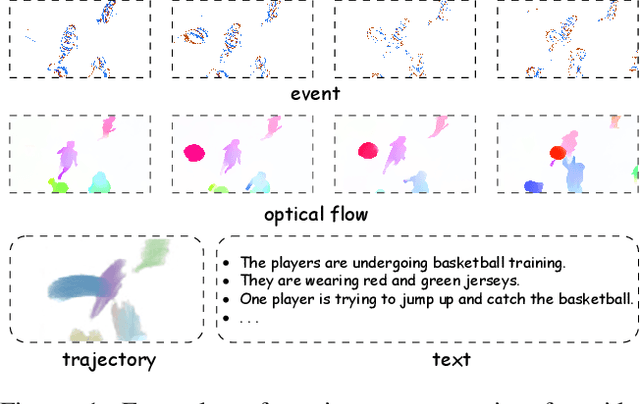
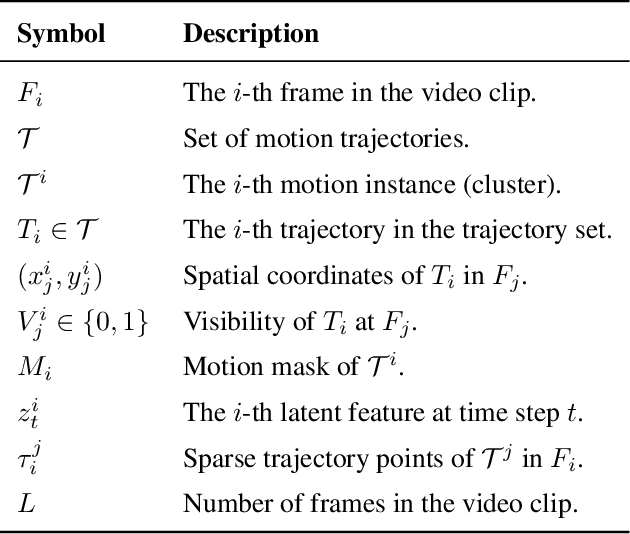
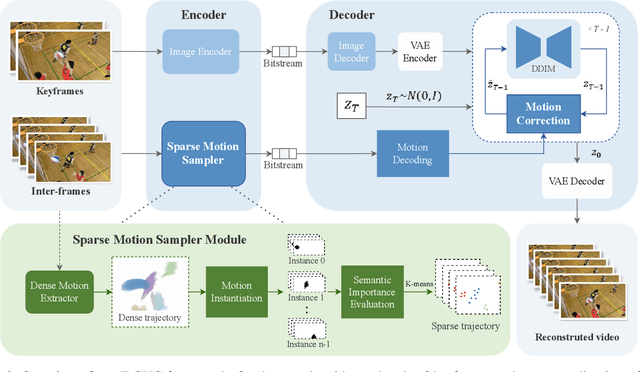
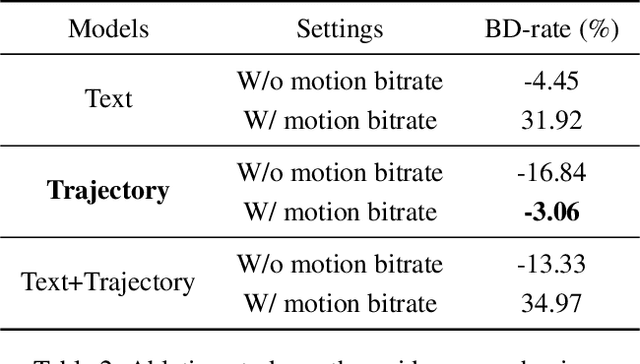
Recent advances in video generation techniques have given rise to an emerging paradigm of generative video coding, aiming to achieve semantically accurate reconstructions in Ultra-Low Bitrate (ULB) scenarios by leveraging strong generative priors. However, most existing methods are limited by domain specificity (e.g., facial or human videos) or an excessive dependence on high-level text guidance, which often fails to capture motion details and results in unrealistic reconstructions. To address these challenges, we propose a Trajectory-Guided Generative Video Coding framework (dubbed T-GVC). T-GVC employs a semantic-aware sparse motion sampling pipeline to effectively bridge low-level motion tracking with high-level semantic understanding by extracting pixel-wise motion as sparse trajectory points based on their semantic importance, not only significantly reducing the bitrate but also preserving critical temporal semantic information. In addition, by incorporating trajectory-aligned loss constraints into diffusion processes, we introduce a training-free latent space guidance mechanism to ensure physically plausible motion patterns without sacrificing the inherent capabilities of generative models. Experimental results demonstrate that our framework outperforms both traditional codecs and state-of-the-art end-to-end video compression methods under ULB conditions. Furthermore, additional experiments confirm that our approach achieves more precise motion control than existing text-guided methods, paving the way for a novel direction of generative video coding guided by geometric motion modeling.
Multi-Timescale Motion-Decoupled Spiking Transformer for Audio-Visual Zero-Shot Learning
May 26, 2025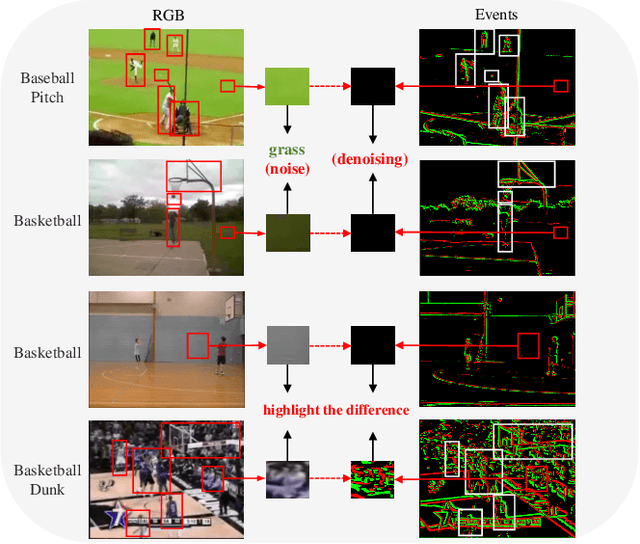
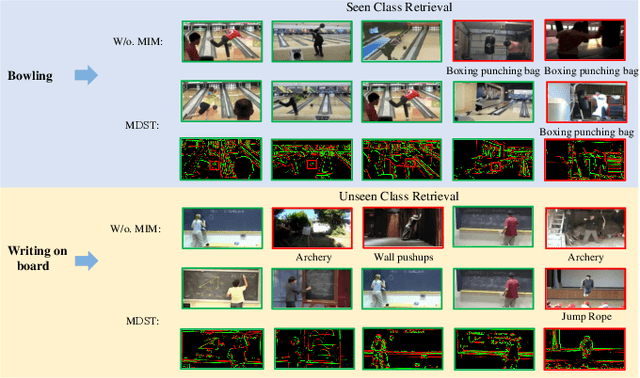
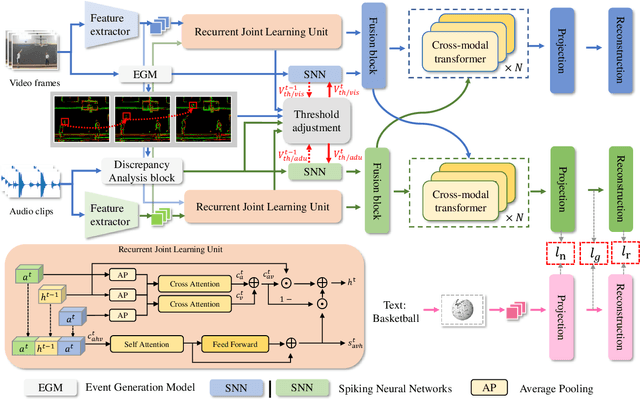
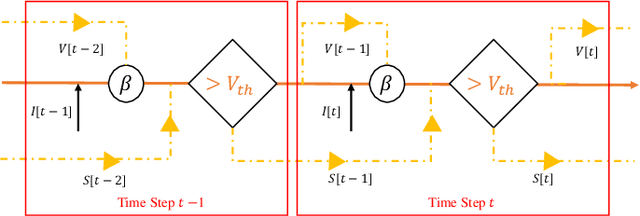
Audio-visual zero-shot learning (ZSL) has been extensively researched for its capability to classify video data from unseen classes during training. Nevertheless, current methodologies often struggle with background scene biases and inadequate motion detail. This paper proposes a novel dual-stream Multi-Timescale Motion-Decoupled Spiking Transformer (MDST++), which decouples contextual semantic information and sparse dynamic motion information. The recurrent joint learning unit is proposed to extract contextual semantic information and capture joint knowledge across various modalities to understand the environment of actions. By converting RGB images to events, our method captures motion information more accurately and mitigates background scene biases. Moreover, we introduce a discrepancy analysis block to model audio motion information. To enhance the robustness of SNNs in extracting temporal and motion cues, we dynamically adjust the threshold of Leaky Integrate-and-Fire neurons based on global motion and contextual semantic information. Our experiments validate the effectiveness of MDST++, demonstrating their consistent superiority over state-of-the-art methods on mainstream benchmarks. Additionally, incorporating motion and multi-timescale information significantly improves HM and ZSL accuracy by 26.2\% and 39.9\%.