 Add to Chrome
 Add to Firefox
 Add to Edge
WildDet3D: Scaling Promptable 3D Detection in the Wild
Apr 09, 2026
Understanding objects in 3D from a single image is a cornerstone of spatial intelligence. A key step toward this goal is monocular 3D object detection--recovering the extent, location, and orientation of objects from an input RGB image. To be practical in the open world, such a detector must generalize beyond closed-set categories, support diverse prompt modalities, and leverage geometric cues when available. Progress is hampered by two bottlenecks: existing methods are designed for a single prompt type and lack a mechanism to incorporate additional geometric cues, and current 3D datasets cover only narrow categories in controlled environments, limiting open-world transfer. In this work we address both gaps. First, we introduce WildDet3D, a unified geometry-aware architecture that natively accepts text, point, and box prompts and can incorporate auxiliary depth signals at inference time. Second, we present WildDet3D-Data, the largest open 3D detection dataset to date, constructed by generating candidate 3D boxes from existing 2D annotations and retaining only human-verified ones, yielding over 1M images across 13.5K categories in diverse real-world scenes. WildDet3D establishes a new state-of-the-art across multiple benchmarks and settings. In the open-world setting, it achieves 22.6/24.8 AP3D on our newly introduced WildDet3D-Bench with text and box prompts. On Omni3D, it reaches 34.2/36.4 AP3D with text and box prompts, respectively. In zero-shot evaluation, it achieves 40.3/48.9 ODS on Argoverse 2 and ScanNet. Notably, incorporating depth cues at inference time yields substantial additional gains (+20.7 AP on average across settings).

PALMS+: Modular Image-Based Floor Plan Localization Leveraging Depth Foundation Model
Nov 12, 2025Indoor localization in GPS-denied environments is crucial for applications like emergency response and assistive navigation. Vision-based methods such as PALMS enable infrastructure-free localization using only a floor plan and a stationary scan, but are limited by the short range of smartphone LiDAR and ambiguity in indoor layouts. We propose PALMS$+$, a modular, image-based system that addresses these challenges by reconstructing scale-aligned 3D point clouds from posed RGB images using a foundation monocular depth estimation model (Depth Pro), followed by geometric layout matching via convolution with the floor plan. PALMS$+$ outputs a posterior over the location and orientation, usable for direct or sequential localization. Evaluated on the Structured3D and a custom campus dataset consisting of 80 observations across four large campus buildings, PALMS$+$ outperforms PALMS and F3Loc in stationary localization accuracy -- without requiring any training. Furthermore, when integrated with a particle filter for sequential localization on 33 real-world trajectories, PALMS$+$ achieved lower localization errors compared to other methods, demonstrating robustness for camera-free tracking and its potential for infrastructure-free applications. Code and data are available at https://github.com/Head-inthe-Cloud/PALMS-Plane-based-Accessible-Indoor-Localization-Using-Mobile-Smartphones
PALMS: Plane-based Accessible Indoor Localization Using Mobile Smartphones
Oct 21, 2024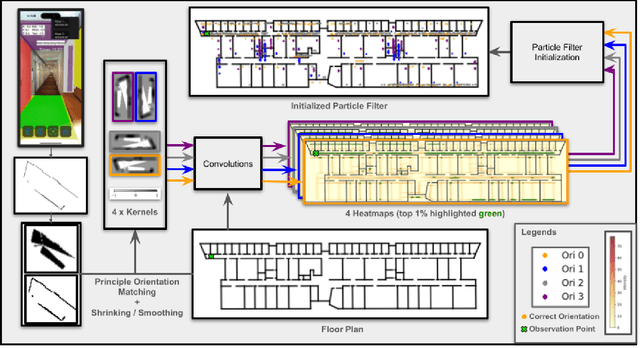
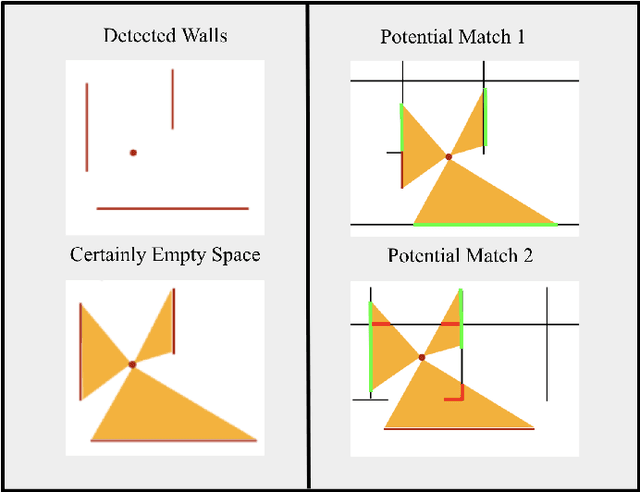
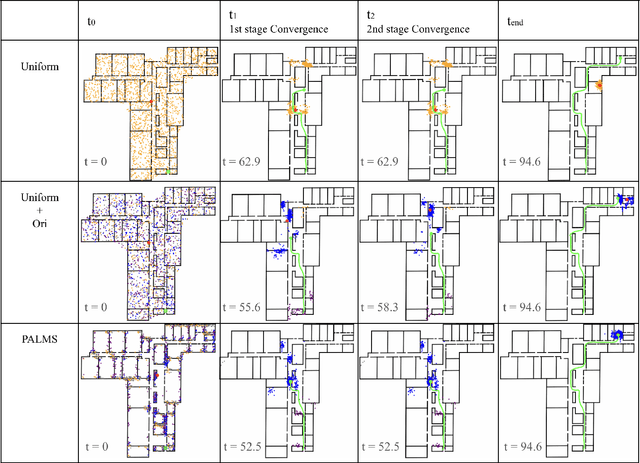

In this paper, we present PALMS, an innovative indoor global localization and relocalization system for mobile smartphones that utilizes publicly available floor plans. Unlike most vision-based methods that require constant visual input, our system adopts a dynamic form of localization that considers a single instantaneous observation and odometry data. The core contribution of this work is the introduction of a particle filter initialization method that leverages the Certainly Empty Space (CES) constraint along with principal orientation matching. This approach creates a spatial probability distribution of the device's location, significantly improving localization accuracy and reducing particle filter convergence time. Our experimental evaluations demonstrate that PALMS outperforms traditional methods with uniformly initialized particle filters, providing a more efficient and accessible approach to indoor wayfinding. By eliminating the need for prior environmental fingerprinting, PALMS provides a scalable and practical approach to indoor navigation.