 Add to Chrome
 Add to Firefox
 Add to Edge
Semi Supervised Learning For Image Captioning
Papers and Code
Describe Anything: Detailed Localized Image and Video Captioning
Apr 22, 2025
Generating detailed and accurate descriptions for specific regions in images and videos remains a fundamental challenge for vision-language models. We introduce the Describe Anything Model (DAM), a model designed for detailed localized captioning (DLC). DAM preserves both local details and global context through two key innovations: a focal prompt, which ensures high-resolution encoding of targeted regions, and a localized vision backbone, which integrates precise localization with its broader context. To tackle the scarcity of high-quality DLC data, we propose a Semi-supervised learning (SSL)-based Data Pipeline (DLC-SDP). DLC-SDP starts with existing segmentation datasets and expands to unlabeled web images using SSL. We introduce DLC-Bench, a benchmark designed to evaluate DLC without relying on reference captions. DAM sets new state-of-the-art on 7 benchmarks spanning keyword-level, phrase-level, and detailed multi-sentence localized image and video captioning.

Google is all you need: Semi-Supervised Transfer Learning Strategy For Light Multimodal Multi-Task Classification Model
Jan 03, 2025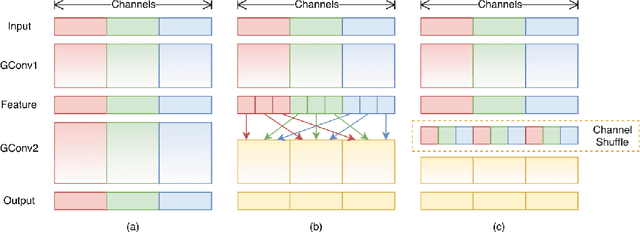
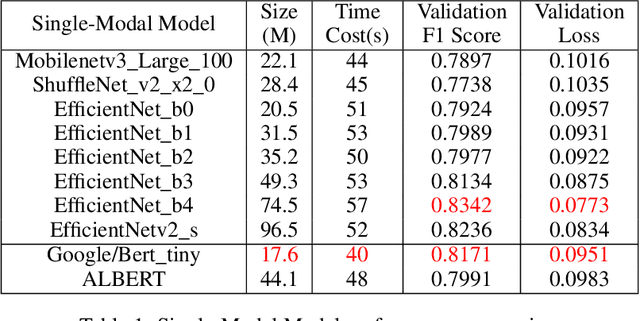
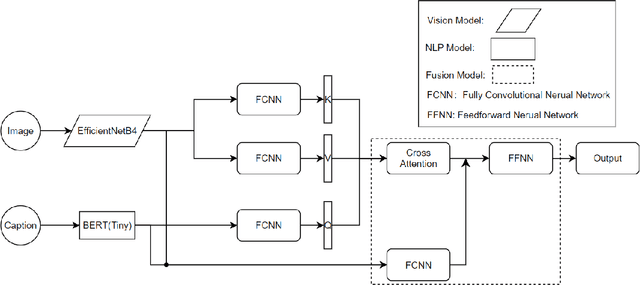
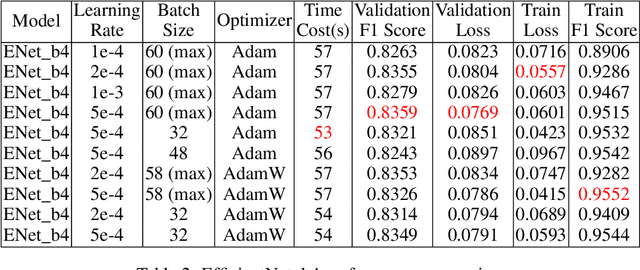
As the volume of digital image data increases, the effectiveness of image classification intensifies. This study introduces a robust multi-label classification system designed to assign multiple labels to a single image, addressing the complexity of images that may be associated with multiple categories (ranging from 1 to 19, excluding 12). We propose a multi-modal classifier that merges advanced image recognition algorithms with Natural Language Processing (NLP) models, incorporating a fusion module to integrate these distinct modalities. The purpose of integrating textual data is to enhance the accuracy of label prediction by providing contextual understanding that visual analysis alone cannot fully capture. Our proposed classification model combines Convolutional Neural Networks (CNN) for image processing with NLP techniques for analyzing textual description (i.e., captions). This approach includes rigorous training and validation phases, with each model component verified and analyzed through ablation experiments. Preliminary results demonstrate the classifier's accuracy and efficiency, highlighting its potential as an automatic image-labeling system.
Visual Delta Generator with Large Multi-modal Models for Semi-supervised Composed Image Retrieval
Apr 23, 2024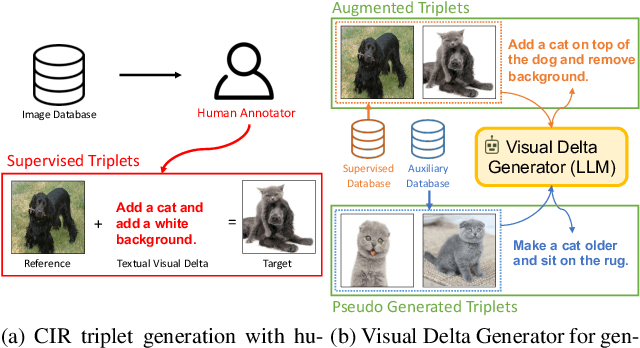
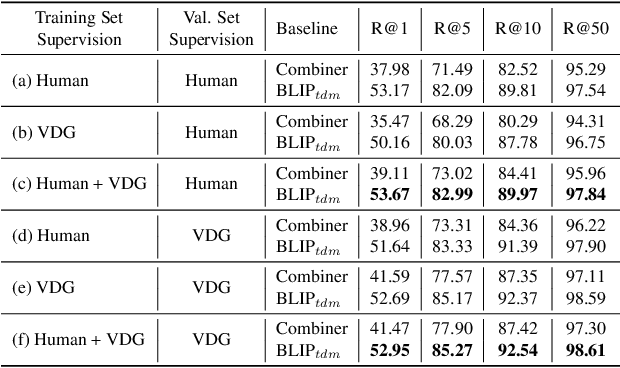
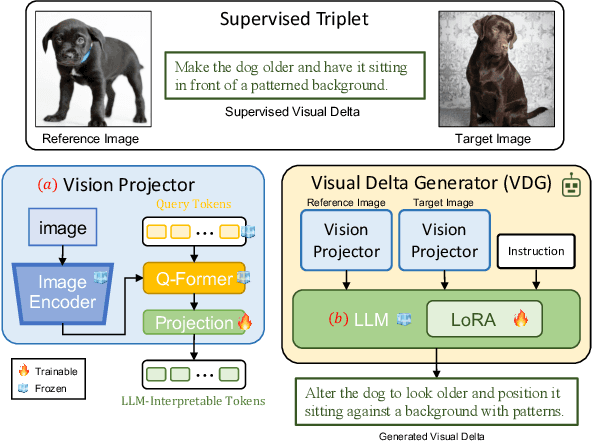
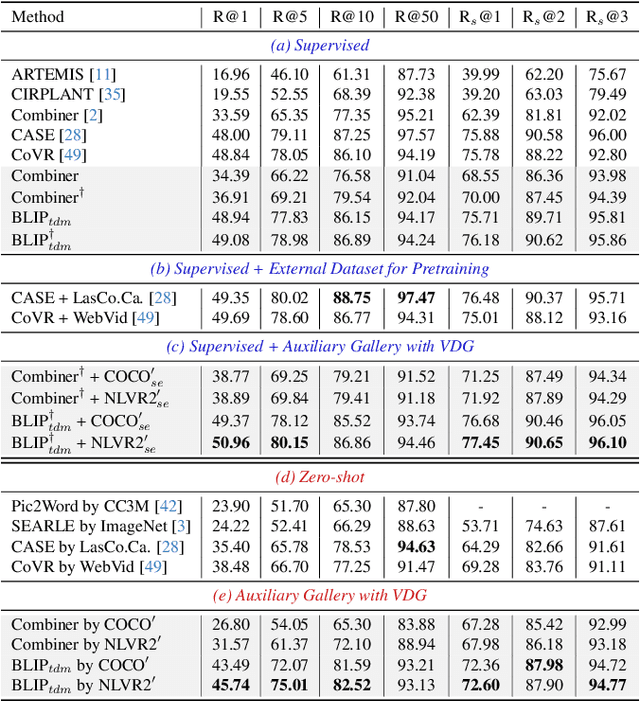
Composed Image Retrieval (CIR) is a task that retrieves images similar to a query, based on a provided textual modification. Current techniques rely on supervised learning for CIR models using labeled triplets of the reference image, text, target image. These specific triplets are not as commonly available as simple image-text pairs, limiting the widespread use of CIR and its scalability. On the other hand, zero-shot CIR can be relatively easily trained with image-caption pairs without considering the image-to-image relation, but this approach tends to yield lower accuracy. We propose a new semi-supervised CIR approach where we search for a reference and its related target images in auxiliary data and learn our large language model-based Visual Delta Generator (VDG) to generate text describing the visual difference (i.e., visual delta) between the two. VDG, equipped with fluent language knowledge and being model agnostic, can generate pseudo triplets to boost the performance of CIR models. Our approach significantly improves the existing supervised learning approaches and achieves state-of-the-art results on the CIR benchmarks.
Semi-Supervised Image Captioning Considering Wasserstein Graph Matching
Mar 26, 2024Image captioning can automatically generate captions for the given images, and the key challenge is to learn a mapping function from visual features to natural language features. Existing approaches are mostly supervised ones, i.e., each image has a corresponding sentence in the training set. However, considering that describing images always requires a huge of manpower, we usually have limited amount of described images (i.e., image-text pairs) and a large number of undescribed images in real-world applications. Thereby, a dilemma is the "Semi-Supervised Image Captioning". To solve this problem, we propose a novel Semi-Supervised Image Captioning method considering Wasserstein Graph Matching (SSIC-WGM), which turns to adopt the raw image inputs to supervise the generated sentences. Different from traditional single modal semi-supervised methods, the difficulty of semi-supervised cross-modal learning lies in constructing intermediately comparable information among heterogeneous modalities. In this paper, SSIC-WGM adopts the successful scene graphs as intermediate information, and constrains the generated sentences from two aspects: 1) inter-modal consistency. SSIC-WGM constructs the scene graphs of the raw image and generated sentence respectively, then employs the wasserstein distance to better measure the similarity between region embeddings of different graphs. 2) intra-modal consistency. SSIC-WGM takes the data augmentation techniques for the raw images, then constrains the consistency among augmented images and generated sentences. Consequently, SSIC-WGM combines the cross-modal pseudo supervision and structure invariant measure for efficiently using the undescribed images, and learns more reasonable mapping function.
Semi-supervised Text-based Person Search
Apr 28, 2024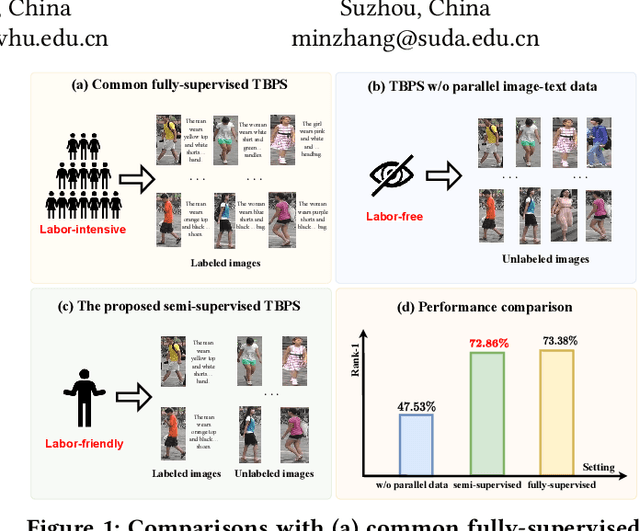
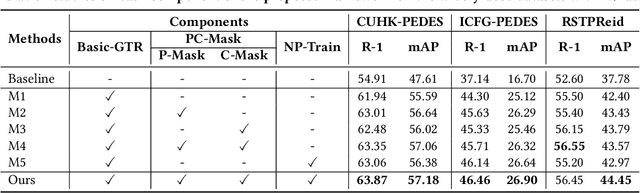
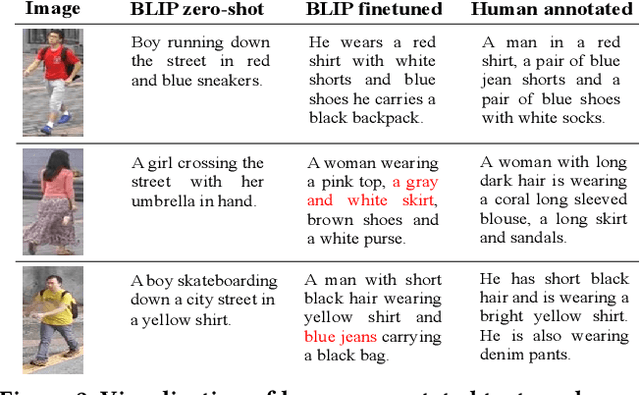
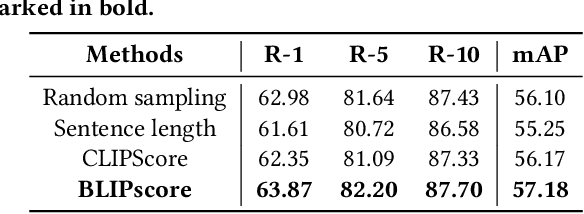
Text-based person search (TBPS) aims to retrieve images of a specific person from a large image gallery based on a natural language description. Existing methods rely on massive annotated image-text data to achieve satisfactory performance in fully-supervised learning. It poses a significant challenge in practice, as acquiring person images from surveillance videos is relatively easy, while obtaining annotated texts is challenging. The paper undertakes a pioneering initiative to explore TBPS under the semi-supervised setting, where only a limited number of person images are annotated with textual descriptions while the majority of images lack annotations. We present a two-stage basic solution based on generation-then-retrieval for semi-supervised TBPS. The generation stage enriches annotated data by applying an image captioning model to generate pseudo-texts for unannotated images. Later, the retrieval stage performs fully-supervised retrieval learning using the augmented data. Significantly, considering the noise interference of the pseudo-texts on retrieval learning, we propose a noise-robust retrieval framework that enhances the ability of the retrieval model to handle noisy data. The framework integrates two key strategies: Hybrid Patch-Channel Masking (PC-Mask) to refine the model architecture, and Noise-Guided Progressive Training (NP-Train) to enhance the training process. PC-Mask performs masking on the input data at both the patch-level and the channel-level to prevent overfitting noisy supervision. NP-Train introduces a progressive training schedule based on the noise level of pseudo-texts to facilitate noise-robust learning. Extensive experiments on multiple TBPS benchmarks show that the proposed framework achieves promising performance under the semi-supervised setting.
Pseudo-RIS: Distinctive Pseudo-supervision Generation for Referring Image Segmentation
Jul 10, 2024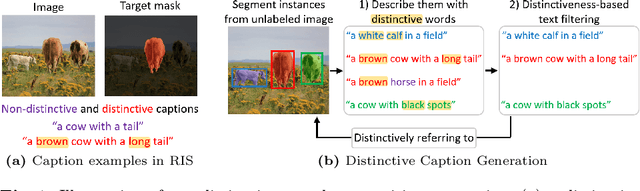
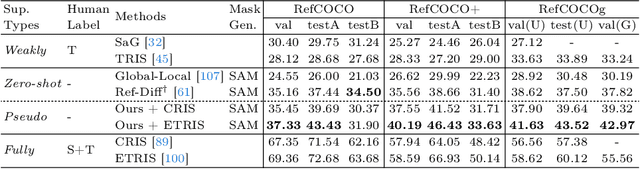
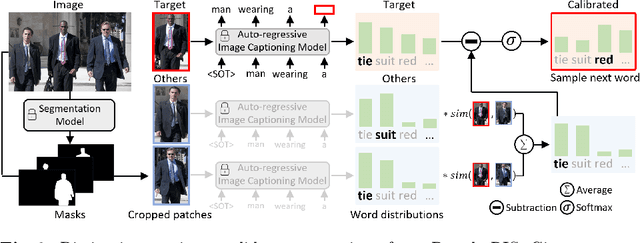
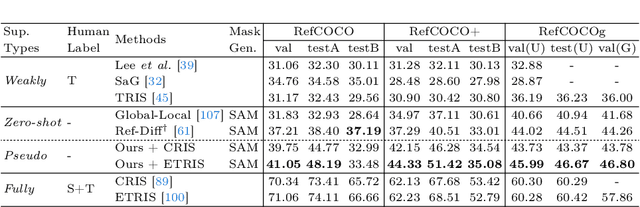
We propose a new framework that automatically generates high-quality segmentation masks with their referring expressions as pseudo supervisions for referring image segmentation (RIS). These pseudo supervisions allow the training of any supervised RIS methods without the cost of manual labeling. To achieve this, we incorporate existing segmentation and image captioning foundation models, leveraging their broad generalization capabilities. However, the naive incorporation of these models may generate non-distinctive expressions that do not distinctively refer to the target masks. To address this challenge, we propose two-fold strategies that generate distinctive captions: 1) 'distinctive caption sampling', a new decoding method for the captioning model, to generate multiple expression candidates with detailed words focusing on the target. 2) 'distinctiveness-based text filtering' to further validate the candidates and filter out those with a low level of distinctiveness. These two strategies ensure that the generated text supervisions can distinguish the target from other objects, making them appropriate for the RIS annotations. Our method significantly outperforms both weakly and zero-shot SoTA methods on the RIS benchmark datasets. It also surpasses fully supervised methods in unseen domains, proving its capability to tackle the open-world challenge within RIS. Furthermore, integrating our method with human annotations yields further improvements, highlighting its potential in semi-supervised learning applications.
NoiseBoost: Alleviating Hallucination with Noise Perturbation for Multimodal Large Language Models
May 31, 2024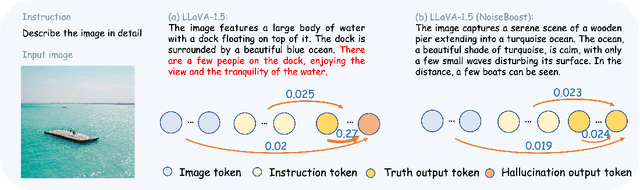
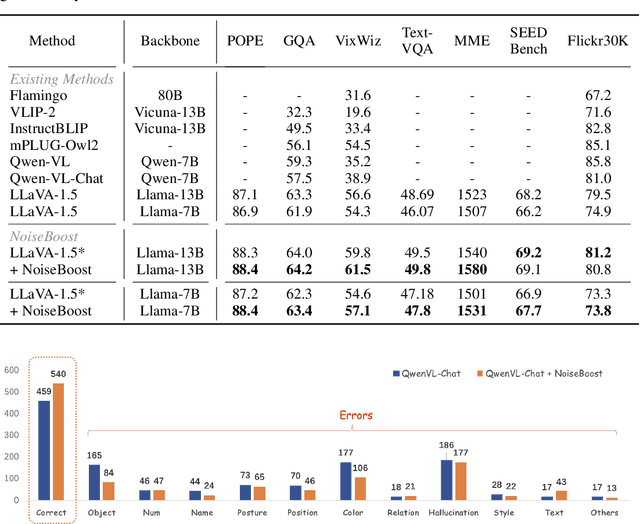
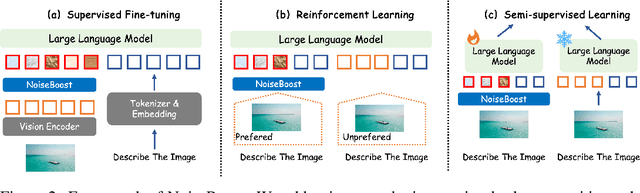

Multimodal large language models (MLLMs) contribute a powerful mechanism to understanding visual information building on large language models. However, MLLMs are notorious for suffering from hallucinations, especially when generating lengthy, detailed descriptions for images. Our analysis reveals that hallucinations stem from the inherent summarization mechanism of large language models, leading to excessive dependence on linguistic tokens while neglecting vision information. In this paper, we propose NoiseBoost, a broadly applicable and simple method for alleviating hallucinations for MLLMs through the integration of noise feature perturbations. Noise perturbation acts as a regularizer, facilitating a balanced distribution of attention weights among visual and linguistic tokens. Despite its simplicity, NoiseBoost consistently enhances the performance of MLLMs across common training strategies, including supervised fine-tuning and reinforcement learning. Further, NoiseBoost pioneerly enables semi-supervised learning for MLLMs, unleashing the power of unlabeled data. Comprehensive experiments demonstrate that NoiseBoost improves dense caption accuracy by 8.1% with human evaluation and achieves comparable results with 50% of the data by mining unlabeled data. Code and models are available at https://kaiwu5.github.io/noiseboost.
Cycle-Consistency Learning for Captioning and Grounding
Dec 23, 2023We present that visual grounding and image captioning, which perform as two mutually inverse processes, can be bridged together for collaborative training by careful designs. By consolidating this idea, we introduce CyCo, a cyclic-consistent learning framework to ameliorate the independent training pipelines of visual grounding and image captioning. The proposed framework (1) allows the semi-weakly supervised training of visual grounding; (2) improves the performance of fully supervised visual grounding; (3) yields a general captioning model that can describe arbitrary image regions. Extensive experiments show that our fully supervised grounding model achieves state-of-the-art performance, and the semi-weakly supervised one also exhibits competitive performance compared to the fully supervised counterparts. Our image captioning model has the capability to freely describe image regions and meanwhile shows impressive performance on prevalent captioning benchmarks.
SemiVL: Semi-Supervised Semantic Segmentation with Vision-Language Guidance
Nov 27, 2023In semi-supervised semantic segmentation, a model is trained with a limited number of labeled images along with a large corpus of unlabeled images to reduce the high annotation effort. While previous methods are able to learn good segmentation boundaries, they are prone to confuse classes with similar visual appearance due to the limited supervision. On the other hand, vision-language models (VLMs) are able to learn diverse semantic knowledge from image-caption datasets but produce noisy segmentation due to the image-level training. In SemiVL, we propose to integrate rich priors from VLM pre-training into semi-supervised semantic segmentation to learn better semantic decision boundaries. To adapt the VLM from global to local reasoning, we introduce a spatial fine-tuning strategy for label-efficient learning. Further, we design a language-guided decoder to jointly reason over vision and language. Finally, we propose to handle inherent ambiguities in class labels by providing the model with language guidance in the form of class definitions. We evaluate SemiVL on 4 semantic segmentation datasets, where it significantly outperforms previous semi-supervised methods. For instance, SemiVL improves the state-of-the-art by +13.5 mIoU on COCO with 232 annotated images and by +6.1 mIoU on Pascal VOC with 92 labels. Project page: https://github.com/google-research/semivl
Semi-Supervised Image Captioning with CLIP
Jun 26, 2023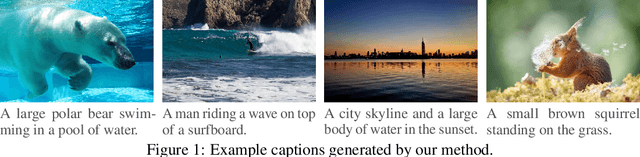
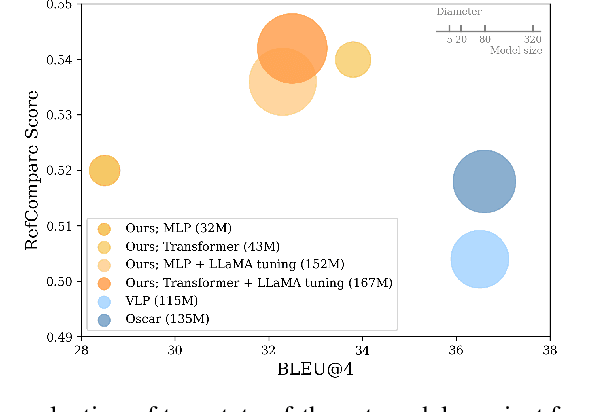
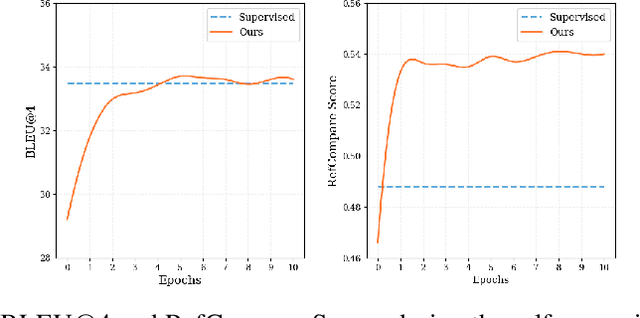

Image captioning, a fundamental task in vision-language understanding, seeks to generate accurate natural language descriptions for provided images. The CLIP model, with its rich semantic features learned from a large corpus of image-text pairs, is well-suited for this task. In this paper, we present a two-stage semi-supervised image captioning approach that exploits the potential of CLIP encoding. Our model comprises a CLIP visual encoder, a mapping network, and a language model for text generation. In the initial stage, we train the model using a small labeled dataset by contrasting the generated captions with the ground truth captions. In the subsequent stage, we continue the training using unlabeled images, aiming to maximize the image-caption similarity based on CLIP embeddings. Remarkably, despite utilizing less than 2% of the COCO-captions, our approach delivers a performance comparable to state-of-the-art models trained on the complete dataset. Furthermore, the captions generated by our approach are more distinctive, informative, and in line with human preference.