 Add to Chrome
 Add to Firefox
 Add to Edge
Protein Interface Prediction
Papers and Code
Scaling Atomistic Protein Binder Design with Generative Pretraining and Test-Time Compute
Mar 30, 2026
Protein interaction modeling is central to protein design, which has been transformed by machine learning with applications in drug discovery and beyond. In this landscape, structure-based de novo binder design is cast as either conditional generative modeling or sequence optimization via structure predictors ("hallucination"). We argue that this is a false dichotomy and propose Proteina-Complexa, a novel fully atomistic binder generation method unifying both paradigms. We extend recent flow-based latent protein generation architectures and leverage the domain-domain interactions of monomeric computationally predicted protein structures to construct Teddymer, a new large-scale dataset of synthetic binder-target pairs for pretraining. Combined with high-quality experimental multimers, this enables training a strong base model. We then perform inference-time optimization with this generative prior, unifying the strengths of previously distinct generative and hallucination methods. Proteina-Complexa sets a new state of the art in computational binder design benchmarks: it delivers markedly higher in-silico success rates than existing generative approaches, and our novel test-time optimization strategies greatly outperform previous hallucination methods under normalized compute budgets. We also demonstrate interface hydrogen bond optimization, fold class-guided binder generation, and extensions to small molecule targets and enzyme design tasks, again surpassing prior methods. Code, models and new data will be publicly released.

PepEDiff: Zero-Shot Peptide Binder Design via Protein Embedding Diffusion
Jan 19, 2026We present PepEDiff, a novel peptide binder generator that designs binding sequences given a target receptor protein sequence and its pocket residues. Peptide binder generation is critical in therapeutic and biochemical applications, yet many existing methods rely heavily on intermediate structure prediction, adding complexity and limiting sequence diversity. Our approach departs from this paradigm by generating binder sequences directly in a continuous latent space derived from a pretrained protein embedding model, without relying on predicted structures, thereby improving structural and sequence diversity. To encourage the model to capture binding-relevant features rather than memorizing known sequences, we perform latent-space exploration and diffusion-based sampling, enabling the generation of peptides beyond the limited distribution of known binders. This zero-shot generative strategy leverages the global protein embedding manifold as a semantic prior, allowing the model to propose novel peptide sequences in previously unseen regions of the protein space. We evaluate PepEDiff on TIGIT, a challenging target with a large, flat protein-protein interaction interface that lacks a druggable pocket. Despite its simplicity, our method outperforms state-of-the-art approaches across benchmark tests and in the TIGIT case study, demonstrating its potential as a general, structure-free framework for zero-shot peptide binder design. The code for this research is available at GitHub: https://github.com/LabJunBMI/PepEDiff-An-Peptide-binder-Embedding-Diffusion-Model
Scalable Agentic Reasoning for Designing Biologics Targeting Intrinsically Disordered Proteins
Dec 17, 2025Intrinsically disordered proteins (IDPs) represent crucial therapeutic targets due to their significant role in disease -- approximately 80\% of cancer-related proteins contain long disordered regions -- but their lack of stable secondary/tertiary structures makes them "undruggable". While recent computational advances, such as diffusion models, can design high-affinity IDP binders, translating these to practical drug discovery requires autonomous systems capable of reasoning across complex conformational ensembles and orchestrating diverse computational tools at scale.To address this challenge, we designed and implemented StructBioReasoner, a scalable multi-agent system for designing biologics that can be used to target IDPs. StructBioReasoner employs a novel tournament-based reasoning framework where specialized agents compete to generate and refine therapeutic hypotheses, naturally distributing computational load for efficient exploration of the vast design space. Agents integrate domain knowledge with access to literature synthesis, AI-structure prediction, molecular simulations, and stability analysis, coordinating their execution on HPC infrastructure via an extensible federated agentic middleware, Academy. We benchmark StructBioReasoner across Der f 21 and NMNAT-2 and demonstrate that over 50\% of 787 designed and validated candidates for Der f 21 outperformed the human-designed reference binders from literature, in terms of improved binding free energy. For the more challenging NMNAT-2 protein, we identified three binding modes from 97,066 binders, including the well-studied NMNAT2:p53 interface. Thus, StructBioReasoner lays the groundwork for agentic reasoning systems for IDP therapeutic discovery on Exascale platforms.
GeoPep: A geometry-aware masked language model for protein-peptide binding site prediction
Oct 30, 2025Multimodal approaches that integrate protein structure and sequence have achieved remarkable success in protein-protein interface prediction. However, extending these methods to protein-peptide interactions remains challenging due to the inherent conformational flexibility of peptides and the limited availability of structural data that hinder direct training of structure-aware models. To address these limitations, we introduce GeoPep, a novel framework for peptide binding site prediction that leverages transfer learning from ESM3, a multimodal protein foundation model. GeoPep fine-tunes ESM3's rich pre-learned representations from protein-protein binding to address the limited availability of protein-peptide binding data. The fine-tuned model is further integrated with a parameter-efficient neural network architecture capable of learning complex patterns from sparse data. Furthermore, the model is trained using distance-based loss functions that exploit 3D structural information to enhance binding site prediction. Comprehensive evaluations demonstrate that GeoPep significantly outperforms existing methods in protein-peptide binding site prediction by effectively capturing sparse and heterogeneous binding patterns.
Controllable protein design through Feynman-Kac steering
Nov 12, 2025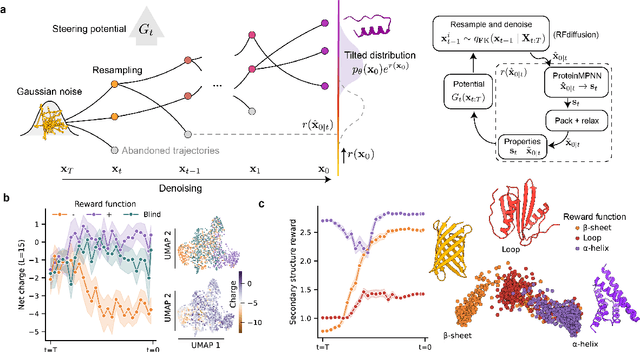

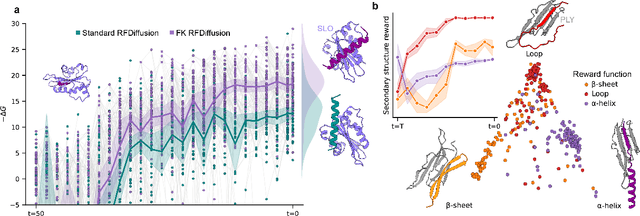
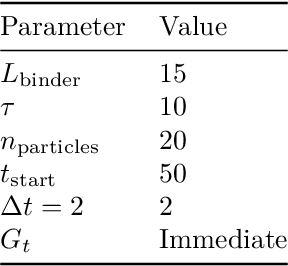
Diffusion-based models have recently enabled the generation of realistic and diverse protein structures, yet they remain limited in their ability to steer outcomes toward specific functional or biochemical objectives, such as binding affinity or sequence composition. Here we extend the Feynman-Kac (FK) steering framework, an inference-time control approach, to diffusion-based protein design. By coupling FK steering with structure generation, the method guides sampling toward desirable structural or energetic features while maintaining the diversity of the underlying diffusion process. To enable simultaneous generation of both sequence and structure properties, rewards are computed on models refined through ProteinMPNN and all-atom relaxation. Applied to binder design, FK steering consistently improves predicted interface energetics across diverse targets with minimal computational overhead. More broadly, this work demonstrates that inference-time FK control generalizes diffusion-based protein design to arbitrary, non-differentiable, and reward-agnostic objectives, providing a unified and model-independent framework for guided molecular generation.
MetaMP: Seamless Metadata Enrichment and AI Application Framework for Enhanced Membrane Protein Visualization and Analysis
Oct 06, 2025Structural biology has made significant progress in determining membrane proteins, leading to a remarkable increase in the number of available structures in dedicated databases. The inherent complexity of membrane protein structures, coupled with challenges such as missing data, inconsistencies, and computational barriers from disparate sources, underscores the need for improved database integration. To address this gap, we present MetaMP, a framework that unifies membrane-protein databases within a web application and uses machine learning for classification. MetaMP improves data quality by enriching metadata, offering a user-friendly interface, and providing eight interactive views for streamlined exploration. MetaMP was effective across tasks of varying difficulty, demonstrating advantages across different levels without compromising speed or accuracy, according to user evaluations. Moreover, MetaMP supports essential functions such as structure classification and outlier detection. We present three practical applications of Artificial Intelligence (AI) in membrane protein research: predicting transmembrane segments, reconciling legacy databases, and classifying structures with explainable AI support. In a validation focused on statistics, MetaMP resolved 77% of data discrepancies and accurately predicted the class of newly identified membrane proteins 98% of the time and overtook expert curation. Altogether, MetaMP is a much-needed resource that harmonizes current knowledge and empowers AI-driven exploration of membrane-protein architecture.
HelixDesign-Binder: A Scalable Production-Grade Platform for Binder Design Built on HelixFold3
May 28, 2025Protein binder design is central to therapeutics, diagnostics, and synthetic biology, yet practical deployment remains challenging due to fragmented workflows, high computational costs, and complex tool integration. We present HelixDesign-Binder, a production-grade, high-throughput platform built on HelixFold3 that automates the full binder design pipeline, from backbone generation and sequence design to structural evaluation and multi-dimensional scoring. By unifying these stages into a scalable and user-friendly system, HelixDesign-Binder enables efficient exploration of binder candidates with favorable structural, energetic, and physicochemical properties. The platform leverages Baidu Cloud's high-performance infrastructure to support large-scale design and incorporates advanced scoring metrics, including ipTM, predicted binding free energy, and interface hydrophobicity. Benchmarking across six protein targets demonstrates that HelixDesign-Binder reliably produces diverse and high-quality binders, some of which match or exceed validated designs in predicted binding affinity. HelixDesign-Binder is accessible via an interactive web interface in PaddleHelix platform, supporting both academic research and industrial applications in antibody and protein binder development.
BindEnergyCraft: Casting Protein Structure Predictors as Energy-Based Models for Binder Design
May 27, 2025Protein binder design has been transformed by hallucination-based methods that optimize structure prediction confidence metrics, such as the interface predicted TM-score (ipTM), via backpropagation. However, these metrics do not reflect the statistical likelihood of a binder-target complex under the learned distribution and yield sparse gradients for optimization. In this work, we propose a method to extract such likelihoods from structure predictors by reinterpreting their confidence outputs as an energy-based model (EBM). By leveraging the Joint Energy-based Modeling (JEM) framework, we introduce pTMEnergy, a statistical energy function derived from predicted inter-residue error distributions. We incorporate pTMEnergy into BindEnergyCraft (BECraft), a design pipeline that maintains the same optimization framework as BindCraft but replaces ipTM with our energy-based objective. BECraft outperforms BindCraft, RFDiffusion, and ESM3 across multiple challenging targets, achieving higher in silico binder success rates while reducing structural clashes. Furthermore, pTMEnergy establishes a new state-of-the-art in structure-based virtual screening tasks for miniprotein and RNA aptamer binders.
SCOPE-DTI: Semi-Inductive Dataset Construction and Framework Optimization for Practical Usability Enhancement in Deep Learning-Based Drug Target Interaction Prediction
Mar 12, 2025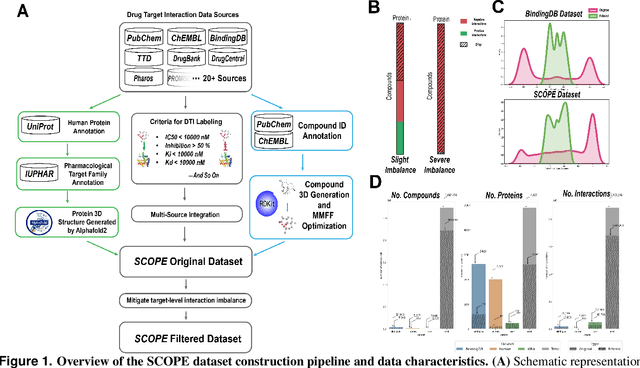
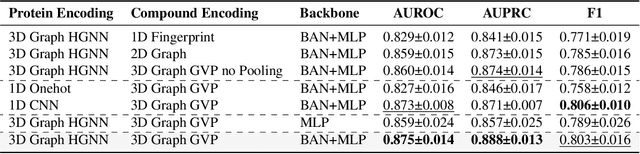
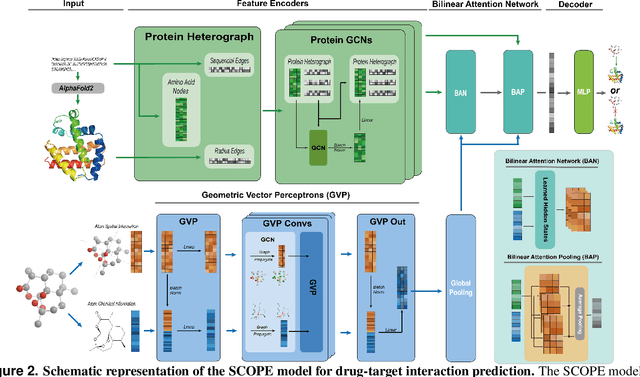
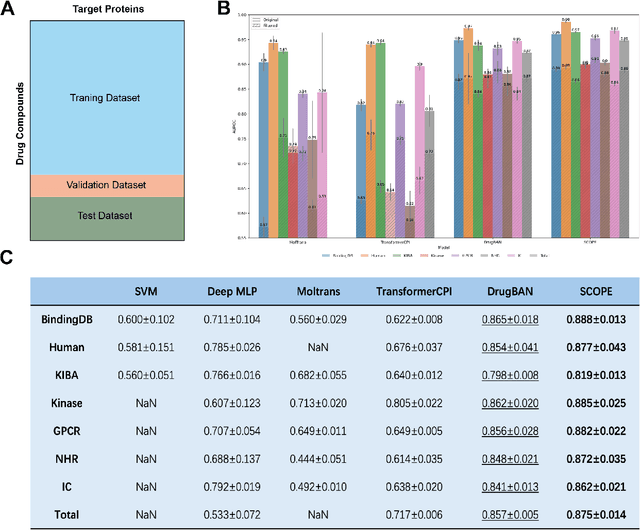
Deep learning-based drug-target interaction (DTI) prediction methods have demonstrated strong performance; however, real-world applicability remains constrained by limited data diversity and modeling complexity. To address these challenges, we propose SCOPE-DTI, a unified framework combining a large-scale, balanced semi-inductive human DTI dataset with advanced deep learning modeling. Constructed from 13 public repositories, the SCOPE dataset expands data volume by up to 100-fold compared to common benchmarks such as the Human dataset. The SCOPE model integrates three-dimensional protein and compound representations, graph neural networks, and bilinear attention mechanisms to effectively capture cross domain interaction patterns, significantly outperforming state-of-the-art methods across various DTI prediction tasks. Additionally, SCOPE-DTI provides a user-friendly interface and database. We further validate its effectiveness by experimentally identifying anticancer targets of Ginsenoside Rh1. By offering comprehensive data, advanced modeling, and accessible tools, SCOPE-DTI accelerates drug discovery research.
adabmDCA 2.0 -- a flexible but easy-to-use package for Direct Coupling Analysis
Jan 30, 2025In this methods article, we provide a flexible but easy-to-use implementation of Direct Coupling Analysis (DCA) based on Boltzmann machine learning, together with a tutorial on how to use it. The package \texttt{adabmDCA 2.0} is available in different programming languages (C++, Julia, Python) usable on different architectures (single-core and multi-core CPU, GPU) using a common front-end interface. In addition to several learning protocols for dense and sparse generative DCA models, it allows to directly address common downstream tasks like residue-residue contact prediction, mutational-effect prediction, scoring of sequence libraries and generation of artificial sequences for sequence design. It is readily applicable to protein and RNA sequence data.