 Add to Chrome
 Add to Firefox
 Add to Edge
FiGuRO: Intrinsic Dimension Estimation for Multi-Modal Data
Aug 11, 2026
Determining the complexity, or Intrinsic Dimension (ID), of data is fundamental to efficient and interpretable representation learning. This is particularly challenging in multi-modal settings when trying to learn disentangled representations for shared and private information. Existing techniques leave a critical gap: they are often static, uni-modal, or in the case of contrastive methods, adapt only to the shared ID implicitly. We introduce Fidelity-Guided Rank Optimization (FiGuRO), a framework for approximating the ID of uni- and multi-modal data under constraints of model capacity and hyperparameters. FiGuRO learns the dimensions of low-rank projections using truncated singular value decomposition and an algorithm that determines when to reduce or increase dimension and in which latent space. Disentanglement of shared and private information arises as an emergent property of this optimization, eliminating the need for complex auxiliary loss functions. We demonstrate that FiGuRO outperforms existing ID estimation techniques and is more robust to hyperparameter changes. Across simulations and real-world data, FiGuRO captures distinct ID scales and varying subspace ratios, and decomposes shared and private information successfully. Furthermore, we show that FiGuRO can be applied to modern uni-modal pretrained models, enabling efficient, post-hoc disentanglement of multi-modal representations.

MultiLoReFT: Decoupling Shared and Modality-Specific Subspaces in Multimodal Learning via Low-Rank Representation Fine-Tuning
Jul 18, 2026Real-world perception and decision making are inherently multimodal, integrating complementary signals across modalities. However, training multimodal models faces two main obstacles. First, collecting large-scale, well-aligned paired multimodal datasets is often impractical, making end-to-end multimodal training difficult. Second, existing multimodal representations frequently entangle information shared across modalities with modality-specific information, hindering interpretability and control. We introduce MultiLoReFT, an efficient and scalable low-rank representation fine-tuning framework for multimodal learning with pretrained unimodal models. MultiLoReFT extends low-rank adaptation to the multimodal setting and learns interpretable projection subspaces that decouple shared and modality-specific information. Across simulated and real-world benchmarks, it produces representations that support multimodal prediction while explicitly revealing how shared and modality-specific information is distributed across modalities.
Relaxing Faithfulness with Intervention-Only Causal Discovery
Jul 13, 2026Causal discovery algorithms learn a network that describes the causal dependencies among random variables. A common workflow involves first utilizing conditional independence properties on observational data to determine partially directed causal relationships, then applying interventions to orient the unknown causal directions. A critical assumption for the first step is faithfulness: a requirement that causally linked variables exhibit statistical dependence. Many natural systems include buffering and stabilizing pathways that cancel out to achieve systemic robustness. This cancellation of pathways violates faithfulness, leading causal discovery algorithms to incorrectly remove causal dependencies. In this paper, we argue that hard interventions contain information about the presence/absence of causal linkage that is overlooked in the first stage of structure discovery. We show that a mild assumption -- called intervention-immediacy faithfulness -- that allows cancellations, is sufficient to nonparametrically identify causal structures with hard interventions. These results position interventions as the primary carriers of information about causal structure, which should take precedence over conditional independence testing. To flip the paradigm, we also specify equivalence classes when the identification criteria are not met due to limitations in the scope of interventions.
CountsDiff: A Diffusion Model on the Natural Numbers for Generation and Imputation of Count-Based Data
Apr 04, 2026Diffusion models have excelled at generative tasks for both continuous and token-based domains, but their application to discrete ordinal data remains underdeveloped. We present CountsDiff, a diffusion framework designed to natively model distributions on the natural numbers. CountsDiff extends the Blackout diffusion framework by simplifying its formulation through a direct parameterization in terms of a survival probability schedule and an explicit loss weighting. This introduces flexibility through design parameters with direct analogues in existing diffusion modeling frameworks. Beyond this reparameterization, CountsDiff introduces features from modern diffusion models, previously absent in counts-based domains, including continuous-time training, classifier-free guidance, and churn/remasking reverse dynamics that allow non-monotone reverse trajectories. We propose an initial instantiation of CountsDiff and validate it on natural image datasets (CIFAR-10, CelebA), exploring the effects of varying the introduced design parameters in a complex, well-studied, and interpretable data domain. We then highlight biological count assays as a natural use case, evaluating CountsDiff on single-cell RNA-seq imputation in a fetal cell and heart cell atlas. Remarkably, we find that even this simple instantiation matches or surpasses the performance of a state-of-the-art discrete generative model and leading RNA-seq imputation methods, while leaving substantial headroom for further gains through optimized design choices in future work.
On the Number of Conditional Independence Tests in Constraint-based Causal Discovery
Mar 23, 2026Learning causal relations from observational data is a fundamental problem with wide-ranging applications across many fields. Constraint-based methods infer the underlying causal structure by performing conditional independence tests. However, existing algorithms such as the prominent PC algorithm need to perform a large number of independence tests, which in the worst case is exponential in the maximum degree of the causal graph. Despite extensive research, it remains unclear if there exist algorithms with better complexity without additional assumptions. Here, we establish an algorithm that achieves a better complexity of $p^{\mathcal{O}(s)}$ tests, where $p$ is the number of nodes in the graph and $s$ denotes the maximum undirected clique size of the underlying essential graph. Complementing this result, we prove that any constraint-based algorithm must perform at least $2^{Ω(s)}$ conditional independence tests, establishing that our proposed algorithm achieves exponent-optimality up to a logarithmic factor in terms of the number of conditional independence tests needed. Finally, we validate our theoretical findings through simulations, on semi-synthetic gene-expression data, and real-world data, demonstrating the efficiency of our algorithm compared to existing methods in terms of number of conditional independence tests needed.
Latent Causal Diffusions for Single-Cell Perturbation Modeling
Jan 20, 2026Perturbation screens hold the potential to systematically map regulatory processes at single-cell resolution, yet modeling and predicting transcriptome-wide responses to perturbations remains a major computational challenge. Existing methods often underperform simple baselines, fail to disentangle measurement noise from biological signal, and provide limited insight into the causal structure governing cellular responses. Here, we present the latent causal diffusion (LCD), a generative model that frames single-cell gene expression as a stationary diffusion process observed under measurement noise. LCD outperforms established approaches in predicting the distributional shifts of unseen perturbation combinations in single-cell RNA-sequencing screens while simultaneously learning a mechanistic dynamical system of gene regulation. To interpret these learned dynamics, we develop an approach we call causal linearization via perturbation responses (CLIPR), which yields an approximation of the direct causal effects between all genes modeled by the diffusion. CLIPR provably identifies causal effects under a linear drift assumption and recovers causal structure in both simulated systems and a genome-wide perturbation screen, where it clusters genes into coherent functional modules and resolves causal relationships that standard differential expression analysis cannot. The LCD-CLIPR framework bridges generative modeling with causal inference to predict unseen perturbation effects and map the underlying regulatory mechanisms of the transcriptome.
Causal Structure and Representation Learning with Biomedical Applications
Nov 06, 2025
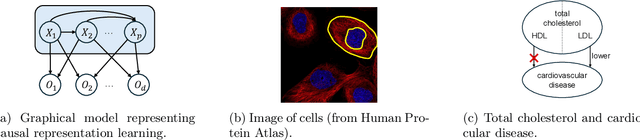
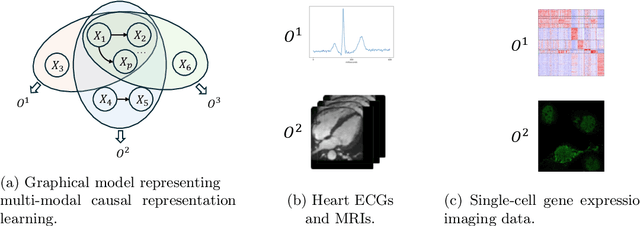
Massive data collection holds the promise of a better understanding of complex phenomena and, ultimately, better decisions. Representation learning has become a key driver of deep learning applications, as it allows learning latent spaces that capture important properties of the data without requiring any supervised annotations. Although representation learning has been hugely successful in predictive tasks, it can fail miserably in causal tasks including predicting the effect of a perturbation/intervention. This calls for a marriage between representation learning and causal inference. An exciting opportunity in this regard stems from the growing availability of multi-modal data (observational and perturbational, imaging-based and sequencing-based, at the single-cell level, tissue-level, and organism-level). We outline a statistical and computational framework for causal structure and representation learning motivated by fundamental biomedical questions: how to effectively use observational and perturbational data to perform causal discovery on observed causal variables; how to use multi-modal views of the system to learn causal variables; and how to design optimal perturbations.
BindEnergyCraft: Casting Protein Structure Predictors as Energy-Based Models for Binder Design
May 27, 2025Protein binder design has been transformed by hallucination-based methods that optimize structure prediction confidence metrics, such as the interface predicted TM-score (ipTM), via backpropagation. However, these metrics do not reflect the statistical likelihood of a binder-target complex under the learned distribution and yield sparse gradients for optimization. In this work, we propose a method to extract such likelihoods from structure predictors by reinterpreting their confidence outputs as an energy-based model (EBM). By leveraging the Joint Energy-based Modeling (JEM) framework, we introduce pTMEnergy, a statistical energy function derived from predicted inter-residue error distributions. We incorporate pTMEnergy into BindEnergyCraft (BECraft), a design pipeline that maintains the same optimization framework as BindCraft but replaces ipTM with our energy-based objective. BECraft outperforms BindCraft, RFDiffusion, and ESM3 across multiple challenging targets, achieving higher in silico binder success rates while reducing structural clashes. Furthermore, pTMEnergy establishes a new state-of-the-art in structure-based virtual screening tasks for miniprotein and RNA aptamer binders.
Meta-Dependence in Conditional Independence Testing
Apr 17, 2025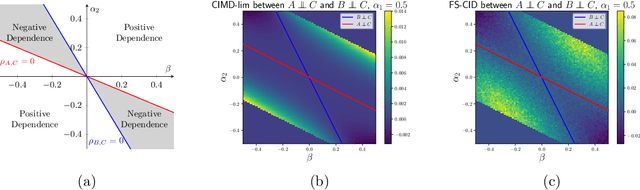
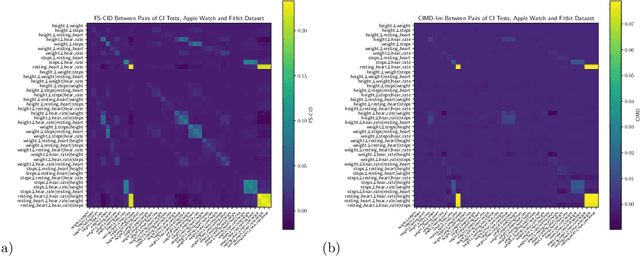
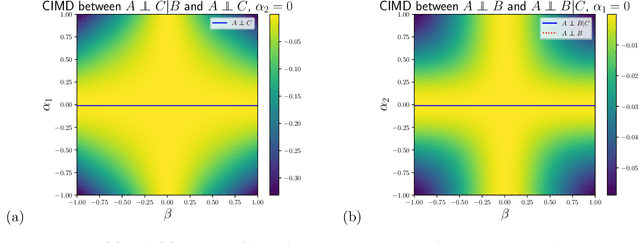
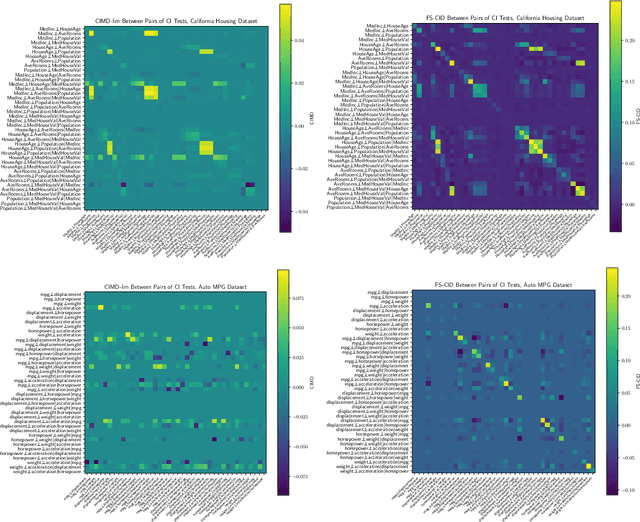
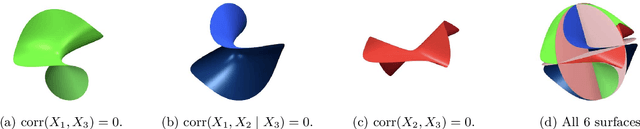
Constraint-based causal discovery algorithms utilize many statistical tests for conditional independence to uncover networks of causal dependencies. These approaches to causal discovery rely on an assumed correspondence between the graphical properties of a causal structure and the conditional independence properties of observed variables, known as the causal Markov condition and faithfulness. Finite data yields an empirical distribution that is "close" to the actual distribution. Across these many possible empirical distributions, the correspondence to the graphical properties can break down for different conditional independencies, and multiple violations can occur at the same time. We study this "meta-dependence" between conditional independence properties using the following geometric intuition: each conditional independence property constrains the space of possible joint distributions to a manifold. The "meta-dependence" between conditional independences is informed by the position of these manifolds relative to the true probability distribution. We provide a simple-to-compute measure of this meta-dependence using information projections and consolidate our findings empirically using both synthetic and real-world data.
No Foundations without Foundations -- Why semi-mechanistic models are essential for regulatory biology
Jan 31, 2025Despite substantial efforts, deep learning has not yet delivered a transformative impact on elucidating regulatory biology, particularly in the realm of predicting gene expression profiles. Here, we argue that genuine "foundation models" of regulatory biology will remain out of reach unless guided by frameworks that integrate mechanistic insight with principled experimental design. We present one such ground-up, semi-mechanistic framework that unifies perturbation-based experimental designs across both in vitro and in vivo CRISPR screens, accounting for differentiating and non-differentiating cellular systems. By revealing previously unrecognised assumptions in published machine learning methods, our approach clarifies links with popular techniques such as variational autoencoders and structural causal models. In practice, this framework suggests a modified loss function that we demonstrate can improve predictive performance, and further suggests an error analysis that informs batching strategies. Ultimately, since cellular regulation emerges from innumerable interactions amongst largely uncharted molecular components, we contend that systems-level understanding cannot be achieved through structural biology alone. Instead, we argue that real progress will require a first-principles perspective on how experiments capture biological phenomena, how data are generated, and how these processes can be reflected in more faithful modelling architectures.