 Add to Chrome
 Add to Firefox
 Add to Edge
Pedestrian Attribute Recognition
Pedestrian attribute recognition is the process of identifying and categorizing different attributes of pedestrians in images.
Papers and Code
PFM-VEPAR: Prompting Foundation Models for RGB-Event Camera based Pedestrian Attribute Recognition
Mar 20, 2026
Event-based pedestrian attribute recognition (PAR) leverages motion cues to enhance RGB cameras in low-light and motion-blur scenarios, enabling more accurate inference of attributes like age and emotion. However, existing two-stream multimodal fusion methods introduce significant computational overhead and neglect the valuable guidance from contextual samples. To address these limitations, this paper proposes an Event Prompter. Discarding the computationally expensive auxiliary backbone, this module directly applies extremely lightweight and efficient Discrete Cosine Transform (DCT) and Inverse DCT (IDCT) operations to the event data. This design extracts frequency-domain event features at a minimal computational cost, thereby effectively augmenting the RGB branch. Furthermore, an external memory bank designed to provide rich prior knowledge, combined with modern Hopfield networks, enables associative memory-augmented representation learning. This mechanism effectively mines and leverages global relational knowledge across different samples. Finally, a cross-attention mechanism fuses the RGB and event modalities, followed by feed-forward networks for attribute prediction. Extensive experiments on multiple benchmark datasets fully validate the effectiveness of the proposed RGB-Event PAR framework. The source code of this paper will be released on https://github.com/Event-AHU/OpenPAR

UniPAR: A Unified Framework for Pedestrian Attribute Recognition
Mar 05, 2026Pedestrian Attribute Recognition is a foundational computer vision task that provides essential support for downstream applications, including person retrieval in video surveillance and intelligent retail analytics. However, existing research is frequently constrained by the ``one-model-per-dataset" paradigm and struggles to handle significant discrepancies across domains in terms of modalities, attribute definitions, and environmental scenarios. To address these challenges, we propose UniPAR, a unified Transformer-based framework for PAR. By incorporating a unified data scheduling strategy and a dynamic classification head, UniPAR enables a single model to simultaneously process diverse datasets from heterogeneous modalities, including RGB images, video sequences, and event streams. We also introduce an innovative phased fusion encoder that explicitly aligns visual features with textual attribute queries through a late deep fusion strategy. Experimental results on the widely used benchmark datasets, including MSP60K, DukeMTMC, and EventPAR, demonstrate that UniPAR achieves performance comparable to specialized SOTA methods. Furthermore, multi-dataset joint training significantly enhances the model's cross-domain generalization and recognition robustness in extreme environments characterized by low light and motion blur. The source code of this paper will be released on https://github.com/Event-AHU/OpenPAR
VLM-PAR: A Vision Language Model for Pedestrian Attribute Recognition
Dec 22, 2025Pedestrian Attribute Recognition (PAR) involves predicting fine-grained attributes such as clothing color, gender, and accessories from pedestrian imagery, yet is hindered by severe class imbalance, intricate attribute co-dependencies, and domain shifts. We introduce VLM-PAR, a modular vision-language framework built on frozen SigLIP 2 multilingual encoders. By first aligning image and prompt embeddings via refining visual features through a compact cross-attention fusion, VLM-PAR achieves significant accuracy improvement on the highly imbalanced PA100K benchmark, setting a new state-of-the-art performance, while also delivering significant gains in mean accuracy across PETA and Market-1501 benchmarks. These results underscore the efficacy of integrating large-scale vision-language pretraining with targeted cross-modal refinement to overcome imbalance and generalization challenges in PAR.
Pedestrian Attribute Recognition via Hierarchical Cross-Modality HyperGraph Learning
Sep 26, 2025Current Pedestrian Attribute Recognition (PAR) algorithms typically focus on mapping visual features to semantic labels or attempt to enhance learning by fusing visual and attribute information. However, these methods fail to fully exploit attribute knowledge and contextual information for more accurate recognition. Although recent works have started to consider using attribute text as additional input to enhance the association between visual and semantic information, these methods are still in their infancy. To address the above challenges, this paper proposes the construction of a multi-modal knowledge graph, which is utilized to mine the relationships between local visual features and text, as well as the relationships between attributes and extensive visual context samples. Specifically, we propose an effective multi-modal knowledge graph construction method that fully considers the relationships among attributes and the relationships between attributes and vision tokens. To effectively model these relationships, this paper introduces a knowledge graph-guided cross-modal hypergraph learning framework to enhance the standard pedestrian attribute recognition framework. Comprehensive experiments on multiple PAR benchmark datasets have thoroughly demonstrated the effectiveness of our proposed knowledge graph for the PAR task, establishing a strong foundation for knowledge-guided pedestrian attribute recognition. The source code of this paper will be released on https://github.com/Event-AHU/OpenPAR
Adversarial Semantic and Label Perturbation Attack for Pedestrian Attribute Recognition
May 29, 2025Pedestrian Attribute Recognition (PAR) is an indispensable task in human-centered research and has made great progress in recent years with the development of deep neural networks. However, the potential vulnerability and anti-interference ability have still not been fully explored. To bridge this gap, this paper proposes the first adversarial attack and defense framework for pedestrian attribute recognition. Specifically, we exploit both global- and patch-level attacks on the pedestrian images, based on the pre-trained CLIP-based PAR framework. It first divides the input pedestrian image into non-overlapping patches and embeds them into feature embeddings using a projection layer. Meanwhile, the attribute set is expanded into sentences using prompts and embedded into attribute features using a pre-trained CLIP text encoder. A multi-modal Transformer is adopted to fuse the obtained vision and text tokens, and a feed-forward network is utilized for attribute recognition. Based on the aforementioned PAR framework, we adopt the adversarial semantic and label-perturbation to generate the adversarial noise, termed ASL-PAR. We also design a semantic offset defense strategy to suppress the influence of adversarial attacks. Extensive experiments conducted on both digital domains (i.e., PETA, PA100K, MSP60K, RAPv2) and physical domains fully validated the effectiveness of our proposed adversarial attack and defense strategies for the pedestrian attribute recognition. The source code of this paper will be released on https://github.com/Event-AHU/OpenPAR.
RGB-Event based Pedestrian Attribute Recognition: A Benchmark Dataset and An Asymmetric RWKV Fusion Framework
Apr 14, 2025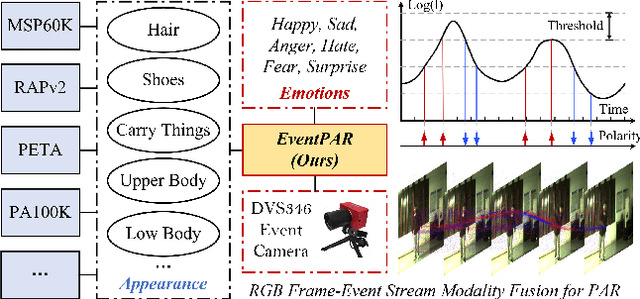
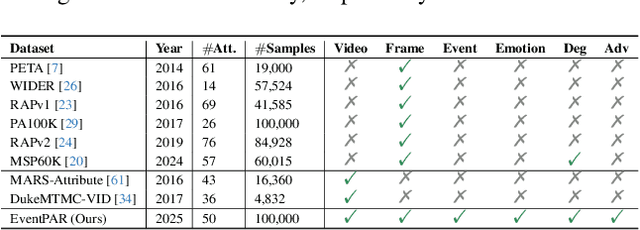
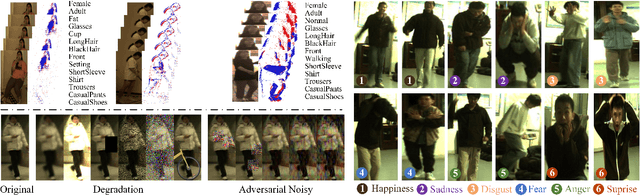
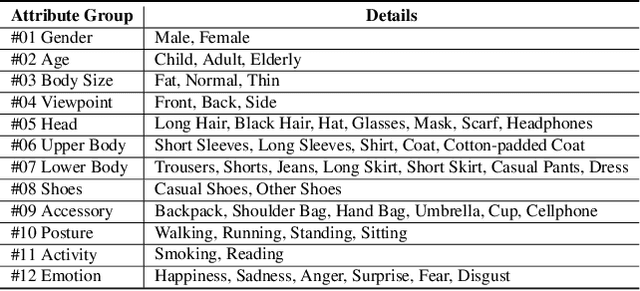
Existing pedestrian attribute recognition methods are generally developed based on RGB frame cameras. However, these approaches are constrained by the limitations of RGB cameras, such as sensitivity to lighting conditions and motion blur, which hinder their performance. Furthermore, current attribute recognition primarily focuses on analyzing pedestrians' external appearance and clothing, lacking an exploration of emotional dimensions. In this paper, we revisit these issues and propose a novel multi-modal RGB-Event attribute recognition task by drawing inspiration from the advantages of event cameras in low-light, high-speed, and low-power consumption. Specifically, we introduce the first large-scale multi-modal pedestrian attribute recognition dataset, termed EventPAR, comprising 100K paired RGB-Event samples that cover 50 attributes related to both appearance and six human emotions, diverse scenes, and various seasons. By retraining and evaluating mainstream PAR models on this dataset, we establish a comprehensive benchmark and provide a solid foundation for future research in terms of data and algorithmic baselines. In addition, we propose a novel RWKV-based multi-modal pedestrian attribute recognition framework, featuring an RWKV visual encoder and an asymmetric RWKV fusion module. Extensive experiments are conducted on our proposed dataset as well as two simulated datasets (MARS-Attribute and DukeMTMC-VID-Attribute), achieving state-of-the-art results. The source code and dataset will be released on https://github.com/Event-AHU/OpenPAR
SNN-PAR: Energy Efficient Pedestrian Attribute Recognition via Spiking Neural Networks
Oct 10, 2024Artificial neural network based Pedestrian Attribute Recognition (PAR) has been widely studied in recent years, despite many progresses, however, the energy consumption is still high. To address this issue, in this paper, we propose a Spiking Neural Network (SNN) based framework for energy-efficient attribute recognition. Specifically, we first adopt a spiking tokenizer module to transform the given pedestrian image into spiking feature representations. Then, the output will be fed into the spiking Transformer backbone networks for energy-efficient feature extraction. We feed the enhanced spiking features into a set of feed-forward networks for pedestrian attribute recognition. In addition to the widely used binary cross-entropy loss function, we also exploit knowledge distillation from the artificial neural network to the spiking Transformer network for more accurate attribute recognition. Extensive experiments on three widely used PAR benchmark datasets fully validated the effectiveness of our proposed SNN-PAR framework. The source code of this paper is released on \url{https://github.com/Event-AHU/OpenPAR}.
Pedestrian Attribute Recognition: A New Benchmark Dataset and A Large Language Model Augmented Framework
Aug 19, 2024Pedestrian Attribute Recognition (PAR) is one of the indispensable tasks in human-centered research. However, existing datasets neglect different domains (e.g., environments, times, populations, and data sources), only conducting simple random splits, and the performance of these datasets has already approached saturation. In the past five years, no large-scale dataset has been opened to the public. To address this issue, this paper proposes a new large-scale, cross-domain pedestrian attribute recognition dataset to fill the data gap, termed MSP60K. It consists of 60,122 images and 57 attribute annotations across eight scenarios. Synthetic degradation is also conducted to further narrow the gap between the dataset and real-world challenging scenarios. To establish a more rigorous benchmark, we evaluate 17 representative PAR models under both random and cross-domain split protocols on our dataset. Additionally, we propose an innovative Large Language Model (LLM) augmented PAR framework, named LLM-PAR. This framework processes pedestrian images through a Vision Transformer (ViT) backbone to extract features and introduces a multi-embedding query Transformer to learn partial-aware features for attribute classification. Significantly, we enhance this framework with LLM for ensemble learning and visual feature augmentation. Comprehensive experiments across multiple PAR benchmark datasets have thoroughly validated the efficacy of our proposed framework. The dataset and source code accompanying this paper will be made publicly available at \url{https://github.com/Event-AHU/OpenPAR}.
An Empirical Study of Mamba-based Pedestrian Attribute Recognition
Jul 15, 2024
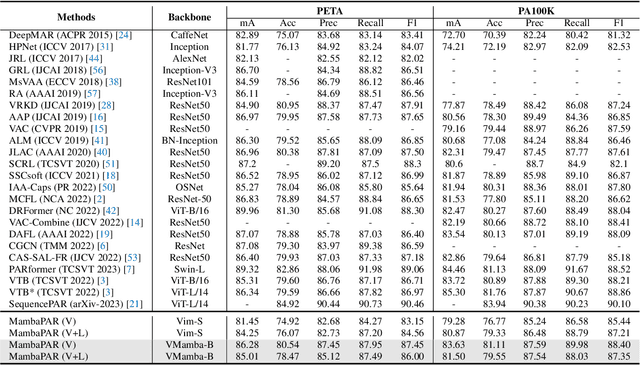
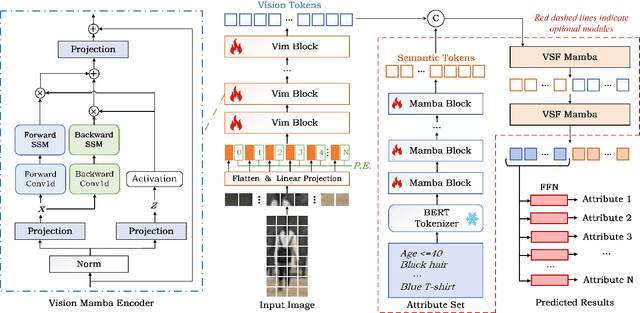
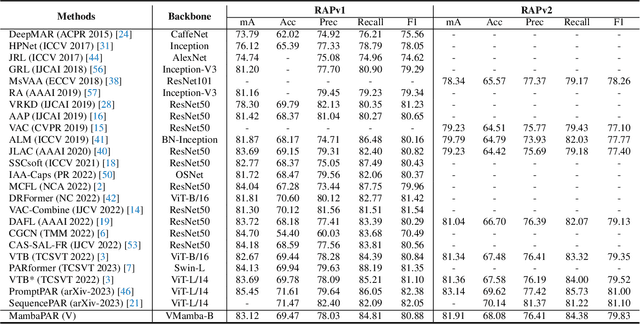
Current strong pedestrian attribute recognition models are developed based on Transformer networks, which are computationally heavy. Recently proposed models with linear complexity (e.g., Mamba) have garnered significant attention and have achieved a good balance between accuracy and computational cost across a variety of visual tasks. Relevant review articles also suggest that while these models can perform well on some pedestrian attribute recognition datasets, they are generally weaker than the corresponding Transformer models. To further tap into the potential of the novel Mamba architecture for PAR tasks, this paper designs and adapts Mamba into two typical PAR frameworks, i.e., the text-image fusion approach and pure vision Mamba multi-label recognition framework. It is found that interacting with attribute tags as additional input does not always lead to an improvement, specifically, Vim can be enhanced, but VMamba cannot. This paper further designs various hybrid Mamba-Transformer variants and conducts thorough experimental validations. These experimental results indicate that simply enhancing Mamba with a Transformer does not always lead to performance improvements but yields better results under certain settings. We hope this empirical study can further inspire research in Mamba for PAR, and even extend into the domain of multi-label recognition, through the design of these network structures and comprehensive experimentation. The source code of this work will be released at \url{https://github.com/Event-AHU/OpenPAR}
Learning Street View Representations with Spatiotemporal Contrast
Feb 07, 2025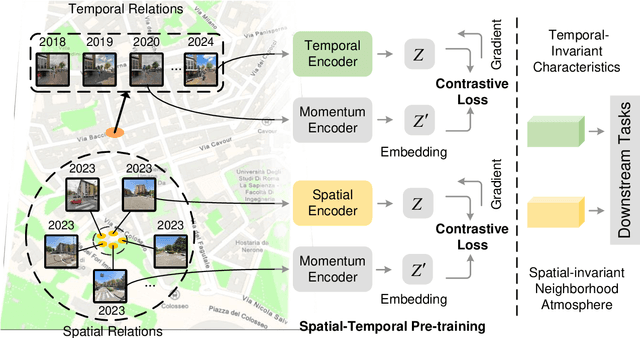
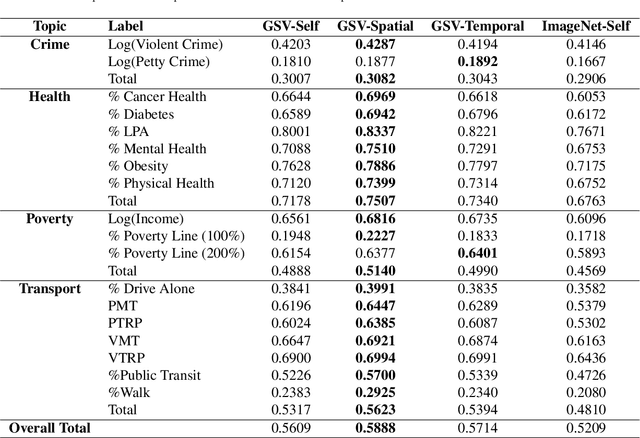
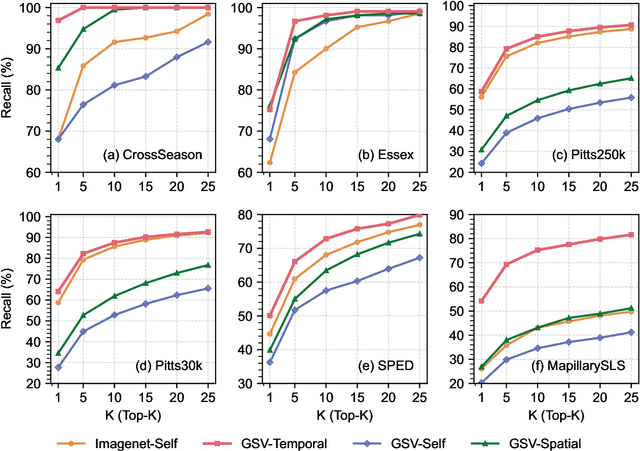
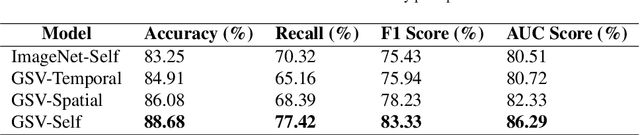
Street view imagery is extensively utilized in representation learning for urban visual environments, supporting various sustainable development tasks such as environmental perception and socio-economic assessment. However, it is challenging for existing image representations to specifically encode the dynamic urban environment (such as pedestrians, vehicles, and vegetation), the built environment (including buildings, roads, and urban infrastructure), and the environmental ambiance (such as the cultural and socioeconomic atmosphere) depicted in street view imagery to address downstream tasks related to the city. In this work, we propose an innovative self-supervised learning framework that leverages temporal and spatial attributes of street view imagery to learn image representations of the dynamic urban environment for diverse downstream tasks. By employing street view images captured at the same location over time and spatially nearby views at the same time, we construct contrastive learning tasks designed to learn the temporal-invariant characteristics of the built environment and the spatial-invariant neighborhood ambiance. Our approach significantly outperforms traditional supervised and unsupervised methods in tasks such as visual place recognition, socioeconomic estimation, and human-environment perception. Moreover, we demonstrate the varying behaviors of image representations learned through different contrastive learning objectives across various downstream tasks. This study systematically discusses representation learning strategies for urban studies based on street view images, providing a benchmark that enhances the applicability of visual data in urban science. The code is available at https://github.com/yonglleee/UrbanSTCL.