 Add to Chrome
 Add to Firefox
 Add to Edge
SysEvolve: An AI-native, safe, autonomous adversarial attack-defense co-evolutionary system
Aug 15, 2026
The rapid advancement of large language models (LLMs) has created a growing asymmetry in cybersecurity, where attack accelerates toward autonomous execution while defense remains predominantly human-intensive. Despite substantial prior work across cyber ranges, AI-driven attack, and AI-driven defense, this asymmetry persists. We trace it to a deeper root cause, that evolution itself has stalled on both sides at three layers. To overcome this, we propose co-evolution as the integrating insight, where attack and defense AI agents autonomously and safely drive each other's evolution through adversarial confrontation. Based on this insight, we present \sysevolve, comprising three co-designed components, \sysfield, \sysspear, and \sysarmor. \sysfield constructs realistic multi-host ranges. \sysspear generates efficient, safe attack schemes. \sysarmor performs real-time, interpretable defense. Together they form a self-driven adversarial loop restoring evolution at all three layers. In evaluation, \sysfield achieves zero-loss collection at 2.1\% overhead and orchestrates 257 CVEs into 1,148 ranges, \sysspear improves attack success by over 25\% over baseline LLMs, and \sysarmor achieves 10--1000$\times$ greater precision than prior systems and detects real APT attacks in production at Huawei and Sangfor. Our evaluation also reveals three findings about LLM agent capabilities. First, multi-step composition and larger topologies expose agent capability gaps hidden by single-step evaluations. Second, the bottleneck lies after initial access in post-compromise state utilization. Third, LLM agents are susceptible to environmental interference. When decoy endpoints are deployed in the range, agent timeouts triple and downstream completion disappears despite the success rates of initial accesses are unchanged.

RangeFactory: Scalable Construction of Multi-Hop Cyber Ranges
Aug 10, 2026Real-world cyberattacks often require sustained progress across multiple hosts and network segments, making multi-hop cyber ranges essential infrastructure for studying and improving LLM agents' ability to sustain complete attack chains. Prior work has scaled isolated vulnerability tasks and constructed multi-host scenarios from manually specified vulnerability semantics. However, they are still unable to automatically orchestrate the growing supply of vulnerability environments into end-to-end validated multi-hop ranges. To this end, we present RangeFactory, an automated cyber-range orchestration framework that constructs multi-hop cyber ranges at scale from isolated vulnerability environments. RangeFactory formulates range construction as dependency resolution: it extracts dependency information from agents' actual attacks against real vulnerabilities, resolves known dependencies through template-guided orchestration, and uses end-to-end attack execution to validate runtime dependencies that emerge after composition. Using RangeFactory, we construct RangeBench with 1,148 validated range instances spanning 287 distinct attack chains and evaluate frontier attack agents across attack depth, network scale, and task information. Among runs that compromise the entry vulnerability, 24.5-47.0% still fail to complete the remaining attack path, revealing a substantial sustained-compromise gap between establishing an initial foothold and completing a multi-hop attack. RangeFactory further produces a corpus of 5,541 outcome-annotated multi-hop attack trajectories, providing execution data for attack-process analysis and future agent training.
Parameter-Dynamic Adaptive Fusion and Calibration Network for RGBT Tracking
Aug 03, 2026Existing RGBT trackers typically employ fusion functions with fixed parameters across different targets and scenarios. Although dynamic-architecture methods improve fusion flexibility by selecting among predefined operations, they still cannot adapt the fusion parameters to the evolving target state. To address these issues, we propose a Parameter-Dynamic Adaptive Fusion and Calibration Network (PAFCNet) for RGBT tracking. PAFCNet dynamically generates target-conditioned parameters for multimodal fusion and temporal calibration, enabling the tracking process to adapt to target appearance variations and modality quality fluctuations. Specifically, we introduce a Target-Adaptive Hypernetwork (TA-HyperNet) that leverages template representations, which preserve stable target identity and recent appearance changes with less background interference, to generate target-conditioned parameters for subsequent fusion and calibration. Based on TA-HyperNet, we design a target-aware parameter-dynamic fusion module that uses the generated parameters to modulate the fusion process. This enables the fusion module to adapt to changes in target appearance and complex scene conditions. Furthermore, since spatio-temporal information propagation may accumulate tracking noise, we propose a dynamic spatio-temporal calibration module that employs TA-HyperNet to generate calibration parameters for spatio-temporal tokens. By dynamically calibrating historical information before propagation, the module improves the reliability of temporal representations. Experimental results demonstrate that PAFCNet achieves competitive performance on multiple RGBT tracking benchmarks.
Spatio-Temporal Conditional Denoising Transformer for Modality-Missing RGBT Tracking
Jul 27, 2026Missing modalities in RGBT tracking often lead to incomplete and unstable multimodal feature representations that greatly degrade the performance. Existing methods typically attempt to recover missing modalities from available ones, but the quality of data generated in challenging scenarios might be unsatisfactory. In addition, current approaches exhibit limited flexibility in processing both missing and complete data. To overcome these limitations, we propose a Spatio-temporal Conditional Denoising Transformer (SCDT), which integrates the spatial cues and the temporal context to adaptively perform information reconstruction of missing modalities and feature enhancement of weak modalities in a unified framework, for robust modality-missing RGBT tracking. In particular, SCDT leverages the short-term temporal cues from recent historical frames to capture the fine-grained temporal correlations and the long-term temporal cues encoding modality evolution to capture the global context. By jointly exploiting long short-term temporal contexts as the conditions, SCDT progressively guides noisy features of available modalities to learn reliable and temporally consistent multimodal representations. Furthermore, SCDT introduces a noisemodulated adaptation mechanism that dynamically adjusts its behavior according to the modal availability, enabling a single framework to unify feature learning under both modality-missing and complete scenarios without changing the architecture or parameters. Extensive experiments on three public benchmark datasets demonstrate that our method consistently outperforms state-of-the-art methods. The code is available here.
Cross-Modal UAV Object Tracking: State-Aware Representation Learning and A Unified Benchmark
Jul 21, 2026Unmanned Aerial Vehicle (UAV) object tracking has emerged as a popular research field with broad practical applications. Modern UAVs are increasingly equipped with both visible light and thermal infrared sensors. However, due to constraints in communication bandwidth, computational resources and power consumption, current systems often activate one modality and switch between modalities to maintain robust tracking in complex scenarios. Such modality switch inevitably leads to significant appearance change and sudden spatial shift, posing great challenges for existing tracking algorithms. To handle this problem, we propose a novel State-Aware Representation Learning Approach called SARLA, which perceives the inconsistent modality states of current frame with template and last frame in the target representations to adapt to the sudden changes in both appearance and position, for robust cross-modal object tracking. In particular, we propose the Modality State Aware Representation Module (MSARM) and Spatial State Aware Representation Module (SSARM). MSARM guides the model to learn appearance correlation, bridging the modality gap, while SSARM models cross-frame spatial correlation to mitigate sudden spatial shift impacts. In addition, we design a spatial shift prediction loss to further handle the effects of spatial variation caused by modality switch. To promote the development of this research field, we establish a large-scale video benchmark called CM-UOT, which consists of 1079 cross-modal sequences with an average video length greater than 621 frames and encompasses over 671K frames in total. Extensive experiments on CM-UOT dataset demonstrate the superior performance of the proposed SARLA against 20 excellent tracking methods. The source code, datasets, and evaluation protocols associated with this work are publicly available at: https://github.com/hongsmile365/sarla-.
RGB-Event based Pedestrian Attribute Recognition: A Benchmark Dataset and An Asymmetric RWKV Fusion Framework
Apr 14, 2025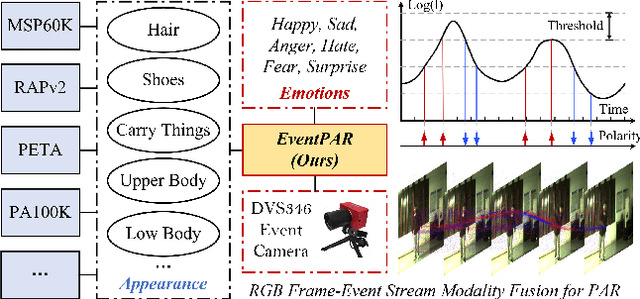
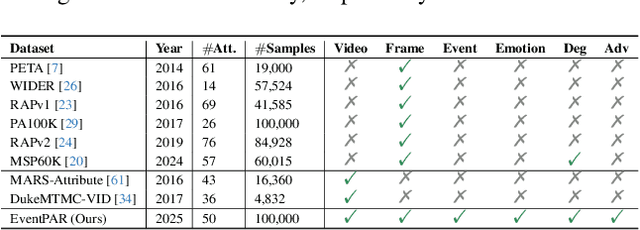
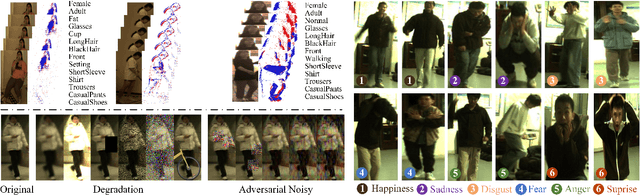
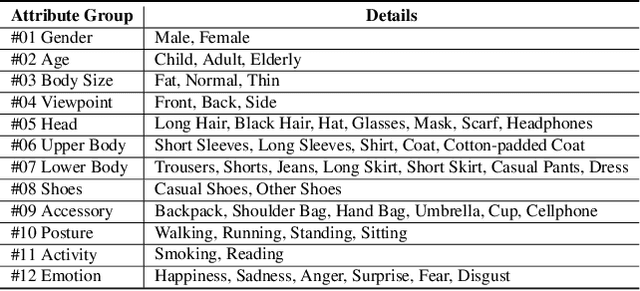
Existing pedestrian attribute recognition methods are generally developed based on RGB frame cameras. However, these approaches are constrained by the limitations of RGB cameras, such as sensitivity to lighting conditions and motion blur, which hinder their performance. Furthermore, current attribute recognition primarily focuses on analyzing pedestrians' external appearance and clothing, lacking an exploration of emotional dimensions. In this paper, we revisit these issues and propose a novel multi-modal RGB-Event attribute recognition task by drawing inspiration from the advantages of event cameras in low-light, high-speed, and low-power consumption. Specifically, we introduce the first large-scale multi-modal pedestrian attribute recognition dataset, termed EventPAR, comprising 100K paired RGB-Event samples that cover 50 attributes related to both appearance and six human emotions, diverse scenes, and various seasons. By retraining and evaluating mainstream PAR models on this dataset, we establish a comprehensive benchmark and provide a solid foundation for future research in terms of data and algorithmic baselines. In addition, we propose a novel RWKV-based multi-modal pedestrian attribute recognition framework, featuring an RWKV visual encoder and an asymmetric RWKV fusion module. Extensive experiments are conducted on our proposed dataset as well as two simulated datasets (MARS-Attribute and DukeMTMC-VID-Attribute), achieving state-of-the-art results. The source code and dataset will be released on https://github.com/Event-AHU/OpenPAR
A Unified Modeling Framework for Automated Penetration Testing
Feb 17, 2025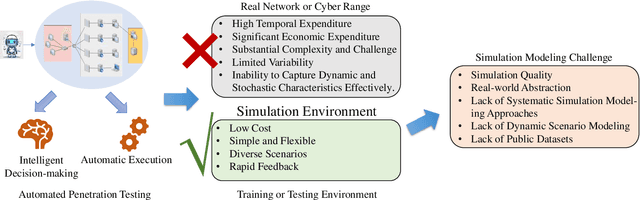
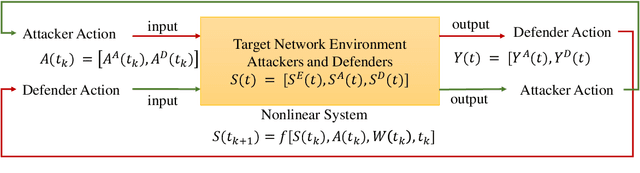
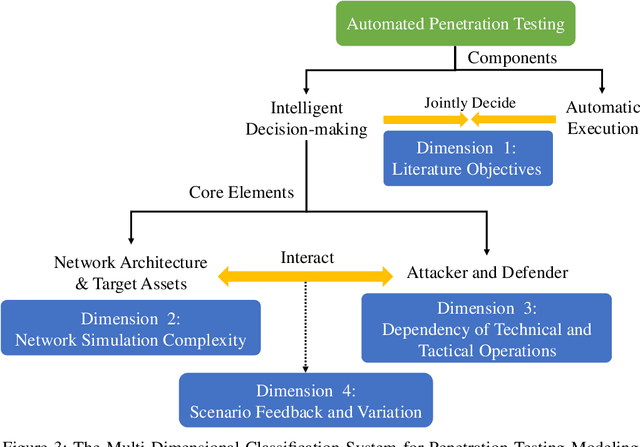
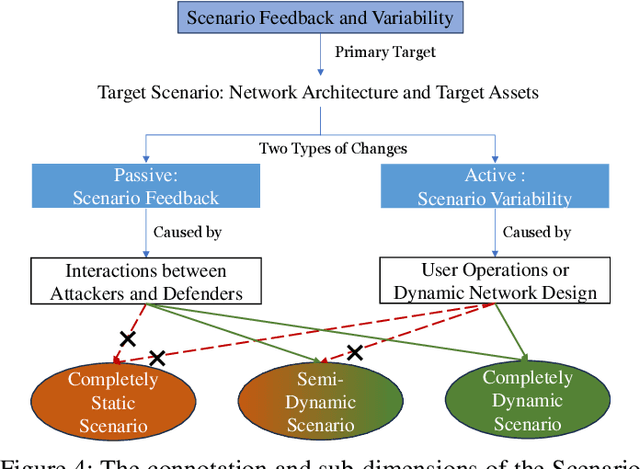
The integration of artificial intelligence into automated penetration testing (AutoPT) has highlighted the necessity of simulation modeling for the training of intelligent agents, due to its cost-efficiency and swift feedback capabilities. Despite the proliferation of AutoPT research, there is a recognized gap in the availability of a unified framework for simulation modeling methods. This paper presents a systematic review and synthesis of existing techniques, introducing MDCPM to categorize studies based on literature objectives, network simulation complexity, dependency of technical and tactical operations, and scenario feedback and variation. To bridge the gap in unified method for multi-dimensional and multi-level simulation modeling, dynamic environment modeling, and the scarcity of public datasets, we introduce AutoPT-Sim, a novel modeling framework that based on policy automation and encompasses the combination of all sub dimensions. AutoPT-Sim offers a comprehensive approach to modeling network environments, attackers, and defenders, transcending the constraints of static modeling and accommodating networks of diverse scales. We publicly release a generated standard network environment dataset and the code of Network Generator. By integrating publicly available datasets flexibly, support is offered for various simulation modeling levels focused on policy automation in MDCPM and the network generator help researchers output customized target network data by adjusting parameters or fine-tuning the network generator.
Pedestrian Attribute Recognition: A New Benchmark Dataset and A Large Language Model Augmented Framework
Aug 19, 2024Pedestrian Attribute Recognition (PAR) is one of the indispensable tasks in human-centered research. However, existing datasets neglect different domains (e.g., environments, times, populations, and data sources), only conducting simple random splits, and the performance of these datasets has already approached saturation. In the past five years, no large-scale dataset has been opened to the public. To address this issue, this paper proposes a new large-scale, cross-domain pedestrian attribute recognition dataset to fill the data gap, termed MSP60K. It consists of 60,122 images and 57 attribute annotations across eight scenarios. Synthetic degradation is also conducted to further narrow the gap between the dataset and real-world challenging scenarios. To establish a more rigorous benchmark, we evaluate 17 representative PAR models under both random and cross-domain split protocols on our dataset. Additionally, we propose an innovative Large Language Model (LLM) augmented PAR framework, named LLM-PAR. This framework processes pedestrian images through a Vision Transformer (ViT) backbone to extract features and introduces a multi-embedding query Transformer to learn partial-aware features for attribute classification. Significantly, we enhance this framework with LLM for ensemble learning and visual feature augmentation. Comprehensive experiments across multiple PAR benchmark datasets have thoroughly validated the efficacy of our proposed framework. The dataset and source code accompanying this paper will be made publicly available at \url{https://github.com/Event-AHU/OpenPAR}.
An Empirical Study of Mamba-based Pedestrian Attribute Recognition
Jul 15, 2024
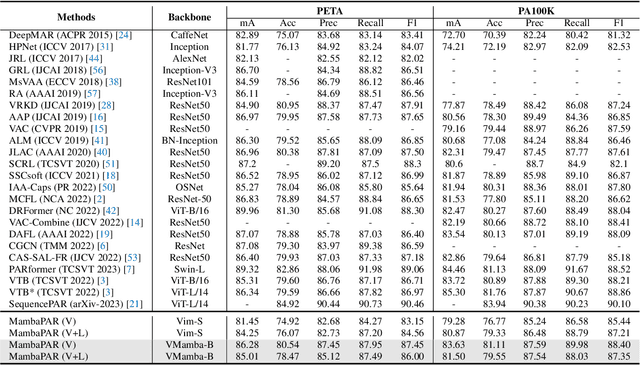
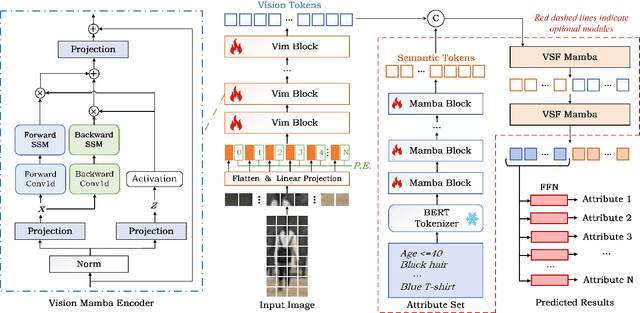
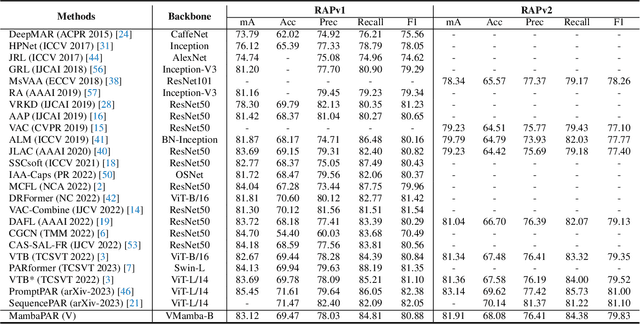
Current strong pedestrian attribute recognition models are developed based on Transformer networks, which are computationally heavy. Recently proposed models with linear complexity (e.g., Mamba) have garnered significant attention and have achieved a good balance between accuracy and computational cost across a variety of visual tasks. Relevant review articles also suggest that while these models can perform well on some pedestrian attribute recognition datasets, they are generally weaker than the corresponding Transformer models. To further tap into the potential of the novel Mamba architecture for PAR tasks, this paper designs and adapts Mamba into two typical PAR frameworks, i.e., the text-image fusion approach and pure vision Mamba multi-label recognition framework. It is found that interacting with attribute tags as additional input does not always lead to an improvement, specifically, Vim can be enhanced, but VMamba cannot. This paper further designs various hybrid Mamba-Transformer variants and conducts thorough experimental validations. These experimental results indicate that simply enhancing Mamba with a Transformer does not always lead to performance improvements but yields better results under certain settings. We hope this empirical study can further inspire research in Mamba for PAR, and even extend into the domain of multi-label recognition, through the design of these network structures and comprehensive experimentation. The source code of this work will be released at \url{https://github.com/Event-AHU/OpenPAR}
Spatio-Temporal Side Tuning Pre-trained Foundation Models for Video-based Pedestrian Attribute Recognition
Apr 27, 2024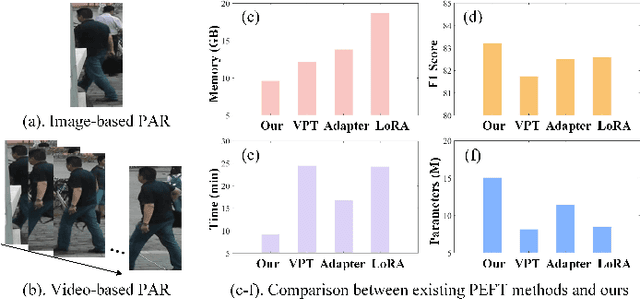
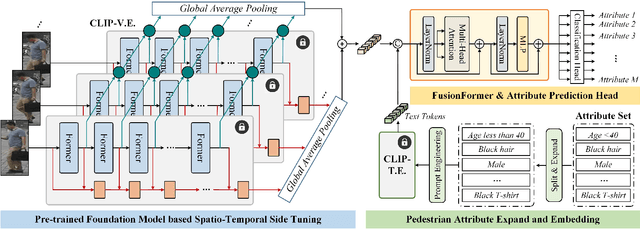
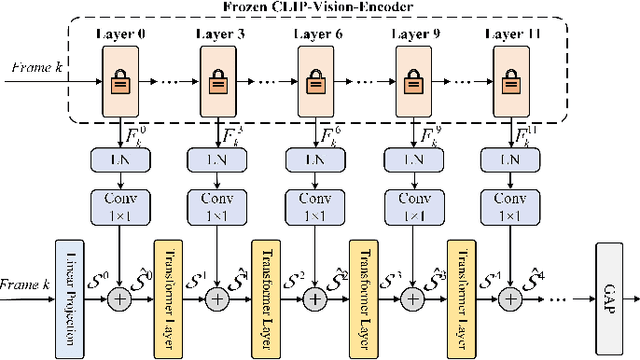
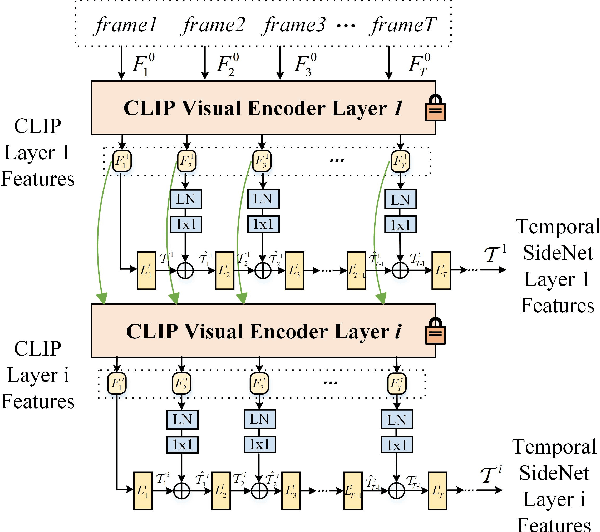
Existing pedestrian attribute recognition (PAR) algorithms are mainly developed based on a static image, however, the performance is unreliable in challenging scenarios, such as heavy occlusion, motion blur, etc. In this work, we propose to understand human attributes using video frames that can fully use temporal information by fine-tuning a pre-trained multi-modal foundation model efficiently. Specifically, we formulate the video-based PAR as a vision-language fusion problem and adopt a pre-trained foundation model CLIP to extract the visual features. More importantly, we propose a novel spatiotemporal side-tuning strategy to achieve parameter-efficient optimization of the pre-trained vision foundation model. To better utilize the semantic information, we take the full attribute list that needs to be recognized as another input and transform the attribute words/phrases into the corresponding sentence via split, expand, and prompt operations. Then, the text encoder of CLIP is utilized for embedding processed attribute descriptions. The averaged visual tokens and text tokens are concatenated and fed into a fusion Transformer for multi-modal interactive learning. The enhanced tokens will be fed into a classification head for pedestrian attribute prediction. Extensive experiments on two large-scale video-based PAR datasets fully validated the effectiveness of our proposed framework. The source code of this paper is available at https://github.com/Event-AHU/OpenPAR.