 Add to Chrome
 Add to Firefox
 Add to Edge
StreetTree: A Large-Scale Global Benchmark for Fine-Grained Tree Species Classification
Feb 22, 2026
The fine-grained classification of street trees is a crucial task for urban planning, streetscape management, and the assessment of urban ecosystem services. However, progress in this field has been significantly hindered by the lack of large-scale, geographically diverse, and publicly available benchmark datasets specifically designed for street trees. To address this critical gap, we introduce StreetTree, the world's first large-scale benchmark dataset dedicated to fine-grained street tree classification. The dataset contains over 12 million images covering more than 8,300 common street tree species, collected from urban streetscapes across 133 countries spanning five continents, and supplemented with expert-verified observational data. StreetTree poses substantial challenges for pretrained vision models under complex urban environments: high inter-species visual similarity, long-tailed natural distributions, significant intra-class variations caused by seasonal changes, and diverse imaging conditions such as lighting, occlusions from buildings, and varying camera angles. In addition, we provide a hierarchical taxonomy (order-family-genus-species) to support research in hierarchical classification and representation learning. Through extensive experiments with various visual models, we establish strong baselines and reveal the limitations of existing methods in handling such real-world complexities. We believe that StreetTree will serve as a key resource for the refined management and research of urban street trees, while also driving new advancements at the intersection of computer vision and urban science.

Learning Street View Representations with Spatiotemporal Contrast
Feb 07, 2025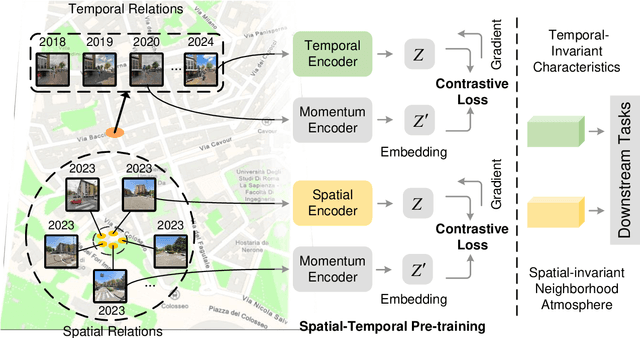
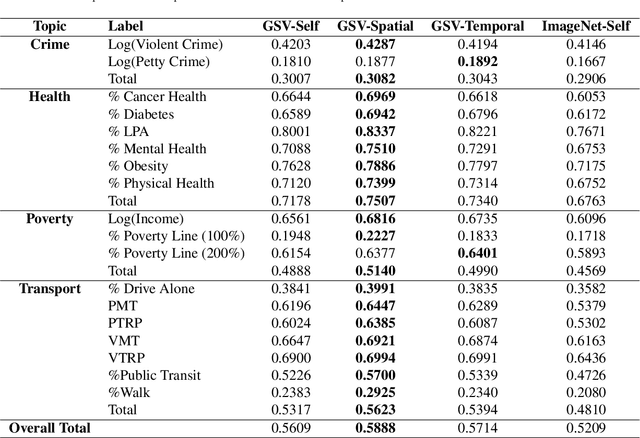
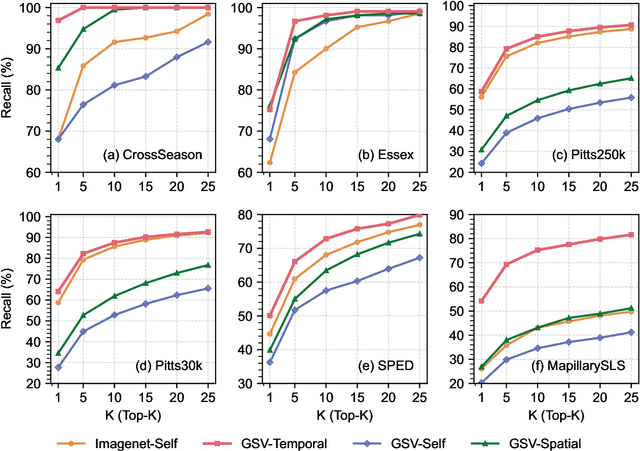
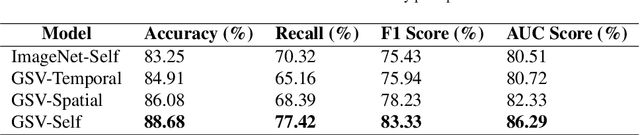
Street view imagery is extensively utilized in representation learning for urban visual environments, supporting various sustainable development tasks such as environmental perception and socio-economic assessment. However, it is challenging for existing image representations to specifically encode the dynamic urban environment (such as pedestrians, vehicles, and vegetation), the built environment (including buildings, roads, and urban infrastructure), and the environmental ambiance (such as the cultural and socioeconomic atmosphere) depicted in street view imagery to address downstream tasks related to the city. In this work, we propose an innovative self-supervised learning framework that leverages temporal and spatial attributes of street view imagery to learn image representations of the dynamic urban environment for diverse downstream tasks. By employing street view images captured at the same location over time and spatially nearby views at the same time, we construct contrastive learning tasks designed to learn the temporal-invariant characteristics of the built environment and the spatial-invariant neighborhood ambiance. Our approach significantly outperforms traditional supervised and unsupervised methods in tasks such as visual place recognition, socioeconomic estimation, and human-environment perception. Moreover, we demonstrate the varying behaviors of image representations learned through different contrastive learning objectives across various downstream tasks. This study systematically discusses representation learning strategies for urban studies based on street view images, providing a benchmark that enhances the applicability of visual data in urban science. The code is available at https://github.com/yonglleee/UrbanSTCL.