 Add to Chrome
 Add to Firefox
 Add to Edge
RF-HiT: Rectified Flow Hierarchical Transformer for General Medical Image Segmentation
Apr 21, 2026
Accurate medical image segmentation requires both long-range contextual reasoning and precise boundary delineation, a task where existing transformer- and diffusion-based paradigms are frequently bottlenecked by quadratic computational complexity and prohibitive inference latency. We propose RF-HiT, a Rectified Flow Hierarchical Transformer that integrates an hourglass transformer backbone with a multi-scale hierarchical encoder for anatomically guided feature conditioning. Unlike prior diffusion-based approaches, RF-HiT leverages rectified flow with efficient transformer blocks to achieve linear complexity while requiring only a few discretization steps. The model further fuses conditioning features across resolutions via learnable interpolation, enabling effective multi-scale representation with minimal computational overhead. As a result, RF-HiT achieves a strong efficiency-performance trade-off, requiring only 10.14 GFLOPs, 13.6M parameters, and inference in as few as three steps. Despite its compact design, RF-HiT attains 91.27% mean Dice on ACDC and 87.40% on BraTS 2021, achieving performance comparable to or exceeding that of significantly more intensive architectures. This demonstrates its strong potential as a robust, computationally efficient foundation for real-time clinical segmentation.

When AI and Experts Agree on Error: Intrinsic Ambiguity in Dermatoscopic Images
Apr 01, 2026The integration of artificial intelligence (AI), particularly Convolutional Neural Networks (CNNs), into dermatological diagnosis demonstrates substantial clinical potential. While existing literature predominantly benchmarks algorithmic performance against human experts, our study adopts a novel perspective by investigating the intrinsic complexity of dermatoscopic images. Through rigorous experimentation with multiple CNN architectures, we isolated a subset of images systematically misclassified across all models-a phenomenon statistically proven to exceed random chance. To determine if these failures stem from algorithmic biases or inherent visual ambiguity, expert dermatologists independently evaluated these challenging cases alongside a control group. The results revealed a collapse in human diagnostic performance on the AI-misclassified images. First, agreement with ground-truth labels plummeted, with Cohen's kappa dropping to a mere 0.08 for the difficult images, compared to a 0.61 for the control group. Second, we observed a severe deterioration in expert consensus; inter-rater reliability among physicians fell from moderate concordance (Fleiss kappa = 0.456) on control images to only modest agreement (Fleiss kappa = 0.275) on difficult cases. We identified image quality as a primary driver of these dual systematic failures. To promote transparency and reproducibility, all data, code, and trained models have been made publicly available
Cross-Modal Mapping and Dual-Branch Reconstruction for 2D-3D Multimodal Industrial Anomaly Detection
Mar 04, 2026Multimodal industrial anomaly detection benefits from integrating RGB appearance with 3D surface geometry, yet existing \emph{unsupervised} approaches commonly rely on memory banks, teacher-student architectures, or fragile fusion schemes, limiting robustness under noisy depth, weak texture, or missing modalities. This paper introduces \textbf{CMDR-IAD}, a lightweight and modality-flexible unsupervised framework for reliable anomaly detection in 2D+3D multimodal as well as single-modality (2D-only or 3D-only) settings. \textbf{CMDR-IAD} combines bidirectional 2D$\leftrightarrow$3D cross-modal mapping to model appearance-geometry consistency with dual-branch reconstruction that independently captures normal texture and geometric structure. A two-part fusion strategy integrates these cues: a reliability-gated mapping anomaly highlights spatially consistent texture-geometry discrepancies, while a confidence-weighted reconstruction anomaly adaptively balances appearance and geometric deviations, yielding stable and precise anomaly localization even in depth-sparse or low-texture regions. On the MVTec 3D-AD benchmark, CMDR-IAD achieves state-of-the-art performance while operating without memory banks, reaching 97.3\% image-level AUROC (I-AUROC), 99.6\% pixel-level AUROC (P-AUROC), and 97.6\% AUPRO. On a real-world polyurethane cutting dataset, the 3D-only variant attains 92.6\% I-AUROC and 92.5\% P-AUROC, demonstrating strong effectiveness under practical industrial conditions. These results highlight the framework's robustness, modality flexibility, and the effectiveness of the proposed fusion strategies for industrial visual inspection. Our source code is available at https://github.com/ECGAI-Research/CMDR-IAD/
VP-Hype: A Hybrid Mamba-Transformer Framework with Visual-Textual Prompting for Hyperspectral Image Classification
Mar 01, 2026Accurate classification of hyperspectral imagery (HSI) is often frustrated by the tension between high-dimensional spectral data and the extreme scarcity of labeled training samples. While hierarchical models like LoLA-SpecViT have demonstrated the power of local windowed attention and parameter-efficient fine-tuning, the quadratic complexity of standard Transformers remains a barrier to scaling. We introduce VP-Hype, a framework that rethinks HSI classification by unifying the linear-time efficiency of State-Space Models (SSMs) with the relational modeling of Transformers in a novel hybrid architecture. Building on a robust 3D-CNN spectral front-end, VP-Hype replaces conventional attention blocks with a Hybrid Mamba-Transformer backbone to capture long-range dependencies with significantly reduced computational overhead. Furthermore, we address the label-scarcity problem by integrating dual-modal Visual and Textual Prompts that provide context-aware guidance for the feature extraction process. Our experimental evaluation demonstrates that VP-Hype establishes a new state of the art in low-data regimes. Specifically, with a training sample distribution of only 2\%, the model achieves Overall Accuracy (OA) of 99.69\% on the Salinas dataset and 99.45\% on the Longkou dataset. These results suggest that the convergence of hybrid sequence modeling and multi-modal prompting provides a robust path forward for high-performance, sample-efficient remote sensing.
VLM-PAR: A Vision Language Model for Pedestrian Attribute Recognition
Dec 22, 2025Pedestrian Attribute Recognition (PAR) involves predicting fine-grained attributes such as clothing color, gender, and accessories from pedestrian imagery, yet is hindered by severe class imbalance, intricate attribute co-dependencies, and domain shifts. We introduce VLM-PAR, a modular vision-language framework built on frozen SigLIP 2 multilingual encoders. By first aligning image and prompt embeddings via refining visual features through a compact cross-attention fusion, VLM-PAR achieves significant accuracy improvement on the highly imbalanced PA100K benchmark, setting a new state-of-the-art performance, while also delivering significant gains in mean accuracy across PETA and Market-1501 benchmarks. These results underscore the efficacy of integrating large-scale vision-language pretraining with targeted cross-modal refinement to overcome imbalance and generalization challenges in PAR.
T2IBias: Uncovering Societal Bias Encoded in the Latent Space of Text-to-Image Generative Models
Nov 15, 2025Text-to-image (T2I) generative models are largely used in AI-powered real-world applications and value creation. However, their strategic deployment raises critical concerns for responsible AI management, particularly regarding the reproduction and amplification of race- and gender-related stereotypes that can undermine organizational ethics. In this work, we investigate whether such societal biases are systematically encoded within the pretrained latent spaces of state-of-the-art T2I models. We conduct an empirical study across the five most popular open-source models, using ten neutral, profession-related prompts to generate 100 images per profession, resulting in a dataset of 5,000 images evaluated by diverse human assessors representing different races and genders. We demonstrate that all five models encode and amplify pronounced societal skew: caregiving and nursing roles are consistently feminized, while high-status professions such as corporate CEO, politician, doctor, and lawyer are overwhelmingly represented by males and mostly White individuals. We further identify model-specific patterns, such as QWEN-Image's near-exclusive focus on East Asian outputs, Kandinsky's dominance of White individuals, and SDXL's comparatively broader but still biased distributions. These results provide critical insights for AI project managers and practitioners, enabling them to select equitable AI models and customized prompts that generate images in alignment with the principles of responsible AI. We conclude by discussing the risks of these biases and proposing actionable strategies for bias mitigation in building responsible GenAI systems. The code and Data Repository: https://github.com/Sufianlab/T2IBias
Advancing Wheat Crop Analysis: A Survey of Deep Learning Approaches Using Hyperspectral Imaging
May 01, 2025As one of the most widely cultivated and consumed crops, wheat is essential to global food security. However, wheat production is increasingly challenged by pests, diseases, climate change, and water scarcity, threatening yields. Traditional crop monitoring methods are labor-intensive and often ineffective for early issue detection. Hyperspectral imaging (HSI) has emerged as a non-destructive and efficient technology for remote crop health assessment. However, the high dimensionality of HSI data and limited availability of labeled samples present notable challenges. In recent years, deep learning has shown great promise in addressing these challenges due to its ability to extract and analysis complex structures. Despite advancements in applying deep learning methods to HSI data for wheat crop analysis, no comprehensive survey currently exists in this field. This review addresses this gap by summarizing benchmark datasets, tracking advancements in deep learning methods, and analyzing key applications such as variety classification, disease detection, and yield estimation. It also highlights the strengths, limitations, and future opportunities in leveraging deep learning methods for HSI-based wheat crop analysis. We have listed the current state-of-the-art papers and will continue tracking updating them in the following https://github.com/fadi-07/Awesome-Wheat-HSI-DeepLearning.
MAAT: Mamba Adaptive Anomaly Transformer with association discrepancy for time series
Feb 11, 2025Anomaly detection in time series is essential for industrial monitoring and environmental sensing, yet distinguishing anomalies from complex patterns remains challenging. Existing methods like the Anomaly Transformer and DCdetector have progressed, but they face limitations such as sensitivity to short-term contexts and inefficiency in noisy, non-stationary environments. To overcome these issues, we introduce MAAT, an improved architecture that enhances association discrepancy modeling and reconstruction quality. MAAT features Sparse Attention, efficiently capturing long-range dependencies by focusing on relevant time steps, thereby reducing computational redundancy. Additionally, a Mamba-Selective State Space Model is incorporated into the reconstruction module, utilizing a skip connection and Gated Attention to improve anomaly localization and detection performance. Extensive experiments show that MAAT significantly outperforms previous methods, achieving better anomaly distinguishability and generalization across various time series applications, setting a new standard for unsupervised time series anomaly detection in real-world scenarios.
Boosting Hyperspectral Image Classification with Gate-Shift-Fuse Mechanisms in a Novel CNN-Transformer Approach
Jun 20, 2024During the process of classifying Hyperspectral Image (HSI), every pixel sample is categorized under a land-cover type. CNN-based techniques for HSI classification have notably advanced the field by their adept feature representation capabilities. However, acquiring deep features remains a challenge for these CNN-based methods. In contrast, transformer models are adept at extracting high-level semantic features, offering a complementary strength. This paper's main contribution is the introduction of an HSI classification model that includes two convolutional blocks, a Gate-Shift-Fuse (GSF) block and a transformer block. This model leverages the strengths of CNNs in local feature extraction and transformers in long-range context modelling. The GSF block is designed to strengthen the extraction of local and global spatial-spectral features. An effective attention mechanism module is also proposed to enhance the extraction of information from HSI cubes. The proposed method is evaluated on four well-known datasets (the Indian Pines, Pavia University, WHU-WHU-Hi-LongKou and WHU-Hi-HanChuan), demonstrating that the proposed framework achieves superior results compared to other models.
Boosting House Price Estimations with Multi-Head Gated Attention
May 13, 2024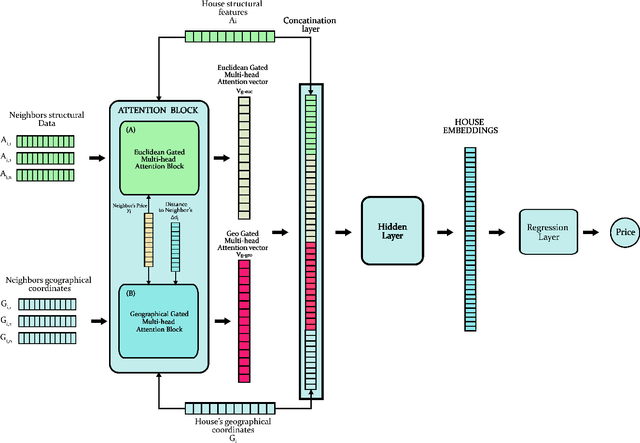

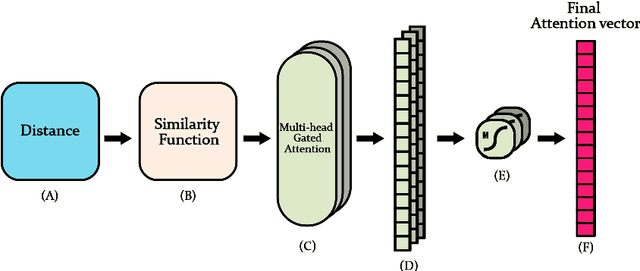
Evaluating house prices is crucial for various stakeholders, including homeowners, investors, and policymakers. However, traditional spatial interpolation methods have limitations in capturing the complex spatial relationships that affect property values. To address these challenges, we have developed a new method called Multi-Head Gated Attention for spatial interpolation. Our approach builds upon attention-based interpolation models and incorporates multiple attention heads and gating mechanisms to capture spatial dependencies and contextual information better. Importantly, our model produces embeddings that reduce the dimensionality of the data, enabling simpler models like linear regression to outperform complex ensembling models. We conducted extensive experiments to compare our model with baseline methods and the original attention-based interpolation model. The results show a significant improvement in the accuracy of house price predictions, validating the effectiveness of our approach. This research advances the field of spatial interpolation and provides a robust tool for more precise house price evaluation. Our GitHub repository.contains the data and code for all datasets, which are available for researchers and practitioners interested in replicating or building upon our work.