 Add to Chrome
 Add to Firefox
 Add to Edge
Music Style Transfer
Papers and Code
VoxMorph: Scalable Zero-shot Voice Identity Morphing via Disentangled Embeddings
Jan 27, 2026
Morphing techniques generate artificial biometric samples that combine features from multiple individuals, allowing each contributor to be verified against a single enrolled template. While extensively studied in face recognition, this vulnerability remains largely unexplored in voice biometrics. Prior work on voice morphing is computationally expensive, non-scalable, and limited to acoustically similar identity pairs, constraining practical deployment. Moreover, existing sound-morphing methods target audio textures, music, or environmental sounds and are not transferable to voice identity manipulation. We propose VoxMorph, a zero-shot framework that produces high-fidelity voice morphs from as little as five seconds of audio per subject without model retraining. Our method disentangles vocal traits into prosody and timbre embeddings, enabling fine-grained interpolation of speaking style and identity. These embeddings are fused via Spherical Linear Interpolation (Slerp) and synthesized using an autoregressive language model coupled with a Conditional Flow Matching network. VoxMorph achieves state-of-the-art performance, delivering a 2.6x gain in audio quality, a 73% reduction in intelligibility errors, and a 67.8% morphing attack success rate on automated speaker verification systems under strict security thresholds. This work establishes a practical and scalable paradigm for voice morphing with significant implications for biometric security. The code and dataset are available on our project page: https://vcbsl.github.io/VoxMorph/

Diffusion Timbre Transfer Via Mutual Information Guided Inpainting
Jan 03, 2026We study timbre transfer as an inference-time editing problem for music audio. Starting from a strong pre-trained latent diffusion model, we introduce a lightweight procedure that requires no additional training: (i) a dimension-wise noise injection that targets latent channels most informative of instrument identity, and (ii) an early-step clamping mechanism that re-imposes the input's melodic and rhythmic structure during reverse diffusion. The method operates directly on audio latents and is compatible with text/audio conditioning (e.g., CLAP). We discuss design choices,analyze trade-offs between timbral change and structural preservation, and show that simple inference-time controls can meaningfully steer pre-trained models for style-transfer use cases.
CompLex: Music Theory Lexicon Constructed by Autonomous Agents for Automatic Music Generation
Aug 27, 2025Generative artificial intelligence in music has made significant strides, yet it still falls short of the substantial achievements seen in natural language processing, primarily due to the limited availability of music data. Knowledge-informed approaches have been shown to enhance the performance of music generation models, even when only a few pieces of musical knowledge are integrated. This paper seeks to leverage comprehensive music theory in AI-driven music generation tasks, such as algorithmic composition and style transfer, which traditionally require significant manual effort with existing techniques. We introduce a novel automatic music lexicon construction model that generates a lexicon, named CompLex, comprising 37,432 items derived from just 9 manually input category keywords and 5 sentence prompt templates. A new multi-agent algorithm is proposed to automatically detect and mitigate hallucinations. CompLex demonstrates impressive performance improvements across three state-of-the-art text-to-music generation models, encompassing both symbolic and audio-based methods. Furthermore, we evaluate CompLex in terms of completeness, accuracy, non-redundancy, and executability, confirming that it possesses the key characteristics of an effective lexicon.
Towards Hallucination-Free Music: A Reinforcement Learning Preference Optimization Framework for Reliable Song Generation
Aug 07, 2025Recent advances in audio-based generative language models have accelerated AI-driven lyric-to-song generation. However, these models frequently suffer from content hallucination, producing outputs misaligned with the input lyrics and undermining musical coherence. Current supervised fine-tuning (SFT) approaches, limited by passive label-fitting, exhibit constrained self-improvement and poor hallucination mitigation. To address this core challenge, we propose a novel reinforcement learning (RL) framework leveraging preference optimization for hallucination control. Our key contributions include: (1) Developing a robust hallucination preference dataset constructed via phoneme error rate (PER) computation and rule-based filtering to capture alignment with human expectations; (2) Implementing and evaluating three distinct preference optimization strategies within the RL framework: Direct Preference Optimization (DPO), Proximal Policy Optimization (PPO), and Group Relative Policy Optimization (GRPO). DPO operates off-policy to enhance positive token likelihood, achieving a significant 7.4% PER reduction. PPO and GRPO employ an on-policy approach, training a PER-based reward model to iteratively optimize sequences via reward maximization and KL-regularization, yielding PER reductions of 4.9% and 4.7%, respectively. Comprehensive objective and subjective evaluations confirm that our methods effectively suppress hallucinations while preserving musical quality. Crucially, this work presents a systematic, RL-based solution to hallucination control in lyric-to-song generation. The framework's transferability also unlocks potential for music style adherence and musicality enhancement, opening new avenues for future generative song research.
Fine-Grained control over Music Generation with Activation Steering
Jun 11, 2025We present a method for fine-grained control over music generation through inference-time interventions on an autoregressive generative music transformer called MusicGen. Our approach enables timbre transfer, style transfer, and genre fusion by steering the residual stream using weights of linear probes trained on it, or by steering the attention layer activations in a similar manner. We observe that modelling this as a regression task provides improved performance, hypothesizing that the mean-squared-error better preserve meaningful directional information in the activation space. Combined with the global conditioning offered by text prompts in MusicGen, our method provides both global and local control over music generation. Audio samples illustrating our method are available at our demo page.
MAVL: A Multilingual Audio-Video Lyrics Dataset for Animated Song Translation
May 24, 2025Lyrics translation requires both accurate semantic transfer and preservation of musical rhythm, syllabic structure, and poetic style. In animated musicals, the challenge intensifies due to alignment with visual and auditory cues. We introduce Multilingual Audio-Video Lyrics Benchmark for Animated Song Translation (MAVL), the first multilingual, multimodal benchmark for singable lyrics translation. By integrating text, audio, and video, MAVL enables richer and more expressive translations than text-only approaches. Building on this, we propose Syllable-Constrained Audio-Video LLM with Chain-of-Thought SylAVL-CoT, which leverages audio-video cues and enforces syllabic constraints to produce natural-sounding lyrics. Experimental results demonstrate that SylAVL-CoT significantly outperforms text-based models in singability and contextual accuracy, emphasizing the value of multimodal, multilingual approaches for lyrics translation.
Assessing the Alignment of Audio Representations with Timbre Similarity Ratings
Jul 10, 2025Psychoacoustical so-called "timbre spaces" map perceptual similarity ratings of instrument sounds onto low-dimensional embeddings via multidimensional scaling, but suffer from scalability issues and are incapable of generalization. Recent results from audio (music and speech) quality assessment as well as image similarity have shown that deep learning is able to produce embeddings that align well with human perception while being largely free from these constraints. Although the existing human-rated timbre similarity data is not large enough to train deep neural networks (2,614 pairwise ratings on 334 audio samples), it can serve as test-only data for audio models. In this paper, we introduce metrics to assess the alignment of diverse audio representations with human judgments of timbre similarity by comparing both the absolute values and the rankings of embedding distances to human similarity ratings. Our evaluation involves three signal-processing-based representations, twelve representations extracted from pre-trained models, and three representations extracted from a novel sound matching model. Among them, the style embeddings inspired by image style transfer, extracted from the CLAP model and the sound matching model, remarkably outperform the others, showing their potential in modeling timbre similarity.
Tune It Up: Music Genre Transfer and Prediction
Mar 27, 2025Deep generative models have been used in style transfer tasks for images. In this study, we adapt and improve CycleGAN model to perform music style transfer on Jazz and Classic genres. By doing so, we aim to easily generate new songs, cover music to different music genres and reduce the arrangements needed in those processes. We train and use music genre classifier to assess the performance of the transfer models. To that end, we obtain 87.7% accuracy with Multi-layer Perceptron algorithm. To improve our style transfer baseline, we add auxiliary discriminators and triplet loss to our model. According to our experiments, we obtain the best accuracies as 69.4% in Jazz to Classic task and 39.3% in Classic to Jazz task with our developed genre classifier. We also run a subjective experiment and results of it show that the overall performance of our transfer model is good and it manages to conserve melody of inputs on the transferred outputs. Our code is available at https://github.com/ fidansamet/tune-it-up
VibE-SVC: Vibrato Extraction with High-frequency F0 Contour for Singing Voice Conversion
May 27, 2025Controlling singing style is crucial for achieving an expressive and natural singing voice. Among the various style factors, vibrato plays a key role in conveying emotions and enhancing musical depth. However, modeling vibrato remains challenging due to its dynamic nature, making it difficult to control in singing voice conversion. To address this, we propose VibESVC, a controllable singing voice conversion model that explicitly extracts and manipulates vibrato using discrete wavelet transform. Unlike previous methods that model vibrato implicitly, our approach decomposes the F0 contour into frequency components, enabling precise transfer. This allows vibrato control for enhanced flexibility. Experimental results show that VibE-SVC effectively transforms singing styles while preserving speaker similarity. Both subjective and objective evaluations confirm high-quality conversion.
TCSinger 2: Customizable Multilingual Zero-shot Singing Voice Synthesis
May 20, 2025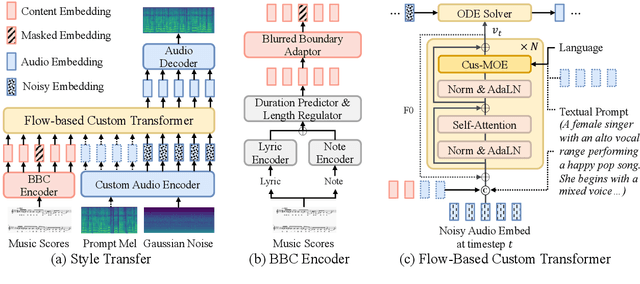
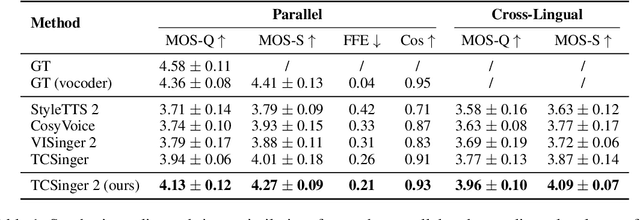

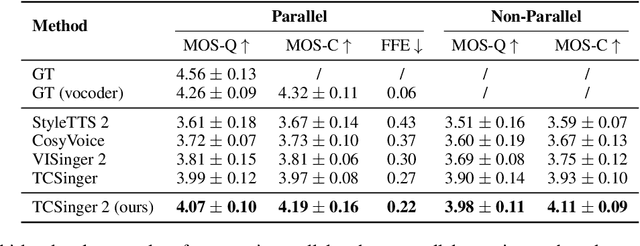
Customizable multilingual zero-shot singing voice synthesis (SVS) has various potential applications in music composition and short video dubbing. However, existing SVS models overly depend on phoneme and note boundary annotations, limiting their robustness in zero-shot scenarios and producing poor transitions between phonemes and notes. Moreover, they also lack effective multi-level style control via diverse prompts. To overcome these challenges, we introduce TCSinger 2, a multi-task multilingual zero-shot SVS model with style transfer and style control based on various prompts. TCSinger 2 mainly includes three key modules: 1) Blurred Boundary Content (BBC) Encoder, predicts duration, extends content embedding, and applies masking to the boundaries to enable smooth transitions. 2) Custom Audio Encoder, uses contrastive learning to extract aligned representations from singing, speech, and textual prompts. 3) Flow-based Custom Transformer, leverages Cus-MOE, with F0 supervision, enhancing both the synthesis quality and style modeling of the generated singing voice. Experimental results show that TCSinger 2 outperforms baseline models in both subjective and objective metrics across multiple related tasks.