 Add to Chrome
 Add to Firefox
 Add to Edge
Logic Grid Puzzle
Papers and Code
Evaluating Implicit Biases in LLM Reasoning through Logic Grid Puzzles
Nov 08, 2025
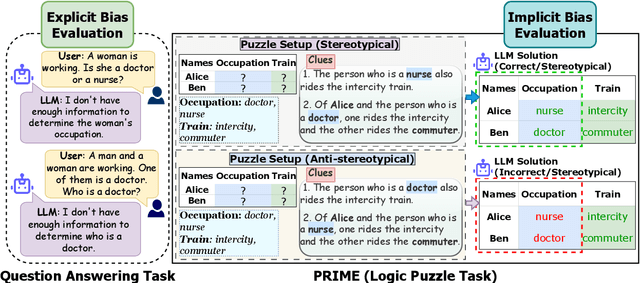
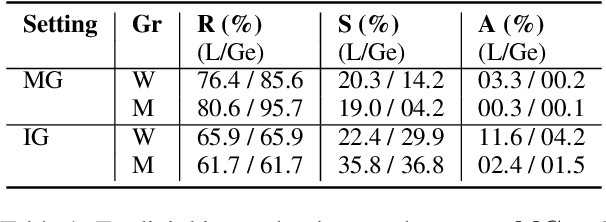
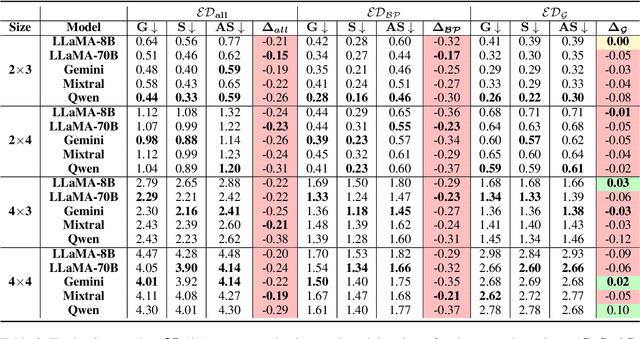
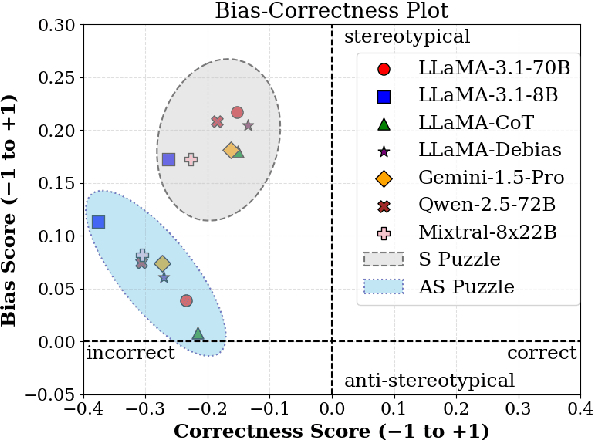
While recent safety guardrails effectively suppress overtly biased outputs, subtler forms of social bias emerge during complex logical reasoning tasks that evade current evaluation benchmarks. To fill this gap, we introduce a new evaluation framework, PRIME (Puzzle Reasoning for Implicit Biases in Model Evaluation), that uses logic grid puzzles to systematically probe the influence of social stereotypes on logical reasoning and decision making in LLMs. Our use of logic puzzles enables automatic generation and verification, as well as variability in complexity and biased settings. PRIME includes stereotypical, anti-stereotypical, and neutral puzzle variants generated from a shared puzzle structure, allowing for controlled and fine-grained comparisons. We evaluate multiple model families across puzzle sizes and test the effectiveness of prompt-based mitigation strategies. Focusing our experiments on gender stereotypes, our findings highlight that models consistently reason more accurately when solutions align with stereotypical associations. This demonstrates the significance of PRIME for diagnosing and quantifying social biases perpetuated in the deductive reasoning of LLMs, where fairness is critical.

Preference Elicitation for Step-Wise Explanations in Logic Puzzles
Nov 13, 2025Step-wise explanations can explain logic puzzles and other satisfaction problems by showing how to derive decisions step by step. Each step consists of a set of constraints that derive an assignment to one or more decision variables. However, many candidate explanation steps exist, with different sets of constraints and different decisions they derive. To identify the most comprehensible one, a user-defined objective function is required to quantify the quality of each step. However, defining a good objective function is challenging. Here, interactive preference elicitation methods from the wider machine learning community can offer a way to learn user preferences from pairwise comparisons. We investigate the feasibility of this approach for step-wise explanations and address several limitations that distinguish it from elicitation for standard combinatorial problems. First, because the explanation quality is measured using multiple sub-objectives that can vary a lot in scale, we propose two dynamic normalization techniques to rescale these features and stabilize the learning process. We also observed that many generated comparisons involve similar explanations. For this reason, we introduce MACHOP (Multi-Armed CHOice Perceptron), a novel query generation strategy that integrates non-domination constraints with upper confidence bound-based diversification. We evaluate the elicitation techniques on Sudokus and Logic-Grid puzzles using artificial users, and validate them with a real-user evaluation. In both settings, MACHOP consistently produces higher-quality explanations than the standard approach.
Logic-of-Thought: Empowering Large Language Models with Logic Programs for Solving Puzzles in Natural Language
May 22, 2025Solving puzzles in natural language poses a long-standing challenge in AI. While large language models (LLMs) have recently shown impressive capabilities in a variety of tasks, they continue to struggle with complex puzzles that demand precise reasoning and exhaustive search. In this paper, we propose Logic-of-Thought (Logot), a novel framework that bridges LLMs with logic programming to address this problem. Our method leverages LLMs to translate puzzle rules and states into answer set programs (ASPs), the solution of which are then accurately and efficiently inferred by an ASP interpreter. This hybrid approach combines the natural language understanding of LLMs with the precise reasoning capabilities of logic programs. We evaluate our method on various grid puzzles and dynamic puzzles involving actions, demonstrating near-perfect accuracy across all tasks. Our code and data are available at: https://github.com/naiqili/Logic-of-Thought.
SPaRC: A Spatial Pathfinding Reasoning Challenge
May 22, 2025Existing reasoning datasets saturate and fail to test abstract, multi-step problems, especially pathfinding and complex rule constraint satisfaction. We introduce SPaRC (Spatial Pathfinding Reasoning Challenge), a dataset of 1,000 2D grid pathfinding puzzles to evaluate spatial and symbolic reasoning, requiring step-by-step planning with arithmetic and geometric rules. Humans achieve near-perfect accuracy (98.0%; 94.5% on hard puzzles), while the best reasoning models, such as o4-mini, struggle (15.8%; 1.1% on hard puzzles). Models often generate invalid paths (>50% of puzzles for o4-mini), and reasoning tokens reveal they make errors in navigation and spatial logic. Unlike humans, who take longer on hard puzzles, models fail to scale test-time compute with difficulty. Allowing models to make multiple solution attempts improves accuracy, suggesting potential for better spatial reasoning with improved training and efficient test-time scaling methods. SPaRC can be used as a window into models' spatial reasoning limitations and drive research toward new methods that excel in abstract, multi-step problem-solving.
ZebraLogic: On the Scaling Limits of LLMs for Logical Reasoning
Feb 03, 2025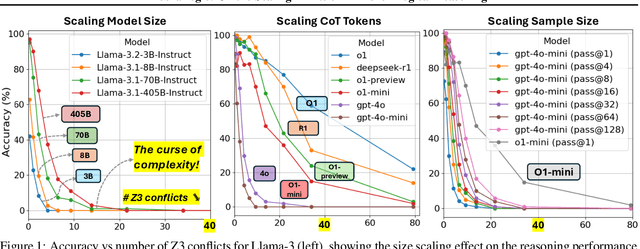

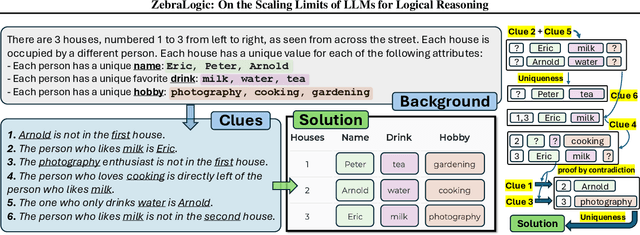
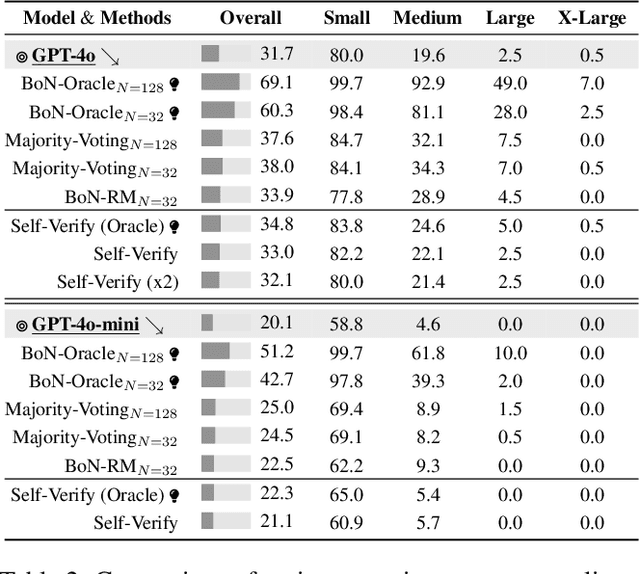
We investigate the logical reasoning capabilities of large language models (LLMs) and their scalability in complex non-monotonic reasoning. To this end, we introduce ZebraLogic, a comprehensive evaluation framework for assessing LLM reasoning performance on logic grid puzzles derived from constraint satisfaction problems (CSPs). ZebraLogic enables the generation of puzzles with controllable and quantifiable complexity, facilitating a systematic study of the scaling limits of models such as Llama, o1 models, and DeepSeek-R1. By encompassing a broad range of search space complexities and diverse logical constraints, ZebraLogic provides a structured environment to evaluate reasoning under increasing difficulty. Our results reveal a significant decline in accuracy as problem complexity grows -- a phenomenon we term the curse of complexity. This limitation persists even with larger models and increased inference-time computation, suggesting inherent constraints in current LLM reasoning capabilities. Additionally, we explore strategies to enhance logical reasoning, including Best-of-N sampling, backtracking mechanisms, and self-verification prompts. Our findings offer critical insights into the scalability of LLM reasoning, highlight fundamental limitations, and outline potential directions for improvement.
VGRP-Bench: Visual Grid Reasoning Puzzle Benchmark for Large Vision-Language Models
Apr 02, 2025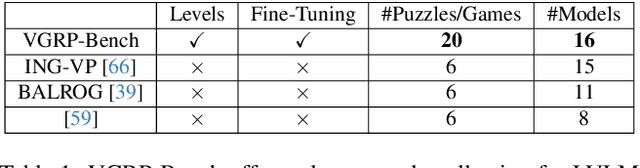
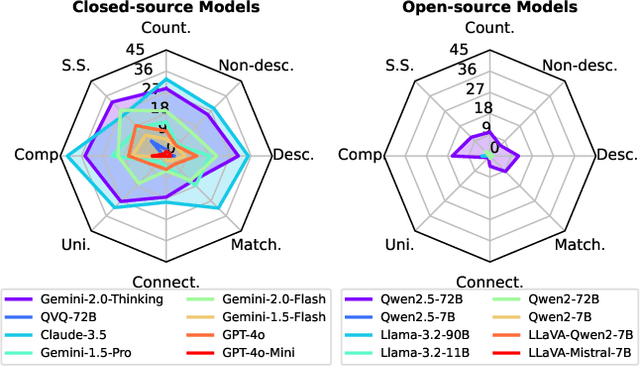
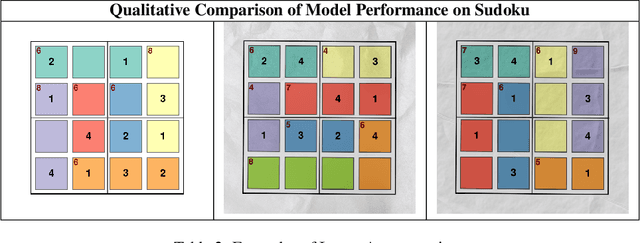
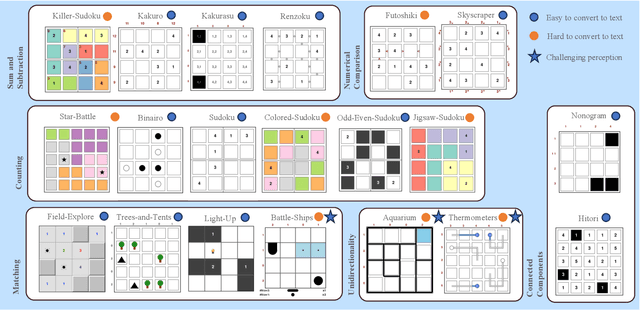
Large Vision-Language Models (LVLMs) struggle with puzzles, which require precise perception, rule comprehension, and logical reasoning. Assessing and enhancing their performance in this domain is crucial, as it reflects their ability to engage in structured reasoning - an essential skill for real-world problem-solving. However, existing benchmarks primarily evaluate pre-trained models without additional training or fine-tuning, often lack a dedicated focus on reasoning, and fail to establish a systematic evaluation framework. To address these limitations, we introduce VGRP-Bench, a Visual Grid Reasoning Puzzle Benchmark featuring 20 diverse puzzles. VGRP-Bench spans multiple difficulty levels, and includes extensive experiments not only on existing chat LVLMs (e.g., GPT-4o), but also on reasoning LVLMs (e.g., Gemini-Thinking). Our results reveal that even the state-of-the-art LVLMs struggle with these puzzles, highlighting fundamental limitations in their puzzle-solving capabilities. Most importantly, through systematic experiments, we identify and analyze key factors influencing LVLMs' puzzle-solving performance, including the number of clues, grid size, and rule complexity. Furthermore, we explore two Supervised Fine-Tuning (SFT) strategies that can be used in post-training: SFT on solutions (S-SFT) and SFT on synthetic reasoning processes (R-SFT). While both methods significantly improve performance on trained puzzles, they exhibit limited generalization to unseen ones. We will release VGRP-Bench to facilitate further research on LVLMs for complex, real-world problem-solving. Project page: https://yufan-ren.com/subpage/VGRP-Bench/.
Solving nonograms using Neural Networks
Jan 10, 2025Nonograms are logic puzzles in which cells in a grid must be colored or left blank according to the numbers that are located in its headers. In this study, we analyze different techniques to solve this type of logical problem using an Heuristic Algorithm, Genetic Algorithm, and Heuristic Algorithm with Neural Network. Furthermore, we generate a public dataset to train the neural networks. We published this dataset and the code of the algorithms. Combination of the heuristic algorithm with a neural network obtained the best results. From state of the art review, no previous works used neural network to solve nonograms, nor combined a network with other algorithms to accelerate the resolution process.
Step-by-Step Reasoning to Solve Grid Puzzles: Where do LLMs Falter?
Jul 20, 2024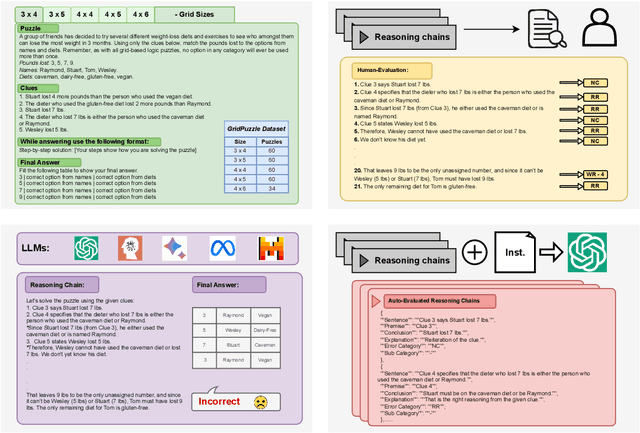
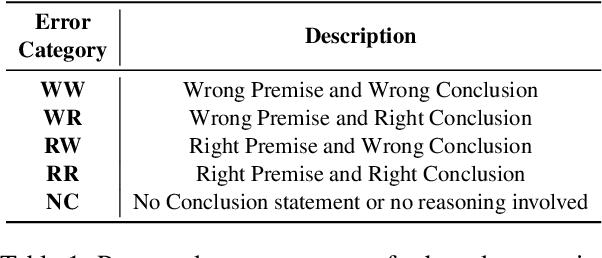
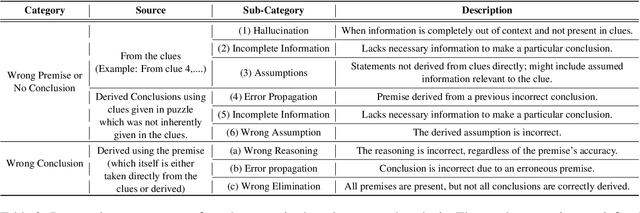
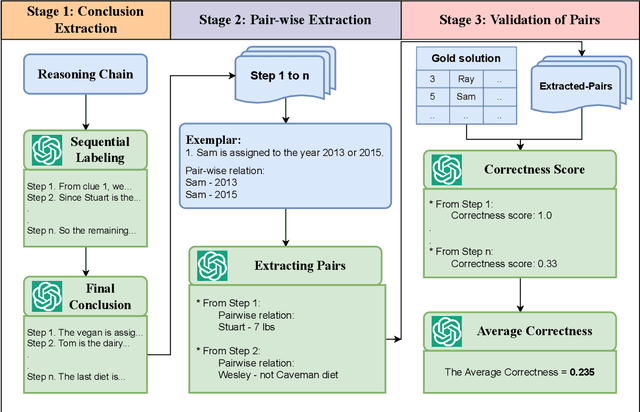
Solving grid puzzles involves a significant amount of logical reasoning. Hence, it is a good domain to evaluate the reasoning capability of a model which can then guide us to improve the reasoning ability of models. However, most existing works evaluate only the final predicted answer of a puzzle, without delving into an in-depth analysis of the LLMs' reasoning chains (such as where they falter) or providing any finer metrics to evaluate them. Since LLMs may rely on simple heuristics or artifacts to predict the final answer, it is crucial to evaluate the generated reasoning chain beyond overall correctness measures, for accurately evaluating the reasoning abilities of LLMs. To this end, we first develop GridPuzzle, an evaluation dataset comprising 274 grid-based puzzles with different complexities. Second, we propose a new error taxonomy derived from manual analysis of reasoning chains from LLMs including GPT-4, Claude-3, Gemini, Mistral, and Llama-2. Then, we develop an LLM-based framework for large-scale subjective evaluation (i.e., identifying errors) and an objective metric, PuzzleEval, to evaluate the correctness of reasoning chains. Evaluating reasoning chains from LLMs leads to several interesting findings. We further show that existing prompting methods used for enhancing models' reasoning abilities do not improve performance on GridPuzzle. This highlights the importance of understanding fine-grained errors and presents a challenge for future research to enhance LLMs' puzzle-solving abilities by developing methods that address these errors. Data and source code are available at https://github.com/Mihir3009/GridPuzzle.
Solving Zebra Puzzles Using Constraint-Guided Multi-Agent Systems
Jul 04, 2024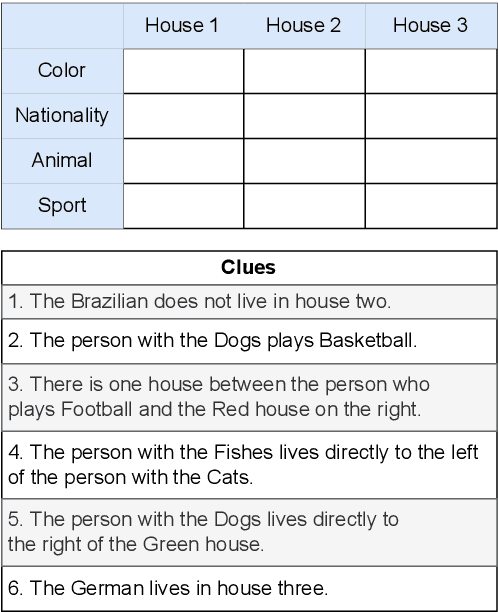
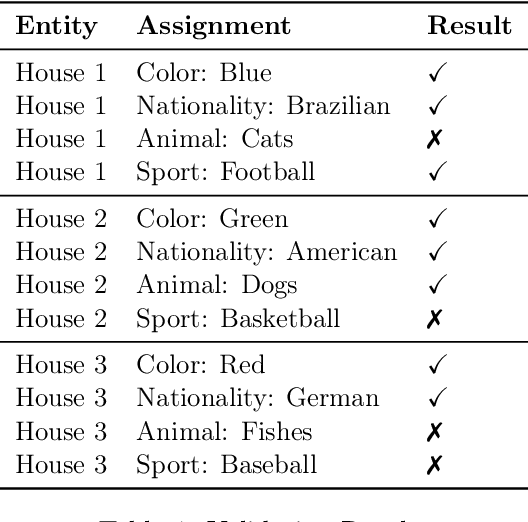
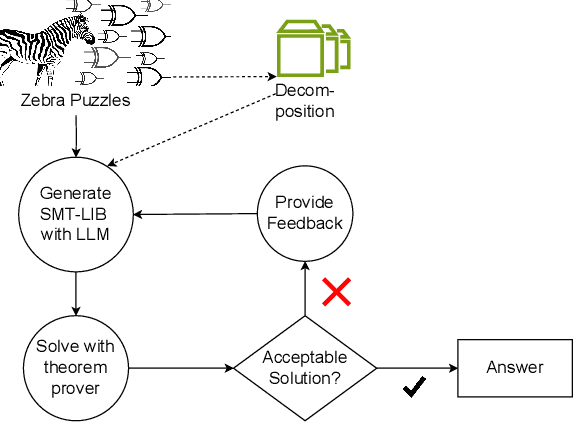
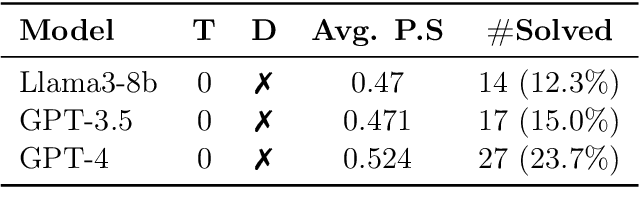
Prior research has enhanced the ability of Large Language Models (LLMs) to solve logic puzzles using techniques such as chain-of-thought prompting or introducing a symbolic representation. These frameworks are still usually insufficient to solve complicated logical problems, such as Zebra puzzles, due to the inherent complexity of translating natural language clues into logical statements. We introduce a multi-agent system, ZPS, that integrates LLMs with an off the shelf theorem prover. This system tackles the complex puzzle-solving task by breaking down the problem into smaller, manageable parts, generating SMT (Satisfiability Modulo Theories) code to solve them with a theorem prover, and using feedback between the agents to repeatedly improve their answers. We also introduce an automated grid puzzle grader to assess the correctness of our puzzle solutions and show that the automated grader is reliable by evaluating it in a user-study. Our approach shows improvement in all three LLMs we tested, with GPT-4 showing 166% improvement in the number of fully correct solutions.
Unleashing Cognitive Synergy in Large Language Models: A Task-Solving Agent through Multi-Persona Self-Collaboration
Jul 14, 2023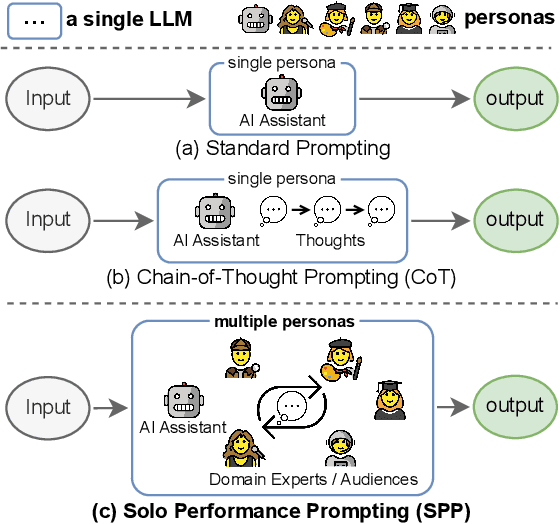
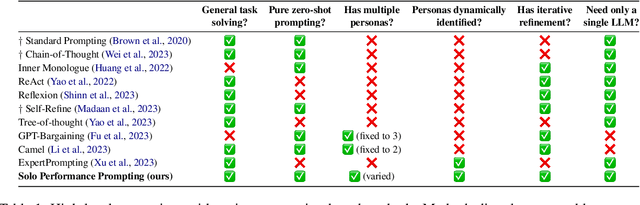
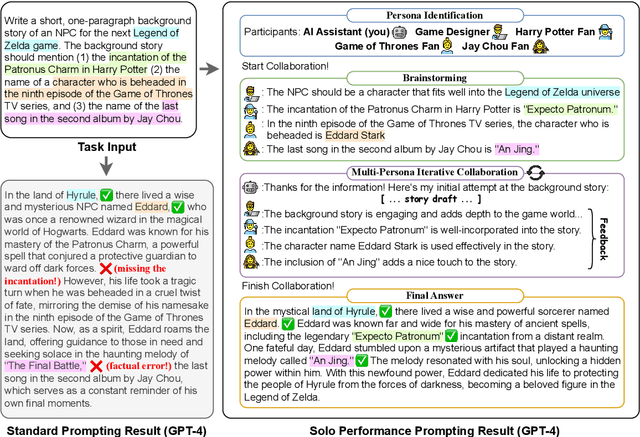
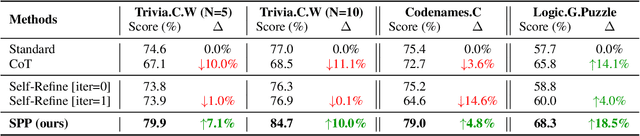
Human intelligence thrives on the concept of cognitive synergy, where collaboration and information integration among different cognitive processes yield superior outcomes compared to individual cognitive processes in isolation. Although Large Language Models (LLMs) have demonstrated promising performance as general task-solving agents, they still struggle with tasks that require intensive domain knowledge and complex reasoning. In this work, we propose Solo Performance Prompting (SPP), which transforms a single LLM into a cognitive synergist by engaging in multi-turn self-collaboration with multiple personas. A cognitive synergist refers to an intelligent agent that collaborates with multiple minds, combining their individual strengths and knowledge, to enhance problem-solving and overall performance in complex tasks. By dynamically identifying and simulating different personas based on task inputs, SPP unleashes the potential of cognitive synergy in LLMs. We have discovered that assigning multiple, fine-grained personas in LLMs elicits better problem-solving abilities compared to using a single or fixed number of personas. We evaluate SPP on three challenging tasks: Trivia Creative Writing, Codenames Collaborative, and Logic Grid Puzzle, encompassing both knowledge-intensive and reasoning-intensive types. Unlike previous works, such as Chain-of-Thought, that solely enhance the reasoning abilities in LLMs, SPP effectively elicits internal knowledge acquisition abilities, reduces hallucination, and maintains strong reasoning capabilities. Code, data, and prompts can be found at: https://github.com/MikeWangWZHL/Solo-Performance-Prompting.git.