 Add to Chrome
 Add to Firefox
 Add to Edge
q0: Primitives for Hyper-Epoch Pretraining
Jun 03, 2026
Multi-epoch training is becoming the standard now that compute is growing faster than the supply of high-quality text. But pretraining a single model saturates within a few passes, long before the compute budget is exhausted. We argue this calls for a conceptual shift from training a single model toward exploring a population of models and aggregating their predictions. We introduce hyper-epoch pretraining (q0), which turns a multi-epoch budget into a population of diverse models whose combined predictions reach a lower validation loss than a single refined model. q0 reduces to three core primitives. A cyclic schedule with anti-correlated learning rate and weight decay collects diverse models from a few parallel trajectories. Chain distillation trains each model against its predecessor so that model quality compounds across the population. A learned prior, fit on a held out set, selects and weights members for any inference budget. On a 1.8B-parameter model trained on 100M FineWeb tokens, q0 matches a strong 256-epoch ensemble baseline using only ~56 epochs (~4.6x fewer), or ~67 epochs (~3.8x fewer) when matched to the baseline's ensemble size, and continues to improve beyond it. These gains reach cumulative ~12.9x data efficiency under the Slowrun setting and transfer to downstream benchmarks. Crucially, the optimal allocation shifts with the budget, so we give prescriptive recipes for how to spend a given epoch budget to maximize generalization, from a single epoch up to the largest budgets.

Solving Zebra Puzzles Using Constraint-Guided Multi-Agent Systems
Jul 04, 2024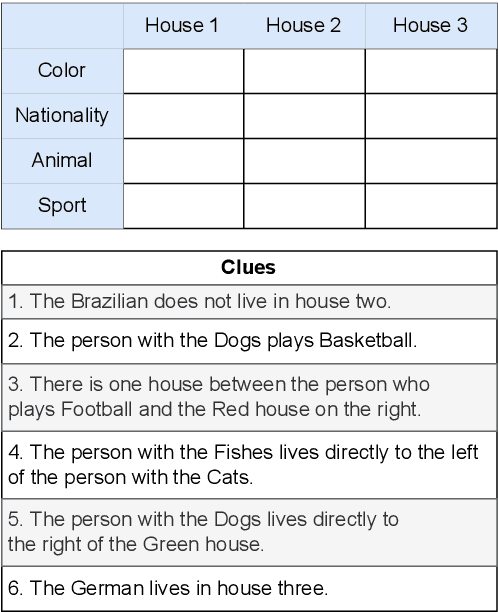
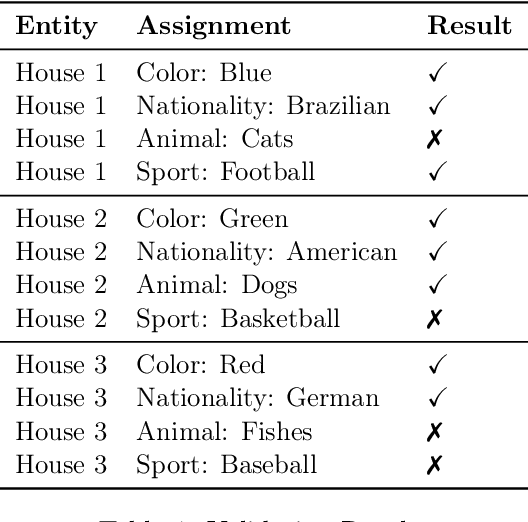
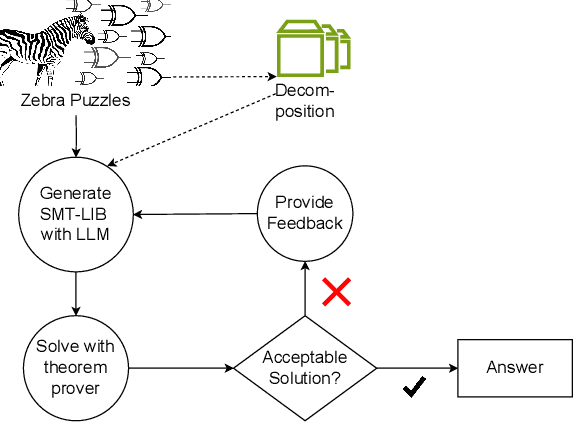
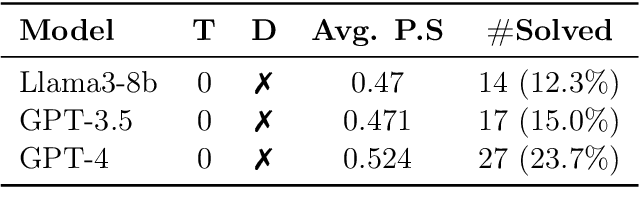
Prior research has enhanced the ability of Large Language Models (LLMs) to solve logic puzzles using techniques such as chain-of-thought prompting or introducing a symbolic representation. These frameworks are still usually insufficient to solve complicated logical problems, such as Zebra puzzles, due to the inherent complexity of translating natural language clues into logical statements. We introduce a multi-agent system, ZPS, that integrates LLMs with an off the shelf theorem prover. This system tackles the complex puzzle-solving task by breaking down the problem into smaller, manageable parts, generating SMT (Satisfiability Modulo Theories) code to solve them with a theorem prover, and using feedback between the agents to repeatedly improve their answers. We also introduce an automated grid puzzle grader to assess the correctness of our puzzle solutions and show that the automated grader is reliable by evaluating it in a user-study. Our approach shows improvement in all three LLMs we tested, with GPT-4 showing 166% improvement in the number of fully correct solutions.