 Add to Chrome
 Add to Firefox
 Add to Edge
Denoising Autoencoder
Papers and Code
X2HDR: HDR Image Generation in a Perceptually Uniform Space
Feb 04, 2026
High-dynamic-range (HDR) formats and displays are becoming increasingly prevalent, yet state-of-the-art image generators (e.g., Stable Diffusion and FLUX) typically remain limited to low-dynamic-range (LDR) output due to the lack of large-scale HDR training data. In this work, we show that existing pretrained diffusion models can be easily adapted to HDR generation without retraining from scratch. A key challenge is that HDR images are natively represented in linear RGB, whose intensity and color statistics differ substantially from those of sRGB-encoded LDR images. This gap, however, can be effectively bridged by converting HDR inputs into perceptually uniform encodings (e.g., using PU21 or PQ). Empirically, we find that LDR-pretrained variational autoencoders (VAEs) reconstruct PU21-encoded HDR inputs with fidelity comparable to LDR data, whereas linear RGB inputs cause severe degradations. Motivated by this finding, we describe an efficient adaptation strategy that freezes the VAE and finetunes only the denoiser via low-rank adaptation in a perceptually uniform space. This results in a unified computational method that supports both text-to-HDR synthesis and single-image RAW-to-HDR reconstruction. Experiments demonstrate that our perceptually encoded adaptation consistently improves perceptual fidelity, text-image alignment, and effective dynamic range, relative to previous techniques.

Masked Autoencoders as Universal Speech Enhancer
Feb 02, 2026Supervised speech enhancement methods have been very successful. However, in practical scenarios, there is a lack of clean speech, and self-supervised learning-based (SSL) speech enhancement methods that offer comparable enhancement performance and can be applied to other speech-related downstream applications are desired. In this work, we develop a masked autoencoder based universal speech enhancer that is agnostic to the type of distortion affecting speech, can handle multiple distortions simultaneously, and is trained in a self-supervised manner. An augmentation stack adds further distortions to the noisy input data. The masked autoencoder model learns to remove the added distortions along with reconstructing the masked regions of the spectrogram during pre-training. The pre-trained embeddings are then used by fine-tuning models trained on a small amount of paired data for specific downstream tasks. We evaluate the pre-trained features for denoising and dereverberation downstream tasks. We explore different augmentations (like single or multi-speaker) in the pre-training augmentation stack and the effect of different noisy input feature representations (like $log1p$ compression) on pre-trained embeddings and downstream fine-tuning enhancement performance. We show that the proposed method not only outperforms the baseline but also achieves state-of-the-art performance for both in-domain and out-of-domain evaluation datasets.
Self-Refining Video Sampling
Jan 26, 2026Modern video generators still struggle with complex physical dynamics, often falling short of physical realism. Existing approaches address this using external verifiers or additional training on augmented data, which is computationally expensive and still limited in capturing fine-grained motion. In this work, we present self-refining video sampling, a simple method that uses a pre-trained video generator trained on large-scale datasets as its own self-refiner. By interpreting the generator as a denoising autoencoder, we enable iterative inner-loop refinement at inference time without any external verifier or additional training. We further introduce an uncertainty-aware refinement strategy that selectively refines regions based on self-consistency, which prevents artifacts caused by over-refinement. Experiments on state-of-the-art video generators demonstrate significant improvements in motion coherence and physics alignment, achieving over 70\% human preference compared to the default sampler and guidance-based sampler.
VAE-REPA: Variational Autoencoder Representation Alignment for Efficient Diffusion Training
Jan 25, 2026Denoising-based diffusion transformers, despite their strong generation performance, suffer from inefficient training convergence. Existing methods addressing this issue, such as REPA (relying on external representation encoders) or SRA (requiring dual-model setups), inevitably incur heavy computational overhead during training due to external dependencies. To tackle these challenges, this paper proposes \textbf{\namex}, a lightweight intrinsic guidance framework for efficient diffusion training. \name leverages off-the-shelf pre-trained Variational Autoencoder (VAE) features: their reconstruction property ensures inherent encoding of visual priors like rich texture details, structural patterns, and basic semantic information. Specifically, \name aligns the intermediate latent features of diffusion transformers with VAE features via a lightweight projection layer, supervised by a feature alignment loss. This design accelerates training without extra representation encoders or dual-model maintenance, resulting in a simple yet effective pipeline. Extensive experiments demonstrate that \name improves both generation quality and training convergence speed compared to vanilla diffusion transformers, matches or outperforms state-of-the-art acceleration methods, and incurs merely 4\% extra GFLOPs with zero additional cost for external guidance models.
D3R-Net: Dual-Domain Denoising Reconstruction Network for Robust Industrial Anomaly Detection
Jan 27, 2026Unsupervised anomaly detection (UAD) is a key ingredient of automated visual inspection in modern manufacturing. The reconstruction-based methods appeal because they have basic architectural design and they process data quickly but they produce oversmoothed results for high-frequency details. As a result, subtle defects are partially reconstructed rather than highlighted, which limits segmentation accuracy. We build on this line of work and introduce D3R-Net, a Dual-Domain Denoising Reconstruction framework that couples a self-supervised 'healing' task with frequency-aware regularization. During training, the network receives synthetically corrupted normal images and is asked to reconstruct the clean targets, which prevents trivial identity mapping and pushes the model to learn the manifold of defect-free textures. In addition to the spatial mean squared error, we employ a Fast Fourier Transform (FFT) magnitude loss that encourages consistency in the frequency domain. The implementation also allows an optional structural similarity (SSIM) term, which we study in an ablation. On the MVTec AD Hazelnut benchmark, D3R-Net with the FFT loss improves localization consistency over a spatial-only baseline: PRO AUC increases from 0.603 to 0.687, while image-level ROC AUC remains robust. Evaluated across fifteen MVTec categories, the FFT variant raises the average pixel ROC AUC from 0.733 to 0.751 and PRO AUC from 0.417 to 0.468 compared to the MSE-only baseline, at roughly 20 FPS on a single GPU. The network is trained from scratch and uses a lightweight convolutional autoencoder backbone, providing a practical alternative to heavy pre-trained feature embedding methods.
Physics-Constrained Denoising Autoencoders for Data-Scarce Wildfire UAV Sensing
Jan 16, 2026Wildfire monitoring requires high-resolution atmospheric measurements, yet low-cost sensors on Unmanned Aerial Vehicles (UAVs) exhibit baseline drift, cross-sensitivity, and response lag that corrupt concentration estimates. Traditional deep learning denoising approaches demand large datasets impractical to obtain from limited UAV flight campaigns. We present PC$^2$DAE, a physics-informed denoising autoencoder that addresses data scarcity by embedding physical constraints directly into the network architecture. Non-negative concentration estimates are enforced via softplus activations and physically plausible temporal smoothing, ensuring outputs are physically admissible by construction rather than relying on loss function penalties. The architecture employs hierarchical decoder heads for Black Carbon, Gas, and CO$_2$ sensor families, with two variants: PC$^2$DAE-Lean (21k parameters) for edge deployment and PC$^2$DAE-Wide (204k parameters) for offline processing. We evaluate on 7,894 synchronized 1 Hz samples collected from UAV flights during prescribed burns in Saskatchewan, Canada (approximately 2.2 hours of flight data), two orders of magnitude below typical deep learning requirements. PC$^2$DAE-Lean achieves 67.3\% smoothness improvement and 90.7\% high-frequency noise reduction with zero physics violations. Five baselines (LSTM-AE, U-Net, Transformer, CBDAE, DeSpaWN) produce 15--23\% negative outputs. The lean variant outperforms wide (+5.6\% smoothness), suggesting reduced capacity with strong inductive bias prevents overfitting in data-scarce regimes. Training completes in under 65 seconds on consumer hardware.
Iterative Amortized Hierarchical VAE
Jan 22, 2026In this paper we propose the Iterative Amortized Hierarchical Variational Autoencoder (IA-HVAE), which expands on amortized inference with a hybrid scheme containing an initial amortized guess and iterative refinement with decoder gradients. We achieve this by creating a linearly separable decoder in a transform domain (e.g. Fourier space), enabling real-time applications with very high model depths. The architectural change leads to a 35x speed-up for iterative inference with respect to the traditional HVAE. We show that our hybrid approach outperforms fully amortized and fully iterative equivalents in accuracy and speed respectively. Moreover, the IAHVAE shows improved reconstruction quality over a vanilla HVAE in inverse problems such as deblurring and denoising.
Contrastive and Multi-Task Learning on Noisy Brain Signals with Nonlinear Dynamical Signatures
Jan 13, 2026We introduce a two-stage multitask learning framework for analyzing Electroencephalography (EEG) signals that integrates denoising, dynamical modeling, and representation learning. In the first stage, a denoising autoencoder is trained to suppress artifacts and stabilize temporal dynamics, providing robust signal representations. In the second stage, a multitask architecture processes these denoised signals to achieve three objectives: motor imagery classification, chaotic versus non-chaotic regime discrimination using Lyapunov exponent-based labels, and self-supervised contrastive representation learning with NT-Xent loss. A convolutional backbone combined with a Transformer encoder captures spatial-temporal structure, while the dynamical task encourages sensitivity to nonlinear brain dynamics. This staged design mitigates interference between reconstruction and discriminative goals, improves stability across datasets, and supports reproducible training by clearly separating noise reduction from higher-level feature learning. Empirical studies show that our framework not only enhances robustness and generalization but also surpasses strong baselines and recent state-of-the-art methods in EEG decoding, highlighting the effectiveness of combining denoising, dynamical features, and self-supervised learning.
Generalization of Diffusion Models Arises with a Balanced Representation Space
Dec 24, 2025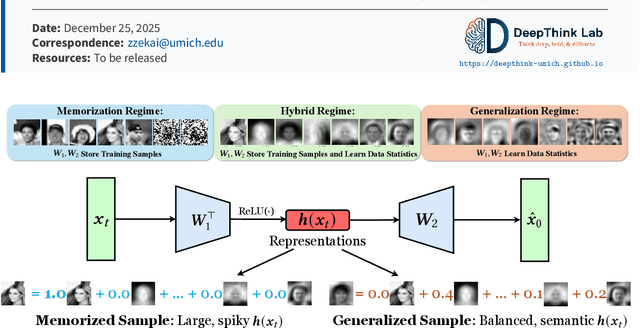
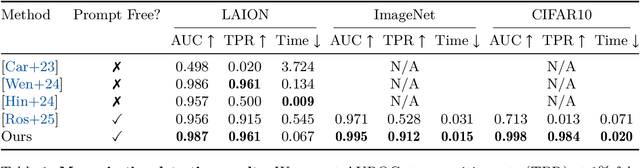
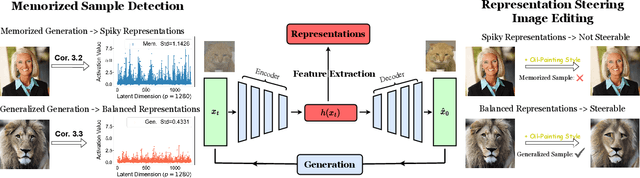
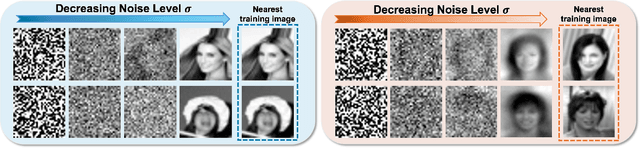
Diffusion models excel at generating high-quality, diverse samples, yet they risk memorizing training data when overfit to the training objective. We analyze the distinctions between memorization and generalization in diffusion models through the lens of representation learning. By investigating a two-layer ReLU denoising autoencoder (DAE), we prove that (i) memorization corresponds to the model storing raw training samples in the learned weights for encoding and decoding, yielding localized "spiky" representations, whereas (ii) generalization arises when the model captures local data statistics, producing "balanced" representations. Furthermore, we validate these theoretical findings on real-world unconditional and text-to-image diffusion models, demonstrating that the same representation structures emerge in deep generative models with significant practical implications. Building on these insights, we propose a representation-based method for detecting memorization and a training-free editing technique that allows precise control via representation steering. Together, our results highlight that learning good representations is central to novel and meaningful generative modeling.
YODA: Yet Another One-step Diffusion-based Video Compressor
Jan 03, 2026While one-step diffusion models have recently excelled in perceptual image compression, their application to video remains limited. Prior efforts typically rely on pretrained 2D autoencoders that generate per-frame latent representations independently, thereby neglecting temporal dependencies. We present YODA--Yet Another One-step Diffusion-based Video Compressor--which embeds multiscale features from temporal references for both latent generation and latent coding to better exploit spatial-temporal correlations for more compact representation, and employs a linear Diffusion Transformer (DiT) for efficient one-step denoising. YODA achieves state-of-the-art perceptual performance, consistently outperforming traditional and deep-learning baselines on LPIPS, DISTS, FID, and KID. Source code will be publicly available at https://github.com/NJUVISION/YODA.