 Add to Chrome
 Add to Firefox
 Add to Edge
Electrocardiogram Classification with Transformers Using Koopman and Wavelet Features
Mar 09, 2026
Electrocardiogram (ECG) analysis is vital for detecting cardiac abnormalities, yet robust automated classification is challenging due to the complexity and variability of physiological signals. In this work, we investigate transformer-based ECG classification using features derived from the Koopman operator and wavelet transforms. Two tasks are studied: (1) binary classification (Normal vs. Non-normal), and (2) four-class classification (Normal, Atrial Fibrillation, Ventricular Arrhythmia, Block). We use Extended Dynamic Mode Decomposition (EDMD) to approximate the Koopman operator. Our results show that wavelet features excel in binary classification, while Koopman features, when paired with transformers, achieve superior performance in the four-class setting. A simple hybrid of Koopman and wavelet features does not improve accuracy. However, selecting an appropriate EDMD dictionary -- specifically a radial basis function dictionary with tuned parameters -- yields significant gains, surpassing the wavelet-only baseline and the hybrid wavelet-Koopman system. We also present a Koopman-based reconstruction analysis for interpretable insights into the learned dynamics and compare against a recurrent neural network baseline. Overall, our findings demonstrate the effectiveness of Koopman-based feature learning with transformers and highlight promising directions for integrating dynamical systems theory into time-series classification.

Contrastive and Multi-Task Learning on Noisy Brain Signals with Nonlinear Dynamical Signatures
Jan 13, 2026We introduce a two-stage multitask learning framework for analyzing Electroencephalography (EEG) signals that integrates denoising, dynamical modeling, and representation learning. In the first stage, a denoising autoencoder is trained to suppress artifacts and stabilize temporal dynamics, providing robust signal representations. In the second stage, a multitask architecture processes these denoised signals to achieve three objectives: motor imagery classification, chaotic versus non-chaotic regime discrimination using Lyapunov exponent-based labels, and self-supervised contrastive representation learning with NT-Xent loss. A convolutional backbone combined with a Transformer encoder captures spatial-temporal structure, while the dynamical task encourages sensitivity to nonlinear brain dynamics. This staged design mitigates interference between reconstruction and discriminative goals, improves stability across datasets, and supports reproducible training by clearly separating noise reduction from higher-level feature learning. Empirical studies show that our framework not only enhances robustness and generalization but also surpasses strong baselines and recent state-of-the-art methods in EEG decoding, highlighting the effectiveness of combining denoising, dynamical features, and self-supervised learning.
Word-Level Alignment of Paper Documents with their Electronic Full-Text Counterparts
Apr 30, 2021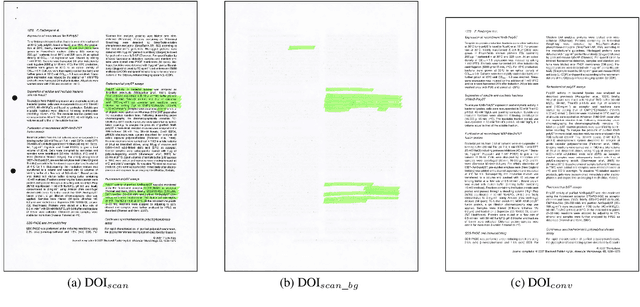
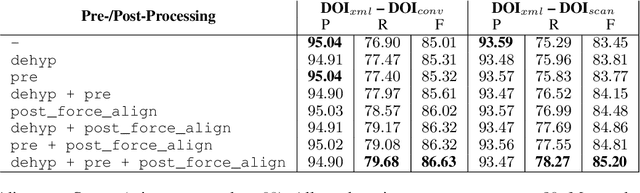
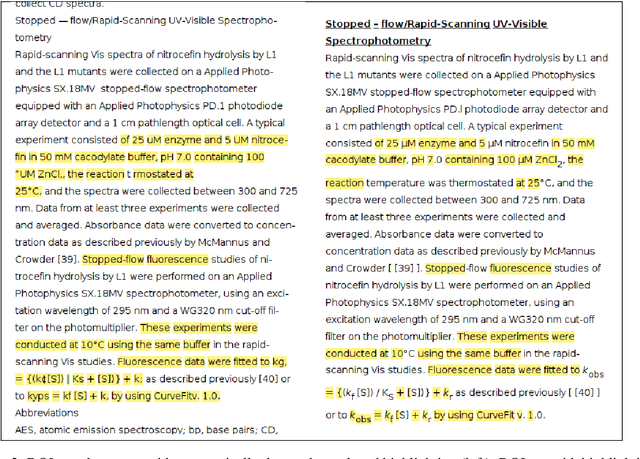
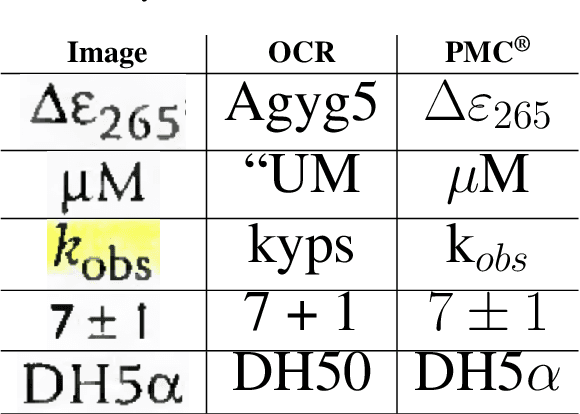
We describe a simple procedure for the automatic creation of word-level alignments between printed documents and their respective full-text versions. The procedure is unsupervised, uses standard, off-the-shelf components only, and reaches an F-score of 85.01 in the basic setup and up to 86.63 when using pre- and post-processing. Potential areas of application are manual database curation (incl. document triage) and biomedical expression OCR.
A Hybrid Framework for Topic Structure using Laughter Occurrences
Dec 31, 2019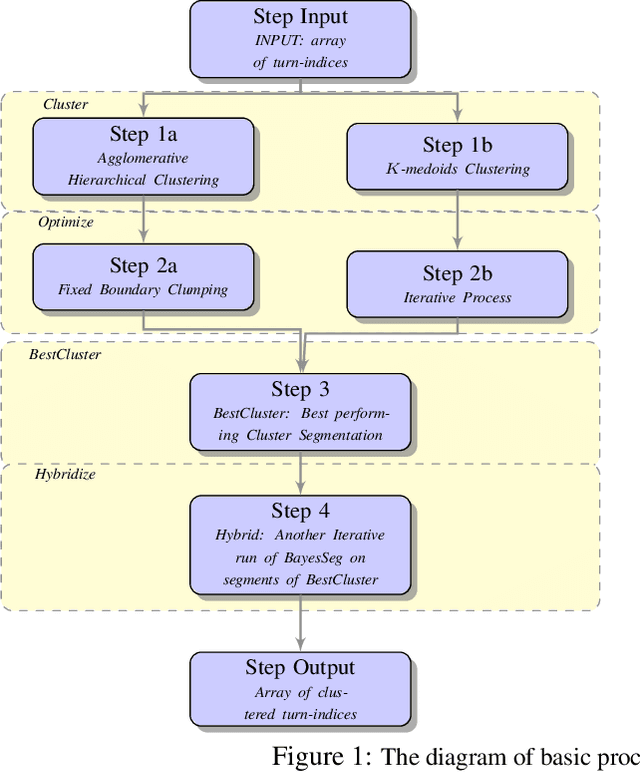
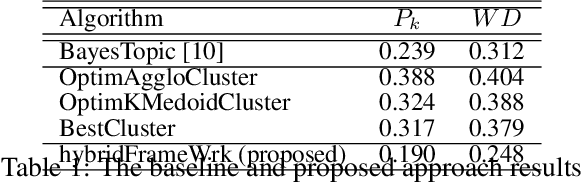
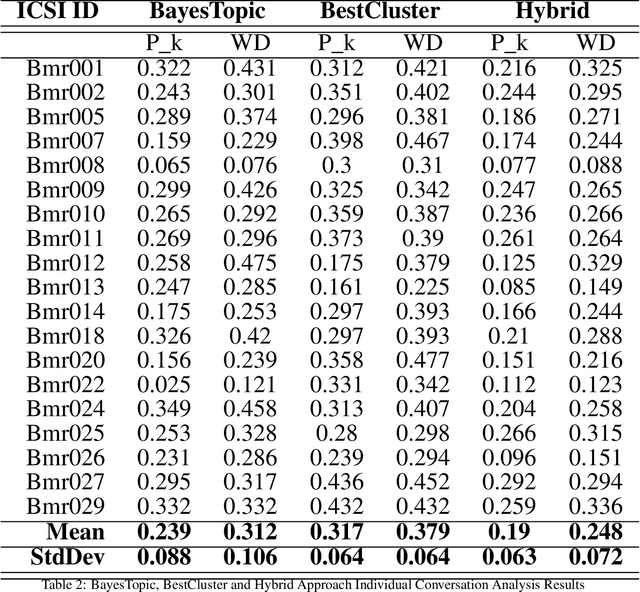
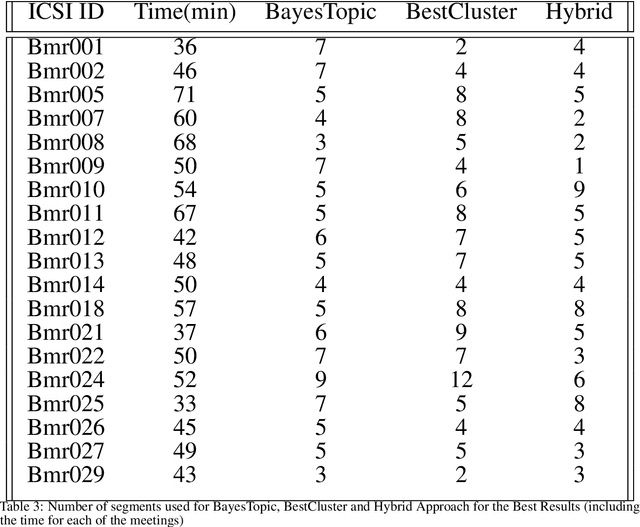
Conversational discourse coherence depends on both linguistic and paralinguistic phenomena. In this work we combine both paralinguistic and linguistic knowledge into a hybrid framework through a multi-level hierarchy. Thus it outputs the discourse-level topic structures. The laughter occurrences are used as paralinguistic information from the multiparty meeting transcripts of ICSI database. A clustering-based algorithm is proposed that chose the best topic-segment cluster from two independent, optimized clusters, namely, hierarchical agglomerative clustering and $K$-medoids. Then it is iteratively hybridized with an existing lexical cohesion based Bayesian topic segmentation framework. The hybrid approach improves the performance of both of the stand-alone approaches. This leads to the brief study of interactions between topic structures with discourse relational structure. This training-free topic structuring approach can be applicable to online understanding of spoken dialogs.
Technical Report: a tool for measuring Prosodic Accommodation
Dec 30, 2015
This article has been withdrawn by arXiv administrators because the submitter did not have the legal authority to grant the license applied to the work.