 Add to Chrome
 Add to Firefox
 Add to Edge
CUDA MPC: A GPU-Native Solver for Model Predictive Control
Aug 04, 2026
Model Predictive Control (MPC) delivers constraint-aware control, but its reliance on online optimization limits its use on systems with fast dynamics, high-dimensional models, or long horizons. Existing GPU implementations typically treat the device as a linear-algebra accelerator, leaving the optimization loop dependent on repeated kernel launches and high-latency memory transfers. This paper introduces CUDA MPC, a GPU-native MPC framework that co-designs the optimization algorithm, execution model, and memory architecture for CUDA hardware. CUDA MPC pairs a parallel-in-horizon alternating direction method of multipliers (ADMM) splitting with a fused CUDA kernel that runs the entire iterative solve on the device. Intermediate optimization variables stay in low-latency, on-chip shared memory, and a localized atomic-flag protocol synchronizes only adjacent horizon blocks, minimizing host intervention, kernel-dispatch overhead, and global-memory traffic. Across six nonlinear robotics benchmarks spanning increasing state dimension and constraint density, CUDA MPC sustains real-time rates at horizons one to two orders of magnitude longer than CPU solvers: it solves an optimization-based collision-avoidance parking problem with 100 s of lookahead within a 0.1 s sampling interval, and is the only solver evaluated that achieves both real-time execution and collision-free coordination for a centralized 10-agent swarm, where acados and CasADi return no feasible solution and require 3.5 s and 4.5 s per solve. Against tensor-framework implementations of the same ADMM splitting, the fused kernel is up to $965\times$ faster.

Anisotropic Template Ansätze for Robust Positive Invariance under State-Dependent Uncertainty
Jun 14, 2026We establish sufficient conditions for robust positive invariance under state- and input-dependent disturbances with anisotropic covariance structure. The proposed ansatz maps a fixed ellipsoidal template through a GP-derived positive-definite matrix field, subsuming scalar homothetic scaling while retaining finite graph-based verification. The resulting LMI conditions couple the learned field to Schur-stable dynamics; an isotropic fallback with inflation factor $r=1/(1-γ_{\mathrm{cl}})$ proves admissibility. During each learning epoch the field is frozen, so online tube evaluation is one GP covariance query and a small matrix square root, with no online set iteration or LMI solve. Quadrotor simulations show a $195\times$ reduction in 3D velocity-tube volume and a $2.1{\times}10^5$ reduction in the joint 7D velocity-control subspace relative to a non-adaptive homothetic baseline. This extended version adds full proofs, a separated offline/online complexity analysis, and controller-sweep, contraction, and projection-area studies.
A Lightweight Toggleable Adhesion Prototype for Multirotor UAV Landing on Tilting Platforms
Apr 24, 2026Autonomous multirotor landings on uncrewed surface vessels (USVs) are critical for persistent maritime operations but remain challenging due to wave-induced tilt, wind disturbances, and limited landing area. Many existing approaches exhibit small pose tolerance for reliable landing. This paper presents a lightweight toggleable adhesion mechanism to improve landing reliability. The system uses a motor-driven corkscrew that engages hook-and-loop material on the landing surface, enabling active adhesion during landing and controlled release during takeoff. We evaluate a prototype using a modified Crazyflie 2.0 and a custom tilting platform at fixed angles representative of extreme wave conditions. Using only a simple vertical PID controller, the proposed approach increases landing success from an average of 40% (baseline) to 80% across platform tilts up to 43 degrees using appropriately selected actuation settings.
A Case Study in Recovery of Drones using Discrete-Event Systems
Apr 23, 2026Discrete-event systems and supervisory control theory provide a rigorous framework for specifying correct-by-construction behavior. However, their practical application to swarm robotics remains largely underexplored. In this paper, we investigate a topological recovery method based on discrete-event-systems within a swarm robotics context. We propose a hybrid architecture that combines a high-level discrete event systems supervisor with a low-level continuous controller, allowing lost drones to safely recover from fault or attack events and re-enter a controlled region. The method is demonstrated using ten simulated UAVs in the py-bullet-drones framework. We show recovery performance across four distinct scenarios, each with varying initial state estimates. Additionally, we introduce a secondary recovery supervisor that manages the regrouping process for a drone after it has re-entered the operational region.
Impact-Aware Model Predictive Control for UAV Landing on a Heaving Platform
Apr 22, 2026Landing UAVs on heaving marine platforms is challenging because relative vertical motion can generate large impact forces and cause rebound on touchdown. To address this, we develop an impact-aware Model Predictive Control (MPC) framework that models landing as a velocity-level rigid-body impact governed by Newton's restitution law. We embed this as a linear complementarity problem (LCP) within the MPC dynamics to predict the discontinuous post-impact velocity and suppress rebound. In simulation, restitution-aware prediction reduces pre-impact relative velocity and improves landing robustness. Experiments on a heaving-deck testbed show an 86.2% reduction in post-impact deflection compared to a tracking MPC.
Physics-Constrained Denoising Autoencoders for Data-Scarce Wildfire UAV Sensing
Jan 16, 2026Wildfire monitoring requires high-resolution atmospheric measurements, yet low-cost sensors on Unmanned Aerial Vehicles (UAVs) exhibit baseline drift, cross-sensitivity, and response lag that corrupt concentration estimates. Traditional deep learning denoising approaches demand large datasets impractical to obtain from limited UAV flight campaigns. We present PC$^2$DAE, a physics-informed denoising autoencoder that addresses data scarcity by embedding physical constraints directly into the network architecture. Non-negative concentration estimates are enforced via softplus activations and physically plausible temporal smoothing, ensuring outputs are physically admissible by construction rather than relying on loss function penalties. The architecture employs hierarchical decoder heads for Black Carbon, Gas, and CO$_2$ sensor families, with two variants: PC$^2$DAE-Lean (21k parameters) for edge deployment and PC$^2$DAE-Wide (204k parameters) for offline processing. We evaluate on 7,894 synchronized 1 Hz samples collected from UAV flights during prescribed burns in Saskatchewan, Canada (approximately 2.2 hours of flight data), two orders of magnitude below typical deep learning requirements. PC$^2$DAE-Lean achieves 67.3\% smoothness improvement and 90.7\% high-frequency noise reduction with zero physics violations. Five baselines (LSTM-AE, U-Net, Transformer, CBDAE, DeSpaWN) produce 15--23\% negative outputs. The lean variant outperforms wide (+5.6\% smoothness), suggesting reduced capacity with strong inductive bias prevents overfitting in data-scarce regimes. Training completes in under 65 seconds on consumer hardware.
UAV See, UGV Do: Aerial Imagery and Virtual Teach Enabling Zero-Shot Ground Vehicle Repeat
May 22, 2025This paper presents Virtual Teach and Repeat (VirT&R): an extension of the Teach and Repeat (T&R) framework that enables GPS-denied, zero-shot autonomous ground vehicle navigation in untraversed environments. VirT&R leverages aerial imagery captured for a target environment to train a Neural Radiance Field (NeRF) model so that dense point clouds and photo-textured meshes can be extracted. The NeRF mesh is used to create a high-fidelity simulation of the environment for piloting an unmanned ground vehicle (UGV) to virtually define a desired path. The mission can then be executed in the actual target environment by using NeRF-derived point cloud submaps associated along the path and an existing LiDAR Teach and Repeat (LT&R) framework. We benchmark the repeatability of VirT&R on over 12 km of autonomous driving data using physical markings that allow a sim-to-real lateral path-tracking error to be obtained and compared with LT&R. VirT&R achieved measured root mean squared errors (RMSE) of 19.5 cm and 18.4 cm in two different environments, which are slightly less than one tire width (24 cm) on the robot used for testing, and respective maximum errors were 39.4 cm and 47.6 cm. This was done using only the NeRF-derived teach map, demonstrating that VirT&R has similar closed-loop path-tracking performance to LT&R but does not require a human to manually teach the path to the UGV in the actual environment.
Bistable SMA-driven engine for pulse-jet locomotion in soft aquatic robots
Apr 04, 2025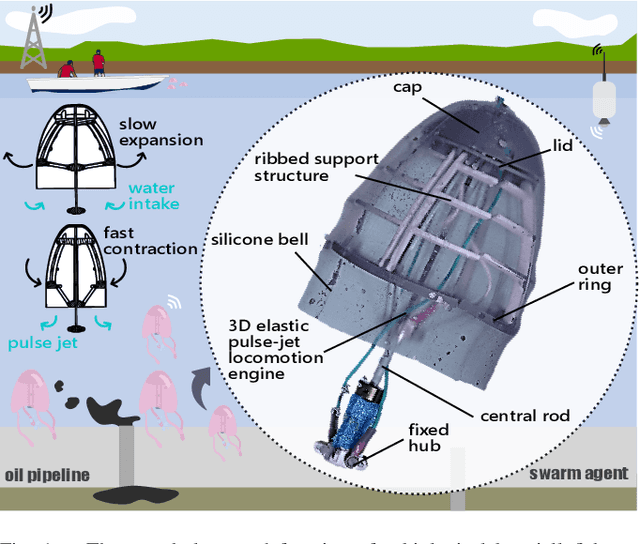
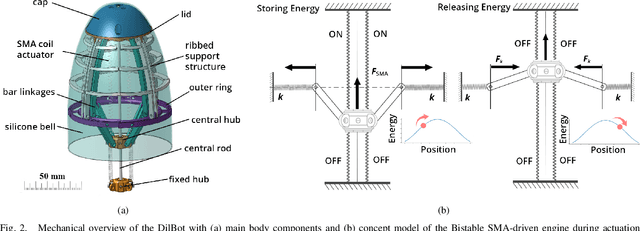
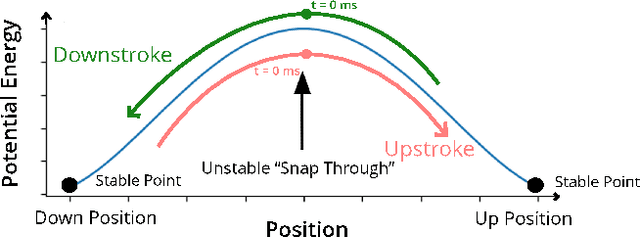
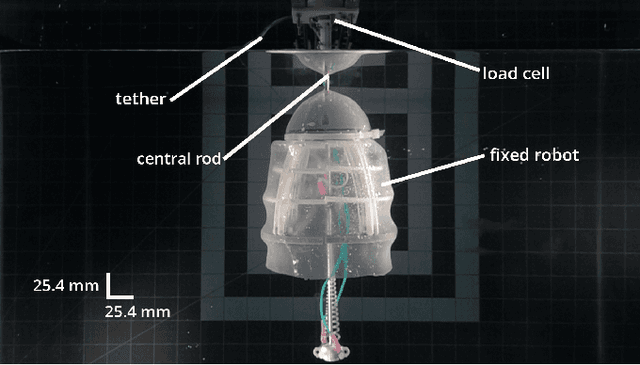
This paper presents the design and experimental validation of a bio-inspired soft aquatic robot, the DilBot, which uses a bistable shape memory alloy-driven engine for pulse-jet locomotion. Drawing inspiration from the efficient swimming mechanisms of box jellyfish, the DilBot incorporates antagonistic shape memory alloy springs encapsulated in silicone insulation to achieve high-power propulsion. The innovative bistable mechanism allows continuous swimming cycles by storing and releasing energy in a controlled manner. Through free-swimming experiments and force characterization tests, we evaluated the DilBot's performance, achieving a peak speed of 158 mm/s and generating a maximum thrust of 5.59 N. This work demonstrates a novel approach to enhancing the efficiency of shape memory alloy actuators in aquatic environments. It presents a promising pathway for future applications in underwater environmental monitoring using robotic swarms.
Evaluation of Flight Parameters in UAV-based 3D Reconstruction for Rooftop Infrastructure Assessment
Apr 02, 2025
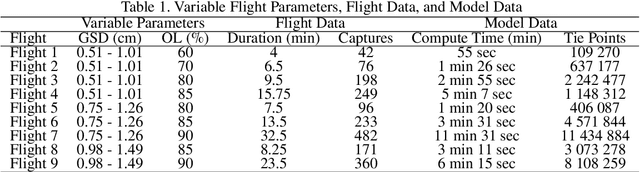
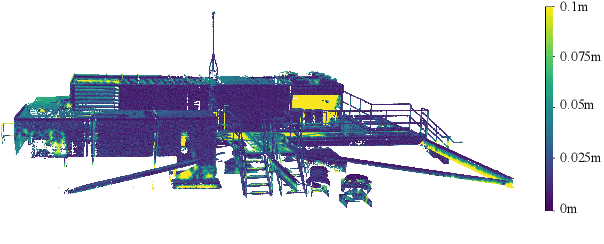

Rooftop 3D reconstruction using UAV-based photogrammetry offers a promising solution for infrastructure assessment, but existing methods often require high percentages of image overlap and extended flight times to ensure model accuracy when using autonomous flight paths. This study systematically evaluates key flight parameters-ground sampling distance (GSD) and image overlap-to optimize the 3D reconstruction of complex rooftop infrastructure. Controlled UAV flights were conducted over a multi-segment rooftop at Queen's University using a DJI Phantom 4 Pro V2, with varied GSD and overlap settings. The collected data were processed using Reality Capture software and evaluated against ground truth models generated from UAV-based LiDAR and terrestrial laser scanning (TLS). Experimental results indicate that a GSD range of 0.75-1.26 cm combined with 85% image overlap achieves a high degree of model accuracy, while minimizing images collected and flight time. These findings provide guidance for planning autonomous UAV flight paths for efficient rooftop assessments.
Tiny Learning-Based MPC for Multirotors: Solver-Aware Learning for Efficient Embedded Predictive Control
Oct 31, 2024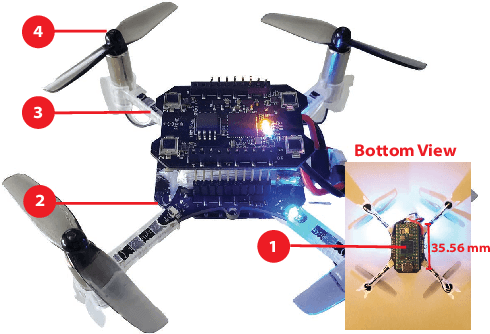
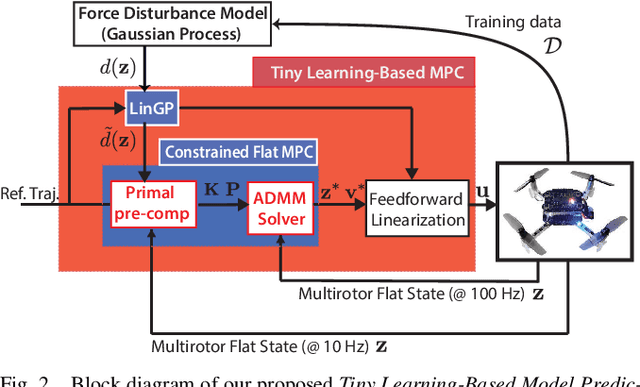
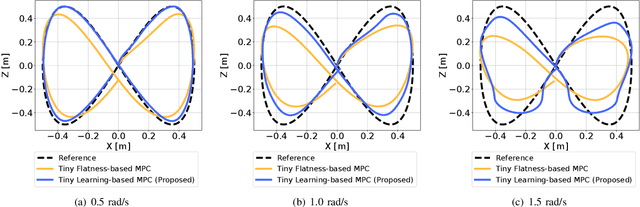
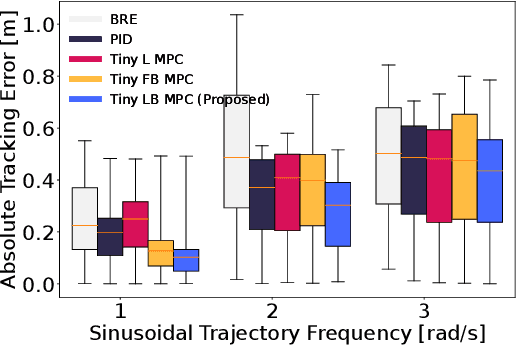
Tiny aerial robots show promise for applications like environmental monitoring and search-and-rescue but face challenges in control due to their limited computing power and complex dynamics. Model Predictive Control (MPC) can achieve agile trajectory tracking and handle constraints. Although current learning-based MPC methods, such as Gaussian Process (GP) MPC, improve control performance by learning residual dynamics, they are computationally demanding, limiting their onboard application on tiny robots. This paper introduces Tiny Learning-Based Model Predictive Control (LB MPC), a novel framework for resource-constrained micro multirotor platforms. By exploiting multirotor dynamics' structure and developing an efficient solver, our approach enables high-rate control at 100 Hz on a Crazyflie 2.1 with a Teensy 4.0 microcontroller. We demonstrate a 23\% average improvement in tracking performance over existing embedded MPC methods, achieving the first onboard implementation of learning-based MPC on a tiny multirotor (53 g).