 Add to Chrome
 Add to Firefox
 Add to Edge
Deepmimo
Papers and Code
PALM: Single-Station Super-Resolved Small-Scale Radio-Map Localization by Path-Atom Matching
Jun 15, 2026
Localizing from a single base station is a longstanding goal, since it removes the synchronized anchors that geometric methods require. A radio map (RM) answers a position query from this one-station survey, yet classical RMs store coarse received power and match it by correlation, ignoring the small-scale path structure a ray tracer provides. We instead build a small-scale RM and show that cell identification, rather than candidate generation, is its information-limited bottleneck. We propose path-atom localization by matching (PALM), which super-resolves a coarse angle-delay observation into scored atoms and matches them to a ray-traced RM by an exact marginal likelihood. The score marginalizes atom reality inside the logarithm, and we prove that the common posterior-scaled surrogate is a Jensen lower bound whose deficit grows with the number of strong paths. We match on the absolute delay axis under a clock nuisance, since relative delays jump across shadowing boundaries, and we prove a unit-gradient law, a capped miss cost, a minimum-mean-square local centroid, and finite-sample conformal coverage. On the real DeepMIMO campus scenario, PALM localizes to a 1.7 meter median from a single base station, cuts the ninetieth-percentile error of received-power RM matching by 34 to 62 percent, and halves the single-snapshot median to 7 meters.

Quantization-Aware EE Optimization and SE-EE Tradeoff for MiLAC-Aided MU-MISO Beamforming
Apr 27, 2026In large antenna arrays, hardware power consumption becomes a dominant design constraint, making energy efficiency (EE) a first-class objective alongside spectral efficiency (SE). Microwave linear analog computer (MiLAC)-aided beamforming, whose front end is a passive reciprocal stream-to-antenna network, addresses this tension by reducing the active radio-frequency chain count to the stream number, at a moderate SE cost. Despite this promise, no EE optimization framework has been established for MiLAC-aided beamforming that accounts for digital-to-analog converter quantization noise and post-quantized transmit power. We fill this gap for downlink multiuser multiple-input single-output (MU-MISO) systems by formulating quantization-aware EE maximization over the MiLAC-feasible beamformer and characterizing the resulting SE-EE tradeoff. Three contributions follow. First, we prove a row-space optimality property of the effective MiLAC-aided beamformer, yielding an equivalent reduced-dimension reformulation whose complexity scales with the stream number rather than the antenna number. Second, we develop a low-complexity Dinkelbach-weighted minimum mean-square error algorithm aided by projected gradient descent that is guaranteed to converge to a stationary point. Third, we cast the SE-EE tradeoff as a multi-objective problem and trace its Pareto boundary via a weighted-sum method that combines an alternative reduced-dimension coordinate with auxiliary-variable successive convex approximation, yielding convex per-iteration subproblems with guaranteed convergence. Numerical results on a DeepMIMO v4 deployment show MiLAC-aided beamforming substantially improves EE over digital and hybrid benchmarks at a moderate SE cost and significantly expands the achievable SE-EE operating region.
Physics-Aware Query-Conditioned Graph Attention Networks for Radio Map Estimation
Apr 19, 2026Radio map estimation from sparse measurements is fundamental to wireless network planning, optimization, and localized map updating. Most recent learning-based approaches formulate the problem as dense map completion over a predefined grid, whereas many practical deployments require estimating transmitter-specific received signal strength only at queried locations or refining an existing map after local changes. This paper proposes a physics-aware query-conditioned hierarchical graph attention network for transmitter-resolved point-wise radio map estimation. For each queried target--transmitter pair, the proposed encoder constructs a bounded local graph over sampled reference observations and aggregates reference-to-query evidence through transmitter-referenced geometric descriptors. A global graph then exchanges representation-level context among nearby target locations to improve neighborhood consistency without revisiting a large number of reference measurements. On top of this shared architecture, we instantiate three operating regimes: direct RSS estimation, prior-conditioned residual correction, and post-hoc gated attenuation of the learned correction. The framework uses only measurement-side quantities and does not rely on environment-side inputs. Simulations on the DeepMIMO scenario show that, in the direct regime, the proposed HGAT achieves the lowest RMSE and MAE among the evaluated learning-based baselines on all reported sites. When conventional prior estimate is available, the residual and gated regimes further reduce the prior error.
Generalizable and Robust Beam Prediction for 6G Networks: An Deep-Learning Framework with Positioning Feature Fusion
Feb 10, 2026Beamforming (BF) is essential for enhancing system capacity in fifth generation (5G) and beyond wireless networks, yet exhaustive beam training in ultra-massive multiple-input multiple-output (MIMO) systems incurs substantial overhead. To address this challenge, we propose a deep learning based framework that leverages position-aware features to improve beam prediction accuracy while reducing training costs. The proposed approach uses spatial coordinate labels to supervise a position extraction branch and integrates the resulting representations with beam-domain features through a feature fusion module. A dual-branch RegNet architecture is adopted to jointly learn location related and communication features for beam prediction. Two fusion strategies, namely adaptive fusion and adversarial fusion, are introduced to enable efficient feature integration. The proposed framework is evaluated on datasets generated by the DeepMIMO simulator across four urban scenarios at 3.5 GHz following 3GPP specifications, where both reference signal received power and user equipment location information are available. Simulation results under both in-distribution and out-of-distribution settings demonstrate that the proposed approach consistently outperforms traditional baselines and achieves more accurate and robust beam prediction by effectively incorporating positioning information.
Structure-Informed Estimation for Pilot-Limited MIMO Channels via Tensor Decomposition
Feb 03, 2026Channel estimation in wideband multiple-input multiple-output (MIMO) systems faces fundamental pilot overhead limitations in high-dimensional beyond-5G and sixth-generation (6G) scenarios. This paper presents a hybrid tensor-neural architecture that formulates pilot-limited channel estimation as low-rank tensor completion from sparse observations -- a fundamentally different setting from prior tensor methods that assume fully observed received signal tensors. A canonical polyadic (CP) baseline implemented via a projection-based scheme (Tucker completion under partial observations) and Tucker decompositions are compared under varying signal-to-noise ratio (SNR) and scattering conditions: CP performs well for specular channels matching the multipath model, while Tucker provides greater robustness under model mismatch. A lightweight three-dimensional (3D) U-Net learns residual components beyond the low-rank structure, bridging algebraic models and realistic propagation effects. Empirical recovery threshold analysis shows that sample complexity scales approximately with intrinsic model dimensionality $L(N_r + N_t + N_f)$ rather than ambient tensor size $N_r N_t N_f$, where $L$ denotes the number of dominant propagation paths. Experiments on synthetic channels demonstrate 10-20\,dB normalized mean-square error (NMSE) improvement over least-squares (LS) and orthogonal matching pursuit (OMP) baselines at 5-10\% pilot density, while evaluations on DeepMIMO ray-tracing channels show 24-44\% additional NMSE reduction over pure tensor-based methods.
Vision Transformer Based User Equipment Positioning
Nov 11, 2025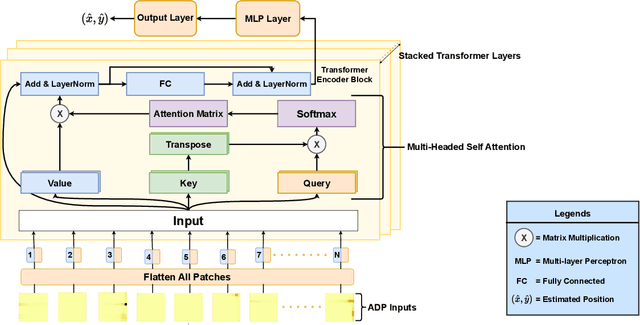
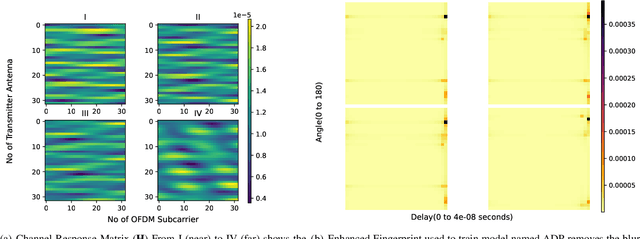
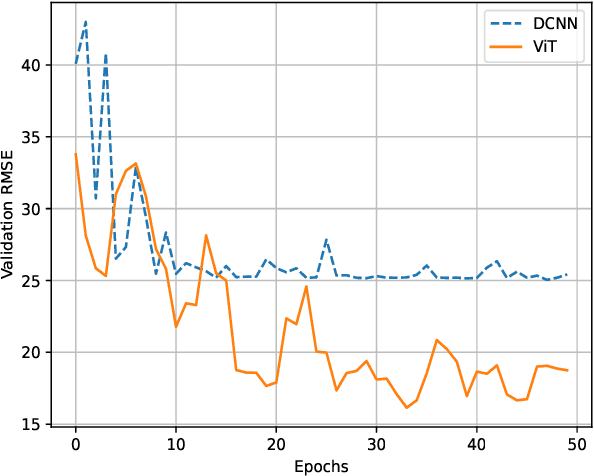
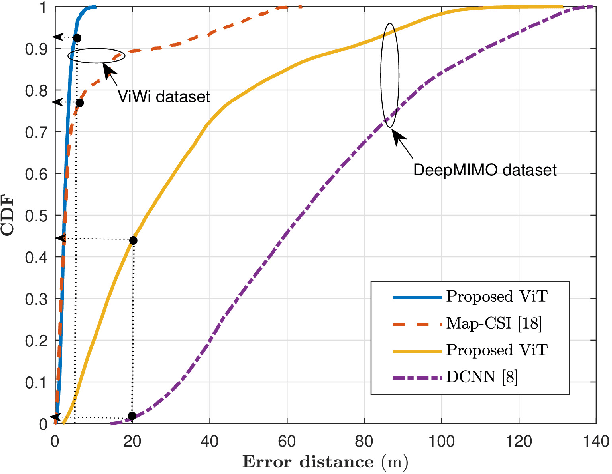
Recently, Deep Learning (DL) techniques have been used for User Equipment (UE) positioning. However, the key shortcomings of such models is that: i) they weigh the same attention to the entire input; ii) they are not well suited for the non-sequential data e.g., when only instantaneous Channel State Information (CSI) is available. In this context, we propose an attention-based Vision Transformer (ViT) architecture that focuses on the Angle Delay Profile (ADP) from CSI matrix. Our approach, validated on the `DeepMIMO' and `ViWi' ray-tracing datasets, achieves an Root Mean Squared Error (RMSE) of 0.55m indoors, 13.59m outdoors in DeepMIMO, and 3.45m in ViWi's outdoor blockage scenario. The proposed scheme outperforms state-of-the-art schemes by $\sim$ 38\%. It also performs substantially better than other approaches that we have considered in terms of the distribution of error distance.
GNN-Enabled Robust Hybrid Beamforming with Score-Based CSI Generation and Denoising
Nov 10, 2025Accurate Channel State Information (CSI) is critical for Hybrid Beamforming (HBF) tasks. However, obtaining high-resolution CSI remains challenging in practical wireless communication systems. To address this issue, we propose to utilize Graph Neural Networks (GNNs) and score-based generative models to enable robust HBF under imperfect CSI conditions. Firstly, we develop the Hybrid Message Graph Attention Network (HMGAT) which updates both node and edge features through node-level and edge-level message passing. Secondly, we design a Bidirectional Encoder Representations from Transformers (BERT)-based Noise Conditional Score Network (NCSN) to learn the distribution of high-resolution CSI, facilitating CSI generation and data augmentation to further improve HMGAT's performance. Finally, we present a Denoising Score Network (DSN) framework and its instantiation, termed DeBERT, which can denoise imperfect CSI under arbitrary channel error levels, thereby facilitating robust HBF. Experiments on DeepMIMO urban datasets demonstrate the proposed models' superior generalization, scalability, and robustness across various HBF tasks with perfect and imperfect CSI.
AI2MMUM: AI-AI Oriented Multi-Modal Universal Model Leveraging Telecom Domain Large Model
May 15, 2025Designing a 6G-oriented universal model capable of processing multi-modal data and executing diverse air interface tasks has emerged as a common goal in future wireless systems. Building on our prior work in communication multi-modal alignment and telecom large language model (LLM), we propose a scalable, task-aware artificial intelligence-air interface multi-modal universal model (AI2MMUM), which flexibility and effectively perform various physical layer tasks according to subtle task instructions. The LLM backbone provides robust contextual comprehension and generalization capabilities, while a fine-tuning approach is adopted to incorporate domain-specific knowledge. To enhance task adaptability, task instructions consist of fixed task keywords and learnable, implicit prefix prompts. Frozen radio modality encoders extract universal representations and adapter layers subsequently bridge radio and language modalities. Moreover, lightweight task-specific heads are designed to directly output task objectives. Comprehensive evaluations demonstrate that AI2MMUM achieves SOTA performance across five representative physical environment/wireless channel-based downstream tasks using the WAIR-D and DeepMIMO datasets.
SemCSINet: A Semantic-Aware CSI Feedback Network in Massive MIMO Systems
May 13, 2025Massive multiple-input multiple-output (MIMO) technology is a key enabler of modern wireless communication systems, which demand accurate downlink channel state information (CSI) for optimal performance. Although deep learning (DL) has shown great potential in improving CSI feedback, most existing approaches fail to exploit the semantic relationship between CSI and other related channel metrics. In this paper, we propose SemCSINet, a semantic-aware Transformer-based framework that incorporates Channel Quality Indicator (CQI) into the CSI feedback process. By embedding CQI information and leveraging a joint coding-modulation (JCM) scheme, SemCSINet enables efficient, digital-friendly CSI feedback under noisy feedback channels. Experimental results on DeepMIMO datasets show that SemCSINet significantly outperforms conventional methods, particularly in scenarios with low signal-to-noise ratio (SNR) and low compression ratios (CRs), highlighting the effectiveness of semantic embedding in enhancing CSI reconstruction accuracy and system robustness.
Analysis of the vulnerability of machine learning regression models to adversarial attacks using data from 5G wireless networks
May 01, 2025This article describes the process of creating a script and conducting an analytical study of a dataset using the DeepMIMO emulator. An advertorial attack was carried out using the FGSM method to maximize the gradient. A comparison is made of the effectiveness of binary classifiers in the task of detecting distorted data. The dynamics of changes in the quality indicators of the regression model were analyzed in conditions without adversarial attacks, during an adversarial attack and when the distorted data was isolated. It is shown that an adversarial FGSM attack with gradient maximization leads to an increase in the value of the MSE metric by 33% and a decrease in the R2 indicator by 10% on average. The LightGBM binary classifier effectively identifies data with adversarial anomalies with 98% accuracy. Regression machine learning models are susceptible to adversarial attacks, but rapid analysis of network traffic and data transmitted over the network makes it possible to identify malicious activity