 Add to Chrome
 Add to Firefox
 Add to Edge
Vision Transformer Based User Equipment Positioning
Nov 11, 2025
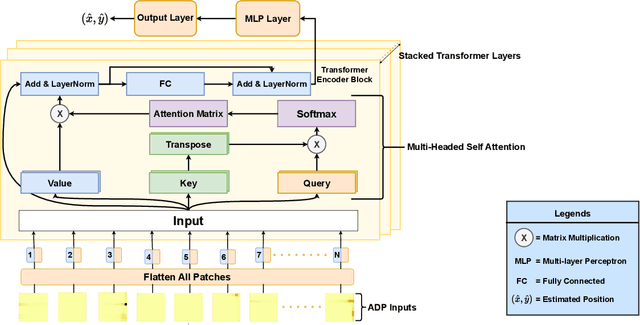
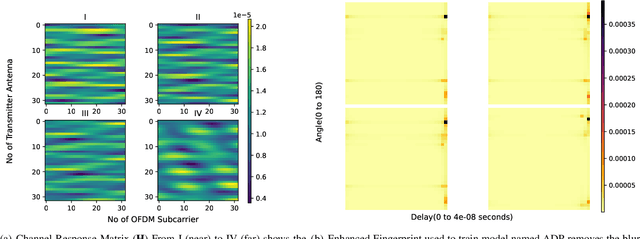
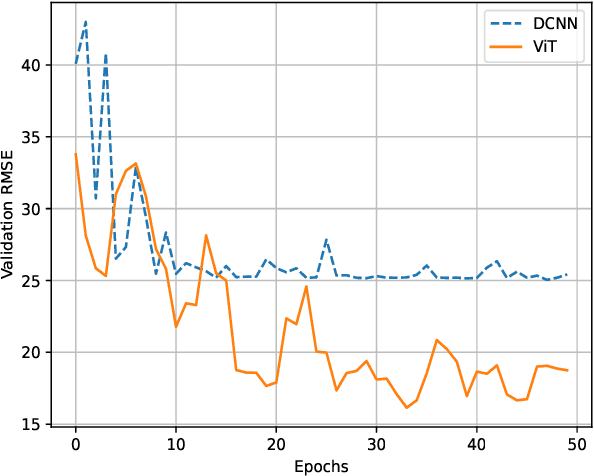
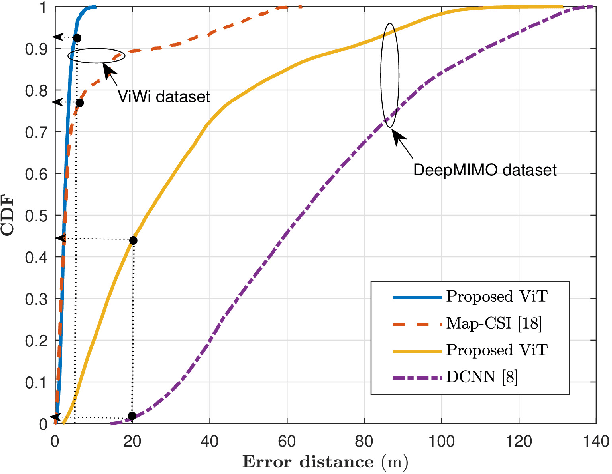
Recently, Deep Learning (DL) techniques have been used for User Equipment (UE) positioning. However, the key shortcomings of such models is that: i) they weigh the same attention to the entire input; ii) they are not well suited for the non-sequential data e.g., when only instantaneous Channel State Information (CSI) is available. In this context, we propose an attention-based Vision Transformer (ViT) architecture that focuses on the Angle Delay Profile (ADP) from CSI matrix. Our approach, validated on the `DeepMIMO' and `ViWi' ray-tracing datasets, achieves an Root Mean Squared Error (RMSE) of 0.55m indoors, 13.59m outdoors in DeepMIMO, and 3.45m in ViWi's outdoor blockage scenario. The proposed scheme outperforms state-of-the-art schemes by $\sim$ 38\%. It also performs substantially better than other approaches that we have considered in terms of the distribution of error distance.

Rate Forecaster based Energy Aware Band Assignment in Multiband Networks
Jun 08, 2023The high frequency communication bands (mmWave and sub-THz) promise tremendous data rates, however, they also have very high power consumption which is particularly significant for battery-power-limited user-equipment (UE). In this context, we design an energy aware band assignment system which reduces the power consumption while also achieving a target sum rate of M in T time-slots. We do this by using 1) Rate forecaster(s); 2) Channel forecaster(s) which forecasts T direct multistep ahead using a stacked (long short term memory) LSTM architecture. We propose an iterative rate updating algorithm which updates the target rate based on current rate and future predicted rates in a frame. The proposed approach is validated on the publicly available `DeepMIMO' dataset. Research findings shows that the rate forecaster based approach performs better than the channel forecaster. Furthermore, LSTM based predictions outperforms well celebrated Transformer predictions in terms of NRMSE and NMAE. Research findings reveals that the power consumption with this approach is ~ 300 mW lower compared to a greedy band assignment at a 1.5Gb/s target rate.
An approach to implement Reinforcement Learning for Heterogeneous Vehicular Networks
Aug 26, 2022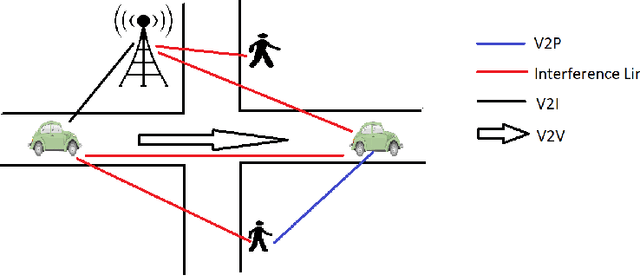


This paper presents the extension of the idea of spectrum sharing in the vehicular networks towards the Heterogeneous Vehicular Network(HetVNET) based on multi-agent reinforcement learning. Here, the multiple vehicle-to-vehicle(V2V) links reuse the spectrum of other vehicle-to-interface(V2I) and also those of other networks. The fast-changing environment in vehicular networks limits the idea of centralizing the CSI and allocate the channels. So, the idea of implementing ML-based methods is used here so that it can be implemented in a distributed manner in all vehicles. Here each On-Board Unit(OBU) can sense the signals in the channel and based on that information runs the RL to decide which channel to autonomously take up. Here, each V2V link will be an agent in MARL. The idea is to train the RL model in such a way that these agents will collaborate rather than compete.